AI Adoption in B2B Markets: Exploring Drivers and Barriers through Behavioural Reasoning Theory and a Care Approach
Keywords:
Technology Adoption, Artificial Intelligence, Care Value, B2B MarketingAbstract
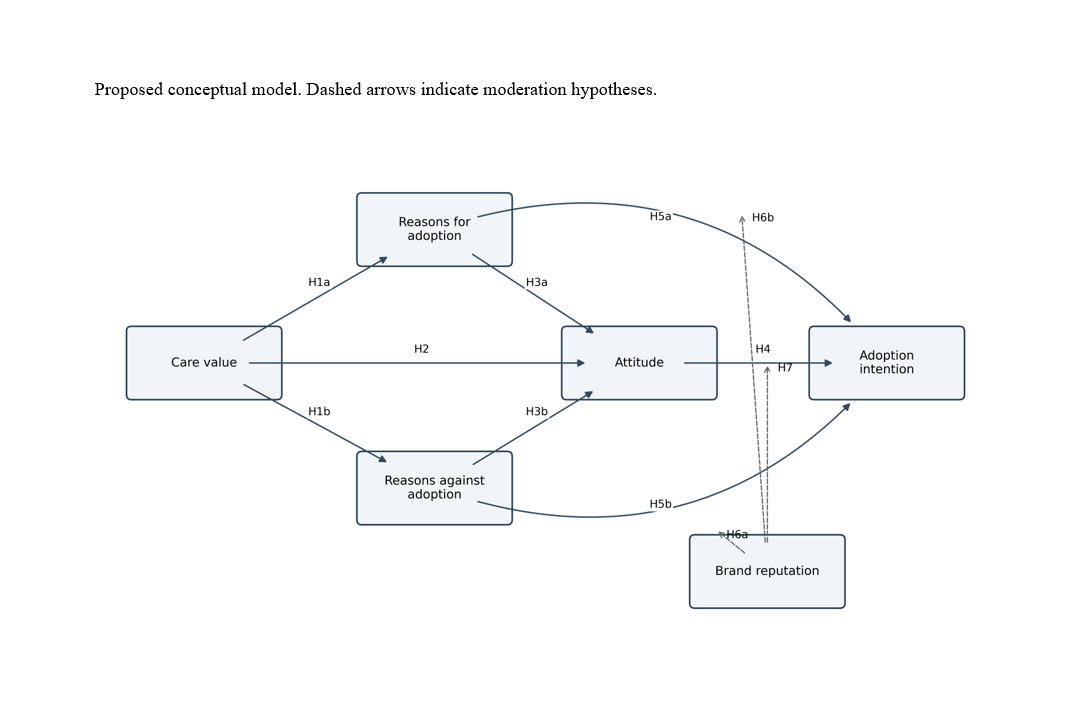
This study examines AI adoption intention in B2B marketing in the Iranian steel industry by integrating Behavioural Reasoning Theory with a care perspective. A cross-sectional survey of 275 industry respondents was analysed using PLS-SEM and the PROCESS macro. Reasons for adoption were positively associated with attitude and intention, whereas reasons against adoption were negatively associated with both outcomes. Care value was positively associated with reasons for adoption and negatively associated with reasons against adoption; the latter association contradicted H1b. Brand reputation did not significantly moderate the direct relationships between reasons and intention, leaving H6a and H6b unsupported. Additional analyses identified interactions predicting attitude and a positive interaction between attitude and reputation predicting intention. These findings concern reported intentions and associations rather than observed adoption or causal effects.
Downloads
References
Acikgoz, F., Perez-Vega, R., Okumus, F., & Stylos, N. (2023). Consumer engagement with AI-powered voice assistants: A behavioral reasoning perspective. Psychology & Marketing, 40(11), 2226-2243. https://doi.org/10.1002/mar.21873
Ajzen, I. (1991). The theory of planned behavior. Organizational Behavior and Human Decision Processes, 50(2), 179-211. https://doi.org/10.1016/0749-5978(91)90020-T
Bagozzi, R. P. (1992). The Self-Regulation of Attitudes, Intentions, and Behavior. Social Psychology Quarterly, 55(2), 178. https://doi.org/10.2307/2786945
Bian, Q., & Forsythe, S. (2012). Purchase intention for luxury brands: A cross cultural comparison. Journal of Business Research, 65(10), 1443-1451. https://doi.org/10.1016/j.jbusres.2011.10.010
Claudy, M. C., Garcia, R., & O'Driscoll, A. (2015). Consumer resistance to innovation-a behavioral reasoning perspective. Journal of the Academy of Marketing Science, 43(4), 528-544. https://doi.org/10.1007/s11747-014-0399-0
Claudy, M. C., & Peterson, M. (2014). Understanding the Underutilization of Urban Bicycle Commuting: A Behavioral Reasoning Perspective. Journal of Public Policy & Marketing, 33(2), 173-187. https://doi.org/10.1509/jppm.13.087
Cohn, J. (2020). In A Different Code: Artificial Intelligence and The Ethics of Care. The International Review of Information Ethics, 28. https://doi.org/10.29173/irie383
Davis, F. D. (1989). Perceived Usefulness, Perceived Ease of Use, and User Acceptance of Information Technology. MIS Quarterly, 13(3), 319-340. https://doi.org/10.2307/249008
Dowling, G. R. (2016). Defining and Measuring Corporate Reputations. European Management Review, 13(3), 207-223. https://doi.org/10.1111/emre.12081
Dwivedi, Y. K., Hughes, L., Ismagilova, E., Aarts, G., Coombs, C., Crick, T., Duan, Y., Dwivedi, R., Edwards, J., Eirug, A., Galanos, V., Ilavarasan, P. V., Janssen, M., Jones, P., Kar, A. K., Kizgin, H., Kronemann, B., Lal, B., Lucini, B., & Williams, M. D. (2021). Artificial Intelligence (AI): Multidisciplinary Perspectives on Emerging Challenges, Opportunities, and Agenda for Research, Practice and Policy. International Journal of Information Management, 57, 101994. https://doi.org/10.1016/j.ijinfomgt.2019.08.002
Dwivedi, Y. K., Kshetri, N., Hughes, L., Slade, E. L., Jeyaraj, A., Kar, A. K., Baabdullah, A. M., Koohang, A., Raghavan, V., Ahuja, M., Albanna, H., Albashrawi, M. A., Al-Busaidi, A. S., Balakrishnan, J., Barlette, Y., Basu, S., Bose, I., Brooks, L., Buhalis, D., & Wright, R. (2023). Opinion Paper: "So what if ChatGPT wrote it?" Multidisciplinary perspectives on opportunities, challenges and implications of generative conversational AI for research, practice and policy. International Journal of Information Management, 71, 102642. https://doi.org/10.1016/j.ijinfomgt.2023.102642
Floridi, L., Cowls, J., Beltrametti, M., Chatila, R., Chazerand, P., Dignum, V., Luetge, C., Madelin, R., Pagallo, U., Rossi, F., Schafer, B., Valcke, P., & Vayena, E. (2018). AI4People-An Ethical Framework for a Good AI Society: Opportunities, Risks, Principles, and Recommendations. Minds and Machines, 28(4), 689-707. https://doi.org/10.1007/s11023-018-9482-5
Fombrun, C., & Shanley, M. (1990). WHAT'S IN A NAME? REPUTATION BUILDING AND CORPORATE STRATEGY. Academy of Management Journal, 33(2), 233-258. https://doi.org/10.2307/256324
Fombrun, C. J. (1996). Reputation: Realizing Value from the Corporate Image. Harvard Business School Press.
Fornell, C., & Larcker, D. F. (1981). Evaluating Structural Equation Models with Unobservable Variables and Measurement Error. Journal of Marketing Research, 18(1), 39-50. https://doi.org/10.1177/002224378101800104
Gesk, T. S., & Leyer, M. (2022). Artificial intelligence in public services: When and why citizens accept its usage. Government Information Quarterly, 39(3), 101704. https://doi.org/10.1016/j.giq.2022.101704
Gilligan, C. (1982). In a different voice: Psychological theory and women's development. Harvard University Press. https://books.google.com/books?hl=en&lr=&id=n4x0z6kHfTEC&oi=fnd&pg=PR9&dq=Gilligan,+C.+(1982).+In+a+different+voice:+Psychological+theory+and+women%27s+development,+Harvard+University+Press.+%09&ots=I1s1sMqUFU&sig=ezNIuGYSfA55fmiq7kAIyM0plB0
Grewal, D., Guha, A., Satornino, C. B., & Schweiger, E. B. (2021). Artificial intelligence: The light and the darkness. Journal of Business Research, 136, 229-236. https://doi.org/10.1016/j.jbusres.2021.07.043
Hair, J. F., Risher, J. J., Sarstedt, M., & Ringle, C. M. (2019). When to use and how to report the results of PLS-SEM. European Business Review, 31(1), 2-24. https://doi.org/10.1108/EBR-11-2018-0203
Hartmann, P., & Apaolaza-Ibáñez, V. (2012). Consumer attitude and purchase intention toward green energy brands: The roles of psychological benefits and environmental concern. Journal of Business Research, 65(9), 1254-1263. https://doi.org/10.1016/j.jbusres.2011.11.001
Hayes, A. F., Montoya, A. K., & Rockwood, N. J. (2017). The analysis of mechanisms and their contingencies: PROCESS versus structural equation modeling. Australasian Marketing Journal, 25(1), 76-81. https://doi.org/10.1016/j.ausmj.2017.02.001
Helm, S. (2007). One reputation or many? Corporate Communications: An International Journal, 12(3), 238-254. https://doi.org/10.1108/13563280710776842
Huang, M. H., & Rust, R. T. (2018). Artificial Intelligence in Service. Journal of Service Research, 21(2), 155-172. https://doi.org/10.1177/1094670517752459
Kahneman, D., & Tversky, A. (1982). The Psychology of Preferences. Scientific American, 246(1), 160-173. https://doi.org/10.1038/scientificamerican0182-160
Lalicic, L., & Weismayer, C. (2021). Consumers' reasons and perceived value co-creation of using artificial intelligence-enabled travel service agents. Journal of Business Research, 129, 891-901. https://doi.org/10.1016/j.jbusres.2020.11.005
Paschen, J., Kietzmann, J., & Kietzmann, T. C. (2019). Artificial intelligence (AI) and its implications for market knowledge in B2B marketing. Journal of Business & Industrial Marketing, 34(7), 1410-1419. https://doi.org/10.1108/JBIM-10-2018-0295
Paschen, J., Wilson, M., & Ferreira, J. J. (2020). Collaborative intelligence: How human and artificial intelligence create value along the B2B sales funnel. Business Horizons, 63(3), 403-414. https://doi.org/10.1016/j.bushor.2020.01.003
Podsakoff, P. M., MacKenzie, S. B., Lee, J. Y., & Podsakoff, N. P. (2003). Common method biases in behavioral research: A critical review of the literature and recommended remedies. Journal of Applied Psychology, 88(5), 879-903. https://doi.org/10.1037/0021-9010.88.5.879
Rahman, M. S., Bag, S., Gupta, S., & Sivarajah, U. (2023). Technology readiness of B2B firms and AI-based customer relationship management capability for enhancing social sustainability performance. Journal of Business Research, 156, 113525. https://doi.org/10.1016/j.jbusres.2022.113525
Raisch, S., & Krakowski, S. (2021). Artificial Intelligence and Management: The Automation-Augmentation Paradox. Academy of Management Review, 46(1), 192-210. https://doi.org/10.5465/amr.2018.0072
Rammer, C., Fernández, G. P., & Czarnitzki, D. (2022). Artificial intelligence and industrial innovation: Evidence from German firm-level data. Research Policy, 51(7), 104555. https://doi.org/10.1016/j.respol.2022.104555
Rasheed, H. M. W., He, Y., Khizar, H. M. U., & Abbas, H. S. M. (2023). Exploring Consumer-Robot interaction in the hospitality sector: Unpacking the reasons for adoption (or resistance) to artificial intelligence. Technological Forecasting and Social Change, 192, 122555. https://doi.org/10.1016/j.techfore.2023.122555
Ryan, J., & Casidy, R. (2018). The role of brand reputation in organic food consumption: A behavioral reasoning perspective. Journal of Retailing and Consumer Services, 41, 239-247.
Sahu, A. K., Padhy, R. K., & Dhir, A. (2020). Envisioning the Future of Behavioral Decision-Making: A Systematic Literature Review of Behavioral Reasoning Theory. Australasian Marketing Journal, 28(4), 145-159. https://doi.org/10.1016/j.ausmj.2020.05.001
Sarstedt, M., Hair, J. F., Pick, M., Liengaard, B. D., Radomir, L., & Ringle, C. M. (2022). Progress in partial least squares structural equation modeling use in marketing research in the last decade. Psychology & Marketing, 39(5), 1035-1064. https://doi.org/10.1002/mar.21640
Schwartz, S. H. (2012). An Overview of the Schwartz Theory of Basic Values. Online Readings in Psychology and Culture, 2(1). https://doi.org/10.9707/2307-0919.1116
Tronto, J. C. (1993). Moral boundaries: A political argument for an ethic of care. Routledge.
Venkatesh, V., Morris, M. G., Davis, G. B., & Davis, F. D. (2003). User Acceptance of Information Technology: Toward A Unified View. MIS Quarterly, 27(3), 425-478. https://doi.org/10.2307/30036540
Villegas-Galaviz, C., & Martin, K. (2024). Moral distance, AI, and the ethics of care. AI & SOCIETY, 39(4), 1695-1706. https://doi.org/10.1007/s00146-023-01642-z
Westaby, J. D. (2005). Behavioral reasoning theory: Identifying new linkages underlying intentions and behavior. Organizational Behavior and Human Decision Processes, 98(2), 97-120. https://doi.org/10.1016/j.obhdp.2005.07.003
Publication Timeline
- Submitted
- Revised
- Accepted