The Impact of Augmented Reality-Based Platforms on Customer Behavioral Responses in Customer Travel
DOI:
https://doi.org/10.61838/kman.aitech.3.2.6Keywords:
policy formulation, artificial intelligence, characteristics of artificial intelligenceAbstract
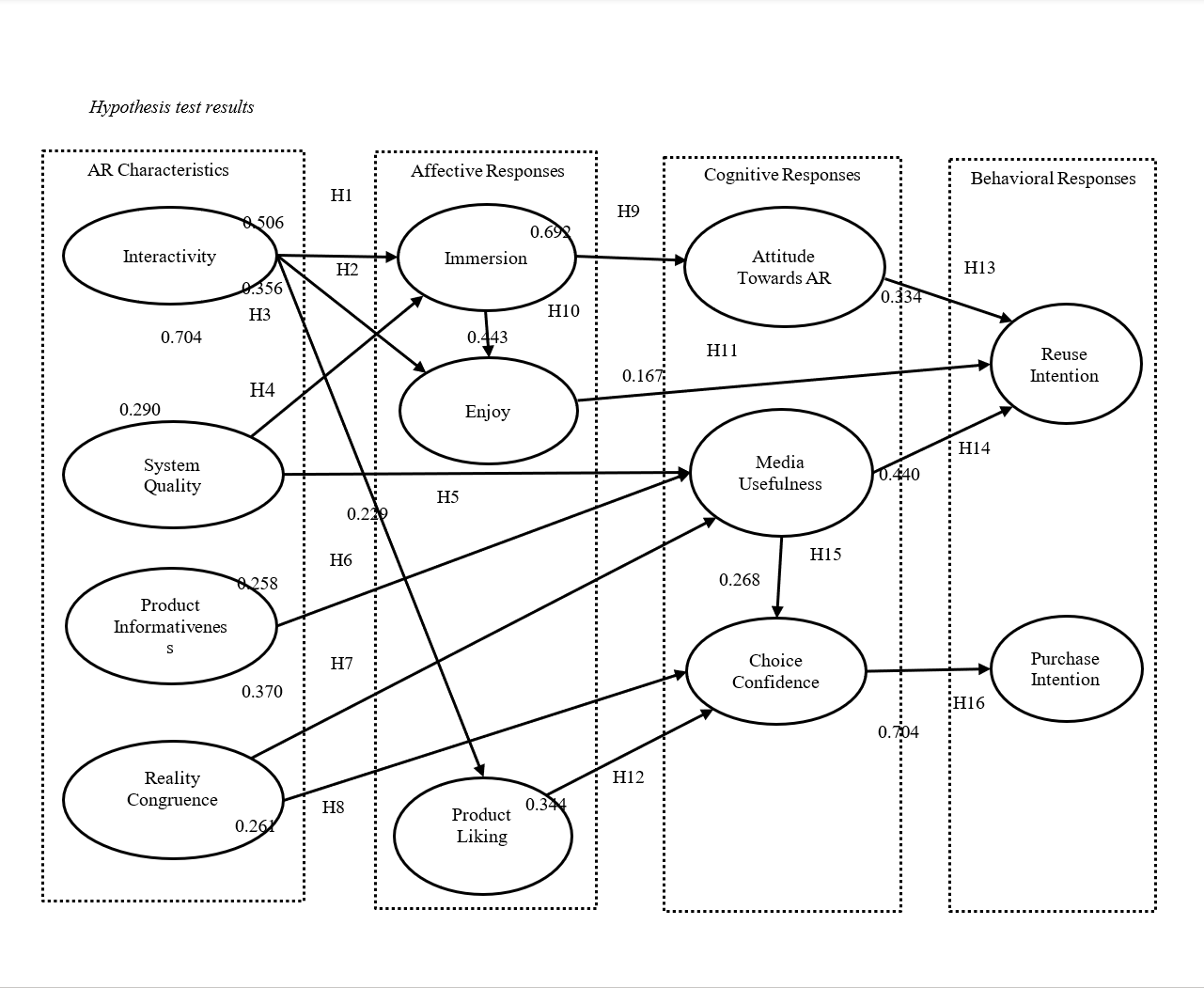
With the increasing popularity of online shopping, the need for a method that can create a different and innovative perception of a brand in customers' minds is of great importance. Augmented reality (AR) is a novel technology that can play a significant role in the field of online sales. To this end, customers of interior design products and furniture in Tehran were selected as the target population, and a quantitative approach and electronic questionnaire distribution were used to investigate the impact of AR-based platforms on customer behavioral responses in customer travel. The sample size of this study was 288 individuals determined using G*Power software. According to the findings of the article, augmented reality technology has a considerable influence on customers' decisions. When AR-based platforms are used at any point during customer travel, due to the features of this technology, customers' sense of immersion, enjoyment, and interest in the product increases, leading to increased trust in their choices, the perceived usefulness of the platform, and overall positive attitudes. Ultimately, this results in an increased intention to reuse the platform and purchase intention among customers. Therefore, it is recommended that managers of companies involved in the field of interior design products and furniture do not overlook the potential of this technology in their business development.
Downloads
References
Akram, M. S., Dwivedi, Y. K., Shareef, M. A., & Bhatti, Z. A. (2022). Editorial introduction to the special issue: Social customer journey-Behavioral and social implications of a digitally disruptive environment. Technological Forecasting and Social Change, 185, 122101. https://doi.org/https://doi.org/10.1016/j.techfore.2022.122101
Arghashi, V., & Yuksel, C. A. (2022). Interactivity, Inspiration, and Perceived Usefulness! How retailers’ AR-apps improve consumer engagement through flow. Journal of Retailing and Consumer Services, 64, 102756. https://doi.org/https://doi.org/10.1016/j.jretconser.2021.102756
Cui, X., Xie, Q., Zhu, J., Shareef, M. A., Goraya, M. A. S., & Akram, M. S. (2022). Understanding the omnichannel customer journey: The effect of online and offline channel interactivity on consumer value co-creation behavior. Journal of Retailing and Consumer Services, 65, 102869. https://doi.org/https://doi.org/10.1016/j.jretconser.2021.102869
Daassi, M., & Debbabi, S. (2021). Intention to reuse AR-based apps: The combined role of the sense of immersion, product presence and perceived realism. Information & Management, 58(4), 103453. https://doi.org/https://doi.org/10.1016/j.im.2021.103453
Faqih, K. M. S. (2022). Factors influencing the behavioral intention to adopt a technological innovation from a developing country context: The case of mobile augmented reality games. Technology in Society, 69, 101958. https://doi.org/https://doi.org/10.1016/j.techsoc.2022.101958
Flavián, C., Ibáñez-Sánchez, S., & Orús, C. (2019). The impact of virtual, augmented and mixed reality technologies on the customer experience. Journal of Business Research, 100, 547-560. https://doi.org/10.1016/j.jbusres.2018.10.050
Grewal, D., & Roggeveen, A. L. (2020). Understanding retail experiences and customer journey management. Journal of Retailing, 96(1), 3-8. https://doi.org/10.1016/j.jretai.2020.02.002
Guillet, B. D., Mattila, A., & Gao, L. (2020). The effects of choice set size and information filtering mechanisms on online hotel booking. International Journal of Hospitality Management, 87, 102379. https://doi.org/https://doi.org/10.1016/j.ijhm.2019.102379
Harborth, D., & Pape, S. (2021). Investigating privacy concerns related to mobile augmented reality Apps-A vignette based online experiment. Computers in human Behavior, 122, 106833. https://doi.org/https://doi.org/10.1016/j.chb.2021.106833
Ho, X. H., Nguyen, D. P., Cheng, J. M. S., & Le, A. N. H. (2022). Customer engagement in the context of retail mobile apps: A contingency model integrating spatial presence experience and its drivers. Journal of Retailing and Consumer Services, 66, 102950. https://doi.org/https://doi.org/10.1016/j.jretconser.2022.102950
Islam, M. M., & Hani, F. F. (2021). Hopes and reality: consumers’ purchase intention towards whitening cream. Future Business Journal, 7, 1-12. https://doi.org/https://doi.org/10.1186/s43093-021-00098-1
Kokins, G., Straujuma, A., & Lapiņa, I. (2021). The role of consumer and customer journeys in customer experience driven and open innovation. Journal of Open Innovation: Technology, Market, and Complexity, 7(3), 185. https://doi.org/https://doi.org/10.3390/joitmc7030185
Koronaki, E., Vlachvei, A., & Panopoulos, A. (2023). Managing the online customer experience and subsequent consumer responses across the customer journey: A Review and Future Research Agenda. Electronic Commerce Research and Applications, 101242. https://doi.org/https://doi.org/10.1016/j.elerap.2023.101242
Kowalczuk, P., Siepmann, C., & Adler, J. (2021). Cognitive, affective, and behavioral consumer responses to augmented reality in e-commerce: A comparative study. Journal of Business Research, 124, 357-373. https://doi.org/https://doi.org/10.1016/j.jbusres.2020.10.050
Lee, W. S., Tang, R., Moon, J., & Song, M. (2022). The structural relationship between a low-cost carrier’s service experience, corporate social responsibility, brand love, and reuse intention: The case of Southwest Airlines. Journal of Air Transport Management, 102, 102216. https://doi.org/https://doi.org/10.1016/j.jairtraman.2022.102216
Lundin, L., & Kindström, D. (2023). Digitalizing customer journeys in B2B markets. Journal of Business Research, 157, 113639. https://doi.org/https://doi.org/10.1016/j.jbusres.2022.113639
Oyman, M., Bal, D., & Ozer, S. (2022). Extending the technology acceptance model to explain how perceived augmented reality affects consumers’ perceptions. Computers in human Behavior, 128, 107127. https://doi.org/https://doi.org/10.1016/j.chb.2021.107127
Poushneh, A., & Vasquez-Parraga, A. Z. (2017). Discernible impact of augmented reality on retail customer’s experience, satisfaction and willingness to buy. Journal of Retailing and Consumer Services, 34, 229-234. https://doi.org/https://doi.org/10.1016/j.jretconser.2016.10.005
Ramdani, M. A., Belgiawan, P. F., Aprilianty, F., & Purwanegara, M. S. (2022). Consumer Perception and the Evaluation to Adopt Augmented Reality in Furniture Retail Mobile Application. Binus Business Review, 13(1), 41-56. https://doi.org/https://doi.org/10.21512/bbr.v13i1.7801
Rusthollkarhu, S., Toukola, S., Aarikka-Stenroos, L., & Mahlamäki, T. (2022). Managing B2B customer journeys in digital era: Four management activities with artificial intelligence-empowered tools. Industrial Marketing Management, 104, 241-257. https://doi.org/https://doi.org/10.1016/j.indmarman.2022.04.014
Sengupta, A., & Cao, L. (2022). Augmented reality’s perceived immersion effect on the customer shopping process: decision-making quality and privacy concerns. International Journal of Retail & Distribution Management. https://doi.org/https://doi.org/10.1108/IJRDM-10-2021-0522
Smink, A. R., Van Reijmersdal, E. A., Van Noort, G., & Neijens, P. C. (2020). Shopping in augmented reality: The effects of spatial presence, personalization and intrusiveness on app and brand responses. Journal of Business Research, 118, 474-485. https://doi.org/https://doi.org/10.1016/j.jbusres.2020.07.018
Taheri, B., Prayag, G., & Muskat, B. (2021). Introduction to the special issue: Consumer experience management and customer journeys in tourism, hospitality and events. Tourism Management Perspectives, 40, 100877. https://doi.org/https://doi.org/10.1016/j.tmp.2021.100877
Terblanche, N. S., & Kidd, M. (2021). Exploring an in-store customer journey for customers shopping for outdoor apparel. Journal of Retailing and Consumer Services, 63, 102722. https://doi.org/https://doi.org/10.1016/j.jretconser.2021.102722
Tseng, F. C., Huang, T. L., Cheng, T. C. E., & Teng, C. I. (2021). Not all qualities are equal: Moderating role of online shopper conscientiousness in quality evaluation. Electronic Commerce Research and Applications, 47, 101056. https://doi.org/https://doi.org/10.1016/j.elerap.2021.101056
Tueanrat, Y., Papagiannidis, S., & Alamanos, E. (2021). Going on a journey: A review of the customer journey literature. Journal of Business Research, 125, 336-353. https://doi.org/10.1016/j.jbusres.2020.12.028
Verhagen, T., & Bloemers, D. (2018). Exploring the cognitive and affective bases of online purchase intentions: A hierarchical test across product types. Electronic Commerce Research, 18(3), 537-561. https://doi.org/https://doi.org/10.1007/s10660-017-9270-y
Wang, H. Y., Wang, J. H., Zhang, J., & Tai, H. W. (2021). The collaborative interaction with Pokémon-Go robot uses augmented reality technology for increasing the intentions of patronizing hospitality. Information Systems Frontiers, 1-13. https://doi.org/https://doi.org/10.1007/s10796-021-10200-1
Wang, Y., Ko, E., & Wang, H. (2021). Augmented reality (AR) app use in the beauty product industry and consumer purchase intention. Asia Pacific Journal of Marketing and Logistics. https://doi.org/https://doi.org/10.1108/APJML-11-2019-0684
Wei, C. L., Wang, Y. M., Lin, H. H., Wang, Y. S., & Huang, J. L. (2022). Developing and validating a business simulation systems success model in the context of management education. The International Journal of Management Education, 20(2), 100634. https://doi.org/https://doi.org/10.1016/j.ijme.2022.100634
Wu, S., Wong, I. A., & Lin, Z. C. J. (2021). Understanding the role of atmospheric cues of travel apps: A synthesis between media richness and stimulus-organism-response theory. Journal of Hospitality and Tourism Management, 49, 226-234. https://doi.org/https://doi.org/10.1016/j.jhtm.2021.09.014
Yachin, J. M. (2018). The ‘customer journey’: Learning from customers in tourism experience encounters. Tourism Management Perspectives, 28, 201-210. https://doi.org/https://doi.org/10.1016/j.tmp.2018.09.002
Zanger, V., Meißner, M., & Rauschnabel, P. A. (2022). Beyond the gimmick: How affective responses drive brand attitudes and intentions in augmented reality marketing. Psychology & Marketing, 39(7), 1285-1301. https://doi.org/https://doi.org/10.1002/mar.21641
Downloads
Additional Files
Publication Timeline
Issue
Section
License
Copyright (c) 2024 AI and Tech in Behavioral and Social Sciences

This work is licensed under a Creative Commons Attribution-NonCommercial 4.0 International License.