Analysis of Structure-Conduct-Performance Pattern in the Competition of Digital Platforms in Sports Goods Market
DOI:
https://doi.org/10.61838/kman.aitech.3.2.8Keywords:
SCP pattern, sports goods market, digital platform, technology, artificial intelligenceAbstract
ABSTRACT
Purpose: The main focus of this research is to analyze the SCP model in the competition of digital platforms in the sports goods market.
Design/methodology/approach: This research is applied and descriptive, utilizing a qualitative method to examine the subject. The statistical population includes experts in the fields of the sports industry, human resources, and technology. Sampling was conducted purposefully and using the snowball method. Semi-structured interviews continued until theoretical saturation was reached, and after interviews 12, 13, 14, and 15, it was determined that no new information was being obtained and the interviews were repetitive, so the interviews were stopped. MAXQDA software was used for data analysis.
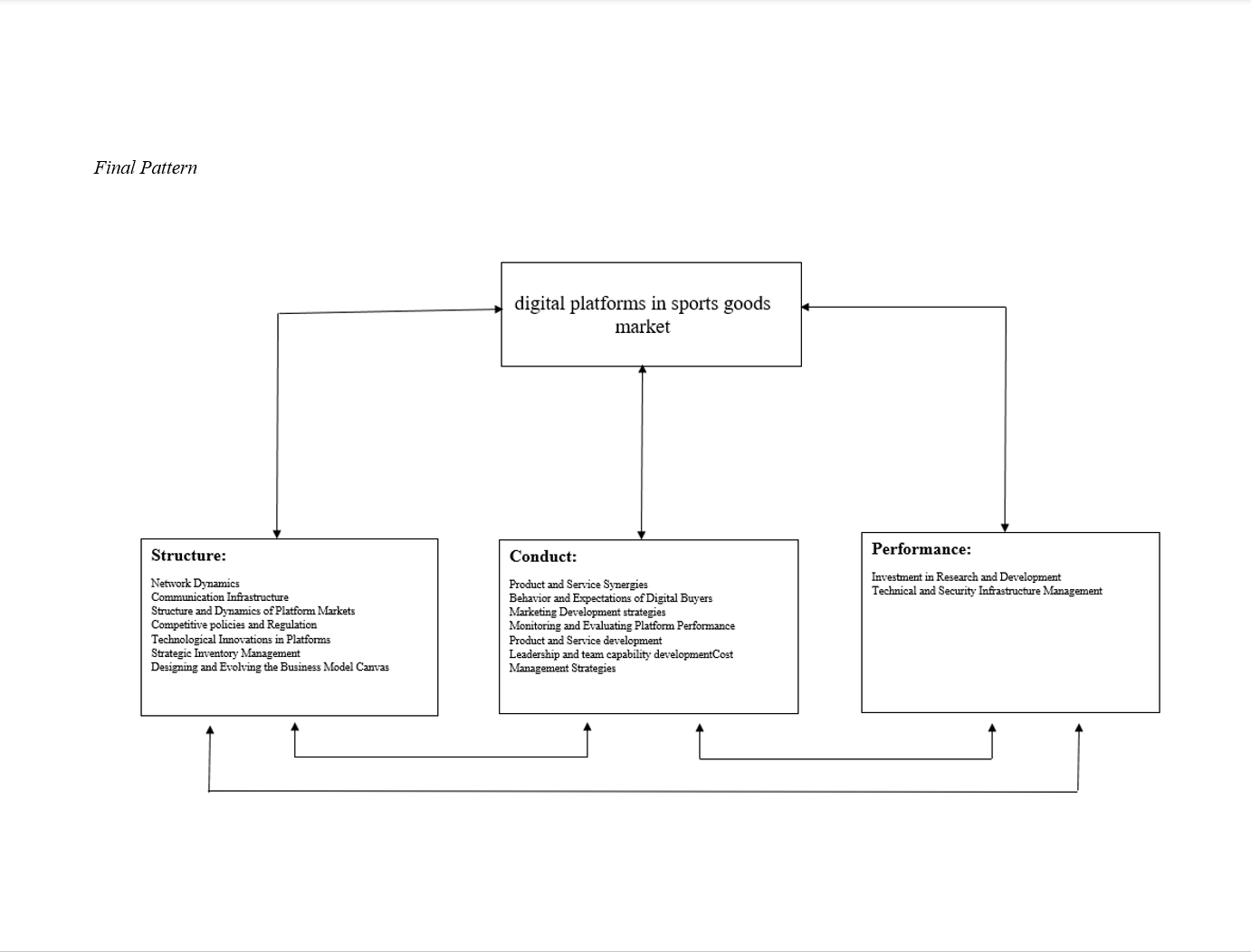
Findings: The results showed that competition in digital platforms in the sports goods market includes 5 main themes, 11 sub-themes, and 26 selective concepts within the SCP model. The most important components are: value creation, market forces, platform design, positioning, and company characteristics. These factors are divided into three categories: factors with a positive impact, factors with a negative impact on the success and sustainability of digital platforms in competition, and factors with ambiguous effects.
Originality: The analysis of the SCP model in the competition of digital platforms has extensive impacts on the sports goods market. This study provides a conceptual framework based on the SCP paradigm, which acts as a logical and systematic guide for the empirical examination of digital platform companies’ performance. This study helps managers focus on parameters that assist them in adapting to uncertainties and coping with future shocks that may negatively affect their success, sustainability, and growth. Managers do this by assessing their company’s position in the market and adjusting their strategies, including analyzing entry and exit barriers and understanding the effects of regulatory policies.
Downloads
References
Abzari, M., Ranjbarian, B., Fathi, S., & Ghorbani, H. (2009). The impact of internal marketing on market orientation and organizational performance in the hospitality industry. Management Perspective, 8(2), 25-42.
Adner, R., & Kapoor, R. (2010). Value creation in innovation ecosystems: How the structure of technological interdependence affects firm performance in new technology generations. Strategic Management Journal, 31(3), 306-333. https://doi.org/10.1002/smj.821
Anderson, P., & Tushman, M. L. (1990). Technological discontinuities and dominant designs: A cyclical model of technological change. Administrative Science Quarterly, 35(4), 604-633. https://doi.org/10.2307/2393511
Aversa, P., Haefliger, S., Hueller, F., & Reza, D. G. (2020). Customer complementarity in the digital space: Exploring Amazon’s business model diversification. Long Range Planning (in press), 54(5). https://doi.org/10.1016/j.lrp.2020.101985
Bain, J. S. (1951). “Relation of profit rate to industry concentration: american manufacturing, 1936-1940”. The Quarterly Journal of Economics, 65(2), 293-324. https://doi.org/10.2307/1882217
Bain, J. S. (1956). Barriers to new competition: Their character and consequences in manufacturing industries. Cambridge, MA: Harvard University Press. . https://doi.org/10.4159/harvard.9780674188037
Banson, K. E., Nguyen, N. C., & Bosch, O. J. H. (2018). A Systems Thinking Approach to the Structure, Conduct and Performance of the Agricultural Sector in Ghana: Systemic Agricultural Structure, Conduct and Performance in Ghana. Systems Research and Behavioral Science, 35(1), 39-57. https://doi.org/10.1002/sres.2437
Bettis, R. A. (1981). Performance differences in related and unrelated diversified firms. . Strategic Management Journal, 2(4), 379-393. https://doi.org/10.1002/smj.4250020406
Bosley, H., Henshall, C., Appleton, J., & Jackson, D. (2022). Understanding antibiotic-seeking behaviour: A qualitative case study of mothers of children aged 5 and under. J Adv Nurs, 78(11), 3772-3781. https://doi.org/10.1111/jan.15356
Boudreau, K. (2010). Open platform strategies and innovation: Granting access vs. devolving control. Management Science, 56(10), 1849-1872. https://doi.org/10.1287/mnsc.1100.1215
Bourai S, Arora R, & N, Y. (2024). Structure-conduct-performance (SCP) paradigm in digital platform competition: a conceptual framework. Journal of Strategy and Management, 17(2). https://doi.org/10.1108/JSMA-07-2023-0184
Bourai, S., Arora, R., & Yadav. (2024). Structure-conduct-performance (SCP) paradigm in digital platform competition: a conceptual framework Journal of Strategy and Management, 17(1), 322-347. https://doi.org/10.1108/JSMA-07-2023-0184
Bowersox, D. J., Closs, D. J., & Stank, T. P. (1999). 21st century logistics: Making supply chain integration a reality. Oak Brook, IL: Council of Logistics Management. . https://www.amazon.com/21st-Century-Logistics-Integration-Reality/dp/0965865320
Braun, V., & Clarke, V. (2006). Using thematic analysis in psychology. Qualitative Research in Psychology. 3(2), 77-101. https://doi.org/10.1191/1478088706qp063oa
Brenner, B. (2018). Transformative sustainable business models in the light of the digital imperative—A global business economics perspective. Sustainability, 10(2), 28-44. https://doi.org/10.3390/su10124428
Bulsara, G., & Vaghela, P. (2023). Trust and online purchase intention: a systematic literature review through meta-analysis. International Journal of Electronic Business, 18(2), 145-162. https://doi.org/10.1504/IJEB.2022.10053045
Carlton, D. W., & Perloff, J. M. (2000). Modern Industrial Organization. Addison-Wesley. https://books.google.com/books/about/Modern_Industrial_Organization.html?id=M7K6AAAAIAAJ
Carlton, D. W., & Perloff, J. M. (2015). Modern Industrial Organization. Pearson.
Ceccagnoli, M., Forman, C., Huang, P., & Wu, D. J. (2012). Cocreation of value in a platform ecosystem: The case of enterprise software. MIS Quarterly, 263-290. https://doi.org/10.2307/41410417
Cennamo, C. (2021). Competing in digital markets: a platform-based perspective. Academy of Management Perspectives, 35(2), 265-291. https://doi.org/10.5465/amp.2016.0048
Cennamo, C., & Santalo, J. (2013). Platform competition: Strategic trade-offs in platform markets. Strategic Management Journal, 34(11), 1331-1350. https://doi.org/10.1002/smj.2066
Chesbrough, H. (2003). Open Innovation: The New Imperative for Creating and Profiting from Technology. Harvard Business Review Press. https://www.amazon.com/Open-Innovation-Imperative-Profiting-Technology/dp/1422102831
Chiu, W., Kim, T., & Won, D. (2018). Predicting consumers’ intention to purchase sporting goods online: An application of the model of goal-directed behavior. Asia Pacific Journal of Marketing and Logistics, 30(2), 333-351. https://doi.org/10.1108/APJML-02-2017-0028
Church, J., & Ware, R. (2000). Industrial Organization: A Strategic Approach. McGraw-Hill.
CompetitionCouncil. (2023). https://www.nicc.gov.ir/
Cozzolino, A., Verona, G., & Rothaermel, F. T. (2018). Unpacking the disruption process: New technology, business models, and incumbent adaptation. Journal of Management Studies, 55(7), 1166-1202. https://doi.org/10.1111/joms.12352
Cusumano, M. A., Gawer, A., & Yoffie, D. B. (2019). The Business of Platforms: Strategy in the Age of Digital Competition, Innovation, and Power. Harper Business. https://www.amazon.com/Business-Platforms-Strategy-Competition-Innovation/dp/0062896326
Day, G. S. (1999). The market driven organization: Understanding, attracting, and keeping valuable customers. . New York, NY: Simon and Schuster, 12(2). https://books.google.com/books/about/The_Market_Driven_Organization.html?id=1pl4lHOf-k8C
Den Hartigh, E., Ortt, J. R., Van de Kaa, G., & Stolwijk, C. C. (2016). “Platform control during battles for market dominance: the case of Apple versus IBM in the early personal computer industry”. Technovation, 48(2), 4-12. https://doi.org/10.1016/j.technovation.2015.12.001
Duch-Brown, N. (2017). “The competitive landscape of online platforms. JRC Digital Economy Working Paper. https://publications.jrc.ec.europa.eu/repository/handle/JRC106299
Eisenmann, T., Parker, G., & Van Alstyne, M. W. (2006). Strategies for two-sided markets. Harvard Business Review, 84(10), 92-101. https://hbr.org/2006/10/strategies-for-two-sided-markets
Ellram, L. M., Tate, W. L., & Billington, C. (2008). Offshore outsourcing of professional services: A transaction cost economics perspective. Journal of Operations Management, 26(2), 148-163. https://doi.org/10.1016/j.jom.2007.02.008
Eurostat. (2020). International trade in sporting goods. Eurostat Statistics Explained: . https://ec.europa.eu/eurostat/statistics-explained/index.php/International_trade_in_sporting_goods#International_trade_in_sporting_goods_between_2013_and_2018
Evans, D. S., & Schmalensee, R. (2016). Matchmakers: The New Economics of Multisided Platforms. Harvard Business Review Press. https://hbr.org/webinar/2016/06/matchmakers-the-new-economics-of-multisided-platforms
Evans, P. C., & Gawer, A. (2016). The rise of the platform enterprise: A global survey. . The Center for Global Enterprise. https://doi.org/10.13140/RG.2.2.35887.05280
Feigenbaum, A., & Thomas, H. (1990). “Strategic groups and performance: the US insurance industry, 1970-84”. Strategic Management Journal, 11(1), 197-215. https://doi.org/10.1002/smj. 4250110303.
Feigenbaum, A., & Thomas, H. (1995). “Strategic groups as reference groups: theory, modelling and empirical examination of industry and competitive strategy”. Strategic Management Journal, 16(1), 461-476. https://doi.org/10.1002/smj.4250160605
Ferguson, T. D., Deephouse, D. L., & Ferguson, W. L. (2000). “Do strategic groups differ in reputation?”. Strategic Management Journal, 12(1), 1195-1214. https://doi.org/10.1002/10970266(200012)21:123.0.co;2-r
Flynn, B. B., Huo, B., & Zhao, X. (2010). The impact of supply chain integration on performance: A contingency and configuration approach. Journal of Operations Management, 28(1), 58-71. https://doi.org/10.1016/j.jom.2009.06.001
Garavaglia, C. (2021). Industry evolution: Evidence from the Italian brewing industry. Competition & Change, 26(7), 389-408. https://doi.org/10.1177/10245294211007408
Gawer, A. (2014). “Bridging differing perspectives on technological platforms: toward an integrative framework”. Research Policy, 43(7), 1339-1249. https://doi.org/10.1016/j.respol.2014.03.006
Gawer, A., & Cusumano, M. A. (2002). Platform Leadership: How Intel, Microsoft and Cisco Drive Industry Innovation. . Boston, MA: Harvard Business School Press. https://www.amazon.com/Platform-Leadership-Microsoft-Industry-Innovation/dp/1578515149
Gawer, A., & Cusumano, M. A. (2008). Platform leaders. MIT Sloan Management Review, 68-75. https://www.researchgate.net/publication/279550906_How_companies_become_platform_leaders
Gawer, A., & Cusumano, M. A. (2014). Industry Platforms and Ecosystem Innovation. . Journal of Product Innovation Management, 31(3), 417-433. https://doi.org/10.1111/jpim.12105
Gibson, B. J., Mentzer, J. T., & Cook, R. L. (2005). Supply chain management: The pursuit of a consensus definition. . Journal of Business Logistics, 26(2), 17-25. https://doi.org/10.1002/j.2158-1592.2005.tb00203.x
Grant, R. M. (1999). The resource-based theory of competitive advantage: Implications for strategy formulation. California Management Review, 33(3), 114-135. https://doi.org/10.1016/B978-0-7506-7088-3.50004-8
Gupta, S., Kushwaha P., Badhera U., Chatterjee P., & E, G. (2023). Identification of benefits, challenges, and pathways in E-commerce industries: An integrated two-phase decision-making model. Sustainable Operations and Computers, 4(1), 200-218. https://doi.org/10.1016/j.susoc.2023.08.005
Hackett, S. C. (2014). Industrial Economics, Issues and Perspectives , by Paul R. Ferguson and Glenys J. Ferguson. The Journal of Economic Education, 26(1), 80-99. https://doi.org/10.1080/00220485.1995.10844860
Haghighi, Z., & Hosseini, S. F. (2015). Investigating the impact of research and development on the marketing performance of agricultural products. . Century, International Conference on Management and Economics in the 21st, 1-6. https://sid.ir/paper/856940/fa
Hagiu, A. (2014). Strategic decisions for multisided platforms. MIT Sloan Management Review, 55(2), 71-80. https://www.researchgate.net/publication/279322256_Strategic_Decisions_for_Multisided_Platforms
Hagiu, A., & Wright, J. (2015). Multi-sided platforms. International Journal of Industrial Organization, 43(2), 162-174. https://doi.org/10.1016/j.ijindorg.2015.03.003
Hanelt, A., Bohnsack, R., Marz, D., & Antunes Marante, C. (2021). “A systematic review of the literature on digital transformation: insights and implications for strategy and organizational change”. Journal of Management Studies, 58(5), 1159-1197. https://doi.org/10.1111/joms.12639
Hanlon, C., & Spaaij, R. (2017). Women’s activewear trends and drivers: a systematic review. Journal of Fashion Marketing and Management, 21(1), 2-15. https://doi.org/10.1108/JFMM-07-2015-0059
Hasanzadeh, A. (2007). Efficiency and its influencing factors in the Iranian banking system. Economic Research Journal, 4(7). https://iee.rihu.ac.ir/article_296.html
Hasiloglu, M., & Kaya. (2021). An analysis of price, service and commission rate decisions in online sales made through E-commerce platforms. Computers & Industrial Engineering, 162(2). https://doi.org/10.1016/j.cie.2021.107688
Henderson, R. M., & Clark, K. B. (1990). Architectural innovation: The reconfiguration of existing product technologies and the failure of established firms. Administrative Science Quarterly, 35(1), 9-30. https://doi.org/10.2307/2393549
Hidding, G. J., Williams, J., & Sviokla, J. J. (2011). “How platform leaders win”. Journal of Business Strategy, 32(2), 29-37. https://doi.org/10.1108/02756661111109752
Huber, T. L., Kude, T., & Dibbern, J. (2017). Governance practices in platform ecosystems: Navigating tensions between cocreated value and governance costs. Information Systems Research, 28(3), 563-584. https://doi.org/10.1287/isre.2017.0701
Jacobides, M. G., Cennamo, C., & Gawer, A. (2018). Towards a theory of ecosystems. . Strategic Management Journal, 39(8), 2255-2276. https://doi.org/10.1002/smj.2904
Jalili, S., Noonehal Nahr, A., & Khaleghi, N. (2012). Evaluation of the ability of financial and profitability indicators in explaining the stock returns of companies listed on the Tehran Stock Exchange. Financial Knowledge of Securities Analysis, 5(14), 77-94. sid.ir/paper/200304/fa
Jap, S. D. (1999). Pie-expansion efforts: Collaboration processes in buyer–supplier relationships. . Journal of Marketing Research, 36(4), 461-475. https://doi.org/10.2307/3152000
Jap, S. D. (2001). Perspectives on joint competitive advantages in buyer–supplier relationships. International Journal of Research in Marketing, 18(1), 19-35. https://doi.org/10.1016/S0167-8116(01)00028-3
Kabiraj, S., & Lestan, F. (2020). Covid-19 outbreak in Finland: Case study on the management of pandemics. In International Case Studies in the Management of Disasters. Emerald Publishing Limited. https://doi.org/10.1108/978-1-83982-186-820201013
Kemp, S. (2020). Digital 2021: global overview report”, . available at:. https://datareportal.com/reports/digital-2021-global-overview-report
Khoddadkashi, F., & Jafari Lilab, P. (2012). Evaluation of the impact of structural elements on the performance of Iran’s banking industry. Economic Research Journal, 47(1), 69-90. https://doi.org/10.22059/jte.2012.24673
Kostopoulos, K., Papalexandris, A., Papachroni, M., & Ioannou, G. (2011). Absorptive capacity, innovation, and financial performance. Journal of Business Research, 64(12), 1335-1343. https://doi.org/10.1016/j.jbusres.2010.12.005
Kotler, P. (2012). Marketing Management: Millennium Edition, New Jersey, Pearson Education Ltd. https://www.researchgate.net/publication/235362523_Marketing_Management_The_Millennium_Edition
Lawrence, P. R., & Lorsch, J. W. (1967). Differentiation and integration in complex organizations. . Administrative Science Quarterly, 12(1), 1-47. https://doi.org/10.2307/2391211
Le, T., Rao, S., & Truong, D. (2004). Industry-Sponsored Marketplaces: a Platform for Supply Chain Integration or a Vehicle for Market Aggregation? Electronic Markets, 14(4), 295-307. https://doi.org/10.1080/10196780412331311748
Lestan, F., & Kabiraj, S. (2021). EMERGING TRENDS IN THE SPORTING GOODS INDUSTRY IN NORTH AMERICA AND EUROPE. . Acta Prosperitatis, 12, 38-58. https://doi.org/10.37804/1691-6077-2021-12-38-58
Leuschner, R., Rogers, D. S., & Charvet, F. F. (2013). A meta-analysis of supply chain integration and firm performance. Journal of Supply Chain Management, 49(2), 34-57. https://doi.org/10.1111/jscm.12013
Malekan, J. (2011). The effects of concentration ratio and economies of scale on profitability in the industrial sector of Iran. Quarterly Journal of Economic Research, 19(58), 99-125.
Marion, B. W. (1976). “Application of the structure, conduct, performance paradigm to subsector analysis”. Working Paper, 1-13.
Mason, E. S. (1939). Price and production policies of large-scale enterprise. The American Economic Review, 29(1), 61-74. https://www.jstor.org/stable/1806955
McIntyre, D. P., & Srinivasan, A. (2017). Networks, platforms, and strategy: Emerging views and next steps. Strategic Management Journal, 38(1), 141-160. https://doi.org/10.1002/smj.2596
McIntyre, D. P., Srinivasan, A., & Chintakananda, A. (2021). “The persistence of platforms: the role of network, platform, and complementor attributes”. Long Range Planning, 54(2). https://doi.org/10.1016/j.lrp.2020.101987
McKinsey, & Company. (2021). Sporting Goods 2021: The Next Normal for an Industry in Flux. McKinsey & Company. https://www.mckinsey.com/industries/retail/our-insights/sporting-goods-2021-the-next-normal-for-an-industry-in-flux
McKone-Sweet, K., & Lee, Y.-T. (2009). Development and analysis of a supply chain strategy taxonomy. . Journal of Supply Chain Management, 45(3), 3-24. https://doi.org/10.1111/j.1745-493X.2009.03167.x
McNamara, G. M., Luce, R. A., & Thompson, G. H. (2002). “Examining the effect of complexity in strategic group knowledge structures on firm performance”. Strategic Management Journal, 23(2), 153-170. https://doi.org/10.1002/smj.211
Mount, K., & Bieler, D. (2008). Economics of the Firm: Theory and Practice. . Pearson Education. https://www.amazon.com/Economics-firm-Prentice-Hall-international-management/dp/0132313812
Muhamed, N., & Magdy. (2020). Market Structure Analysis (perfect competition, monopolistic competition, monopoly, oligopoly). https://doi.org/10.13140/RG.2.2.14844.56969
Nair, A., & Kotha, S. (2001). “Does group membership matter? Evidence from the Japanese steel industry”. Strategic Management Journal, 22(2), 221-235. https://doi.org/10.1002/smj.154
Nanda, A., Xu, Y., & Zhang, F. (2021). How would the COVID-19 pandemic reshape retail real estate and high streets through acceleration of E-commerce and digitalization? . Journal of Urban Management, 10(2), 110-124. https://doi.org/10.1016/j.jum.2021.04.001
Nucciarelli, A., Li, F., Fernandes, K. J., Goumagias, N., Cabras, I., Devlin, S., & Cowling, P. (2017). From value chains to technological platforms: The effects of crowdfunding in the digital game industry. . Journal of Business Research, 78(3), 341-352. https://doi.org/10.1016/j.jbusres.2016.12.030
OECD. (2012). Research and development (R&D). https://doi.org/10.1787/09614029-en
Osterwalder, A., & Pigneur, Y. (2010). Business model generation. Hoboken, New Jersey: John Wiley & Sons. https://vace.uky.edu/sites/vace/files/downloads/9_business_model_generation.pdf
Panagiotou, G. (2006). The impact of managerial cognitions on the structure–conduct–performance (SCP) paradigm: A strategic group perspective. . Management Decision, 44(3), 423-441. https://doi.org/10.1108/00251740610656296
Parida, V., Burstr¨om, T., Visnjic, I., & Wincent, J. (2019). Orchestrating industrial ecosystem in circular economy: A two-stage transformation model for large manufacturing companies. Journal of Business Research, 101(5), 715-725. https://doi.org/10.1016/j.jbusres.2019.01.006
Parker, G., & Van Alstyne, M. W. (2005). “Two-sided network effects: a theory of information product design”. Management Science, 51(10), 1494-1504. https://doi.org/10.1287/mnsc.1050.0400
Parker, G., Van Alstyne, M. W., & Choudary, S. P. (2016). Platform Revolution: How Networked Markets Are Transforming the Economy and How to Make Them Work for You. W. W. Norton & Company. https://www.amazon.com/Platform-Revolution-Networked-Markets-Transforming/dp/0393249131
PhilipsHue. (2023). Philips Hue Developer Program. Retrieved from Philips Hue. https://developers.meethue.com/
Pisano, G. P. (1990). The R&D boundaries of the firm: An empirical analysis. . Administrative Science Quarterly, 35(1), 153-176. https://doi.org/10.2307/2393554
Porter, M. E. (1979). The structure within industries and companies’ performance. . The Review of Economics and Statistics, 61(2), 214-227. https://doi.org/10.2307/1924589
Porter, M. E. (1980). Competitive strategy. Techniques for Analyzing Industries and Competitors. . New York, NY: Free Press. https://www.hbs.edu/faculty/Pages/item.aspx?num=195
Porter, M. E. (1991). Towards a dynamic theory of strategy. . Strategic Management Journal, 12(2), 95-117. https://doi.org/10.1002/smj.4250121008
Purcărea, T., & Purcărea, A. (2017). Services marketing in the era of disruption and digital transformation. Romanian Economic and Business Review, 12(4), 7-26. https://www.researchgate.net/publication/325957937
Rahnamay Roudposhti, F., Nikoomaram, H., & Shahverdiani, S. (2008). Strategic financial management: Value creation based on risk management. Islamic Azad University Press (In Persian).
Rane, N., Achari, A., & Choudhary, S. (2023). Enhancing customer loyalty through quality of service: Effective strategies to improve customer satisfaction, experience, relationship, and engagement. International Research Journal of Modernization in Engineering Technology and Science 5(5). https://doi.org/10.56726/IRJMETS38104
Rane, N., Paramesha, M., Choudhary, S., & Rane, J. (2024). Artificial Intelligence in Sales and Marketing: Enhancing Customer Satisfaction, Experience and Loyalty. SSRN Electronic Journal. https://doi.org/10.2139/ssrn.4831903
Rochet, J. C., & Tirole, J. (2003). Platform competition in two-sided markets. Journal of the European Economic Association, 1(4), 990-1029. https://doi.org/10.1162/154247603322493212
Rodríguez, R., Roberts-Lombard, M., Høgevold N., & G, S. (2024). Proposing a sales performance motivational framework for B2B sellers in services firms. European Research on Management and Business Economics, 30(1), 200-235. https://doi.org/10.1016/j.iedeen.2023.100235
Roth, A. E. (2007). The Art of Designing Markets. Harvard University Press., 85(10), 118-137. https://www.researchgate.net/publication/299255186_The_art_of_designing_markets
Sadraoui, T., & Mchirgui, N. (2014). Supply Chain Management Optimization within
Information System Development. International Journal of Econometrics and Financial Management, 2(2), 59-71. https://doi.org/10.12691/ijefm-2-2-2
Sadrayi Javaheri, A., Zabihi Dan, M., & Behzadi, Z. (2012). Comparison of structure-conduct-performance with efficient structure hypothesis in the Iranian insurance industry. Insurance Research Journal, 27(3). https://doi.org/https://civilica.com/doc/835854
Samsam Shariat, S. M., Atashpour, S. H., & Kamkar, M. (2007). Comparison of factors affecting the effectiveness of commercial advertising from the perspective of the public and advertising experts. Knowledge and Research in Psychology(32), 90-120.
Sarker, I. H. (2021). Data science and analytics: an overview from data-driven smart computing, decision-making and applications perspective. SN Computer Science, 2(5), 377-392. https://doi.org/10.1007/s42979-021-00765-8
Scherer, F. M., & Ross, D. (1990). Industrial Market Structure and Economic Performance. Houghton Mifflin.
Shapiro, C., & Varian, H. R. (1999). “The art of standards wars”. California Management Review, 41(2), 8-32. https://doi.org/10.2307/41165984
Shapiro, C., & Varian, H. R. (2008). Information Rules: A Strategic Guide to the Network Economy. Academy of Management Review, 30(2). https://doi.org/10.2307/1183273
Shopify. (2023). Shopify App Store. Retrieved from Shopify. https://apps.shopify.com/
Sin, E., Wong CHY, Chau BKH, Rauterberg M, Siu KWM, & YT, S. (2024). Understanding the Changes in Brain Activation When Viewing Products with Differences in Attractiveness. Neurol Int, 16(5), 918-932. https://doi.org/10.3390/neurolint16050069
Skeoch, L. A. (2014). American Industry: Structure, Conduct, Performance. By Richard Caves. Englewood Cliffs, NJ: Prentice-Hall. Canadian Journal of Economics and Political Science, 30(4), 630-641. https://doi.org/10.2307/139542
Smith, J. (2020). Infrastructure Costs in Marker Platforms. Journal of Economic Studies, 45(3), 123-145. https://doi.org/10.1108/JES-03-2020-0045
Smith, J. E., & Trigeorgis, L. (2004). Strategic Investment: Real Options and Games. Princeton University Press. https://www.academia.edu/81796611/Strategic_investment_Real_options_and_games
Soomro, N., & Yuhui, W. (2023). Appraisal of existing evidences of competition law and policy: Bilateral legislative developments of Sino-Pak. journal homepage: www.cell.com/heliyon, 9(8). https://doi.org/10.1016/j.heliyon.2023.e18935
Stank, T. P., Davis, B. R., & Fugate, B. S. (2005). A strategic framework for supply chain oriented logistics. Journal of Business Logistics, 26(2), 27-46. https://doi.org/10.1002/j.2158-1592.2005.tb00204.x
Statista. (2021). Statista Research Department. Sporting Goods Industry – Statistics & Facts. Statista: . https://www.statista.com/topics/961/sporting-goods/
Stefano, G., Denicol, J., Broyd, T., & Davies, A. (2023). What are the strategies to manage megaproject supply chains? A systematic literature review and research agenda. International Journal of Project Management, 41(3). https://doi.org/10.1016/j.ijproman.2023.102457
Sun, H. (2010). Sellers' Trust and Continued Use of Online Marketplaces. Journal of the Association for Information Systems, 11(4). https://doi.org/10.17705/1jais.00226
Tadelis, S. (2016). Reputation and Feedback Systems in Online Platform
Markets. Haas School of Business, 8(3), 21-40. https://doi.org/10.1146/annurev-economics-080315-015325
tanrıkulu, C. (2024). Sustainable Consumption Behaviour of Young Consumers: Gender-Based Approach From an Emerging Market. In book: Trends, Challenges, and Practices in Contemporary Strategic Management, 126-148. https://doi.org/10.4018/979-8-3693-1155-4.ch007
Teece, D. J. (2010a). Business models, business strategy and innovatio. Long Range Planning, 43(2), 172-194. https://doi.org/10.1016/j.lrp.2009.07.003
Teece, D. J. (2010b). Business models, business strategy and innovation. Long Range Planning, 43(2), 172-194. https://doi.org/10.1016/j.lrp.2009.07.003
Teece, D. J., Pisano, G., & Shuen, A. (1997). Dynamic capabilities and strategic management. Strategic Management Journal, 18(7), 509-533. https://doi.org/10.1002/(SICI)1097-0266(199708)18:7<509::AID-SMJ882>3.0.CO;2-Z
Tirole, J. (1988). The Theory of Industrial Organization. MIT Press. https://mitpress.mit.edu/9780262200714/the-theory-of-industrial-organization/
Tiwana, A. (2014). Platform ecosystems: Aligning architecture, governance, and strategy. Morgan Kaufmann. https://www.sciencedirect.com/book/9780124080669/platform-ecosystems
Tiwana, A., Konsynski, B., & Bush, A. A. (2010). Research commentary—Platform evolution: Coevolution of platform architecture, governance, and environmental dynamics. Information Systems Research, 21(4), 675-687. https://doi.org/10.1287/isre.1100.0323
Tripsas, M., & Gavetti, G. (2000). Capabilities, cognition, and inertia: Evidence from digital imaging. . Strategic Management Journal, 21(10), 1147-1161. https://doi.org/10.1002/1097-0266(200010/11)21:10/11<1147::AID-SMJ128>3.0.CO;2-R
UNESCO. (2023). Guidelines for regulating digital platforms. Retrieved from UNESCO’s official website. https://www.unesco.org/sites/default/files/medias/fichiers/2023/04/draft2_guidelines_for_regulating_digital_platforms_en.pdf
Weiss, L. W. (1979). The structure–conduct–performance paradigm and antitrust. University of Pennsylvania Law Review, 127(4), 1104-1140. https://scholarship.law.upenn.edu/penn_law_review/vol127/iss4/22
Wirtz, B. W., Pistoia, A., Ullrich, S., & Gottel, V. (2016). Business Models: Origin, Development and Future Research Perspectives. Long Range Planning, 49(1), 36-54. https://doi.org/10.1016/j.lrp.2015.04.001
Yoffie, D. B., & Rossano, P. (2012). Apple Inc. in 2012. Harvard Business School Case, 490-712. https://www.hbs.edu/faculty/Pages/item.aspx?num=42570
Yoon, S. (2004). A note on the market structure and performance in Korean manufacturing industries. Journal of Policy Modeling, 26(6), 733-746. https://doi.org/10.1016/j.jpolmod.2004.03.005
Yu, H., Ji, S., & Yang, D. (2020). The effect of experienced buyers’ feedback on consumer behavior: Evidence from the largest online marketplace in China. Journal of Intelligent & Fuzzy Systems, 39(2), 1-10. https://doi.org/10.3233/JIFS-179933
Zhou, H., & Xiong, Z. (2024). Navigating the Digital Frontier: Inherent Mechanisms, Challenges, and Strategies for Sports Consumption Upgrade in the Digital Economy. J Knowl Econ (2024). . J Knowl Econ https://doi.org/10.1007/s13132-024-02005-9
Zhu, F., & Iansiti, M. (2012). “Entry into platform-based markets”. Strategic Management Journal, 33(1), 88-106. https://doi.org/10.1002/smj.941
Zhu, F., Li, X., Valavi, E., & Iansiti, M. (2021). “Network interconnectivity and entry into platform markets”. Information Systems Research, 32(3), 1009-1024. https://doi.org/10.1287/isre.2021.1010
Zhu, F., & Liu, Q. (2018). Competing with complementors: An empirical look at Amazon. com. Strategic Management Journal, 39(10), 2618-2642. https://doi.org/10.1002/smj.2932
Zott, Amit, & Massa. (2011). The Business Model: Recent Developments and Future Research. Journal of Management, 37(4), 1-24. https://doi.org/10.2139/ssrn.1674384
Downloads
Additional Files
Publication Timeline
Issue
Section
License
Copyright (c) 2024 mostafa mohammadian (Author); Hassan Bahrololoum (Corresponding Author); Reza Andam, ali dehghani (Author)

This work is licensed under a Creative Commons Attribution-NonCommercial 4.0 International License.