Generative AI-Assisted Academic Transgressions: A Theoretical “Reflegration” on Student and Faculty Cheating
DOI:
https://doi.org/10.61838/kman.aitech.3.3.7Keywords:
Generative AI-Assisted Academic Transgression, Cheating, Students, Faculty Members, Fraud Diamond Framework, Self-Control Theory, Higher EducationAbstract
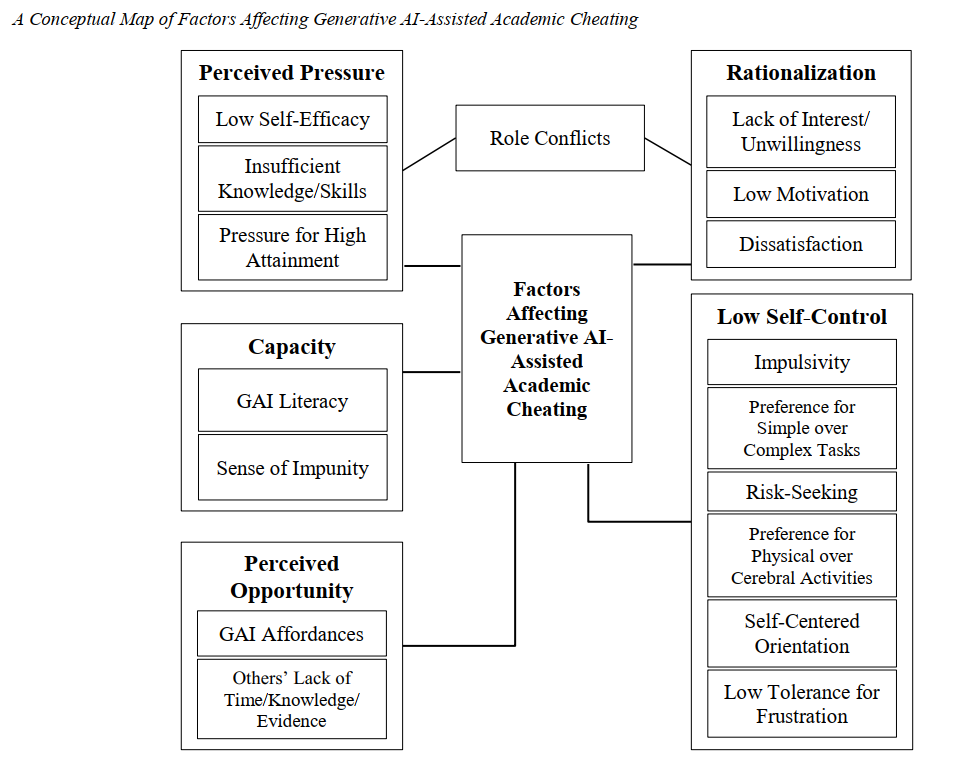
Academic transgression—any behavior, belief, or condition that violates social and academic norms—is a persistent concern in educational institutions. Cheating, a prevalent form of academic transgression, has been exacerbated by the advent of Generative Artificial Intelligence (GAI). While GAI offers remarkable opportunities, its incorporation into research, publication, and teaching and learning processes has also facilitated easier forms of cheating and fraud. By combining the fraud diamond framework with self-control theory, this article aimed to delve into the factors affecting GAI-assisted cheating by both students and faculty members. To this end, I intertwined the critical academic reflective writing method with side-by-side propositional theoretical integration—what I coin as Theoretical “Reflegration”—in a cross-level (macro–micro) and interdisciplinary manner, bridging the gap between practical experience and theory by providing personal examples that illustrate theoretical principles. I discussed how perceived pressure (low self-efficacy, insufficient knowledge/skills, pressure for high attainment), rationalization (lack of interest/unwillingness, dissatisfaction, low motivation), role conflicts (a sub-factor shared by both perceived pressure and rationalization); perceived opportunity (GAI affordances, others’ lack of time/knowledge/evidence), capacity (GAI literacy, sense of impunity), and low self-control with its six sub-factors, can influence academic cheating behaviors among students and faculty. The arguments presented in this article can inform the development of effective solutions and policies to deter and detect at-risk individuals, reduce cheating-conducive situations, and promote academic integrity.
Downloads
References
Abbasi, P., Yoosefi-Lebni, J., Jalali, A., Ziapour, A., & Nouri, P. (2021). Causes of the plagiarism: A grounded theory study. Nursing ethics, 28(2), 282-296.
Abd-Elaal, E. S., Gamage, S. H., & Mills, J. E. (2019). Artificial intelligence is a tool for cheating academic integrity. Proceedings of the AAEE2019 Conference, Brisbane, Australia.
Acosta-Enriquez, B. G., Ballesteros, M. A. A., Jordan, O. H., Roca, C. L., & Tirado, K. S. (2024). Analysis of college students' attitudes toward the use of ChatGPT in their academic activities: effect of intent to use, verification of information and responsible use. BMC Psychology, 12, 255 https://doi.org/https://doi.org/10.1186/s40359-024-01764-z
Adams, M. L. (2006). The quest for tenure: Job security and academic freedom. Catholic University Law Review, 56, 67-98.
Alsabhan, W. (2023). Student cheating detection in higher education by implementing machine learning and LSTM techniques. Sensors, 23, 4149. https://doi.org/https://doi.org/10.3390/s23084149
Atmini, S., Jusoh, R., Prastiwi, A., Wahyudi, S. T., Hardanti, K. N., & Widiarti, N. N. A. (2024). Plagiarism among accounting and business postgraduate students: a fraud diamond framework moderated by understanding of artificial intelligence. Cogent Education, 11(1), 2375077. https://doi.org/https://doi.org/10.1080/2331186X.2024.2375077
Błachnio, A., Cudo, A., Kot, P., Torój, M., Oppong Asante, K., Enea, V., ..., & Wright, M. F. (2022). Cultural and psychological variables predicting academic dishonesty: a cross-sectional study in nine countries. Ethics & Behavior, 32(1), 44-89. https://doi.org/https://doi.org/10.1080/10508422.2021.1910826
Bowman, M. (2021a). A framework for scaffolding academic reflective writing in dentistry. European Journal of Dental Education, 25(1), 35-49. https://doi.org/10.1111/eje.12575
Bowman, M. (2021b). Good academic reflective writing in dentistry. In Melinda Whong & Jeanne Godfrey (Eds.), What Is Good Academic Writing?: Insights into Discipline-Specific Student Writing (pp. 111-134).
Bowman, M., & Addyman, B. (2014). Academic reflective writing: A study to examine its usefulness. British Journal of Nursing, 23(6), 304-309.
Bubaš, G., & Čižmešija, A. (2023). A critical analysis of students’ cheating in online assessment in higher education: Post-COVID-19 Issues and challenges related to conversational artificial intelligence Proceedings of the 46th ICT & Electronics Convention MIPRO 2023, Opatija, Croatia.
Bulathwela, S., Pérez-Ortiz, M., Holloway, C., Cukurova, M., & Shawe-Taylor, J. (2024). Artificial intelligence alone will not democratise education: On educational inequality, techno-solutionism and inclusive tools. Sustainability, 16(2), 781. https://doi.org/https://doi.org/10.3390/su16020781
Capraro, V., Lentsch, A., Acemoglu, D., Akgun, S., Akhmedova, A., Bilancini, E., ..., & Viale, R. (2024). The impact of generative artificial intelligence on socioeconomic inequalities and policy making. PNAS nexus, 3(6), 191. https://doi.org/https://doi.org/10.1093/pnasnexus/pgae191
Chen, C., Long, J., Liu, J., Wang, Z., Wang, L., & Zhang, J. (2020). Online academic dishonesty of college students: A review.Advances in Social Science, Education and Humanities Research Proceedings of the 2020 International Conference on Advanced Education, Management and Social Science (AEMSS2020),
Christensen Hughes, J., & Eaton, S. E. (2022). Academic misconduct in higher education: Beyond student cheating. In Academic Integrity in Canada (pp. 81-102). Springer, Cham.
Darling, S. (2020). Examining career plateau in the public service University of Victoria].
Dawson, P. (2021). Defending assessment security in a digital world: Preventing e-cheating and supporting academic integrity in higher education. Routledge.
de Ridder, D. (2024). Can self-control make you happy? Current Opinion in Psychology(101875). https://doi.org/https://doi.org/10.1016/j.copsyc.2024.101875
De Ridder, D. T., Lensvelt-Mulders, G., Finkenauer, C., Stok, F. M., & Baumeister, R. F. (2012). Taking stock of self-control: A meta-analysis of how trait self-control relates to a wide range of behaviors. Personality and Social Psychology Review, 16(1), 76-99. https://doi.org/10.1177/1088868311418749
Diego-Medrano, E., & Salazar, L. R. (2021). Examining the work-life balance of faculty in higher education. International Journal of Social Policy and Education, 3(3), 27-36.
Ednadita, G., Octavia, S., Khairunnisa, F. S., Rodhiyah, I., & Hendraputra, D. (2020). Effects of Self-Control on Cheating Among Indonesian College Students. Indonesian Psychological Research, 2(2), 87-95. https://doi.org/10.2980/ipr.v2i2.246
Elliott, T. L., Marquis, L. M., & Neal, C. S. (2013). Business ethics perspectives: Faculty plagiarism and fraud. Journal of business ethics, 112(1), 91-99.
Franco, L. S., Picinin, C. T., Pilatti, L. A., & Franco, A. C. (2021). Work-life balance in Higher Education: a systematic review of the impact on the well-being of teachers. Ensaio: Avaliação e Políticas Públicas em Educação, 29(112), 691-717. https://doi.org/https://doi.org/10.1590/S0104-403620210002903021
Gillebaart, M., & Schneider, I. K. (2024). Effortless self-control. Current Opinion in Psychology, 101860. https://doi.org/https://doi.org/10.1016/j.copsyc.2024.101860
Giluk, T. L., & Postlethwaite, B. E. (2015). Big Five personality and academic dishonesty: A meta-analytic review. Personality and individual differences, 72, 59-67. https://doi.org/http://dx.doi.org/10.1016/j.paid.2014.08.027
Glendinning, I., Orim, S. M., & King, A. (2019). Policies and Actions of Accreditation and Quality Assurance Bodies to Counter Corruption in Higher Education. Project Report. Council for Higher Education Accreditation.
Gottfredson, M. (2017). Self-control theory and crime. In Henry N. Pontell (Ed.), Oxford Research Encyclopedias: Criminology and Criminal Justice. Oxford https://doi.org/https://doi.org/10.1093/acrefore/9780190264079.013.252
Hawdon, J., Costello, M., & Reichelmann, A. V. (2025). Cheating with ChatGPT and Techniques of Neutralization. Deviant Behavior, 1–22. https://doi.org/10.1080/01639625.2025.2456067
Heidari, A., Beheshty, S. S., Shahriyari, M., & Navah, A. (2020). Sociological Analysis of Career Plateau among Faculty Members in Iranian Universities based on Grounded Theory Approach. Journal of Applied Sociology, 31(2), 95-122. https://doi.org/10.22108/jas.2019.109893.1328
Hennecke, M., & Kulkarni, P. (2024). Metacognitive Knowledge About Self-Control. Current Opinion in Psychology, 101861. https://doi.org/https://doi.org/10.1016/j.copsyc.2024.101861
Heron, M., & Corradini, E. (2023). A genre-based study of professional reflective writing in higher education. Teaching in Higher Education, 28(3), 504-516. https://doi.org/https://doi.org/10.1080/13562517.2020.1824178
Hofmann, W., Grelle, S., Nielsen, K., & Kukowski, C. (2024). Self-Control and Behavioral Public Policy. Current Opinion in Psychology, 101873. https://doi.org/https://doi.org/10.1016/j.copsyc.2024.101873
Hutson, J. (2024). Rethinking Plagiarism in the Era of Generative AI. Journal of Intelligent Communication, 4(1), 20-31. https://doi.org/https://doi.org/10.54963/jic.v4i1.220
Kangwa, D., Msafiri, M. M., Wan, X., & Fute, A. (2024). Self-doubt and self-regulation: A systematic literature review of the factors affecting academic cheating in online learning environments. Social Psychology of Education, 27, 2809–2855. https://doi.org/10.1007/s11218-024-09939-7
Khabaronline. (2013, January 4). Retrieved 24 March, 2023 from khabaronline.ir/x4hKy
Krohn, M., & Ward, J. T. (2016). Integrating criminological theories. In A. R. Piquero (Ed.), The handbook of criminological theory (pp. 318-335). Wiley & Sons, Inc.
Krohn, M. D., & Eassey, J. M. (2014). Integrated theories of crime. In The Encyclopedia of Theoretical Criminology (pp. 1-6). https://doi.org/10.1002/9781118517390.wbetc028
Leaton Gray, S., Edsall, D., & Parapadakis, D. (2025). AI-Based Digital Cheating At University, and the Case for New Ethical Pedagogies. Journal of Academic Ethics. https://doi.org/10.1007/s10805-025-09642-y
Logan, A. (2012). Improving personal voice in academic writing: an action inquiry using self-reflective practice. Reflective practice, 13(6), 775-788. https://doi.org/http://dx.doi.org/10.1080/14623943.2012.732937
Lukac, D., & Lazareva, A. (2023). Artificial intelligence and educational assessment system landscape, challenges and ways to tackle ai based plagiarism [Abstract]. EDULEARN23 Proceedings, Palma, Spain.
Lund, B. D., Lee, T. H., Mannuru, N. R., & Arutla, N. (2025). AI and academic integrity: Exploring student perceptions and implications for higher education. Journal of Academic Ethics, 1-21. https://doi.org/10.1007/s10805-025-09613-3
Meraji Oskuie, S. (2024). Necessity of Social Control for Academic Transgression: Student Generative AI-Assisted Cheating. Conference proceedings: 1st National Conference on Artificial Intelligence in Education and Learning, Tehran, Iran.
Meraji Oskuie, S., Abbaspour, A., Delavar, A., & Toloie Eshlaghy, A. (2023). A Perceived Causal Relations Model for Social Control of Academic Transgressions Among Faculty Members. International Journal of Ethics and Society, 5(3), 27-40. https://doi.org/10.22034/ijethics.5.3.27
Meraji Oskuie, S., Mohamadkhani, K., Delavar, A., & Farhangi, A. A. (2023a). A Mixed Methods Approach to Social Control of Cybercultural Transgressions: An Iranian Perspective. International Journal of Digital Content Managment, 4(6), 1-30. https://doi.org/10.22054/dcm.2022.66744.1065
Meraji Oskuie, S., Mohamadkhani, K., Delavar, A., & Farhangi, A. A. (2023b). Self-Control and Cybercultural Transgressions: How Social Media Users Differ. Journal of Cyberspace Studies, 7(1), 81-104. https://doi.org/10.22059/JCSS.2023.350499.1081
Mohammadkarimi, E. (2023). Teachers’ reflections on academic dishonesty in EFL students’ writings in the era of artificial intelligence. Journal of Applied Learning and Teaching, 6(2). https://doi.org/https://doi.org/10.37074/jalt.2023.6.2.10
Muftić, L. R. (2009). Macro-Micro Theoretical Integration: An Unexplored Theoretical Frontier. Journal of Theoretical and Philosophical Criminology, 1(2), Article 3. https://scholars.indianastate.edu/jtpcrim/vol1/iss2/3
Napolitano, C. M., Duckworth, A. L., & Gross, J. J. (2024). Trait self-control: A Process Model perspective. Current Opinion in Psychology, 101858. https://doi.org/https://doi.org/10.1016/j.copsyc.2024.101858
Nartgün, Z., & Kennedy, E. (2024). Cheating in Higher Education in the Age of Artifical Intelligence. International Journal on Lifelong Education and Leadership, 10(2), 47-53. https://doi.org/10.25233/ijlel.1553831
National Academies of Sciences, E., and Medicine. (2018). Sexual Harassment of Women: Climate, Culture, and Consequences in Academic Sciences, Engineering, and Medicine. The National Academies Press. https://doi.org/https://doi.org/https://doi.org/10.17226/24994
Ng, D. T. K., Leung, J. K. L., Chu, S. K. W., & Qiao, M. S. (2021). Conceptualizing AI literacy: An exploratory review. Computers and Education: Artificial Intelligence, 2, 100041. https://doi.org/https://doi.org/10.1016/j.caeai.2021.100041
Nilsen, F. A., Bang, H., & Røysamb, E. (2024). Personality traits and self-control: The moderating role of neuroticism. PloS one, 19(8), e0307871. https://doi.org/https://doi.org/10.1371/journal.pone.0307871
Oravec, J. A. (2023). Artificial Intelligence Implications for Academic Cheating: Expanding the Dimensions of Responsible Human-AI Collaboration with ChatGPT and Bard. Journal of Interactive Learning Research, 34(2), 213-237.
Reisig, M. D., Holtfreter, K., & Berzofsky, M. E. (2020). Assessing the perceived prevalence of research fraud among faculty at research-intensive universities in the USA. Accountability in Research, 27(7), 457-475.
Rokni, M. B., Bizhani, N., Habibzadeh, F., Farhud, D. D., Mohammadi, N., Alizadeh, A., & Rokni, L. (2020). Comprehensive survey of plagiarism in Iran. Pakistan Journal of Medical Sciences, 36(7), 1441-1448.
Ruankaew, T. (2016). Beyond the fraud diamond. International Journal of Business Management & Economic Research, 7(1), 474-476.
Sholikhah, Z., Pramuka, B. A., Adawiyah, W. R., Yanuar, I., Respati, Y. A., & Pramuka, M. F. (2024). It's Bad but It's Good: An Exploration of AI Cheating on Higher Educational Students Perspectives. 2024 IEEE Technology & Engineering Management Conference - Asia Pacific (TEMSCON-ASPAC), Denpasar, Indonesia.
Siaputra, I. B., & Santosa, D. A. (2016). Academic integrity campaign in Indonesia. In T. Bretag (Ed.), Handbook of Academic Integrity (pp. 75-86). SpringerNature.
Silver, E., & Ulmer, J. T. (2012). Future selves and self-control motivation. Deviant Behavior, 33(9), 699-714. https://doi.org/https://doi.org/10.1080/01639625.2011.647589
Sozon, M., Mohammad Alkharabsheh, O. H., Fong, P. W., & Chuan, S. B. (2024). Cheating and plagiarism in higher education institutions (HEIs): A literature review. F1000Research, 13, 788. https://doi.org/https://doi.org/10.12688/f1000research.147140.1
Stone, B. W. (2025). Generative AI in higher education: Uncertain students, ambiguous use cases, and mercenary perspectives. Teaching of Psychology, 52(3), 347-356. https://doi.org/10.1177/00986283241305398
Vasconez-Gonzalez, J., Izquierdo-Condoy, J. S., Naranjo-Lara, P., Garcia-Bereguiain, M. Á., & Ortiz-Prado, E. (2024). Integrity at stake: confronting “publish or perish” in the developing world and emerging economies. Frontiers in Medicine, 11, 1405424. https://doi.org/https://doi.org/10.3389/fmed.2024.1405424
Wang, H., & Zhang, Y. (2022). The effects of personality traits and attitudes towards the rule on academic dishonesty among university students. Scientific Reports, 12(1), 14181. https://doi.org/https://doi.org/10.1038/s41598-022-18394-3
Xie, Y., Wu, S., & Chakravarty, S. (2023). AI meets AI: Artificial Intelligence and Academic Integrity-A Survey on Mitigating AI-Assisted Cheating in Computing Education The 24th Annual Conference on Information Technology Education (SIGITE ’23), Marietta, GA, USA.
Yavich, R., & Davidovitch, N. (2024). Plagiarism among Higher Education Students. Education Sciences, 14(8), 908. https://doi.org/10.3390/educsci14080908
Downloads
Additional Files
Publication Timeline
Issue
Section
License
Copyright (c) 2024 Shalaleh Meraji Oskuie (Corresponding Author)

This work is licensed under a Creative Commons Attribution-NonCommercial 4.0 International License.