The Impact of Artificial Intelligence on Enhancing Customer Experience Through Social Media Marketing: The Mediating Role of Chatbots, Virtual Influencers, and Augmented Reality (Case Study: Digikala Customers)
Keywords:
artificial intelligence, customer experience enhancement, social media marketing, chatbot, virtual influencer, augmented reality, structural equation modelingAbstract
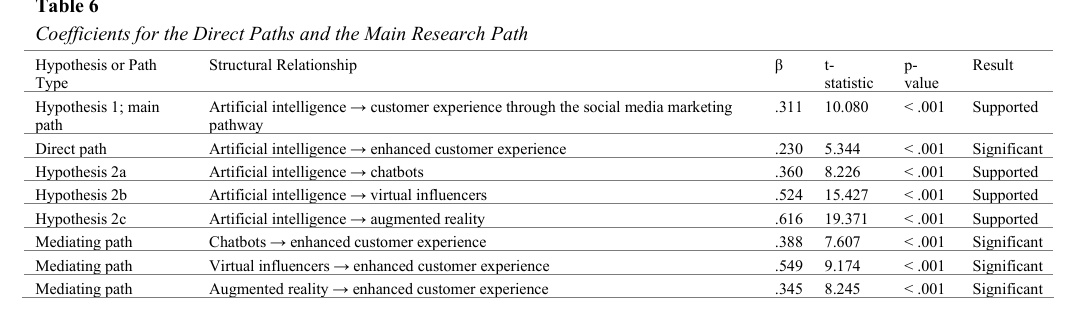
The present study aimed to investigate the impact of artificial intelligence on enhancing customer experience through social media marketing, with the mediating roles of chatbots, virtual influencers, and augmented reality. In terms of purpose, this study was applied; in terms of nature, it was descriptive; and in terms of data collection, it employed a cross-sectional survey design. The statistical population consisted of customers of Digikala. Given the unlimited size of the population, the sample size was determined as 384 individuals using Cochran’s formula, and participants were selected through convenience sampling. Data were collected using a standardized 29-item questionnaire based on a five-point Likert scale. Data analysis was conducted using partial least squares structural equation modeling (PLS-SEM). The findings indicated that artificial intelligence had a significant effect on enhancing customer experience through social media marketing (β = .311, t = 10.080). Artificial intelligence also had positive and significant effects on chatbots (β = .360), virtual influencers (β = .524), and augmented reality (β = .616). Chatbots (β = .388), virtual influencers (β = .549), and augmented reality (β = .345) also exerted significant effects on enhanced customer experience. The mediating role of all three variables was confirmed. Model fit was supported by a GOF value of .383 and an R² value of .576 for customer experience.
Downloads
References
Afshari, S. (2025). Examining the effect of chatbot service capabilities on customer experience and satisfaction in the banking industry [Master's thesis, Shahid Ashrafi Esfahani University]. Isfahan.
Angmo, P., Mahajan, R., & Ranjitha, G. P. (2025). Unveiling the power of virtual influencers: Impact of content and credibility on consumer engagement and purchase intentions. Journal of Internet Commerce, 24(1), 58-89. https://doi.org/10.1080/15332667.2025.2471668
Daraei, A., Heidari Sharifabad, A., & Mortazavi, S. M. R. (2025). Presenting a model for predicting virtual media customers' reactions using artificial intelligence. Intelligent Marketing Management, 6(2).
Divsalar, Z. (2025). Strategic analysis of the effects of integrating artificial intelligence on customer experience across industries. Quarterly Journal of Intelligent Marketing Management, 6(2), 171-205.
Hassanpour, V., & Hassanpour, F. (2024). Examining the impact of marketing-based artificial intelligence technology and human-machine interaction on reducing economic inequality and protecting privacy International Conference on Artificial Intelligence and Future Civilization, Tehran.
Kalantari, M., & Ghasemi, M. (2026). When algorithms market: Artificial intelligence and the creation of novel customer experiences. Allameh Tabataba'i University Press.
Khanlari, A., & Abdolhosseini, R. (2025). The interaction between artificial intelligence and customer experience: A bibliometric analysis. Intelligent Marketing Management, 6(2), 171-205.
Kim, H., & So, K. K. F. (2022). Two decades of customer experience research in hospitality and tourism. International Journal of Hospitality Management, 100, 103082. https://doi.org/10.1016/j.ijhm.2021.103082
Koeswara, F. O., & Nugroho, B. Y. (2024). The role of artificial intelligence marketing efforts on brand preference mediated by brand experience of TikTok users in DKI Jakarta. Indonesian Journal of Multidisciplinary Science, 4(2), 104-115. https://doi.org/10.55324/ijoms.v4i2.1019
Moghaddasi, A., & Shadman Kahu, F. (2024). Examining the impact of artificial intelligence on customer experience and customer service in businesses Ninth International Conference on Management, Tourism, and Technology, Tehran.
Moustakas, E. (2020). Blurring lines between fiction and reality: Perspectives of experts on marketing effectiveness of virtual influencers IEEE Cyber Security, https://doi.org/10.1109/CyberSecurity49315.2020.9138861
Nourian, K., & Bahrami, M. (2024). The role of artificial intelligence in customers' purchasing behavior on social media Second Conference on Modern Business Management, Business, and Innovative Marketing, Qazvin.
Omeish, F., Al Khasawneh, M., & Khair, N. (2024). Investigating the impact of AI on improving customer experience through social media marketing: An analysis of Jordanian Millennials. Computers in Human Behavior Reports, 1-11. https://doi.org/10.1016/j.chbr.2024.100464
Sharifian Esfahani, A. A., & Mirghaderi, S. A. H. (2026). Analyzing the role of artificial intelligence in transforming social media marketing and consumer behavior: A bibliometric approach. Sociology of Social Communications, 6(3), 37-73.
Shiravani, P. (2024). Implementing AI-powered personalization in marketing: A case study analysis of business value and consumer acceptance [Master's thesis, University of Padua].
Swani, K., Brown, B. P., & Mudambi, S. M. (2020). The untapped potential of B2B advertising. Industrial Marketing Management, 89, 581-593. https://doi.org/10.1016/j.indmarman.2019.05.010
Downloads
Publication Timeline
- Submitted
- Revised
- Accepted