The Model of Innovative Challenges with the Approach of Responding to Industrial Demands
DOI:
https://doi.org/10.61838/kman.aitech.3.2.7Keywords:
open innovation, crowdsourcing, open innovation mediators, innovative challengesAbstract
Abstract
Purpose: In today’s competitive markets, innovation is essential for survival and success. Companies adopt various tools to foster innovation and address their challenges—one of which is hosting innovative challenges. These events allow firms to engage with problem-solving communities to generate solutions. This study aims to explore the conditions necessary for organizing such events and to identify the key factors that influence their success in addressing industrial demands.
Method: This research employs a mixed-methods approach (qualitative–quantitative). Initially, a qualitative method was used to extract relevant factors from existing literature through content analysis, expert interviews, and open coding. Subsequently, the identified factors were screened using a quantitative approach, specifically the fuzzy Delphi method, conducted in two rounds with expert input. To develop a conceptual model comprising indices and sub-indices, exploratory factor analysis was conducted based on expert evaluations. Finally, the proposed model was validated through confirmatory factor analysis using structural equation modeling in LISREL software.
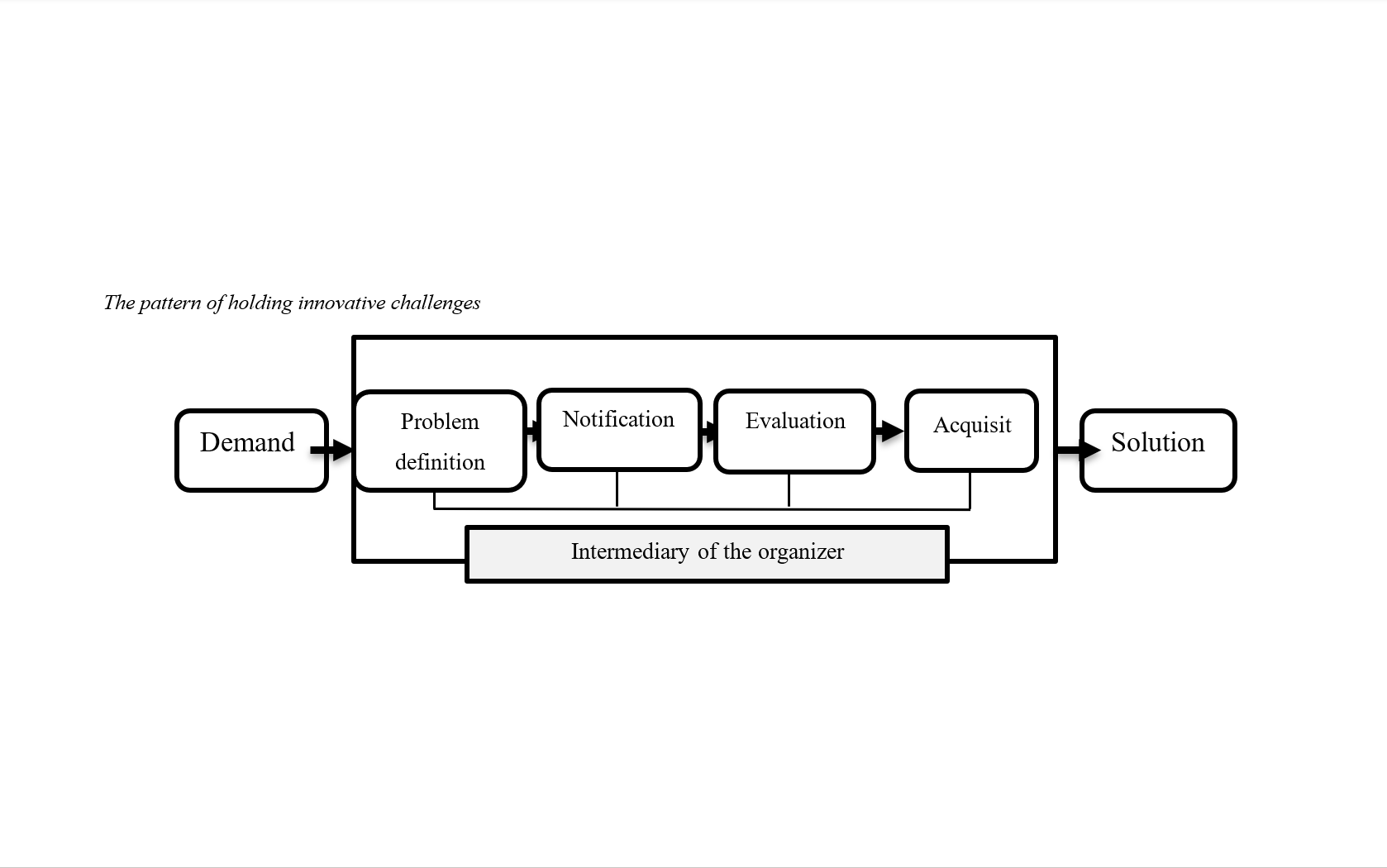
Findings: The results indicate that the process of conducting innovative challenges to address industrial needs consists of four main stages: Problem Definition, Information, Evaluation, and Acquisition. Additionally, 20 critical success factors were identified as essential for organizing an effective event. Based on these findings, a comprehensive model for implementing innovative challenges was developed.
Downloads
References
Abi Saad, E., Tremblay, N., & Agogué, M. (2024). A multi-level perspective on innovation intermediaries: The case of the diffusion of digital technologies in healthcare. Technovation, 129, 102899. https://doi.org/10.1016/j.technovation.2023.102899
Bakici, T. (2020). Comparison of crowdsourcing platforms from social-psychological and motivational perspectives. International Journal of Information Management, 54. https://doi.org/10.1016/j.ijinfomgt.2020.102121
Battistella, C., & Nonino, F. (2012). Open innovation web-based platforms: the impact of different forms of motivation on collaboration. Innovations, 14(4), 557-575. https://doi.org/10.5172/impp.2012.14.4.557
Bäumle, P. (2025). Knowledge intermediaries in regional innovation systems.
Brabham, D. C. (2008). Crowdsourcing as a model for problem solving. Convergence, 14(1), 75-90. https://doi.org/10.1177/1354856507084420
Chauhan, A. S., Nepal, B., Soni, G., & Rathore, A. P. S. (2018). Examining the state of risk management research in new product development process. Engineering Management Journal, 30(2), 85-97. https://doi.org/10.1080/10429247.2018.1446120
Chen, L., Wang, M., Cui, L., & Li, S. (2021). Experience base, strategy‐by‐doing and new product performance. Strategic management journal, 42(7), 1379-1398. https://doi.org/10.1002/smj.3262
Chesbrough, H. (2006). Open Business Models. Harvard Business School Press.
Chesbrough, H. W. (2003). Open Innovation: The New Imperative for Creating and Profiting from Technology. Harvard Business School Press.
Chu, X., & Bai, Y. (2025). Effect of the digital transformation of firms in a developing country on their reverse innovation: the complementary roles of multi-contexts. Int. J. Technology Management, 97(2/3), 275-304. https://doi.org/10.1504/IJTM.2025.143582
Claire, H., McCarthy, A., Ferri, P., & Shapira, P. (2024). Innovation intermediaries at the convergence of digital technologies, sustainability, and governance: A case study of AI-enabled engineering biology. Technovation, 129, 102875. https://doi.org/10.1016/j.technovation.2023.102875
Colovic, A., Caloffi, A., Rossi, F., & Russo, M. (2025). Institutionalising the digital transition: The role of digital innovation intermediaries. Research Policy, 54(1), 105146. https://doi.org/10.1016/j.respol.2024.105146
Cooper, R. G. (2019). The drivers of success in new-product development. Industrial Marketing Management, 76, 36-47. https://doi.org/10.1016/j.indmarman.2018.07.005
Dahlander, L., & Gann, D. (2010). How open is innovation? Research Policy, 39(6). https://doi.org/10.1016/j.respol.2010.01.013
De Almeida, J. F., Amaral, D. C., & Coelho, R. T. (2021). Innovative Framework to manage New Product Development (NPD) Additive Manufacturing (AM) and Agile Management
De Mattosa, C. A., Kissimotob, K. O., & Laurindoc, F. J. B. (2018). The role of information technology for building virtual environments to integrate crowdsourcing mechanisms into the open innovation process. Technological Forecasting & Social Change, 129. https://doi.org/10.1016/j.techfore.2017.12.020
Durmusoglu, S. S., & Kawakami, T. (2021). Information technology tool use frequency in new product development: The effect of stage-specific use frequency on performance. Industrial Marketing Management, 93. https://doi.org/10.1016/j.indmarman.2021.01.014
Egger, R., Gula, I., & Walcher, D. (2016). Towards a Holistic Framework of Open Tourism. In R. Egger, I. Gula, & D. Walcher (Eds.), Open Tourism: Open Innovation, Crowdsourcing and Co-Creation Challenging the Tourism Industry. Springer. https://doi.org/10.1007/978-3-642-54089-9
Ettlinger, N. (2017). Open innovation and its discontents. Geoforum, 80. https://doi.org/10.1016/j.geoforum.2017.01.011
Foege, J. N., Dragsdahl Lauritzen, G., Tietze, F., & Salge, T. O. (2019). Reconceptualizing the paradox of openness: How solvers navigate sharingprotecting tensions in crowdsourcing. Research Policy, 48. https://doi.org/10.1016/j.respol.2019.01.013
Ghezzi, A., Gabelloni, D., Martini, A., & Natalicchio, A. (2017). Crowdsourcing: A Review and Suggestions for Future Research. International Journal of Management Reviews.
Grönlund, J., Sjödin, D. R., & Frishammar, J. (2010). Open innovation and the stage-gate process: A revised model for new product development. California Management Review, 52(3), 106-131. https://doi.org/10.1525/cmr.2010.52.3.106
Gutierrez-Gutierrez, L. J., Barrales-Molina, V., & Kaynak, H. (2018). The role of human resource-related quality management practices in new product development: A dynamic capability perspective. International Journal of Operations & Production Management, 38(1), 43-66. https://doi.org/10.1108/IJOPM-07-2016-0387
Hossain, M., & Kauranen, I. (2015). Crowdsourcing: a comprehensive literature review. Strategic Outsourcing: An International Journal, 8(1). https://doi.org/10.1108/SO-12-2014-0029
Howe, J. (2006). The Rise of Crowdsourcing. WIRED, 14.
Howells, J. (2024). Innovation intermediaries in a digital paradigm: A theoretical perspective. Technovation, 129, 102889. https://doi.org/10.1016/j.technovation.2023.102889
Hyvärinen, A. M., Keskinen, M., & Levänen, J. (2024). Intermediaries as drivers of innovation development in resource-constrained environments: Insights from the Kenyan water sector. Technovation, 131, 102956. https://doi.org/10.1016/j.technovation.2024.102956
InnoCentive. (2021). InnoCentive.com. www.Innocentive.com
Keinz, P., & Marhold, K. (2021). Technological competence leveraging projects via intermediaries: Viable means to outbound open innovation and mediated capability building? International Journal of Project Management, 29. https://doi.org/10.1016/j.ijproman.2020.10.006
Lee, H., & Cho, N. (2024). Relationship between Absorptive Capacity, Technology Collaboration Performance, and Innovation Intermediaries: A Grounded Theory Approach. Journal of Information Technology Applications and Management, 31(3), 105-117. https://doi.org/10.21219/JITAM.2024.31.3.105
Leimeister, J. M., Huber, M., Bretschneider, U., & Krcmar, H. (2009). Leveraging Crowdsourcing: Activation-Supporting components for IT-based ideas competition. Journal of Management Information Systems (JMIS), 26(1), 197-224. https://doi.org/10.2753/MIS0742-1222260108
Lu, P., Yuan, S., & Wu, J. (2017). The interaction effect between intra-organizational and inter-organizational control on the project performance of new product development in open innovation. International Journal of Project Management, 35(8). https://doi.org/10.1016/j.ijproman.2017.09.009
Mazzola, E., Piazza, M., Acur, N., & Perrone, G. (2020). Treating the crowd fairly: Increasing the solvers' self-selection in idea innovation contests. Industrial Marketing Management, 91, 16-29. https://doi.org/10.1016/j.indmarman.2020.07.019
Mergel, I., & Desouza, K. C. (2013). Implementing Open Innovation in the Public Sector: The Case of Challenge.gov. Public Administration Review, 73, 882-890. https://doi.org/10.1111/puar.12141
Ozaygen, A., & Balague, C. (2018). Idea Evaluation in Innovation Contest Platforms: A Network Perspective. Decision Support Systems, 112, 15-22. https://doi.org/10.1016/j.dss.2018.06.001
Pollok, P., Lüttgens, D., & Piller, F. T. (2018). How firms develop capabilities for crowdsourcing to increase open innovation performance: The interplay between organizational roles and knowledge processes. Journal of Product Innovation Management, 36(4). https://doi.org/10.1111/jpim.12485
Pollok, P., Lüttgens, D., & Piller, F. T. (2019). Attracting solutions in crowdsourcing contests: The role of knowledge distance, identity disclosure, and seeker status. Research Policy, 48(1), 98-114. https://doi.org/10.1016/j.respol.2018.07.022
Presenza, A., Abbate, T., Cesaroni, F., & Appio, F. P. (2019). Enacting Social Crowdfunding Business Ecosystems: The case of the platform Meridonare. Technological Forecasting & Social Change, 143. https://doi.org/10.1016/j.techfore.2019.03.001
Richard, B., Ford, R., & Perry, W. (2016). Crowdsourcing in the lodging industry: Innovation on a budget. In R. Egger, I. Gula, & D. Walcher (Eds.), Open Tourism - Open Innovation, Crowdsourcing and Collaborative Consumption challenging the tourism industry (pp. 79-94). https://doi.org/10.1007/978-3-642-54089-9_6
Rivasa, A. A., Chenb, Y.-C., & Yang, T.-K. (2020). Entrepreneurial and alliance orientation alignment in new product development. Technological Forecasting & Social Change, 153, 119916. https://doi.org/10.1016/j.techfore.2020.119916
Sala-Vilar, L. R., Li-Ying, J., & Traunecker, T. (2024). How do innovation intermediaries' business models cope with their need to develop new digital services? Technovation, 131, 102950. https://doi.org/10.1016/j.technovation.2023.102950
Sari, A., Tosun, A., & Alptekin, G. I. (2019). A systematic literature review on crowdsourcing in software engineering. The Journal of Systems and Software, 153. https://doi.org/10.1016/j.jss.2019.04.027
Scarbrough, H., Sanfilippo, K. R. M., Ziemann, A., & Stavropoulou, C. (2024). Mobilizing pilot-based evidence for the spread and sustainability of innovations in healthcare: The role of innovation intermediaries. Social Science & Medicine, 340, 116394. https://doi.org/10.1016/j.socscimed.2023.116394
Schemmann, B., Herrmann, A., Chappin, M. M. H., & Heimeriks, G. J. (2016). Crowdsourcing ideas: Involving ordinary users in the ideation phase of new product development. Research Policy, 45. https://doi.org/10.1016/j.respol.2016.02.003
Strazzullo, S., Mauriello, R., Corvello, V., Cricelli, L., & Grimaldi, M. (2025). How open innovation can improve companies' corporate social responsibility performance? Business Ethics, the Environment & Responsibility, 34(1), 1-16. https://doi.org/10.1111/beer.12535
Taeihagh, A. (2017). Examination of crowdsourcing as a tool for policy making
Tam, C., da Costa Moura, E. J., Oliveira, T., & Varajão, J. (2020). The factors influencing the success of on-going agile software development projects. International Journal of Project Management, 38(3), 165-176. https://doi.org/10.1016/j.ijproman.2020.02.001
Vidmar, M. (2021). Enablers, Equippers, Shapers and Movers: A typology of innovation intermediaries' interventions and the development of an emergent innovation system. Acta Astronautica, 179. https://doi.org/10.1016/j.actaastro.2020.10.011
Xiao, S., Lew, Y. K., & Park, B. I. (2021). International new product development performance, entrepreneurial capability, and network in high-tech ventures. Journal of Business Research, 124. https://doi.org/10.1016/j.jbusres.2020.11.048
Ye, W., Xu, P., Jia, Y., & Jiang, F. (2012). Crowdsourcing for open innovations. Applied Mathematics, 6(3S).
Yin, R. K. (2018). Case study research and applications. Sage publications.
Zahaya, D., Hajlib, N., & Sihic, D. (2017). Managerial perspectives on crowdsourcing in the new product development process. Industrial Marketing Management. https://doi.org/10.1016/j.indmarman.2017.11.002
Zhua, X., Xiaob, Z., Dongc, M. C., & Gud, J. (2019). The fit between firms' open innovation and business model for new product development speed: A contingent perspective. Technovation. https://doi.org/10.1016/j.technovation.2019.05.005
Downloads
Additional Files
Publication Timeline
Issue
Section
License
Copyright (c) 2024 Hadi Hosseini, Naser Azad, Mahmoud Modiri, Manochehr Mantegi (Author)

This work is licensed under a Creative Commons Attribution-NonCommercial 4.0 International License.