The Silent Workforce Revolution: Are Workers Engaging in Stealth Use of Generative Artificial Intelligence and Reaping Career Gains?
DOI:
https://doi.org/10.61838/kman.aitech.3.3.12Keywords:
Generative AI, Cognitive Mediation Networks Theory, Sophotechnia, Organizational BehaviorAbstract
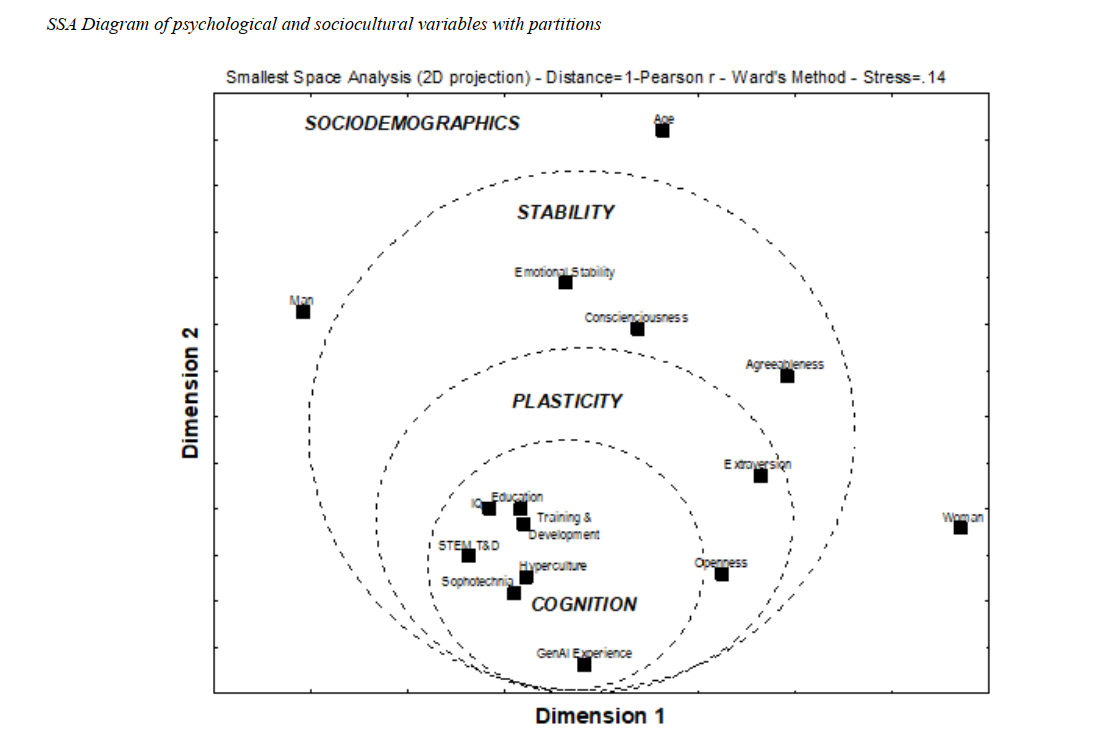
Generative Artificial Intelligence (GenAI) is reshaping workplace dynamics, often informally and without explicit employer endorsement. Using data from 576 professionals in Recife's Metropolitan Region, Brazil, we study the implications of GenAI use in organizations through the lenses of Cognitive Mediation Networks Theory (CMNT) and Actor-Network Theory (ANT). Specifically, we investigate the associations of the internalization of AI-mediated reasoning (Sophotechnia) with sociodemographic factors, psychological traits, and career success. Findings indicated that Sophotechnia is primarily a cognitive trait developed through experience with GenAIs. This trait is particularly fostered by an exploration-oriented personality. Organizationally, while 81.0% of the workers had interacted with GenAI, only 22.6% were employed in organizations that had formally adopted AI tools. Of those that had engaged with the technology, the vast majority used it for knowledge acquisition or construction (92.2%), and writing, interpreting or manipulating texts (83.4%). Those with higher levels of Sophotechnia exhibited not only greater confidence in the positive impacts of GenAIs (62.9% of users believed in a personal positive impact versus 15.2% of the non-users), but also superior job performance (81.3% chance of exceeding work requirements among those with high Sophotechnia versus only 27.6% for those in the lower range). Additionally, Sophotechnia showed a positive association to the speed of career growth (Rho=.37), plus greater satisfaction with job rewards (Rho=.29) and workplace relationships (Rho=.15). There was yet a positive correlation with the time spent working from home (Rho=.26), but not to the overall time spent working (Rho=.03). These findings highlight a disconnect between individual and corporate AI strategies. Workers seem to independently use GenAIs at home to improve their performance and obtain benefits, often without their employers’ awareness. This poses a managerial challenge for organizations to strategically integrate GenAI and maximize its benefits while addressing ethical and regulatory challenges.
Downloads
References
Agência Brasil. (2025). Brazilians are among world’s top AI users. https://agenciabrasil.ebc.com.br/en/geral/noticia/2025-01/brazilians-are-among-worlds-top-ai-users
Al-Smadi, M. (2023). ChatGPT and beyond: The generative AI revolution in education. https://arxiv.org/abs/2311.15198
Arthur, D. L. (2023). Generative artificial intelligence: Toward a new civilization? https://www.adlittle.com/cn-en/insights/report/generative-artificial-intelligence-toward-new-civilization
Brown, T. B., Mann, B., Ryder, N., Subbiah, M., Kaplan, J. D., Dhariwal, P., & Amodei, D. (2020). Language models are few-shot learners. Advances in Neural Information Processing Systems, 33, 1877-1901.
Brynjolfsson, E., Li, D., & Raymond, E. (2023). Generative AI as a productivity tool.
Business Insider. (2025). Cheap AI could be good for workers. https://www.businessinsider.com/lower-cost-ai-deepseek-good-for-workers-productivity-boost-2025-1
Cetic, B. (2024). Artificial intelligence and the labor market. https://www.cetic.br/media/docs/publicacoes/6/20241218181258/year-xvi-n-4-artificial-intelligence-andthe-labor-market.pdf
Chen, Y., Jensen, S., Albert, L. J., Gupta, S., & Lee, T. (2023). Artificial intelligence (AI) student assistants in the classroom: Designing chatbots to support student success. Information Systems Frontiers, 25(1), 161-182. https://doi.org/10.1007/s10796-022-10249-1
Comunale, M., & Manera, C. (2024). Skills and employment transitions in Brazil. https://www.ilo.org/employment/areas/skills-andemployability/publications/WCMS_896654
Dave, D. M., & Mandvikar, S. (2023). Augmented intelligence: Human-AI collaboration in the era of digital transformation. International Journal of Engineering Applied Sciences and Technology, 8(1), 24-30. https://doi.org/10.33564/IJEAST.2023.v08i06.003
Deloitte. (2025). AI is likely to impact careers. How can organizations help? https://www2.deloitte.com/us/en/insights/topics/talent/ai-in-the-workplace.html
DeYoung, C. G. (2015). Cybernetic big five theory. Journal of Research in Personality, 56, 33-58. https://doi.org/10.1016/j.jrp.2014.11.004
10.1016/j.jrp.2014.07.004
Dhingra, S., Singh, M., Vaisakh, S. B., & Malviya, N. (2023). Mind meets machine: Unravelling GPT-4’s cognitive psychology. https://arxiv.org/abs/2303.11436
European Parliament and Council of the European Union. (2024). Regulation (EU) 2024/1689 of 13 June 2024 laying down harmonised rules on artificial intelligence and amending various regulations and directives (Artificial Intelligence Act). https://eur-lex.europa.eu/
EY-Parthenon. (2024). The impact of GenAI on the labor market. https://www.ey.com/en_us/insights/ai/genai-impact-on-labor-market
Goodfellow, I., Pouget-Abadie, J., Mirza, M., Xu, B., Warde-Farley, D., Ozair, S., & Bengio, Y. (2014). Generative adversarial nets. Advances in Neural Information Processing Systems, 27, 2672-2680. https://doi.org/10.48550/arXiv.1406.2661
Gosling, S. D., Rentfrow, P. J., & Swann, W. B. (2003). A very brief measure of the big five personality domains. Journal of Research in Personality, 37(6), 504-528. https://doi.org/10.1016/S00926566(03)00046-1
10.1016/S0092-6566(03)00046-1
Gutiérrez, J., & Calderón, J. (2024). Actor-network theory and ICT research: A sociological approach to technology and information systems. International Journal of Information Management, 68, Article 102599. https://doi.org/10.1016/j.ijinfomgt.2023.102599
Hernández-Orallo, J., Dowe, D. L., & Hernández-Lloreda, M. V. (2024). The cognitive capabilities of generative AI: A comparative analysis. https://arxiv.org/abs/2410.07391v1
Huang, D. (2023). Automation and augmentation: Artificial intelligence, robots, and work. Annual Review of Sociology, 49, 1-20. https://doi.org/10.1146/annurev-soc-103021-100009
Ipsos Global, A. (2024). The Ipsos AI Monitor 2024: A 32-country survey. https://www.ipsos.com/sites/default/files/ct/publication/documents/2024-06/Ipsos-AI-Monitor-2024-Portuguese_0.pdf
Johnson, M., Bradshaw, J. M., Feltovich, P. J., Jonker, C. M., & Van Riemsdijk, M. B. (2023). Defining human-AI teaming the human-centered way. Frontiers in Robotics and AI, 10, Article 1057043. https://doi.org/10.3389/frobt.2023.1057043
Karras, T., Laine, S., & Aila, T. (2019). A style-based generator architecture for generative adversarial networks.
Kumar, A., Singh, R., & Patel, D. (2024). Generative AI in industrial revolution: A comprehensive research on transformations, challenges, and future directions. Journal of Knowledge, Learning and Scientific Technologies, 2(3), 147-163. https://jklst.org/index.php/home/article/view/147
Latour, B. (2005). Reassembling the social: An introduction to actor-network-theory. Oxford University Press. https://doi.org/10.1093/oso/9780199256044.001.0001
Leslie, D., & Meng, X. L. (2024). Future shock: Grappling with the generative AI revolution. Special Issue 5: Grappling With the Generative AI Revolution. https://doi.org/10.1162/99608f92.fad6d25c
McKinsey & Company. (2023). Generative AI and the future of work in America. https://www.mckinsey.com/mgi/our-research/generative-ai-and-the-future-of-work-in-america
NITI, A. (2023). National strategy for artificial intelligence. https://www.niti.gov.in/sites/default/files/2023-03/National-Strategy-for-Artificial-Intelligence.pdf
North Carolina Department of Commerce. (2024). Insights on generative AI and the future of work. https://www.commerce.nc.gov/news/the-lead-feed/generative-ai-and-future-work
Open Science, C. (2015). Estimating the reproducibility of psychological science. Science, 349(6251), Article aac4716. https://doi.org/10.1126/science.aac4716
Ouyang, L., Wu, J., Jiang, X., Almeida, D., Lattimore, T., Schneider, A., & Amodei, D. (2022). Training language models to follow instructions with human feedback. https://arxiv.org/abs/2203.02155
Pavlovic, J., Krstic, J., Mitrovic, L., Babic, D., Milosavljevic, A., Nikolic, M., & Karaklic, T. (2024). Generative AI as a metacognitive agent: A comparative mixed-method study with human participants on ICF-mimicking exam performance. https://arxiv.org/abs/2405.05285
Plomin, R., & von Stumm, S. (2018). The new genetics of intelligence. Nature Reviews Genetics, 19(3), 148-159. https://doi.org/10.1038/nrg.2017.104
Prahl, A. (2023). Literature review on use cases for generative AI in organizations. https://www.fhwedel.de/fileadmin/Mitarbeiter/Records/Prahl_2023_-_Literature_Review_on_Use_Cases_for_Generative_AI_in_organizations.pdf
PricewaterhouseCoopers. (2024). Leveraging generative AI for job augmentation and workforce productivity. https://www.pwc.com/gx/en/issues/artificial-intelligence/wef-leveraging-generative-ai-forjob-augmentation-and-workforce-productivity-2024.pdf
Radford, A., Narasimhan, K., Salimans, T., & Sutskever, I. (2018). Improving language understanding by generative pre-training. https://cdn.openai.com/research-covers/languageunsupervised/language_understanding_paper.pdf
Sloat, S. (2025). Inside France’s effort to shape the global AI conversation. https://time.com/7213186/france-paris-ai-summit-anne-bouverot/
Song, Y., Sohl-Dickstein, J., Kingma, D. P., Kumar, A., Ermon, S., & Poole, B. (2021). Score-based generative modeling through stochastic differential equations. https://arxiv.org/abs/2011.13456
Souza, B. C., Andrade Neto, A. S., & Roazzi, A. (2024). The generative AI revolution, cognitive mediation networks theory and the emergence of a new mode of mental functioning: Introducing the sophotechnic mediation scale. Computers in Human Behavior: Artificial Humans, 2(1), Article 100042. https://doi.org/10.1016/j.chbah.2023.100042
10.1016/j.chbah.2024.100042
Souza, B. C., da Silva, A. S., da Silva, A. M., Roazzi, A., & da Silva Carrilho, S. L. (2012). Putting the cognitive mediation networks theory to the test: Evaluation of a framework for understanding the digital age. Computers in Human Behavior, 28(6), 2320-2330. https://doi.org/10.1016/j.chb.2012.06.036
Souza, B. C., Roazzi, A., & Andrade Neto, A. S. (2023). How to easily construct a very brief practical measure of IQ: The Pernambuco Adult Intelligence Mini Test. Amazônica - Revista de Psicopedagogia, Psicologia escolar e Educação, 16(2).
Souza, B. C., Souza, F. M. C., & Roazzi, A. (2015). The lack of a treatment of uncertainty in facet theory: A relevant problem? In A. Roazzi, B. C. Souza, & W. Bilsky (Eds.), Facet theory: Searching for structure in complex social, cultural and psychological phenomena (pp. 54-64). Editora Universitária - UFPE.
Tony Blair Institute. (2024). The impact of AI on the labour market. https://institute.global/insights/economic-prosperity/the-impact-of-ai-on-the-labour-market
Vaswani, A., Shazeer, N., Parmar, N., Uszkoreit, J., Jones, L., Gomez, A. N., & Polosukhin, I. (2017). Attention is all you need. Advances in Neural Information Processing Systems, 30, 5998-6008.
West, D. M., & Allen, J. R. (2023). How artificial intelligence is reshaping the workforce. https://www.brookings.edu/research/how-artificial-intelligence-is-reshaping-the-workforce
Wodecki, B. (2024). Utah AI policy act, Utah Code Ann. § 63C-25-101. State of Utah
Yang, B., Guo, J., Iwasawa, Y., & Matsuo, Y. (2025). Tom-agent: Large language models as theory of mind aware generative agents with counterfactual reflection. https://arxiv.org/abs/2501.15355
Zeng, X., & Zhang, Y. (2023). Using actor-network theory to revisit the digitalized tool in social design structure: Transformations in institutions. Journal of Information Technology, 38(2), 137-154. https://doi.org/10.1177/02683962221140438
Zhai, X., Nyaaba, M., & Ma, W. (2024). Can generative AI and ChatGPT outperform humans on cognitivedemanding problem-solving tasks in science? https://arxiv.org/abs/2401.15081
Downloads
Additional Files
Publication Timeline
Issue
Section
License
Copyright (c) 2024 AI and Tech in Behavioral and Social Sciences

This work is licensed under a Creative Commons Attribution-NonCommercial 4.0 International License.