Application of Cyber-Constructive Triangulation in Qualitative Research: Simultaneous Analysis of Human, Machine, and Data Interactions
DOI:
https://doi.org/10.61838/kman.aitech.4321Abstract
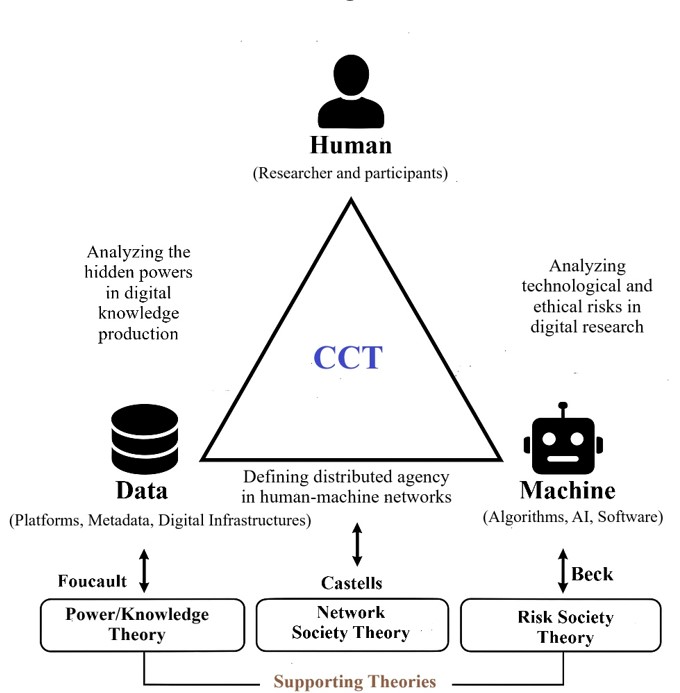
The refinement of artificial intelligence (AI) systems has significantly impacted the field of qualitative research. Within this space, the interaction of human researchers, algorithmic agents, and data architectures is complex and requires new methodological frameworks which are adaptive and responsive. This article presents a new mixed-method framework called Cyber-Constructive Triangulation (CCT) which seeks to provide solutions to the epistemic, ethical, and methodological dilemmas posed by the intersection of qualitative research and AI technologies in the age of big data. The framework aims to examine the simultaneous and critical interplay of three elements: humans (the researchers and the participants), machines (algorithms and automated systems), and data (the digital and social systems). Unlike other approaches which CCT as a qualitative methhod attributes meaning construction solely to human activity or technology, CCT illustrates that in digital research, meaning and knowledge emerge from interplay of distributed processes involving human and non-human actors. These are informed by three main theories which are Foucault power/knowledge theory, Castells’ network society theory, and Beck risk society theory. They assist in the examination of algorithmic power, digital agency, and ethical risks posed by modern technologies. The model comprises of three primary stages: design, creation of mixed data set and perform a three-tiered analysis composed of interpretive, algorithmic, and contextual layers. This enhances the level of analysis, promotes ethical sensitivity, and allows researchers to become more self-aware and responsible. This paper demonstrates through case studies the different applications of CCT in various disciplines as a general, reusable, and locally flexible instrument for qualitative data analysis. In this sense, CCT presents a new opportunity for qualitative researchers working in digital spaces to integrate precision, reasoning, and theoretical coherence.
Downloads
References
Abbaszadeh, M., Budaghi, A., & Karimi, F. (2012). Types of case analysis and the application of triangulation in it. Sociological Studies, 5(14), 69-87.
Abbaszadeh, M., & Pashaie, S. (2025). Algorithmic Interviewers and the Reconfiguration of Knowledge Production: Toward a Critical Intelligent Methodology in AI-Based Qualitative Research. Methodology of Social Sciences and Humanities, -. https://doi.org/10.30471/mssh.2025.10961.2640
Ahmadi, H., & Dehghani, R. (2016). Ulrich Beck’s Thoughts and Ideas (The Theorist of Risk Society). Quarterly Journal of Social Development (Previously Human Development), 10(2), 101-126. https://doi.org/10.22055/qjsd.2016.11946
AlDajani, I. M., & Bocanegra Barbecho, L. (2024). The Digital Transformation of Social Sciences and Humanities Studies. In Reconciliation, Conflict Transformation, and Peace Studies (pp. 147-160). Springer. https://doi.org/10.1007/978-3-031-47839-0_8
Bans-Akutey, A., & Tiimub, B. M. (2021). Triangulation in research. Academia Letters, 2(3392), 1-7. https://doi.org/10.20935/AL3392
Beck, U. (2009). World at risk. Polity.
Beck, U. (2014). Risk society. Essential concepts of global environmental governance, 178.
Bhandari, P. (2022). Triangulation in Research | Guide, Types, Examples. https://www.scribbr.com/methodology/triangulation/
Bonami, B., Nocenzi, M., & Passarelli, B. (2020). Qualitative Analysis of Digital Technology Studies in the Field of Social and Human Sciences. Journal of e-Learning and Knowledge Society, 16(3), 50-59. https://doi.org/10.20368/1971-8829/1135241
Bryda, G., & Costa, A. P. (2023). Qualitative research in digital era: innovations, methodologies and collaborations. Social Sciences, 12(10), 570. https://doi.org/10.3390/socsci12100570
Castells, M. (2003). The Internet Galaxy: Reflections on the Internet, Business and Society.
Castells, M. (2011). The rise of the network society. John wiley & sons.
ContentSquare. (2023). Qualitative vs Quantitative: Understanding the Difference. https://contentsquare.com/blog/qualitative-vs-quantitive/
Costa, E. P., & Costa, A. P. (2017). O trabalho colaborativo apoiado pelas tecnologias: o exemplo da investigação qualitativa. Default journal, 17(2), 61-69. https://doi.org/10.29276/redapeci.2017.17.26660.61-69
Crawford, T. H. (2020). Actor-network theory. In Oxford research encyclopedia of literature. https://doi.org/10.1093/acrefore/9780190201098.013.965
Daher, M., Olivares, H., Carré, D., Jaramillo, A., & Tomicic, A. (2017). Experience and meaning in qualitative research: A conceptual review and a methodological device proposal. Forum Qualitative Sozialforschung/Forum: Qualitative Social Research,
Denzin, N. K. (2012). Triangulation 2.0. Journal of mixed methods research, 6(2), 80-88. https://doi.org/10.1177/1558689812437186
Dootson, S. (1995). An in‐depth study of triangulation. Journal of Advanced Nursing, 22(1), 183-187. https://doi.org/10.1046/j.1365-2648.1995.22010183.x
Farasetkhah, M. (2024). Qualitative research methods in social sciences: With an emphasis on grounded theory (GTM). Agah
Fast, A. (2019). Using Triangulation to Evaluate Machine Learning Models CounterFlow AI, Inc.
Fooladi, M. (2014). The position and scope of qualitative research: A critique and review. Ayare Pajoohesh dar Olume Ensani, 4(2), 8.
Foucault, M. (1972). Interview-Questions on Geography. Power/knowledge: selected interviews and other writings.
Foucault, M. (2020). Power/knowledge. In The new social theory reader (pp. 73-79). Routledge. https://doi.org/10.4324/9781003060963-10
Fusch, P., Fusch, G. E., & Ness, L. R. (2018). Denzin’s paradigm shift: Revisiting triangulation in qualitative research. Journal of Sustainable Social Change, 10(1), 2. https://doi.org/10.5590/JOSC.2018.10.1.02
Griffin, A., & May, V. (2012). Narrative analysis and interpretative phenomenological analysis. Researching society and culture, 3, 441-458.
Hussein, A. (2009). The use of triangulation in social sciences research: can qualitative and quantitative methods be combined? Journal of comparative social work, 4(1), 106-117. https://doi.org/10.31265/jcsw.v4i1.48
Lim, W. M. (2025). What is qualitative research? An overview and guidelines. Australasian Marketing Journal, 33(2), 199-229. https://doi.org/10.1177/14413582241264619
Lulka, J. (2025). Machine Learning vs. Natural Language Processing Explained. https://www.digitalocean.com/resources/articles/machine-learning-vs-natural-language-processing
Meydan, C. H., & Akkaş, H. (2024). The role of triangulation in qualitative research: Converging perspectives. In Principles of Conducting Qualitative Research in Multicultural Settings (pp. 98-129). IGI Global. https://doi.org/10.4018/979-8-3693-3306-8.ch006
Meyer, E. T., & Schroeder, R. (2023). Knowledge machines: Digital transformations of the sciences and humanities. Mit Press.
Moon, M. D. (2019). Triangulation: A method to increase validity, reliability, and legitimation in clinical research. Journal of emergency nursing, 45(1), 103-105. https://doi.org/10.1016/j.jen.2018.11.004
Morgan, H. (2024). Using triangulation and crystallization to make qualitative studies trustworthy and rigorous. The Qualitative Report, 29(7), 1844-1856. https://doi.org/10.46743/2160-3715/2024.6071
Naghibulsadat, S. (2022). Analysis of social networks with web data mining (web mining) Data mining of intergenerational relationships and family values in social networks. News Science, 11(42), 157-184.
Nakkash, R., Soweid, R. A. A., Nehlawi, M. T., Shediac-Rizkallah, M. C., Hajjar, T. A., & Khogali, M. (2003). The development of a feasible community-specific cardiovascular disease prevention program: Triangulation of methods and sources. Health education & behavior, 30(6), 723-739. https://doi.org/10.1177/1090198103255521
Pashaie, S., Abbaszadeh, M., Abdavi, F., & Golmohammadi, H. (2023). Improving the Validity of Mixed and Multi-Methods through Triangulation in New Sports Management Research. Research in Sport Management and Marketing, 4(2), 16-27. https://doi.org/10.22098/rsmm.2023.12593.1216
Qin, X. (2024). Intelligent technologies and methodological transformations in the social sciences. Chinese Political Science Review, 9(1), 1-17. https://doi.org/10.1007/s41111-021-00197-y
Riessman, C. K. (2008). Narrative methods for the human sciences. Sage.
Rowe, F. (2018). Being critical is good, but better with philosophy! From digital transformation and values to the future of IS research. European Journal of Information Systems, 27(3), 380-393. https://doi.org/10.1080/0960085X.2018.1471789
Seaver, N. (2017). Algorithms as culture: Some tactics for the ethnography of algorithmic systems. Big data & society, 4(2), 2053951717738104. https://doi.org/10.1177/2053951717738104
Sposato, M. (2025). Introducing AI to Qualitative Research: Theoretical and Practical Implications. In (pp. 1-20). IGI Global Scientific https://doi.org/10.4018/979-8-3693-7698-0.ch010
Tavasoli, G. A., & Vadadhir, A. A. (2010). Appropriate knowledge and politics in a fear-ridden society: Sociological reflection on the formation of communities BymZdh. Iranian Journal of Sociology, 10(4), 1-35. http://www.jsi-isa.ir/article_21887_1e0a736e7f227127566bfcaaa7757344.pdf
Tayebi Abolhasani, A. (2019). Introduction to Research Methodology: Standard procedures for qualitative data analysis. Science and Technology Policy Letters, 09(2), 67-96. https://stpl.ristip.sharif.ir/article_21535_d7df0f8d67cc7fe6f58b150cc004f39f.pdf
Tosuli, G., & Vadehiri, A. (2009). Knowledge and politics in a risk society: A sociological reflection on the formation of risk societies in the contemporary era. Iranian Journal of Sociology, 10(4), 22-42.
Wilkie, A. (2010). User assemblages in design: An ethnographic study Goldsmiths, University of London].
Willcocks, L. (2004). Foucault, power/knowledge and information systems: Reconstructing the present. Social theory and philosophy for information systems, 238-296.
Yeasmin, F. (2024). The impact of digital transformation on society: unraveling trends, challenges, and opportunities. Eunomia–Rozwój Zrównoważony–Sustainable Development(2 (108), 53-67. https://doi.org/0009-0001-3542-2655
Yeung, H. W.-c. (1995). Qualitative personal interviews in international business research: some lessons from a study of Hong Kong transnational corporations. International Business Review, 4(3), 313-339. https://doi.org/10.1016/0969-5931(95)00012-O
Downloads
Additional Files
Publication Timeline
- Submitted
- Revised
- Accepted
Issue
Section
License
Copyright (c) 2024 Mohammad Abbaszadeh (Author); Sajjad Pashaie (Corresponding Author); Monika Piątkowska, Vedran Zubović (Author)

This work is licensed under a Creative Commons Attribution-NonCommercial 4.0 International License.