The Impact of Artificial Intelligence (AI) on Monitoring Athletes' Mental States: A Machine Learning Approach
DOI:
https://doi.org/10.61838/kman.aitech.3.3.8Keywords:
AI in sports, mental state monitoring, athlete psychology, Machine Learning, stress detectionAbstract
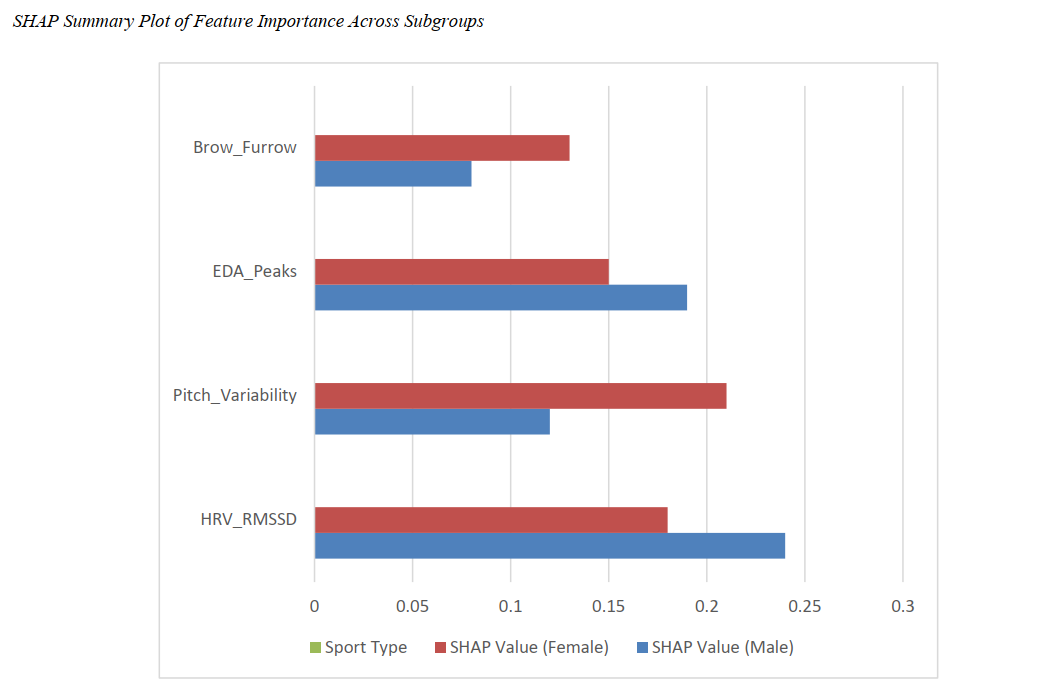
This study aimed to develop and validate an artificial intelligence (AI) framework for monitoring athletes' mental states, addressing critical gaps in traditional assessment methods through advanced machine learning techniques. A mixed-methods longitudinal design was employed with 128 elite athletes, integrating multimodal data streams including physiological (Empatica E4, Polar H10), psychological (APSQ, CAT-MH), and behavioral (facial/voice analysis) measures. A hybrid ensemble model combining Temporal Convolutional Networks with multimodal fusion and explainable AI components was developed and validated through controlled stress induction protocols and ecological momentary assessments over 12 weeks. The AI model demonstrated superior performance (84.7% accuracy) in classifying mental states compared to unimodal approaches, identifying distinct stress phenotypes with differential intervention needs. Real-time feedback reduced acute stress duration by 42.3%, while subgroup analyses revealed gender- and sport-specific stress signatures. The system detected subclinical stress 6.7 minutes before athlete self-report, with strong validation against clinician ratings (κ=0.78) and biochemical markers (cortisol r=0.69). This research establishes that carefully designed AI systems can overcome limitations of conventional athlete mental health monitoring, providing sensitive, actionable insights while maintaining ethical standards. The framework offers sports medicine professionals a transformative tool for early intervention and personalized psychological support, representing a significant advancement in sports science with immediate practical applications. Future work should explore longitudinal implementation across diverse athletic populations.
Downloads
References
Anderson, T., Adams, W. M., Bartley, J. D., Brutus, A. L., Donaldson, A. T., & Finnoff, J. T. (2023). Analysis of the Sport Mental Health Assessment Tool 1 (SMHAT-1) in Team USA athletes. British Journal of Sports Medicine, 57(18), 1187-1194. https://doi.org/10.1136/bjsports-2022-106495
Assalve, G., Lunetti, P., Di Cagno, A., De Luca, E. W., Aldegheri, S., Zara, V., & Ferramosca, A. (2024). Advanced Wearable Devices for Monitoring Sweat Biochemical Markers in Athletic Performance: A Comprehensive Review. Biosensors, 14(12), 574. https://doi.org/10.3390/bios14120574
Balcombe, L., & De Leo, D. (2020). Psychological Screening and Tracking of Athletes and Digital Mental Health Solutions in a Hybrid Model of Care: Mini Review. Jmir Formative Research, 4(12), e22755. https://doi.org/10.2196/22755
Ben Ezzdine, L., Dhahbi, W., Dergaa, I., Ceylan, H. I., Guelmami, N., Ben Saad, H., Chamari, K., Stefanica, V., & El Omri, A. (2025). Physical activity and neuroplasticity in neurodegenerative disorders: a comprehensive review of exercise interventions, cognitive training, and AI applications. Frontiers in Neuroscience, 19, 1502417. https://doi.org/10.3389/fnins.2025.1502417
Biró, A., Cuesta-Vargas, A. I., & Szilágyi, L. (2023). AI-Assisted Fatigue and Stamina Control for Performance Sports on IMU-Generated Multivariate Times Series Datasets. Sensors (Basel, Switzerland), 24(1), 132. https://doi.org/10.3390/s24010132
Cheng, Y., Liang, X., Xu, Y., & Kuang, X. (2022). Artificial Intelligence Technology in Basketball Training Action Recognition. Frontiers in Neurorobotics, 16, 819784. https://doi.org/10.3389/fnbot.2022.819784
Chin, J. H., Do, C., & Kim, M. (2022). How to Increase Sport Facility Users' Intention to Use AI Fitness Services: Based on the Technology Adoption Model. International journal of environmental research and public health, 19(21), 14453. https://doi.org/10.3390/ijerph192114453
Claussen, M. C., Currie, A., Koh Boon Yau, E., Nishida, M., Martínez, V., Burger, J., Creado, S., Schorb, A., Nicola, R. F., Pattojoshi, A., Menon, R., Glick, I., Whitehead, J., Edwards, C., & Baron, D. (2024). First international consensus statement on sports psychiatry. Scandinavian Journal of Medicine & Science in Sports, 34(4), e14627. https://doi.org/10.1111/sms.14627
Cohen, S., & Hamrick, N. (2003). Stable individual differences in physiological response to stressors: implications for stress-elicited changes in immune related health. Brain, behavior, and immunity, 17(6), 407-414. https://doi.org/10.1016/s0889-1591(03)00110-7
Dindorf, C., Dully, J., Bartaguiz, E., Menges, T., Reidick, C., Seibert, J. N., & Fröhlich, M. (2025). Characteristics and perceived suitability of artificial intelligence-driven sports coaches: a pilot study on psychological and perceptual factors. Frontiers in Sports and Active Living, 7, 1548980. https://doi.org/10.3389/fspor.2025.1548980
Fabbrizio, A., Fucarino, A., Cantoia, M., De Giorgio, A., Garrido, N. D., Iuliano, E., Reis, V. M., Sausa, M., Vilaça-Alves, J., Zimatore, G., Baldari, C., & Macaluso, F. (2023). Smart Devices for Health and Wellness Applied to Tele-Exercise: An Overview of New Trends and Technologies Such as IoT and AI. Healthcare (Basel, Switzerland), 11(12), 1805. https://doi.org/10.3390/healthcare11121805
Farhud, D. D., & Zokaei, S. (2021). Ethical Issues of Artificial Intelligence in Medicine and Healthcare. Iranian Journal of Public Health, 50(11), i-v. https://doi.org/10.18502/ijph.v50i11.7600
Giles, S., Fletcher, D., Arnold, R., Ashfield, A., & Harrison, J. (2020). Measuring Well-Being in Sport Performers: Where are We Now and How do we Progress? Sports medicine (Auckland, N.Z.), 50(7), 1255-1270. https://doi.org/10.1007/s40279-020-01274-z
Gkintoni, E., Antonopoulou, H., Sortwell, A., & Halkiopoulos, C. (2025). Challenging Cognitive Load Theory: The Role of Educational Neuroscience and Artificial Intelligence in Redefining Learning Efficacy. Brain Sciences, 15(2), 203. https://doi.org/10.3390/brainsci15020203
Gouttebarge, V., Bindra, A., Blauwet, C., Campriani, N., Currie, A., Engebretsen, L., Hainline, B., Kroshus, E., McDuff, D., Mountjoy, M., Purcell, R., Putukian, M., Reardon, C. L., Rice, S. M., & Budgett, R. (2021). International Olympic Committee (IOC) Sport Mental Health Assessment Tool 1 (SMHAT-1) and Sport Mental Health Recognition Tool 1 (SMHRT-1): towards better support of athletes' mental health. British Journal of Sports Medicine, 55(1), 30-37. https://doi.org/10.1136/bjsports-2020-102411
Hammes, F., Hagg, A., Asteroth, A., & Link, D. (2022). Artificial Intelligence in Elite Sports-A Narrative Review of Success Stories and Challenges. Frontiers in Sports and Active Living, 4, 861466. https://doi.org/10.3389/fspor.2022.861466
Hilal Yagin, F., Kelmann, M., Impelizzeri, F., & Badri Al-Mhann, S. (2025). Machine Learning-Driven Prediction and Personalized Intervention for Athlete Burnout: Integrating Biometric and Psychological Markers. Functional Research in Sport Psychology, 2(3), 63-76. https://doi.org/10.22091/frs.2025.13436.1085
Huhn, S., Axt, M., Gunga, H. C., Maggioni, M. A., Munga, S., Obor, D., Sié, A., Boudo, V., Bunker, A., Sauerborn, R., Bärnighausen, T., & Barteit, S. (2022). The Impact of Wearable Technologies in Health Research: Scoping Review. Jmir Mhealth and Uhealth, 10(1), e34384. https://doi.org/10.2196/34384
Jeon, T., Bae, H. B., Lee, Y., Jang, S., & Lee, S. (2021). Deep-Learning-Based Stress Recognition with Spatial-Temporal Facial Information. Sensors, 21(22), 7498. https://doi.org/10.3390/s21227498
Khoo, L. S., Lim, M. K., Chong, C. Y., & McNaney, R. (2024). Machine Learning for Multimodal Mental Health Detection: A Systematic Review of Passive Sensing Approaches. Sensors, 24(2), 348. https://doi.org/10.3390/s24020348
Kim, J. H., Kim, J., Kang, H., & Youn, B. Y. (2025). Ethical implications of artificial intelligence in sport: A systematic scoping review. Journal of sport and health science, 14, 101047. https://doi.org/10.1016/j.jshs.2025.101047
Kong, Y., & Duan, Z. (2024). Boxing behavior recognition based on artificial intelligence convolutional neural network with sports psychology assistant. Scientific reports, 14(1), 7640. https://doi.org/10.1038/s41598-024-58518-5
Larsen, E., Murton, O., Song, X., Joachim, D., Watts, D., Kapczinski, F., Venesky, L., & Hurowitz, G. (2024). Validating the efficacy and value proposition of mental fitness vocal biomarkers in a psychiatric population: prospective cohort study. Frontiers in Psychiatry, 15, 1342835. https://doi.org/10.3389/fpsyt.2024.1342835
Maccaro, A., Stokes, K., Statham, L., He, L., Williams, A., Pecchia, L., & Piaggio, D. (2024). Clearing the Fog: A Scoping Literature Review on the Ethical Issues Surrounding Artificial Intelligence-Based Medical Devices. Journal of Personalized Medicine, 14(5), 443. https://doi.org/10.3390/jpm14050443
Migliaccio, G. M., Padulo, J., & Russo, L. (2024). The Impact of Wearable Technologies on Marginal Gains in Sports Performance: An Integrative Overview on Advances in Sports, Exercise, and Health. Applied Sciences, 14(15), 6649. https://doi.org/10.3390/app14156649
Munoz-Macho, A. A., Domínguez-Morales, M. J., & Sevillano-Ramos, J. L. (2024). Performance and healthcare analysis in elite sports teams using artificial intelligence: a scoping review. Frontiers in Sports and Active Living, 6, 1383723. https://doi.org/10.3389/fspor.2024.1383723
Oguro, S., Ojio, Y., Matsunaga, A., Shiozawa, T., Kawamura, S., Yoshitani, G., Horiguchi, M., & Fujii, C. (2023). Mental health help-seeking preferences and behaviour in elite male rugby players. BMJ Open Sport & Exercise Medicine, 9(2), e001586. https://doi.org/10.1136/bmjsem-2023-001586
Patil, S. A., & Paithane, A. N. (2025). AI-Driven Multimodal Stress Detection: A Comparative Study. Biomed Pharmacol J, 18(March Spl Edition). https://bit.ly/4hSwsAj
Pickering, C., & Kiely, J. (2019). The Development of a Personalised Training Framework: Implementation of Emerging Technologies for Performance. Journal of Functional Morphology and Kinesiology, 4(2), 25. https://doi.org/10.3390/jfmk4020025
Pinge, A., Gad, V., Jaisighani, D., Ghosh, S., & Sen, S. (2024). Detection and monitoring of stress using wearables: a systematic review. Frontiers in Computer Science, 6, 1478851. https://doi.org/10.3389/fcomp.2024.1478851
Rakhmatulin, I., Dao, M. S., Nassibi, A., & Mandic, D. (2024). Exploring Convolutional Neural Network Architectures for EEG Feature Extraction. Sensors, 24(3), 877. https://doi.org/10.3390/s24030877
Reardon, C. L., Hainline, B., Aron, C. M., & et al. (2019). Mental health in elite athletes: International Olympic Committee consensus statement (2019). British Journal of Sports Medicine, 53, 667-699.
Rice, S. M., Gwyther, K., Santesteban-Echarri, O., Baron, D., Gorczynski, P., Gouttebarge, V., Reardon, C. L., Hitchcock, M. E., Hainline, B., & Purcell, R. (2019). Determinants of anxiety in elite athletes: a systematic review and meta-analysis. British Journal of Sports Medicine, 53(11), 722-730. https://doi.org/10.1136/bjsports-2019-100620
Rice, S. M., Parker, A. G., Mawren, D., Clifton, P., Harcourt, P., Lloyd, M., Kountouris, A., Smith, B., McGorry, P. D., & Purcell, R. (2020). Preliminary psychometric validation of a brief screening tool for athlete mental health among male elite athletes: the Athlete Psychological Strain Questionnaire. International Journal of Sport and Exercise Psychology, 18(6), 850-865. https://doi.org/10.1080/1612197X.2019.1611900
Rice, S. M., Purcell, R., De Silva, S., Mawren, D., McGorry, P. D., & Parker, A. G. (2016). The Mental Health of Elite Athletes: A Narrative Systematic Review. Sports medicine (Auckland, N.Z.), 46(9), 1333-1353. https://doi.org/10.1007/s40279-016-0492-2
Rudin, C. (2019). Stop Explaining Black Box Machine Learning Models for High Stakes Decisions and Use Interpretable Models Instead. Nature Machine Intelligence, 1(5), 206-215. https://doi.org/10.1038/s42256-019-0048-x
Schoenmakers, M., Saygin, M., Sikora, M., Vaessen, T., Noordzij, M., & de Geus, E. (2025). Stress in action wearables database: A database of noninvasive wearable monitors with systematic technical, reliability, validity, and usability information. Behavior Research Methods, 57(6), 171. https://doi.org/10.3758/s13428-025-02685-4
Schuurmans, A. A. T., de Looff, P., Nijhof, K. S., Rosada, C., Scholte, R. H. J., Popma, A., & Otten, R. (2020). Validity of the Empatica E4 Wristband to Measure Heart Rate Variability (HRV) Parameters: a Comparison to Electrocardiography (ECG). Journal of Medical Systems, 44(11), 190. https://doi.org/10.1007/s10916-020-01648-w
Shannon, S., Hanna, D., Haughey, T., Leavey, G., McGeown, C., & Breslin, G. (2019). Effects of a Mental Health Intervention in Athletes: Applying Self-Determination Theory. Frontiers in psychology, 10, 1875. https://doi.org/10.3389/fpsyg.2019.01875
Sore, K., Franic, F., Androja, L., Batarelo Kokic, I., Marčinko, D., Drmic, S., Markser, Z. V., & Franic, T. (2024). Translation, Cross-Cultural Adaptation, and Validation of the Croatian Version of the Athlete Psychological Strain Questionnaire (APSQ). Sports (Basel, Switzerland), 12(8), 228. https://doi.org/10.3390/sports12080228
Tomé-Lourido, D., Ponte, D., Sampedro, M. J., & Arce, C. (2023). Pandemic Impacts on Athlete Competitive Anxiety and Its Relationship with Sex, Competitive Level and Emotional Self-Control: A Cohort Study before and after COVID-19. Sustainability, 15(12), 9315. https://doi.org/10.3390/su15129315
Tu, Z., Jeffries, S. D., Morse, J., & Hemmerling, T. M. (2025). Comparison of time-series models for predicting physiological metrics under sedation. Journal of Clinical Monitoring and Computing, 39(3), 595-605. https://doi.org/10.1007/s10877-024-01237-z
Vos, G., Trinh, K., Sarnyai, Z., & Rahimi Azghadi, M. (2023). Generalizable machine learning for stress monitoring from wearable devices: A systematic literature review. International Journal of Medical Informatics, 173, 105026. https://doi.org/10.1016/j.ijmedinf.2023.105026
Xiang, J. Z., Wang, Q. Y., Fang, Z. B., Esquivel, J. A., & Su, Z. X. (2025). A multi-modal deep learning approach for stress detection using physiological signals: integrating time and frequency domain features. Frontiers in Physiology, 16, 1584299. https://doi.org/10.3389/fphys.2025.1584299
Yang, W., Wang, S., Cui, H., Tang, Z., & Li, Y. (2023). A Review of Homomorphic Encryption for Privacy-Preserving Biometrics. Sensors, 23(7), 3566. https://doi.org/10.3390/s23073566
Zhang, X., Lin, Z., & Gu, S. (2025). A machine learning model the prediction of athlete engagement based on cohesion, passion and mental toughness. Scientific reports, 15(1), 3220. https://doi.org/10.1038/s41598-025-87794-y
Zhou, Y., Lu, W., & Zhang, Y. (2022). Distributed Intelligent Learning and Decision Model Based on Logic Predictive Control. Computational Intelligence and Neuroscience, 2022, 6431776. https://doi.org/10.1155/2022/6431776
Downloads
Additional Files
Publication Timeline
Issue
Section
License
Copyright (c) 2024 Dr. Georgian Badicu (Corresponding Author); Dr. Rui Miguel Silva (Author)

This work is licensed under a Creative Commons Attribution-NonCommercial 4.0 International License.