Sports Communication Using Transformative Engagement Theory: The Impact of Virtual Reality Technology
DOI:
https://doi.org/10.61838/kman.aitech.4377Keywords:
Virtual Reality, Metaverse, Immersive Experiences, Fan Engagement, Athletic Training, Sports Marketing, Digital TransformationAbstract
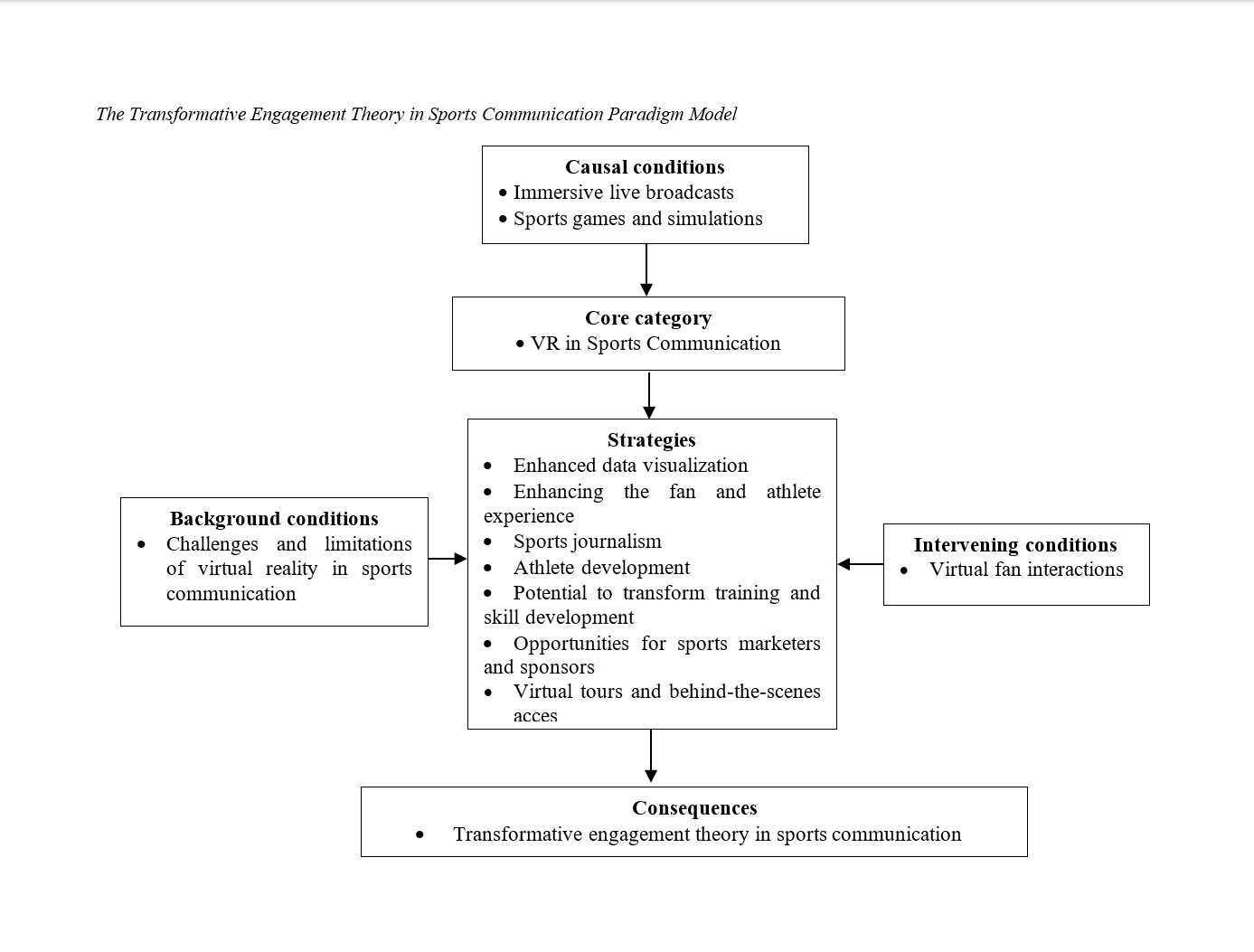
The advent of virtual reality (VR) technology is poised to bring about a notable change in the sports communication environment, as it presents a unique opportunity to revolutionize traditional communication methods by immersing participants in realistic and interactive settings. The purpose of this study is to look into how VR technology is changing sports communication. Through a thorough grounded theory (GT) inquiry, this study explores the potential benefits, drawbacks, opportunities, and difficulties of integrating VR into sports communication. The study uses qualitative analysis with MAXQDATM20 software, which includes interviews with 17 prominent sports experts and a thorough coding process. The study found that VR greatly enhances communication abilities by fostering dynamic and engaging surroundings. Additionally, VR can assist in creating creative marketing techniques and strengthen ties between athletes, fans, and organizations. Finally, in light of these findings, we developed a new theoretical framework called "Transformative Engagement Theory in Sports Communication." The novel contribution of this study is the proposition of the Transformative Engagement Theory in Sports Communication. The study provides a thorough grasp of the complex interactions between VR technologies and the dynamics of sports communication, as well as a road map for professionals in sports management, stakeholders, and researchers to navigate this revolutionary change successfully.
Downloads
References
Abich IV, J., Parker, J., Murphy, J. S., & Eudy, M. (2021). A review of the evidence for training effectiveness with virtual reality technology. Virtual Reality, 25(4), 919-933. https://doi.org/10.1007/s10055-020-00498-8
Aburumman, N., Gillies, M., Ward, J. A., & Hamilton, A. F. d. C. (2022). Nonverbal communication in virtual reality: Nodding as a social signal in virtual interactions. International Journal of Human-Computer Studies, 164, 102819. https://doi.org/10.1016/j.ijhcs.2022.102819
Ahir, K., Govani, K., Gajera, R., & Shah, M. (2020). Application on virtual reality for enhanced education learning, military training and sports. Augmented Human Research, 5, 1-9. https://doi.org/10.1007/s41133-019-0025-2
Alcañiz, M., Bigné, E., & Guixeres, J. (2019). Virtual reality in marketing: a framework, review, and research agenda. Frontiers in psychology, 10, 1530. https://doi.org/10.3389/fpsyg.2019.01530
Babbie, E. (2002). The Basics of Social Science Research, 2e. Wadsworth, Belmont, California, 461 (2, illustrated)
Baca, A., & Perl, J. (2019). Modelling and simulation in sport and exercise. Routledge.
Bailenson, J. (2018). Experience on demand: What virtual reality is, how it works, and what it can do. WW Norton & Company.
Bernard, H. R. (2017). Research methods in anthropology: Qualitative and quantitative approaches. Rowman & Littlefield.
Biocca, F., & Delaney, B. (1995). Immersive virtual reality technology. Communication in the age of virtual reality, 15(32), 10-5555.
Blumler, J. G., & Katz, E. (1974). The Uses of Mass Communications: Current Perspectives on Gratifications Research. Sage Annual Reviews of Communication Research Volume III.
Boddy, C. R. (2016). Sample size for qualitative research. Qualitative market research: An international journal, 19(4), 426-432. https://doi.org/10.1108/QMR-06-2016-0053
Boroumand, M. R., Pourkiani, M., & Afrouzeh, A. (2021). Creating telepresence and flow experience through virtual reality (VR) technology and their impact on brand attitude and purchase intentions of sport products customers. Sport Management and Development, 10(2), 182-197. https://doi.org/ 10.22124/jsmd.2021.5053
Bryant, L., Brunner, M., & Hemsley, B. (2019). A review of virtual reality technologies in the field of communication disability: implications for practice and research. Disability and Rehabilitation: Assistive Technology. https://doi.org/10.1080/17483107.2018.1549276
Chang, E., Kim, H. T., & Yoo, B. (2020). Virtual reality sickness: a review of causes and measurements. International Journal of Human–Computer Interaction, 36(17), 1658-1682. https://doi.org/10.1080/10447318.2020.1778351
Charmaz, K. (2014). Constructing grounded theory. In: sage.
Cheung, M. L., Leung, W. K., Chang, L. M. K., Aw, E. C.-X., & Wong, R. Y. (2024). Immersive time in the metaverse and visits to the physical world: why not both? A holistic customer engagement framework. International Journal of Contemporary Hospitality Management, 36(11), 3674-3703. https://doi.org/10.1108/IJCHM-07-2023-0999
Cohen, A. (2023). NBA signs multi-year virtual reality partnership extension with Meta. ahead-of-print. https://www.sportsbusinessjournal.com/Daily/Issues/2023/01/23/Technology/nba-meta-virtual-reality.aspx
Coleman, P. (2022). Validity and reliability within qualitative research for the caring sciences. International Journal of Caring Sciences, 14(3), 2041-2045.
Cook, M., Lischer-Katz, Z., Hall, N., Hardesty, J., Johnson, J., McDonald, R., & Carlisle, T. (2019). Challenges and strategies for educational virtual reality: Results of an expert-led forum on 3D/VR technologies across academic institutions. Information Technology and Libraries, 38(4), 25-48. https://doi.org/10.6017/ital.v38i4.11075
Corbin, J., & Strauss, A. (1990). Grounded theory research: Procedures, canons, and evaluative criteria. Qualitative sociology, 13(1), 3-21. https://doi.org/10.1007/BF00988593
Corbin, J., & Strauss, A. (2015). Basics of qualitative research (Vol. 14). SAGE Publications, Inc. https://doi.org/10.4135/9781452230153
Creswell, J. W. (2015). Educational research: Planning, conducting, and evaluating quantitative and qualitative research. pearson.
Creswell, J. W., & Clark, V. L. P. (2017). Designing and conducting mixed methods research. Sage publications.
Creswell, J. W., & Poth, C. N. (2016). Qualitative inquiry and research design: Choosing among five approaches. Sage publications. https://scholar.google.com/scholar?q=related:Fs7-7HJYX2sJ:scholar.google.com/&scioq=Qualitative+inquiry+and+research+design:+choosing+among+five+approaches+including+narrative+research&hl=en&as_sdt=0,5
Daft, R. L., & Lengel, R. H. (1984). Information richness: A new approach to managerial behavior and organizational design. Research in organizational behavior.
Danaeifard, H., Alvani, S. M., & Azar, A. (2004). Qualitative research methodology in management: a comprehensive approach. Tehran: Saffar Pub.
Davis, F. D. (1989). Technology acceptance model: TAM. Al-Suqri, MN, Al-Aufi, AS: Information Seeking Behavior and Technology Adoption, 205(219), 5.
Faghir Ganji, M., Keshkar, S., Honari, H., & Shahlaei, J. (2021). Qualitative pattern of virtual reality application in sports marketing. Sports Marketing Studies, 2(4), 1-34.
Feiz, D., Asgharinajib, M., Alipour, S., & Maleki Minbashrazgah, M. (2022). The effectiveness of virtual reality-based advertising in creating a customer empathy map using the video hermeneutic method: A case study of Ramak Company. Journal of Business Administration Researches, 14(29), 181-212. https://doi.org/10.22034/jbar.2023.16599.3976
Flavián, C., Ibáñez-Sánchez, S., & Orús, C. (2019). The impact of virtual, augmented and mixed reality technologies on the customer experience. Journal of business research, 100, 547-560. https://doi.org/10.1016/j.jbusres.2018.10.050
Gall, M., Borg, W., & Gall, J. (2016). Quantitative and qualitative research methods in educational sciences and psychology. Translated by Ahmad Reza Nasr, et al, 1398(11).
Greengard, S. (2019). Virtual reality. Mit Press.
Ha, J.-P., Kang, S. J., & Kim, Y. (2017). Sport fans in a “smart sport” (SS) age: drivers of smartphone use for sport consumption. International Journal of Sports Marketing and Sponsorship, 18(3), 281-297. https://doi.org/10.1108/IJSMS-08-2017-093
Hajli, N. (2025). Exploring fan engagement and value co-creation in virtual sport communities: A comparative study of virtual sport communities over time. Technological Forecasting and Social Change, 212, 123934. https://doi.org/10.1016/j.techfore.2024.123934
Hoyer, W. D., Kroschke, M., Schmitt, B., Kraume, K., & Shankar, V. (2020). Transforming the customer experience through new technologies. Journal of interactive marketing, 51(1), 57-71. https://doi.org/10.1016/j.intmar.2020.04.001
Huang, Q., & Wang, F. (2021). VR Technology on the Communication of Sports Culture in Chinese Universities. The Sixth International Conference on Information Management and Technology,
Ishii, K., Lyons, M. M., & Carr, S. A. (2019). Revisiting media richness theory for today and future. Human behavior and emerging technologies, 1(2), 124-131. https://doi.org/10.1002/hbe2.138
Jiang, K., & Phakdeephirot, N. (2024). The Impact of Digital Media on Sports Management. Academic Journal of Science and Technology, 10(3), 208-213. https://doi.org/10.54097/x2xxah70
Kassing, J. W., Billings, A. C., Brown, R. S., Halone, K. K., Harrison, K., Krizek, B., Mean, L. J., & Turman, P. D. (2004). Communication in the community of sport: The process of enacting,(re) producing, consuming, and organizing sport. Annals of the international communication Association, 28(1), 373-409. https://doi.org/10.1080/23808985.2004.11679040
Kiani, M. S. (2024). An in-depth look at the future of sports with artificial intelligence, virtual reality, and data visualization to improve athlete performance analysis. Intelligent Knowledge Exploration and Processing, 4(12), 1. https://doi.org/10.30508/kdip.2024.451951.1100
Kim, D., & Ko, Y. J. (2019). The impact of virtual reality (VR) technology on sport spectators' flow experience and satisfaction. Computers in human Behavior, 93, 346-356. https://doi.org/10.1016/j.chb.2018.12.040
Kittel, A., Larkin, P., Elsworthy, N., Lindsay, R., & Spittle, M. (2020). Effectiveness of 360 virtual reality and match broadcast video to improve decision-making skill. Science and Medicine in Football, 4(4), 255-262. https://doi.org/10.1080/24733938.2020.1754449
Lee, H.-G., Chung, S., & Lee, W.-H. (2013). Presence in virtual golf simulators: The effects of presence on perceived enjoyment, perceived value, and behavioral intention. New media & society, 15(6), 930-946.
Li, C., & Li, Y. (2020). Feasibility analysis of vr technology in physical education and sports training. IEEE Access. https://doi.org/10.1109/ACCESS.2020.3020842
Li, J. (2022). Grounded theory-based model of the influence of digital communication on handicraft intangible cultural heritage. Heritage Science, 10(1), 126. https://doi.org/10.1186/s40494-022-00760-z
Liao, T. (2018). Mobile versus headworn augmented reality: How visions of the future shape, contest, and stabilize an emerging technology. New Media & Society, 20(2), 796-814. https://doi.org/10.1177/1461444816672019
Lin, L.-P., Huang, S.-C., & Ho, Y.-C. (2020). Could virtual reality effectively market slow travel in a heritage destination? Tourism Management, 78, 104027. https://doi.org/https://doi.org/10.1016/j.tourman.2019.104027
Lombard, M., & Ditton, T. (1997). At the heart of it all: The concept of presence. Journal of computer-mediated communication, 3(2), JCMC321. https://doi.org/10.1111/j.1083-6101.1997.tb00072.x
López Carril, S., Villamón Herrera, M., & McBride, S. (2020). Embracing social media in sport management education: perspectives for its use in the classroom. Journal of Physical Education and Sport, 2020, vol. 20, num. 6, p. 3706-3712.
Loureiro, S. M. C., Guerreiro, J., & Ali, F. (2020). 20 years of research on virtual reality and augmented reality in tourism context: A text-mining approach. Tourism Management, 77, 104028. https://doi.org/https://doi.org/10.1016/j.tourman.2019.104028
Markowitz, D., & Bailenson, J. (2019). Virtual reality and communication. Human Communication Research, 34, 287-318. https://doi.org/10.1007/978-3-030-50801-2_15
Martín-Gutiérrez, J., Mora, C. E., Añorbe-Díaz, B., & González-Marrero, A. (2017). Virtual technologies trends in education. Eurasia journal of mathematics, science and technology education, 13(2), 469-486.
Meier, A. A. (2015). The ever-evolving landscape in sports communication: gaining insights from collegiate athletics Kansas State University].
Miah, A., Fenton, A., & Chadwick, S. (2020). Virtual Reality and Sports: The Rise of Mixed, Augmented, Immersive, and Esports Experiences. In S. L. Schmidt (Ed.), 21st Century Sports: How Technologies Will Change Sports in the Digital Age (pp. 249-262). Springer International Publishing. https://doi.org/10.1007/978-3-030-50801-2_15
Miles, H. C., Pop, S. R., Watt, S. J., Lawrence, G. P., & John, N. W. (2012). A review of virtual environments for training in ball sports. Computers & Graphics, 36(6), 714-726. https://doi.org/https://doi.org/10.1016/j.cag.2012.04.007
Morimoto, T., Kobayashi, T., Hirata, H., Otani, K., Sugimoto, M., Tsukamoto, M., Yoshihara, T., Ueno, M., & Mawatari, M. (2022). XR (extended reality: virtual reality, augmented reality, mixed reality) technology in spine medicine: status quo and quo vadis. Journal of Clinical Medicine, 11(2), 470. https://doi.org/10.3390/jcm11020470
Mueller, A. (2024). How New Technology in Sports Impacts Fan Engagement Texas Christian University]. Texas
Muhanna, M. A. (2015). Virtual reality and the CAVE: Taxonomy, interaction challenges and research directions. Journal of King Saud University-Computer and Information Sciences, 27(3), 344-361. https://doi.org/10.1016/j.jksuci.2014.03.023
Park, K., Koo, G.-Y., Kim, M., & Kim, S. (2024). Consumer adoption of virtual reality for spectator sport: an adopter categorization based on the diffusion of innovation and uses and gratification theories. International Journal of Sports Marketing and Sponsorship, ahead-of-print. https://doi.org/10.1108/IJSMS-04-2023-0059
Parveen, F., Jaafar, N. I., & Ainin, S. (2015). Social media usage and organizational performance: Reflections of Malaysian social media managers. Telematics and informatics, 32(1), 67-78. https://doi.org/10.1016/j.tele.2014.03.001
Pashaie, S., Abbaszadeh, M., Abdavi, F., & Golmohammadi, H. (2023). Improving the Validity of Mixed and Multi-Methods through Triangulation in New Sports Management Research. Research in Sport Management and Marketing, 4(2), 16-27. https://doi.org/10.22098/RSMM.2023.12593.1216
Pashaie, S., Dickson, G., Abdavi, F., Badri Azarin, Y., Golmohammadi, H., Zheng, J., & Habibpour, R. (2023). Football and the Video Assistant Referee: A Grounded Theory Approach. Proceedings of the Institution of Mechanical Engineers, Part P: Journal of Sports Engineering and Technology, OnlineFirst 1-12. https://doi.org/10.1177/17543371231213739
Pashaie, S., & Golmohammadi, H. (2024). Exploring the Influence of E-CRM on the innovation capabilities of sports venues: The moderating role of covid-19. Sports Marketing Studies, 4(3), 108-128. https://doi.org/10.22034/sms.2024.139773.1253
Pashaie, S., Mohammadi, S., & Golmohammadi, H. (2024). Unlocking Athlete Potential: The Evolution of Coaching Strategies through Artificial Intelligence. Proc IMechE Part P: J Sports Engineering and Technology, Articles in Press, 1-20. https://doi.org/10.1177/17543371241300889
Patton, M. Q. (2002). Qualitative research and evaluation methods. Thousand Oaks. Cal.: Sage Publications, 4.
Pavlik, J. V., & Bridges, F. (2013). The emergence of augmented reality (AR) as a storytelling medium in journalism. Journalism & communication monographs, 15(1), 4-59. https://doi.org/10.1177/1522637912470819
Pedersen, P. M., Laucella, P., Geurin, A., & Kian, E. (2020). Strategic sport communication. Human Kinetics Publishers.
Richlan, F., Weiß, M., Kastner, P., & Braid, J. (2023). Virtual training, real effects: A narrative review on sports performance enhancement through interventions in virtual reality. Frontiers in Psychology, 14, 1240790. https://doi.org/10.3389/fpsyg.2023.1240790
Roulston, K. (2010). Considering quality in qualitative interviewing. Qualitative research, 10(2), 199-228. https://doi.org/10.1177/1468794109356739
Seale, C. (1999). The quality of qualitative research. Sage Publications, Inc, 5(4), 478.
Sichach, M. (2023). Uses and Gratifications Theory-Background, History and Limitations. History and Limitations (November 17, 2023), 11. https://doi.org/10.2139/ssrn.4729248
Singh, K. (2015). The study of key factors resistance to change when adoption of new technologies in the companies. https://doi.org/123456789/1796
Thatcher, B., Ivanov, G., Szerovay, M., & Mills, G. (2020). Virtual reality technology in football coaching: barriers and opportunities. International Sport Coaching Journal, 8(2), 234-243. https://doi.org/10.1123/iscj.2020-0011
Vincent, A., & Frewen, P. (2023). Being where, with whom, and when it happens: spatial, interpersonal, and temporal presence while viewing live streaming of collegiate sports in virtual reality. Frontiers in Virtual Reality, 4, 1167051. https://doi.org/10.3389/frvir.2023.1167051
Wen, J., & Gheisari, M. (2020). Using virtual reality to facilitate communication in the AEC domain: A systematic review. Construction Innovation, 20(3), 509-542. https://doi.org/10.1108/CI-11-2019-0122
Wu, C.-W., Shieh, M.-D., Lien, J.-J. J., Yang, J.-F., Chu, W.-T., Huang, T.-H., Hsieh, H.-C., Chiu, H.-T., Tu, K.-C., & Chen, Y.-T. (2022). Enhancing fan engagement in a 5G stadium with AI-based technologies and live streaming. IEEE Systems Journal, 16(4), 6590-6601. https://doi.org/10.1109/JSYST.2022.3169553
Wu, F. (2021). Construction of Digital Dynamic Sports System Platform Based on VR Technology. 2021 2nd International Conference on Computers, Information Processing and Advanced Education, Ottawa ON Canada
Zhang, J., Zhang, D., & Dai, G. (2024). Mechanisms of Emotional Experiences of Online Spectators of E-Sports Events From the Perspective of Interactive Ritual Chain. Communication & Sport, 12(6), 1054-1074. https://doi.org/10.1177/21674795241227771
Downloads
Additional Files
Publication Timeline
- Submitted
- Revised
- Accepted
Issue
Section
License
Copyright (c) 2024 Sajjad Pashaie , Timothy Jung, Hamed Golmohammadi, Zühal Yurtsizoglu, Javad Karimi (Author)

This work is licensed under a Creative Commons Attribution-NonCommercial 4.0 International License.