Designing a Meta-Synthesis Model of Smartization of the Value Chain with an Industry 4.0 approach
DOI:
https://doi.org/10.61838/kman.aitech.4483Keywords:
Fourth Industrial Revolution, , Value Chain, Meta-Synthesis Model, SmartizationAbstract
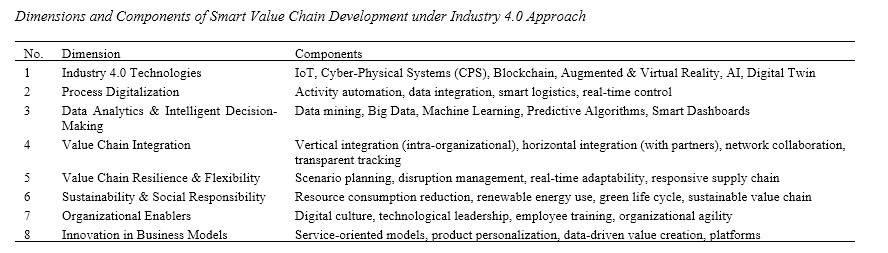
In the era of the Fourth Industrial Revolution, organizations are compelled to redesign their value chains with a smart and technology-oriented approach. This transformation requires the precise identification of the dimensions and components influencing the smartization of value chains. The aim of this study is to develop a meta-synthesis model that reflects the transformative perspective of smart value chain development in the context of Industry 4.0. The innovation and novelty of the present study lie in its introduction of smart value chain management within the context of the Fourth Industrial Revolution, exploring new and practical models for optimizing supply chain processes and enhancing organizational efficiency. The research is grounded in an interpretivist paradigm and employs the meta-synthesis method to identify a localized framework for value chain smartization. The statistical population consists of academic resources obtained through a systematic search of reputable databases, based on inclusion and exclusion criteria such as relevance, quality, and publication year. All credible scientific documents published between 2018 and 2025 that address the paradigms of smart value chains and the Fourth Industrial Revolution were reviewed. Initially, 153 articles were extracted from reputable databases such as ScienceDirect, Emerald, Sage, Taylor & Francis, and others. After screening titles and abstracts, 38 relevant articles (including 18 literature reviews and 20 empirical studies) were selected and analyzed from the Web of Science database. Structural summaries of these articles led to the identification of broader thematic categories. The findings highlight three key thematic areas linked to smart value chains and Industry 4.0. Through the meta-synthesis approach, eight dimensions and 35 components were extracted: Industry 4.0 technologies, process digitalization, data analytics and intelligent decision-making, value chain integration, resilience and agility, sustainability and social responsibility, organizational empowerment, and business model innovation. The results of this study can provide a strategic roadmap for managers, policymakers, and digital transformation designers across various industries and offer a solid theoretical foundation for future research.
Downloads
References
Alhawamdeh, M., & Lee, A. (2024). A systematic review and meta-synthesis of the barriers of offsite construction projects. International Journal of Construction Management, 1-13. https://doi.org/10.1080/15623599.2024.2397287
Anshari, M., Syafrudin, M., & Fitriyani, N. L. (2022). Fourth Industrial Revolution between Knowledge Management and Digital Humanities. Information, 13, 292. https://doi.org/10.3390/info13060292
Apel, C., Kümmerer, K., Sudheshwar, A., Nowack, B., Som, C., Colin, C., & Soeteman-Hernández, L. G. (2024). Safe-and-sustainable-by-design: State of the art approaches and lessons learned from value chain perspectives. Current Opinion in Green and Sustainable Chemistry, 45, 100876. https://doi.org/10.1016/j.cogsc.2023.100876
Bai, C., Dallasega, P., Orzes, G., & Sarkis, J. (2020). Industry 4.0 technologies assessment: a sustainability perspective. International Journal of Production Economics, 229, 107776. https://doi.org/10.1016/j.ijpe.2020.107776
Barbosa, A. M. C., & Saisse, M. C. P. (2019). Hybrid project management for sociotechnical digital transformation context. Brazilian Journal of Operations & Production Management, 16(2), 316-332. https://doi.org/10.14488/BJOPM.2019.v16.n2.a12
Barbosa, G. F., Shiki, S. B., & da Silva, I. B. (2020). R&D roadmap for process robotization driven to the digital transformation of the industry 4.0. Concurrent Engineering, Research and Applications, 28(4), 290-304. https://doi.org/10.1177/1063293X20958927
Birasnav, M., & Bienstock, J. (2019). Supply chain integration, advanced manufacturing technology, and strategic leadership: an empirical study. Computers & Industrial Engineering, 130, 142-157. https://doi.org/10.1016/j.cie.2019.01.021
Bruno, G., Faveto, A., & Traini, E. (2020). An open source framework for the storage and reuse of industrial knowledge through the integration of PLM and MES. Management and Production Engineering Review, 11(2), 62-73. https://doi.org/10.24425/mper.2020.133729
Bubakar, A. M., Elrehail, H., Alatailat, M. A., & Elçi, A. (2019). Knowledge management, decision-making style and organizational performance. Journal of Innovation & Knowledge, 4(2), 104-114. https://doi.org/10.1016/j.jik.2017.07.003
Buer, S. V., Strandhagen, J. O., & Chan, F. T. (2018). The link between industry 4.0 and lean manufacturing: mapping current research and establishing a research agenda. International Journal of Production Research, 56(8), 2924-2940. https://doi.org/10.1080/00207543.2018.1442945
Buřita, L., Hrušecká, D., Pivnička, M., & Rosman, P. (2018). The use of knowledge management systems and event-B modelling in a lean enterprise. Journal of Competitiveness, 10(1), 40-53. https://doi.org/10.7441/joc.2018.01.03
Castro, J. I. D., Muniz, J., Jr., Bernardes, E., & Tramarico, C. L. (2021). Logistics projects based on radio frequency identification: multi-criteria assessment of Brazilian aircraft industry. Pesquisa Operacional, 41, e244928. https://doi.org/10.1590/0101-7438.2021.041.00244928
Chaka, C. (2020). Skills, competencies and literacies attributed to 4IR/industry 4.0: scoping review. IFLA Journal, 46(4), 369-399. https://doi.org/10.1177/0340035219896376
Dalenogare, L. S., Benitez, G. B., Ayala, N. F., & Frank, A. G. (2018). The expected contribution of industry 4.0 technologies for industrial performance. International Journal of Production Economics, 204, 383-394. https://doi.org/10.1016/j.ijpe.2018.08.019
Ghobakhloo, M., Iranmanesh, M., Foroughi, B., Tseng, M.-L., Nikbin, D., & Khanfar, A. A. A. (2025). Industry 4.0 digital transformation and opportunities for supply chain resilience: a comprehensive review and a strategic roadmap. Production Planning & Control, 36(1), 61-91. https://doi.org/10.1080/09537287.2023.2252376
Hakola, L., Abedi, F., Nordman, S., Smolander, M., & Paltakari, J. (2025). Smart Tags as Enablers for Digital Product Passports in Circular Electronics Value Chains. Circular Economy and Sustainability. https://doi.org/10.1007/s43615-025-00500-y
Liu, Y., & Lv, X. (2025). Sustainable industrial digital transformation based on smart blockchain, technology. Journal of Combinatorial Mathematics and Combinatorial Computing, 127a. https://doi.org/10.61091/jcmcc127a-351
Liu, Z., Chen, S., Tang, T., Luo, H., & Guan, Q. (2024). How public education investment and advanced human capital structure affect regional innovation: A spatial econometric analysis from the perspective of innovation value chain. Socio-Economic Planning Sciences, 91, 101800. https://doi.org/10.1016/j.seps.2023.101800
Manurung, A., Kepas, A., Siregar, H., Fahmi, I., & Hakim, D. B. (2024). Value Chain and ESG Performance as Determinants of Sustainable Lending in Commercial Bank: A Systematic Literature Review. Aptisi Transactions on Technopreneurship (ATT), 6(1), 41-55. https://doi.org/10.34306/att.v6i1.381
Su, J., Pedersen, J. W., Ringgaard, I. M., & Larsen, M. A. D. (2025). Incorporating compound flood events in the weather service value chain. Npj Natural Hazards, 2(1). https://doi.org/10.1038/s44304-025-00077-4
Thao, N. V., Bańka, M. S., & Tien, N. H. (2024). Completing Dried Coconut Value Chain of Vietnam Towards Sustainable Development Goals. Journal of Lifestyle and SDGs Review, 5(1), e03321. https://doi.org/10.47172/2965-730X.SDGsReview.v5.n01.pe03321
Tseng, M.-L., Bui, T.-D., Lewi, S., Rizaldy, H., Lim, M. K., & Wu, K.-J. (2025). Causality sustainable supply chain management practices in the Indonesian coffee industry using qualitative information: digitalization integration leads performance improvement. International Journal of Logistics Research and Applications, 28(2), 210-240. https://doi.org/10.1080/13675567.2022.2155936
Utomo, B. S., Widoningrum, L. N., Raharjo, S. T., & Sukresna, I. M. (2025). Marketing Relations Performance Behavior in Value Chain Based Credit Initiative. Research Horizon, 5(1), 107-116. https://doi.org/10.54518/rh.5.1.2025.458
Xu, S., Qian, J., Chen, Y., & Zhang, H. (2024). Impact of RCEP implementation on agricultural sector in regional countries: a global value chain perspective. Journal of Integrative Agriculture. https://doi.org/10.1016/j.jia.2024.11.035
Downloads
Publication Timeline
- Submitted
- Revised
- Accepted