Strategic Priorities for AI Integration and Digital Transformation in Academic Libraries
DOI:
https://doi.org/10.61838/kman.aitech.4826Keywords:
Artificial Intelligence, Academic Libraries, Digital Transformation, Strategic Framework, Knowledge Management, Developing Countries, Phased ImplementationAbstract
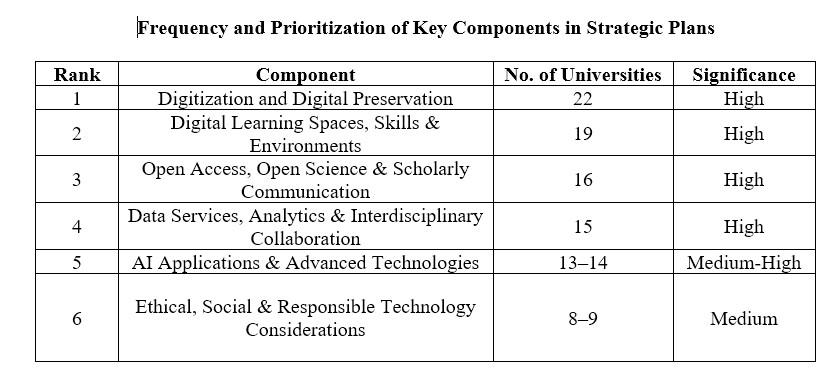
This study develops a strategic framework for the integration of artificial intelligence and digital transformation in academic libraries to enhance knowledge management and user services in higher education. Employing a mixed-methods approach, the research analyzes strategic plans from the top 25 universities according to the Times Higher Education 2024 World University Rankings. Qualitative content analysis (validated by Cohen’s Kappa, κ = 0.737), Shannon entropy for component prioritization, and sensitivity analysis were used to identify key priorities and assess result stability. The findings reveal that digitization and digital preservation constitute the dominant strategic priority, followed by digital learning environments, open access initiatives, and data analytics. While interest in AI is growing, the implementation of advanced AI applications such as chatbots and intelligent agents remains limited. Key barriers include legacy infrastructures, ethical concerns (algorithmic bias, privacy, and transparency), and a shortage of AI skilled professionals’ challenges that are particularly acute in resource-constrained settings. The proposed scalable strategic framework adopts a phased approach: beginning with foundational digitization, advancing to data analytics and AI-powered services, and culminating in mature integration with strong ethical governance. This framework is specifically tailored for developing countries, offering contextual recommendations for academic libraries in Iran. By systematically mapping strategic priorities from leading institutions and integrating theoretical and practical dimensions, this study advances knowledge management theories particularly Nonaka’s SECI model and provides actionable guidance for library administrators seeking to build inclusive, intelligent, and sustainable academic libraries worldwide.
Downloads
References
Adilovic, E. (2024). How academic libraries bridge the gap to AI driven knowledge.
American Psychological, A. (2020). Publication manual of the American Psychological Association. American Psychological Association. https://doi.org/10.1037/0000165-000
Bazeley, P. (2021). Qualitative data analysis: Practical strategies. Sage. https://www.torrossa.com/gs/resourceProxy?an=5018476&publisher=FZ7200
Bodleian Libraries. (2022). Strategic plan 2022–2027.
Cox, A. M., Corrall, S., & Pinfield, S. (2023). How artificial intelligence might change academic library work: Applying the competencies literature and the theory of the professions. Journal of the Association for Information Science and Technology, 74(3), 367-380. https://doi.org/10.1002/asi.24635
Creswell, J. W., & Creswell, J. D. (2018). Research design: Qualitative, quantitative, and mixed methods approaches. Sage. https://www.ucg.ac.me/skladiste/blog_609332/objava_105202/fajlovi/Creswell.pdf
Gasparini, A. (2022). Understanding artificial intelligence in research libraries: An extensive literature review. LIBER Quarterly, 32. https://www.academia.edu/download/99568981/13102.pdf
Hervieux, S., & Wheatley, M. (2021). The rise of AI: Implications and applications of artificial intelligence in academic libraries. Association of College & Research Libraries. https://rfcia.com.br/wp-content/uploads/2023/12/the-rise-of-ai-implications-and-applications-of-artificial-intelligence-in-academic-libraries-sandy-hervieux-amanda-wheatley.pdf
Huang, Y. (2023). Artificial intelligence in academic library strategy in the United Kingdom and China https://www.sciencedirect.com/science/article/pii/S0099133323001118
Huang, Y., Cox, A. M., & Cox, J. (2023). Artificial intelligence in academic library strategy in the United Kingdom and the Mainland of China. The Journal of Academic Librarianship, 49(6), 102772. https://doi.org/10.1016/j.acalib.2023.102772
Jin, H. (2025). Artificial Intelligence–Driven Knowledge Management in Academic Libraries: A Framework for Enhancing Information Retrieval Efficiency and User-Centred Service Delivery. African Journal of Library, Archives and Information Science, 35(1), 1-19. https://doi.org/10.5281/zenodo.17387818
Landis, J. R., & Koch, G. G. (1977). The measurement of observer agreement for categorical data. Biometrics, 33(1), 159-174. https://pubmed.ncbi.nlm.nih.gov/843571/
Nonaka, I., & Takeuchi, H. (1995). The knowledge-creating company: How Japanese companies create the dynamics of innovation. Oxford University Press. https://academic.oup.com/book/52097
Oladokun, B. D., & et al. (2025). Adoption of artificial intelligence in academic libraries: A systematic review of current practices, challenges, and research opportunities. Library Hi Tech Review. https://www.sciencedirect.com/science/article/pii/S0099133325001818
Padilla, T. (2019). Responsible operations: Data science, machine learning, and AI in libraries.
Rahmani, M. (2023). Exploring the integration of AI in public library services. AI and Tech in Behavioral and Social Sciences, 1(4), 33-39. https://doi.org/10.61838/kman.aitech.1.4.6
Semantic, S. (2024). Semantic Scholar overview.
Van Thinh, P. (2026). The role of artificial intelligence in academic libraries. European Journal of Science, Media, and Technology. https://ejsmt.com/index.php/journal/article/view/125
Downloads
Additional Files
Publication Timeline
- Submitted
- Revised
- Accepted