A Comprehensive Model for FinTech Development in Iran's Banking System: A Grounded Theory Approach
Keywords:
FinTech, banking, Iran, grounded theory, PLS-SEM, financial innovationAbstract
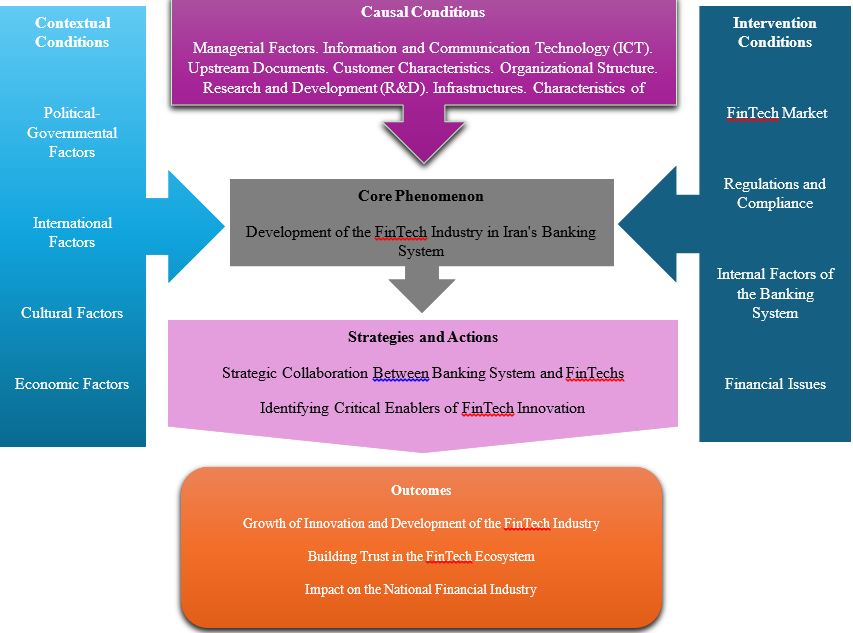
FinTech has become a central driver of financial innovation, yet evidence on its development in Iran's banking system remains fragmented across regulatory, technological, managerial, and market-oriented studies. This study developed and empirically examined a comprehensive model of FinTech development using a sequential mixed-methods design. In the qualitative phase, 63 published studies were synthesized through a modified grounded-theory approach informed by qualitative meta-synthesis. Open, axial, and selective coding generated a paradigmatic model containing causal conditions, contextual conditions, intervening conditions, strategies and actions, and outcomes around the core phenomenon of FinTech development. In the quantitative phase, the structural relationships among the model components were examined using PLS-SEM with data from 384 banking and academic experts. The results indicate that contextual factors had the strongest direct association with FinTech development, followed by causal and intervening conditions. FinTech development was positively associated with strategies and actions, and strategies and actions showed the strongest association with expected outcomes. The findings provide an exploratory diagnostic framework for policymakers, banks, and FinTech actors seeking to strengthen financial innovation in Iran's banking sector while accounting for macro-institutional constraints.
Downloads
References
Azimi Nejad, A., Hamidi Zadeh, M. R., Jandagi, G. R., & Sohrabi, T. (2022). Investigating driving and inhibitory contents of upstream documents in supporting the development of the country's FinTech industry. Innovation Management Journal, 10(4), 149-178. https://www.nowavari.ir/&url=http:/www.nowavari.ir/article_144773.html?lang=en
Benlala, M. A. (2023). Exploring risks and issues related to policy making and regulation in FinTech. Perspectives of Law and Public Administration, 12(2), 249-255. https://www.ceeol.com/search/article-detail?id=1221776
Charmaz, K. (2006). Constructing grounded theory: A practical guide through qualitative analysis. Sage. https://books.google.com/books?hl=en&lr=&id=2ThdBAAAQBAJ&oi=fnd&pg=PP1&dq=Charmaz,+K.+(2006).+Constructing+grounded+theory:+A+practical+guide+through+qualitative+analysis,+Sage.+%09&ots=f-qRcPsDCT&sig=y9b9aJJUVuWXtz2pkSeaxqMOTYQ
Cohen, J. (2013). Statistical power analysis for the behavioral sciences. Routledge. https://api.taylorfrancis.com/content/books/mono/download?identifierName=doi&identifierValue=10.4324/9780203771587&type=googlepdf
Gai, K., Qiu, M., & Sun, X. (2018). A survey on FinTech. Journal of network and computer applications, 103, 262-273. https://doi.org/10.1016/j.jnca.2017.10.011
Hair, J. F., Hult, G. T. M., Ringle, C. M., Sarstedt, M., Danks, N. P., & Ray, S. (2021). Partial least squares structural equation modeling (PLS-SEM) using R: A workbook. Springer. https://link.springer.com/content/pdf/10.1007/978-3-030-80519-7.pdf
Hedayati, A., Arshad, M., Dehdashti, Z., Mohammadian, M., & Nasehifar, V. (2022). Designing a model of factors affecting the collaboration of Iranian private banks with FinTechs using the meta-synthesis method. Commercial Research Journal, 27(107), 39-66. https://pajooheshnameh.itsr.ir/article_13612_0.../article_707166.html?lang=en
Henseler, J., Ringle, C. M., & Sarstedt, M. (2015). A new criterion for assessing discriminant validity in variance-based structural equation modeling. Journal of the Academy of Marketing Science, 43(1), 115-135. https://doi.org/10.1007/s11747-014-0403-8
Hoon, C. (2013). Meta-synthesis of qualitative case studies: An approach to theory building. Organizational Research Methods, 16(4), 522-556. https://journals.sagepub.com/doi/abs/10.1177/1094428113484969
Hornuf, L., Klus, M. F., Lohwasser, T. S., & Schwienbacher, A. (2021). How do banks interact with fintech startups? Small Business Economics, 57(3), 1505-1526. https://doi.org/10.1007/s11187-020-00359-3
Hu, Z., Ding, S., Li, S., Chen, L., & Yang, S. (2019). Adoption intention of fintech services for bank users: An empirical examination with an extended technology acceptance model. Symmetry, 11(3), 340. https://www.mdpi.com/2073-8994/11/3/340
International Organization of Securities, C. (2017). IOSCO research report on financial technologies (Fintech). https://www.iosco.org/library/pubdocs/pdf/IOSCOPD554.pdf
Lawshe, C. H. (1975). A quantitative approach to content validity. Personnel Psychology, 28(4), 563-575. https://parsmodir.com/wp-content/uploads/2015/03/lawshe.pdf
Lee, I., & Shin, Y. J. (2018). Fintech: Ecosystem, business models, investment decisions, and challenges. Business Horizons, 61(1), 35-46. https://www.sciencedirect.com/science/article/pii/S0007681317301246
Maleki, M. H., Mahloujian, H., Ramshe, M., & Oveicy Nick, F. (2023). Presenting a model for identifying and managing financial technology challenges in payment in Iran. Innovation Management Journal, 12(1), 71-94. https://www.nowavari.ir/article_188201_en.html
Marvat, A. B., & Nazari Zadeh, F. (2022). Scenarios for FinTech startups and banking in Iran by 1410 using cross-impact analysis. Management Improvement, 16(3), 1-32. https://www.behboodmodiriat.ir/article_161989.html
Mohammadi, M., Ghaffari, F., & Khanlari, A. (2022). Identifying the pattern of FinTech development in Iran by the technological innovation system approach. Innovation Management in Defensive Organizations, 5(2), 101-126. https://doi.org/10.22034/qjimdo.2022.327013.1481
Moradi, M., Shiva, A., Naderi, B., Delangizhan, S., & Sohrab, P. (2020). Examining the process of developing FinTech startups in Iran. Scientific Journal of Entrepreneurial Development, 13(1), 121-140.
Noblit, G. W., & Hare, R. D. (1988). Meta-ethnography: Synthesizing qualitative studies. Sage.
Rabbani, M. R., Bashar, A., Hawaldar, I. T., Shaik, M., & Selim, M. (2022). What do we know about crowdfunding and P2P lending research? A bibliometric review and meta-analysis. Journal of Risk and Financial Management, 15(10), 451. https://doi.org/10.3390/jrfm15100451
Roy, D., Pramanik, H. S., Bandyopadhyay, C., Datta, S., & Kirtania, M. (2025). Exploring association model across banks and fintechs in India. Qualitative Research in Financial Markets, 17(2), 312-347. https://doi.org/10.1108/QRFM-09-2023-0224
Salleh, M. N. M., Alwi, S., Rosnan, H., & Wahab, N. A. (2025). Exploring the impact of FinTech on sustainable development in Malaysia: An interpretative phenomenological analysis. Discover Sustainability, 6, 373. https://doi.org/10.1007/s43621-025-01205-w
Sandelowski, M., & Barroso, J. (2007). Handbook for synthesizing qualitative research. Springer.
Stewart, H., & Jürjens, J. (2018). Data security and consumer trust in FinTech innovation in Germany. Information & Computer Security, 26(1), 109-128. https://www.emerald.com/ics/article/26/1/109/199503
Strauss, A., & Corbin, J. (1998). Basics of qualitative research: Techniques and procedures for developing grounded theory. Sage. https://moodle.znu.edu.ua/pluginfile.php/196150/mod_resource/content/1/
Sun, Y., Li, S., & Wang, R. (2023). Fintech: From budding to explosion - An overview of the current state of research. Review of Managerial Science, 17, 715-755. https://doi.org/10.1007/s11846-021-00513-5
Tahmasebi Aghbelaghi, D., Soltani, M., Shahbazi, M., & Ozaei, A. (2021). Development of a framework for strategic collaboration between the private banking system and FinTechs in Iran. Journal of Technology Development Management, 9(1), 41-66. https://doi.org/10.22104/jtdm.2021.4781.2761
Tenenhaus, M., Amato, S., & Esposito Vinzi, V. (2004). A global goodness-of-fit index for PLS structural equation modelling. Proceedings of the XLII SIS Scientific Meeting,
Thakor, A. V. (2020). Fintech and banking: What do we know? Journal of Financial Intermediation, 41, 100833. https://doi.org/10.1016/j.jfi.2019.100833
Timulak, L. (2009). Meta-analysis of qualitative studies: A tool for reviewing qualitative research findings in psychotherapy. Psychotherapy Research, 19(4-5), 591-600. https://www.tandfonline.com/doi/abs/10.1080/10503300802477989
Wetzels, M., Odekerken-Schröder, G., & van Oppen, C. (2009). Using PLS path modeling for assessing hierarchical construct models: Guidelines and empirical illustration. MIS Quarterly, 33(1), 177-195. https://misq.umn.edu/misq/article/33/1/177/217
Zhang, W., Siyal, S., Riaz, S., Ahmad, R., Hilmi, M. F., & Li, Z. (2023). Data security, customer trust and intention for adoption of Fintech services: An empirical analysis from commercial bank users in Pakistan. SAGE Open, 13(3), 21582440231181388. https://doi.org/10.1177/21582440231181388
Downloads
Publication Timeline
- Submitted
- Revised
- Accepted