Developing a Resilient Supply Chain Model Based on Industry 4.0 in the Circular Printing Industry
DOI:
https://doi.org/10.61838/kman.aitech.5033Keywords:
Digital transformation, Resilient supply chain, Circular economy, Printing industryAbstract
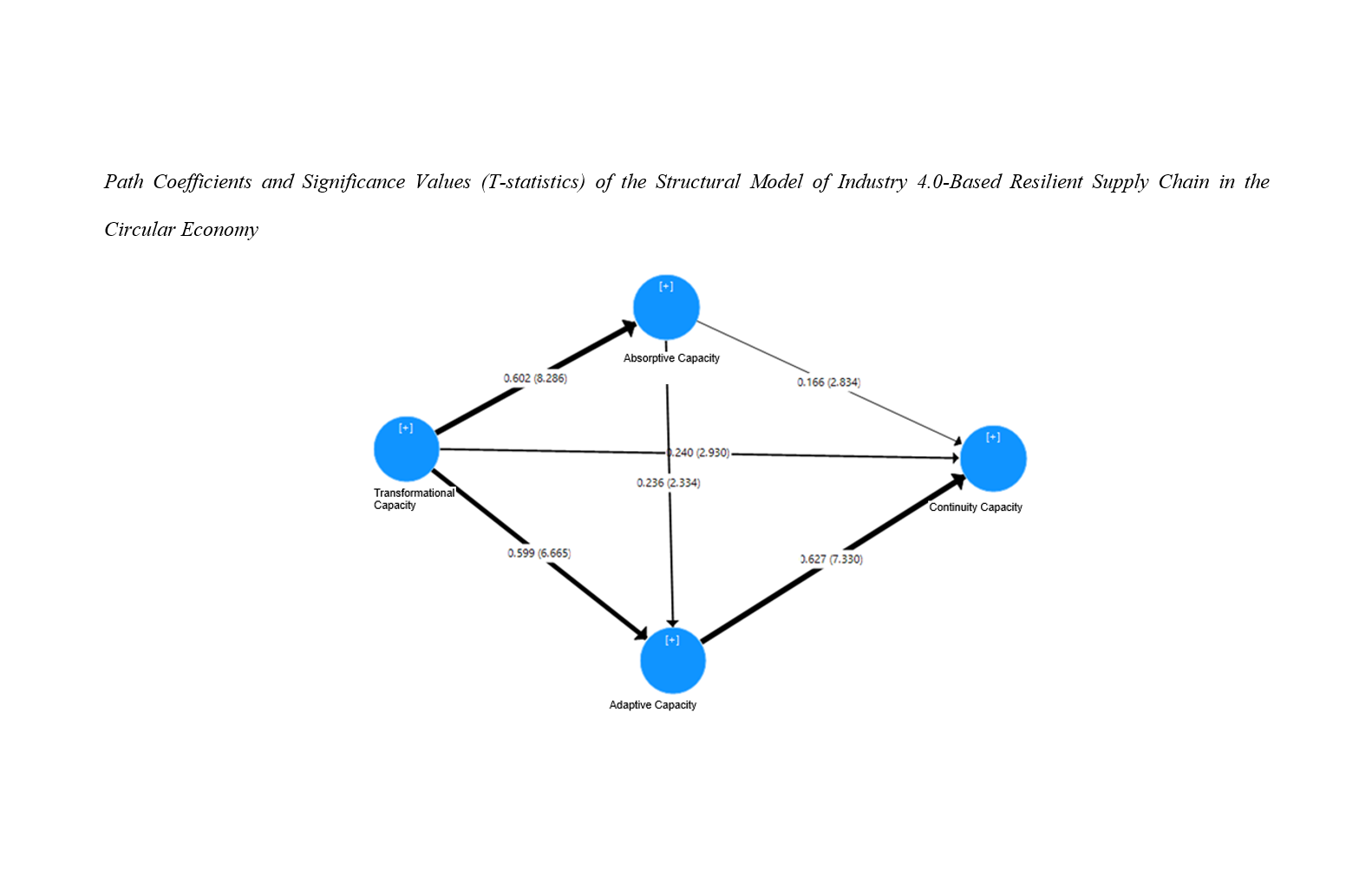
Today, enhancing supply chain resilience has become one of the fundamental responsibilities of management, which can be improved through emerging Industry 4.0 technologies. This study aims to develop a resilient supply chain model based on Industry 4.0 within the circular printing industry. The study was conducted in two qualitative and quantitative phases. In the qualitative phase, the research method was hybrid content analysis (deductive–inductive), and in the quantitative phase, causal and correlational methods were employed. The research population in the qualitative phase included participants such as senior managers, senior experts, consultants from the printing industry, and university faculty members specializing in technology management, supply chain management, and environmental management. These participants were selected using purposive non-probability sampling, totaling 20 individuals. In the quantitative phase, the statistical population consisted of experts working in the printing company, and a complete census method was used to select 107 individuals. The findings of the qualitative phase indicated that the model variables included “transformational capacity,” “absorptive capacity,” “adaptive capacity,” and “continuity capacity.” According to the fuzzy DEMATEL results, the variable “transformational capacity” was identified as the most influential factor, which sequentially affects “absorptive capacity,” “adaptive capacity,” and “continuity capacity.” The results of testing the developed model showed that “transformational capacity” has a positive and statistically significant effect on “absorptive capacity,” “adaptive capacity,” and “continuity capacity.” Furthermore, the effect of “absorptive capacity” on “adaptive capacity” and “continuity capacity” was confirmed to be positive and statistically significant. Finally, “adaptive capacity” has a positive and statistically significant relationship with “continuity capacity.” The results of the study indicate the critical role of digital strategic transformation in enhancing supply chain resilience capacity within the circular economy.
Downloads
References
Alfina, K. N., Ratnayake, R. C., Wibisono, D., Basri, M. H., & Mulyono, N. B. (2025). Prioritizing Performance Indicators for the Circular Economy Transition in Healthcare Supply Chains. Circular Economy and Sustainability, 5(1), 231-276. https://doi.org/10.1007/s43615-024-00436-9
Bhawna, Kang, P. S., & Sharma, S. K. (2024). Bridging the gap: a systematic analysis of circular economy, supply chain management, and digitization for sustainability and resilience. Operations Management Research, 17(3), 1039-1057. https://doi.org/10.1007/s12063-024-00490-4
Birkel, H., & Müller, J. M. (2025). Resilient by nature or technology? How Industry 4.0 enhances Supply Chain Resilience until 2035. Supply Chain Management: An International Journal, 30(3), 304-322. https://doi.org/10.1108/SCM-07-2023-0340
Borgatti, S. P., & Li, X. (2009). On social network analysis in a supply chain context. Journal of Supply Chain Management, 45(2), 5-22. https://doi.org/10.1111/j.1745-493X.2009.03166.x
Centobelli, P., Cerchione, R., Maglietta, A., & Oropallo, E. (2023). Sailing through a digital and resilient shipbuilding supply chain: An empirical investigation. Journal of Business Research, 158, 113686-113686. https://doi.org/10.1016/j.jbusres.2023.113686
Cherrafi, A., Chiarini, A., Belhadi, A., El Baz, J., & Benabdellah, A. C. (2022). Digital technologies and circular economy practices: vital enablers to support sustainable and resilient supply chain management in the post-COVID-19 era. The TQM Journal, 34(7), 179-202. https://doi.org/10.1108/TQM-12-2021-0374
Çolak, H., & Kağnıcıoğlu, C. H. (2023). Predicting the Blockchain Technology Acceptance in Supply Chains with Inter-Firm Perspective: An Integrated DEMATEL and PLS-SEM Approach. Journal of Business-to-Business Marketing, 1-24. https://doi.org/10.1080/1051712X.2023.2214543
De Lima, F. A., & Seuring, S. (2023). A Delphi study examining risk and uncertainty management in circular supply chains. International Journal of Production Economics, 258, 108810-108810. https://doi.org/10.1016/j.ijpe.2023.108810
Dubey, R., Gunasekaran, A., Childe, S. J., Blome, C., & Papadopoulos, T. (2019). Big data and predictive analytics and manufacturing performance: integrating institutional theory, resource‐based view and big data culture. British Journal of Management, 30(2), 341-361. https://doi.org/10.1111/1467-8551.12355
Duman Altan, A., Beyca, Ö. F., & Zaim, S. (2024). Link between Digital Technologies Adoption and Sustainability Performance: Supply Chain Traceability/Resilience or Circular Economy Practices. Sustainability, 16(19), 8694-8694. https://doi.org/10.3390/su16198694
Elgazzar, Y., El-Shahawy, R., & Senousy, Y. (2022, 2022). The role of digital transformation in enhancing business resilience with pandemic of COVID-19. Digital transformation technology: Proceedings of ITAF 2020,
Fiksel, J., Sanjay, P., & Raman, K. (2021). Steps toward a resilient circular economy in India. Clean Technologies and Environmental Policy, 23, 203-218. https://doi.org/10.1007/s10098-020-01982-0
Gaudenzi, B., Pellegrino, R., & Confente, I. (2023). Achieving supply chain resilience in an era of disruptions: a configuration approach of capacities and strategies. Supply Chain Management: An International Journal, 28(7), 97-111. https://doi.org/10.1108/SCM-09-2022-0383
Ghobakhloo, M., Iranmanesh, M., Foroughi, B., Tseng, M. L., Nikbin, D., & Khanfar, A. A. (2025). Industry 4.0 digital transformation and opportunities for supply chain resilience: a comprehensive review and a strategic roadmap. Production Planning & Control, 36(1), 61-91. https://doi.org/10.1080/09537287.2023.2252376
Gkountani, V. A., Tsoulfas, G. T., & Rachaniotis, N. P. (2021, 2021). Circular economy and resilience: convergences and deviations in the case of agri-food supply chains. IOP Conference Series: Earth and Environmental Science,
Hair, J. F., Astrachan, C. B., Moisescu, O. I., Radomir, L., Sarstedt, M., Vaithilingam, S., & Ringle, C. M. (2021). Executing and interpreting applications of PLS-SEM: Updates for family business researchers. Journal of Family Business Strategy, 12(3), 100392-100392. https://doi.org/10.1016/j.jfbs.2020.100392
Harju, A., Hallikas, J., Immonen, M., & Lintukangas, K. (2023). The impact of procurement digitalization on supply chain resilience: empirical evidence from Finland. Supply Chain Management: An International Journal, 28(7), 62-76. https://doi.org/10.1108/SCM-08-2022-0312
He, Z., Huang, H., Choi, H., & Bilgihan, A. (2022). Building organizational resilience with digital transformation. Journal of Services Management. https://doi.org/10.1108/JOSM-06-2021-0216
Islam, S., Hassan, S., Hossain, S., Ahmed, T., Karmaker, C. L., & Bari, A. M. (2025). Exploring the influence of circular economy on big data analytics and supply chain resilience nexus: A structural equation modeling approach. Green Technologies and Sustainability, 100219-100219. https://doi.org/10.1016/j.grets.2025.100219
Ivanov, D., & Dolgui, A. (2021). A digital supply chain twin for managing the disruption risks and resilience in the era of Industry 4.0. Production Planning & Control, 32(9), 775-788. https://doi.org/10.1080/09537287.2020.1768450
Ivanov, D., Dolgui, A., & Sokolov, B. (2019). The impact of digital technology and Industry 4.0 on the ripple effect and supply chain risk analytics. International Journal of Production Research, 57(3), 829-846. https://doi.org/10.1080/00207543.2018.1488086
Jowkar, A. A., Mahmoudi Meymand, M., Parhizgar, M. M., & Mohebali, M. M. (2024). Designing an Artificial Intelligence-Based Supply Chain Resilience Model in the Online Retail Sector (Case Study: Tehran City). Scientific-Research Quarterly of Economics and Urban Management, 12(45), 107-129. https://en.civilica.com/doc/2093804/
Karimi Shirazi, H., & Vakil Alroaia, Y. (2024). Identification of the challenges of using the technology of 4.0 industry in the circular supply chain of sustainable agriculture. Journal of Public Service Marketing, 2(1). https://en.civilica.com/doc/1994245/
Kennedy, S., & Linnenluecke, M. K. (2022). Circular economy and resilience: A research agenda. Business Strategy and the Environment, 31(6), 2754-2765. https://doi.org/10.1002/bse.3004
Lahane, S., & Kant, R. (2021). Evaluation and ranking of solutions to mitigate circular supply chain risks. Sustainable Production and Consumption, 27, 753-773. https://doi.org/10.1016/j.spc.2021.01.034
Li, P., Chen, Y., & Guo, X. (2025). Digital transformation and supply chain resilience. International Review of Economics & Finance, 99, 104033-104033. https://doi.org/10.1016/j.iref.2025.104628
Liu, L., Song, W., & Liu, Y. (2023). Leveraging digital capabilities toward a circular economy: Reinforcing sustainable supply chain management with Industry 4.0 technologies. Computers & Industrial Engineering, 178, 109113-109113. https://doi.org/10.1016/j.cie.2023.109113
Ma, C., Zhang, L., You, L., & Tian, W. (2024). A review of supply chain resilience: A network modeling perspective. Applied Sciences, 15(1), 265-265. https://doi.org/10.3390/app15010265
Mamun, M. (2025). Circular Economy and Digital Supply Chain: The role of emerging technologies for facilitating sustainability. https://osuva.uwasa.fi/items/59acbf49-8c3b-4826-ab9f-e973b2c73e76
Mehrbakhsh, S., & Ghezavati, V. (2020). Mathematical modeling for green supply chain considering product recovery capacity and uncertainty for demand. Environmental Science and Pollution Research, 27, 44378-44395. https://doi.org/10.1007/s11356-020-10331-z
Nakandala, D., Yang, R., Lau, H., & Weerabahu, S. (2023). Industry 4.0 technology capabilities, resilience and incremental innovation in Australian manufacturing firms: a serial mediation model. Supply Chain Management: An International Journal, 28(4), 760-772. https://doi.org/10.1108/SCM-08-2022-0325
Nayal, K., Raut, R. D., Yadav, V. S., Priyadarshinee, P., & Narkhede, B. E. (2022). RETRACTED: The impact of sustainable development strategy on sustainable supply chain firm performance in the digital transformation era. Business Strategy and the Environment, 31(3), 845-859. https://doi.org/10.1002/bse.2921
Ngo, V. M., Pham, H. C., & Nguyen, H. H. (2023). Drivers of digital supply chain transformation in SMEs and large enterprises-a case of COVID-19 disruption risk. International Journal of Emerging Markets, 18(6), 1355-1377. https://doi.org/10.1108/IJOEM-10-2021-1561
Sadat Mousavipour, S., Modiri, M., Fathi Hafshjani, K., & Hashemzadeh Khorasgani, G. (2026). Designing a Strategic Smart Reverse Supply Chain Model in the Tire Manufacturing Industry with a Mixed-Methods Approach. Modern Management Engineering, 11(2). https://www.magiran.com/paper/2866824/designing-a-model-of-a-smart-reverse-supply-chain-strategic-in-the-rubber-industry-with-a-mixed-approach?lang=en
Sharifian Jazi, S., Mohammadi, A., Abbasi, A., & Alimohammadlou, M. (2025). Identifying Challenges Affecting the Implementation of Circular Economy and Industry 4.0 in Supply Chain Management. Management Research in Iran, 28(2), 146-183. https://mri.modares.ac.ir/article_661_en.html?lang=fa
Spieske, A., & Birkel, H. (2021). Improving supply chain resilience through industry 4.0: A systematic literature review under the impressions of the COVID-19 pandemic. Computers & Industrial Engineering, 158, 107452-107452. https://doi.org/10.1016/j.cie.2021.107452
Taghikhah, F., Voinov, A., & Shukla, N. (2019). Extending the supply chain to address sustainability. Journal of Cleaner Production, 229, 652-666. https://doi.org/10.1016/j.jclepro.2019.05.051
Tathavadekar, V. P. (2025). Sustainable and Resilient Supply Chain Practices through Digital Transformation and Circular Economy Strategies. https://www.google.com/url?sa=t&source=web&rct=j&opi=89978449&url=https://zenodo.org/records/15605978/files/V13i601.pdf%3Fdownload%3D1&ved=2ahUKEwieoc2ai9eSAxUIXKQEHa4GApsQFnoECBsQAQ&usg=AOvVaw0S-paBPhl3RbMbSdYMcOWv
Tortorella, G., Gloet, M., Samson, D., Kurnia, S., Fogliatto, F. S., & Anzanello, M. J. (2025). Food supply chain resilience through digital transformation: a mixed-method approach. The International Journal of Logistics Management, 36(2), 381-412. https://doi.org/10.1108/IJLM-01-2024-0030
Vadigicherla, M. S. (2024). Enhancing Supply Chain Resilience through Emerging Technologies: A Holistic Approach to Digital Transformation. https://www.researchgate.net/publication/384483999_Enhancing_Supply_Chain_Resilience_through_Emerging_Technologies_A_Holistic_Approach_to_Digital_Transformation
Wietschel, L., Helbig, C., Hillenbrand, M., & Thorenz, A. (2025). Integrated conceptual framework for resilience and criticality assessments for raw material supply chains. Resources, Conservation and Recycling, 218, 108249-108249. https://doi.org/10.1016/j.resconrec.2025.108249
Yuan, Y., Tan, H., & Liu, L. (2023). The effects of digital transformation on supply chain resilience: a moderated and mediated model. Journal of Enterprise Information Management. https://doi.org/10.1108/JEIM-09-2022-0333
Zhang, G., Yang, Y., & Yang, G. (2023). Smart supply chain management in Industry 4.0: the review, research agenda and strategies in North America. Annals of Operations Research, 322(2), 1075-1117. https://doi.org/10.1007/s10479-022-04689-1
Zhao, N., Hong, J., & Lau, K. H. (2023). Impact of supply chain digitalization on supply chain resilience and performance: A multi-mediation model. International Journal of Production Economics, 259, 108817-108817. https://doi.org/10.1016/j.ijpe.2023.108817
Zouari, D., Ruel, S., & Viale, L. (2021). Does digitalising the supply chain contribute to its resilience? International Journal of Physical Distribution & Logistics Management, 51(2), 149-180. https://doi.org/10.1108/IJPDLM-01-2020-0038