Designing a Qualitative Model of School Principals’ Performance with a Meritocracy Approach
DOI:
https://doi.org/10.61838/kman.aitech.5138Keywords:
school principals’ performance, qualitative performance model, meritocracy approachAbstract
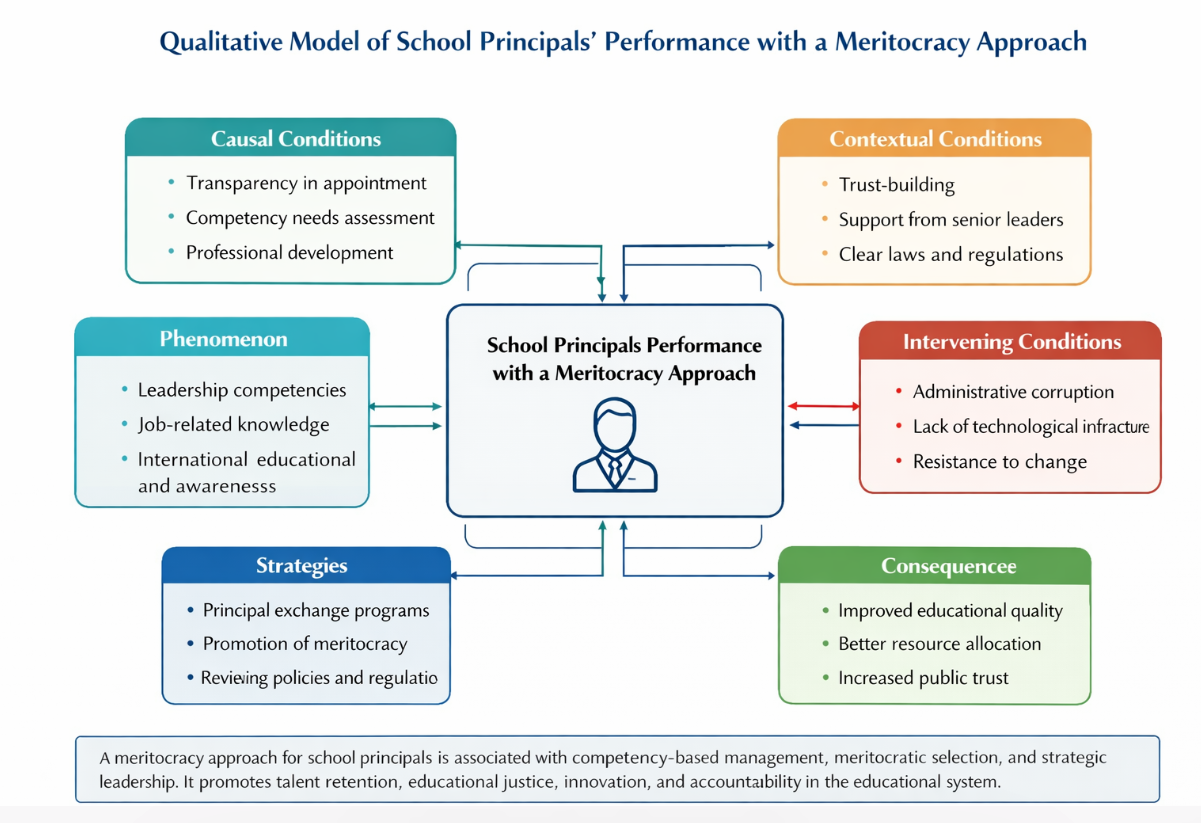
The purpose of this study was to design a qualitative model of school principals’ performance in the Department of Education of Karaj County based on a meritocracy approach. The research method was qualitative and based on grounded theory. The participants included organizational and academic experts related to the research topic, who were selected through purposive sampling. A total of 15 participants were interviewed until theoretical saturation was achieved. Data were collected through semi-structured interviews and analyzed using open, axial, and selective coding. The findings indicated that the qualitative model of school principals’ performance in the Department of Education of Karaj County with a meritocracy approach consists of six dimensions: talent attraction and retention, sufficient job-related information, support for the meritocracy process, awareness and analysis of international educational systems, knowledge management, and facilitation of organizational learning. In addition, 20 components were identified, including creating a platform for knowledge production, improving the psychological climate and organizational atmosphere, increasing efficiency, optimizing processes, better resource management, achieving improved student outcomes, enhancing the learning environment, improving educational quality, increasing educational equity, enhancing the effectiveness and productivity of the educational system, reducing costs, moving toward strategic goals, viewing the school as a learning organization, preventing rent-seeking, promoting meritocracy, developing a culture of citizenship and social responsibility, strengthening trust in the educational system, fostering creativity and innovation, and increasing staff commitment. Overall, 168 indicators were extracted and categorized within the paradigmatic model of the research in the form of causal conditions, contextual conditions, intervening conditions, strategies, and consequences.
Downloads
References
References
1. Leithwood K, Harris A, Hopkins D. Seven strong claims about successful school leadership revisited. Sch Leadersh Manag. 2020;40(1):5-22.
https://doi.org/10.1080/13632434.2019.1596077
2. Grissom JA, Egalite AJ, Lindsay CA. How principals affect students and schools: A systematic synthesis of two decades of research. New York: The Wallace Foundation; 2021. https://doi.org/10.59656/el-sb1065.001
3. Hallinger P, Heck RH. Leadership for learning: Does collaborative leadership make a difference in school improvement? Educ Manag Adm Leadersh. 2010;38(6):654-678. https://doi.org/10.1177/1741143210379060
4. Leithwood K, Louis KS, Anderson S, Wahlstrom K. How leadership influences student learning. New York: The Wallace Foundation; 2004. https://doi.org/10.59656/el-sb5787.001
5. Robinson VMJ, Lloyd CA, Rowe KJ. The impact of leadership on student outcomes: An analysis of the differential effects of leadership types. Educ Adm Q. 2008;44(5):635-674. https://doi.org/10.1177/0013161x08321509
6. Bush T. Assessing successful school leadership: What do we know? Educ Manag Adm Leadersh. 2021;49(5):687-689. https://doi.org/10.1177/17411432211034675
7. Lochmiller CR, Perrone F, Finley C. Understanding school leadership’s influence on teacher retention in high-poverty settings: An exploratory study in the U.S. Education Sciences. 2024;14(5):545. https://doi.org/10.3390/educsci14050545
8. Hulpia H, Devos G, Van Keer H. The influence of distributed leadership on teachers’ organizational commitment: A multilevel approach. J Educ Res. 2009;103(1):40-52. https://doi.org/10.1080/00220670903231201
9. Galdames-Calderón M, Rodríguez-Gómez D, Leiva-Guerrero MV, López-Fernández V. Distributed leadership: School principals’ practices to support teacher leadership and school effectiveness. Education Sciences. 2023;13(7):715. https://doi.org/10.3390/educsci13070715
10. Napoletano T. Meritocracy, meritocratic education, and equality of opportunity. Theory Res Educ. 2024;22(1):3-18. https://doi.org/10.1177/14778785241226662
11. Campion MA, Fink AA, Ruggeberg BJ, Carr L, Phillips GM, Odman RB. Doing competencies well: Best practices in competency modeling. Pers Psychol. 2011;64(1):225-262. https://doi.org/10.1111/j.1744-6570.2010.01207.x
12. Pellegrini MM, Ciampi F, Marzi G, Orlando B. The relationship between knowledge management and leadership: Mapping the field and providing future research avenues. J Knowl Manag. 2020;24(6):1445-1492. https://doi.org/10.1108/jkm-01-2020-0034
13. Imran MK, Ilyas M, Aslam U, Fatima T. Knowledge processes and firm performance: The mediating effect of organizational learning and knowledge management. J Knowl Manag. 2018;22(6):1401-1426. https://doi.org/10.1108/jocm-10-2016-0202
14. Nguyen TD. Linking school organizational characteristics and teacher retention: Evidence from repeated cross-sectional national data. Teach Teach Educ. 2021;97:103220. https://doi.org/10.1016/j.tate.2020.103220
15. Dahlkamp S, Peters ML, Schumacher G. Principal self-efficacy, school climate, and teacher retention: A multi-level analysis. Alta J Educ Res. 2017;63(4):357-376. https://doi.org/10.55016/ojs/ajer.v63i4.56351
16. Yada T, Savolainen H. Principal self-efficacy and school climate as antecedents of collective teacher efficacy. Sch Eff Sch Improv. 2023;34(2):209-225. https://doi.org/10.1080/09243453.2023.2170425
17. Nguyen D, See BH, Brown C, Kokotsaki D. Leadership for teacher retention: Exploring the evidence base on why and how to support teacher autonomy, development, and voice. Oxf Rev Educ. 2024. https://doi.org/10.1080/03054985.2024.2432635
18. Gningue SM, Naser M, Madsen J, Sparks SD. The relationship between teacher leadership and school climate: Findings from a teacher-leadership project. Education Sciences. 2022;12(11):749. https://doi.org/10.3390/educsci12110749