Designing Intelligent Learning Ecosystems: The Role of Artificial Intelligence and Blended Learning in Enhancing Digital Education Quality
DOI:
https://doi.org/10.61838/kman.aitech.5147Keywords:
intelligent learning ecosystems, artificial intelligence, blended learning, digital education quality, e-learning, higher educationAbstract
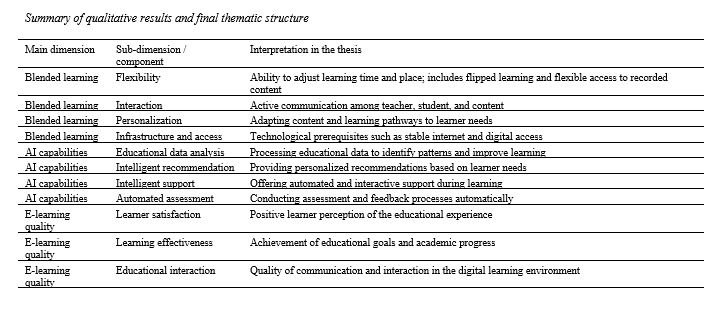
This study presents a model for designing intelligent learning ecosystems that enhance the quality of digital education through the integration of artificial intelligence and blended learning, with Islamic Azad University as the empirical context. The research addresses persistent challenges in e-learning, including limited interaction, unequal access, and the need to respond to diverse learner profiles through technology-enhanced educational design. A mixed-methods approach was employed. In the qualitative phase, semi-structured interviews were conducted with 15 experts in education and educational technology selected through purposive sampling. In the quantitative phase, data were collected from 384 faculty members and university staff using stratified random sampling across regions and academic fields. Qualitative data were analyzed through thematic analysis, while quantitative data were examined using Partial Least Squares Structural Equation Modeling (PLS-SEM), Artificial Neural Networks (ANN), and the MABAC multi-criteria decision-making method. Findings revealed that the proposed ecosystem is built around three core dimensions: blended learning, artificial intelligence capabilities, and digital education quality. Blended learning was defined through flexibility, interaction, personalization, and infrastructure, while AI capabilities included educational data analysis, intelligent recommendation, intelligent support, and automated assessment. The quality of digital education was reflected in learner satisfaction, learning effectiveness, and educational interaction. The model demonstrated strong explanatory power (R² = 0.712). ANN results identified learner satisfaction and learning effectiveness as the most influential indicators, and MABAC ranked intelligent support as the highest-priority AI capability. The study concludes that integrating AI-driven support into blended learning environments can provide a practical pathway for strengthening digital education quality and informing future policy and implementation in higher education.
Downloads
References
Graham, Charles R. (2009). Blended learning models. In Encyclopedia of Information Science and Technology, Second Edition (pp. 375–382). IGI Global. https://doi.org/10.4018/978-1-60566-026-4.ch063
Halverson, Lisa R; Spring, Kristian J; Huyett, Sabrina; Henrie, Curtis R; & Graham, Charles R. (2023). Blended learning research in higher education and K-12 settings. In Learning, design, and technology: An international compendium of theory, research, practice, and policy (pp. 3107–3135). Springer. https://doi.org/10.1007/978-3-319-17461-7_31
Hamadneh, Nawaf N; Atawneh, Samer; Khan, Waqar A; Almejalli, Khaled A; & Alhomoud, Adeeb. (2022). Using artificial intelligence to predict students’ academic performance in blended learning. Sustainability, 14(18), 11642. https://doi.org/10.3390/su141811642
Heinze, Aleksej; & Procter, Chris. (2010). The significance of the reflective practitioner in blended learning. International Journal of Mobile and Blended Learning (IJMBL), 2(2), 18–29. https://doi.org/10.4018/jmbl.2010040102
Horn, Michael B; & Staker, Heather. (2014). Blended: Using disruptive innovation to improve schools. John Wiley & Sons.
Ilieva, Galina; Yankova, Tania; Klisarova-Belcheva, Stanislava; Dimitrov, Angel; Bratkov, Marin; & Angelov, Delian. (2023). Effects of Generative Chatbots in Higher Education. Information, 14(9), 492. https://doi.org/10.3390/info14090492
Istenič, Andreja. (2024). Blended learning in higher education: The integrated and distributed model and a thematic analysis. Discover Education, 3(1), 165. https://doi.org/10.1007/s44217-024-00239-y
Jones, Kevin Anthony; & Ravishankar, Sharma. (2021). Higher education 4.0: The digital transformation of classroom lectures to blended learning. Springer Nature. https://doi.org/10.1007/978-981-33-6683-1
Joseph, Sylvester; Tahir, Amna; Bibi, Farwa; Hamid, Khalid; Iqbal, Muhammad Waseem; Ruk, Sadaquat Ali; & Ahmad, Saleem Zubair. (2024). A Review Analysis on Using “AIED” to Improve Student Engagement in Hybrid Education. Bulletin of Business and Economics (BBE), 13(2), 424–435. https://doi.org/10.61506/01.00348
Kadhim, Mohammed K; & Hassan, Alia K. (2020). Towards Intelligent E-Learning Systems: A Hybrid Model for Predicatingthe Learning Continuity in Iraqi Higher Education. Webology, 17(2). https://doi.org/10.14704/web/v17i2/web17023
Katsamakas, Evangelos; Pavlov, Oleg V; & Saklad, Ryan. (2024). Artificial intelligence and the transformation of higher education institutions: A systems approach. Sustainability, 16(14). https://doi.org/10.3390/su16146118
Komsiyah, Indah. (2023). Control Quality of E-Learning Implementation Management. AL-ISHLAH: Jurnal Pendidikan, 15(2), 1881–1887. https://doi.org/10.35445/alishlah.v15i2.2972
Legon, Ron; & Garrett, Richard. (2018). The changing landscape of online education (CHLOE) 2: A deeper dive. Quality Matters & Eduventures Survey of Chief Online Officers.