The Future of Marketing: Using Agentic AI to Transform Segmentation and Positioning
Keywords:
agentic AI, artificial intelligence in marketing, market segmentation, positioning, agent-based simulation, PLS-SEMAbstract
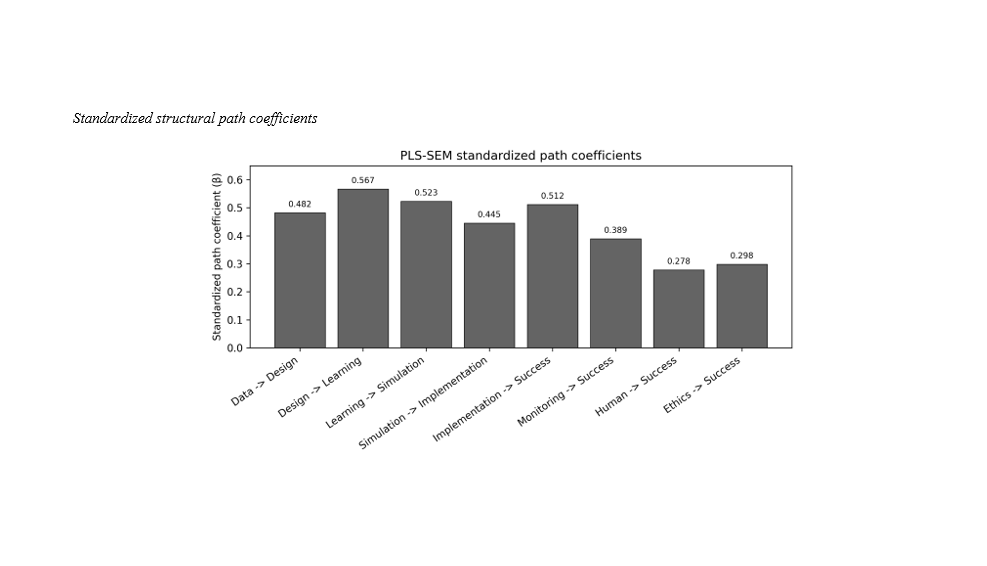
This study developed and empirically tested an operational framework for using agentic artificial intelligence (AI) in market segmentation and positioning. A descriptive survey design was used. The target population consisted of marketing managers, data analysts, and AI specialists working in 250 active companies in Tehran that had implemented AI-related marketing projects during the previous two years. A stratified random sample of 152 participants completed a 42-item researcher-developed questionnaire scored on a five-point Likert scale. Content validity was assessed by eight experts, and internal consistency was acceptable (Cronbach's alpha = .92). The data were analyzed using descriptive statistics and partial least squares structural equation modeling (PLS-SEM) in SmartPLS 4. The descriptive results indicated that the lowest mean scores were observed for human skills (M = 2.78) and agent-based market simulation (M = 2.85), whereas the highest mean was observed for ethical and privacy factors (M = 3.45). The structural results showed that all hypothesized paths were statistically significant. The strongest path was from agent design to agent learning (β = .567), followed by agent learning to market simulation (β = .523) and operational implementation to success (β = .512). The model explained 58.3% of the variance in implementation success. The findings suggest that agentic AI can substantially improve segmentation and positioning when organizations develop integrated data infrastructure, robust agent design, human analytical skills, continuous monitoring routines, and clear ethical and privacy safeguards.
Downloads
References
Becker, G. S. (1976). The economic approach to human behavior. University of Chicago Press. https://doi.org/10.7208/chicago/9780226217062.001.0001
Blackwell, R. D., Miniard, P. W., & Engel, J. F. (2001). Consumer behavior (9th ed.). Harcourt College Publishers. https://www.scirp.org/reference/referencespapers?referenceid=1298292
Davenport, T. H., Guha, A., Grewal, D., & Bressgott, T. (2020). How artificial intelligence will change the future of marketing. Journal of the Academy of Marketing Science, 48, 24-42. https://doi.org/10.1007/s11747-019-00696-0
Hair, J. F., Hult, G. T. M., Ringle, C. M., & Sarstedt, M. (2022). A primer on partial least squares structural equation modeling (PLS-SEM) (3rd ed.). SAGE. https://doi.org/10.1007/978-3-030-80519-7
Huang, M. H., & Rust, R. T. (2021). A strategic framework for artificial intelligence in marketing. Journal of the Academy of Marketing Science, 49, 30-50. https://doi.org/10.1007/s11747-020-00749-9
Kotler, P., & Keller, K. L. (2016). Marketing management (15th ed.). Pearson. https://fil.welib.org/md5/8e430253989370bab3f58b80330cfed7.pdf
Krejcie, R. V., & Morgan, D. W. (1970). Determining sample size for research activities. Educational and Psychological Measurement, 30(3), 607-610. https://doi.org/10.1177/001316447003000308
Rand, W., & Rust, R. T. (2011). Agent-based modeling in marketing: Guidelines for rigor. International Journal of Research in Marketing, 28(3), 181-193. https://doi.org/10.1016/j.ijresmar.2011.04.002
Wooldridge, M., & Jennings, N. R. (1995). Intelligent agents: Theory and practice. The Knowledge Engineering Review, 10(2), 115-152. https://doi.org/10.1017/S0269888900008122
Wooldridge, M., Jennings, N. R., & Kinny, D. (2000). The Gaia methodology for agent-oriented analysis and design. Autonomous Agents and Multi-Agent Systems, 3(3), 285-312. https://doi.org/10.1023/A:1010071910869
Downloads
Publication Timeline
- Submitted
- Revised
- Accepted