An Applied Artificial Intelligence Model for Social Media-Based Natural Crisis Management in Iran
Keywords:
artificial intelligence, crisis communication, misinformation detection, natural disasters, social media, community resilience, IranAbstract
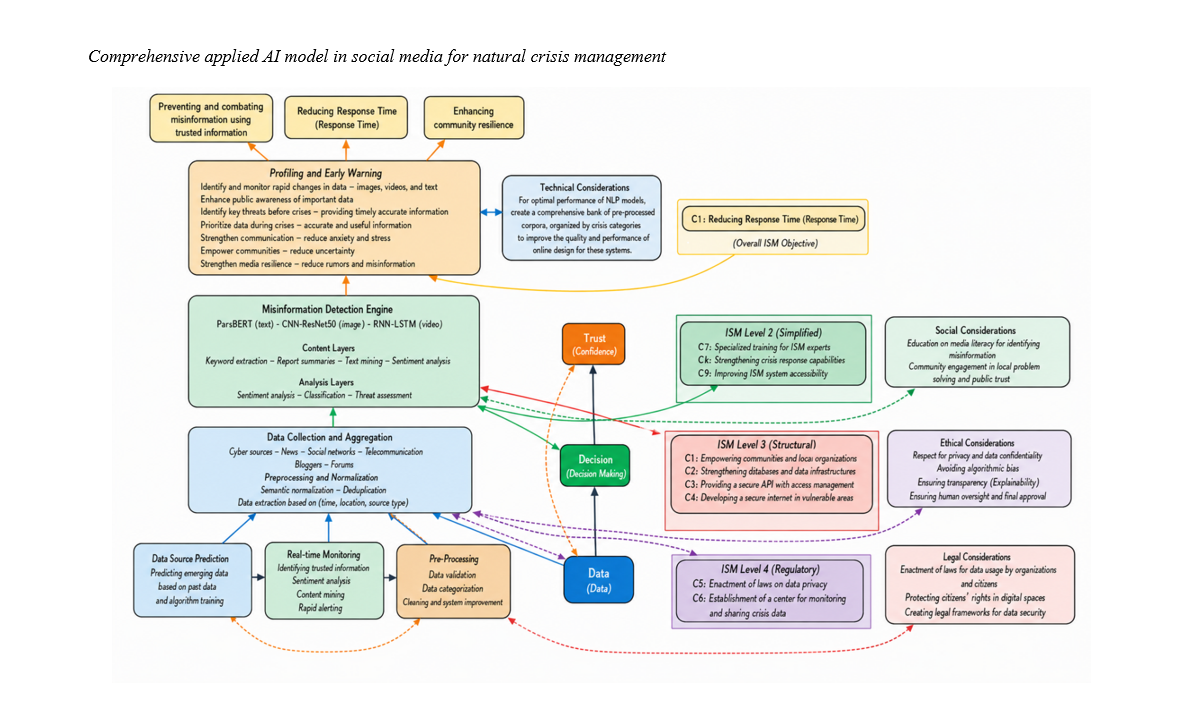
Natural hazards in Iran frequently generate complex communication demands because earthquakes, floods, droughts, and other disasters unfold in environments where social media platforms rapidly become both information resources and rumor amplifiers. This study developed an applied model for the use of artificial intelligence (AI) in social media for natural crisis management in Iran, with particular attention to detecting, analyzing, and countering misinformation. The article is based on the findings of a mixed-method, exploratory-sequential study conducted in five consecutive phases. First, semi-structured interviews with 16 experts in crisis management, media, artificial intelligence, and relief operations were analyzed thematically, producing nine major themes and ten key factors; instrument validity was confirmed through CVR and CVI, and reliability was supported by Cohen's kappa of 0.847. Second, interpretive structural modeling (ISM) with an eight-member expert panel identified an integrated crisis data monitoring center and transparent privacy legislation as foundational drivers, while reducing response time emerged as the ultimate system outcome. Third, a quantitative analysis of 384 social media messages from the Varzaghan-Ahar earthquake, the Khoy earthquake, and the Lorestan flood showed that 16.9% of messages contained misinformation and more than 45% of rumors appeared during the first six hours of crisis. Fourth, six AI algorithms were evaluated; ParsBERT performed best for Persian text with 88.2% test-set accuracy and an F1 score of 85.7%, CNN achieved 90.0% accuracy in the reported image test subset, and RNN-LSTM reached 83.3% accuracy in the reported video test subset. Finally, the findings were integrated into a five-layer operational model consisting of data, preprocessing, intelligent analysis, human verification and feedback, and decision/action layers. The model specifies three major objectives: preventing rumors and misinformation, reducing response time, and strengthening community resilience. The findings indicate that AI-supported social media monitoring can improve crisis communication, but implementation requires technical, ethical, legal, and social safeguards.
Downloads
References
Aïmeur, E., Amri, S., & Brassard, G. (2023). Fake news, disinformation and misinformation in social media: A review. Applied Sciences, 13(1), Article 30. https://doi.org/10.3390/app13010030
Alexander, D. E. (2014). Social media in disaster risk reduction and crisis management. Science and Engineering Ethics, 20, 717-733. https://doi.org/10.1007/s11948-013-9502-z
Braun, V., & Clarke, V. (2006). Using thematic analysis in psychology. Qualitative Research in Psychology, 3(2), 77-101. https://doi.org/10.1191/1478088706qp063oa
Castillo, C., Mendoza, M., & Poblete, B. (2011). Information credibility on Twitter. Proceedings of the 20th International Conference on World Wide Web,
Devlin, J., Chang, M. W., Lee, K., & Toutanova, K. (2019). BERT: Pre-training of deep bidirectional transformers for language understanding. Proceedings of NAACL-HLT 2019,
Farahani, M., Gharachorloo, M., Farahani, M., & Manthouri, M. (2020). ParsBERT: Transformer-based model for Persian language understanding (arXiv, Issue. https://arxiv.org/abs/2005.12515
Gao, H., Barbier, G., & Goolsby, R. (2011). Harnessing the crowdsourcing power of social media for disaster relief. IEEE Intelligent Systems, 26(3), 10-14. https://doi.org/10.1109/MIS.2011.52
Goodchild, M. F., & Glennon, J. A. (2010). Crowdsourcing geographic information for disaster response: A research frontier. International Journal of Digital Earth, 3(3), 231-241. https://doi.org/10.1080/17538941003759255
Imran, M., Castillo, C., Diaz, F., & Vieweg, S. (2014). Processing social media messages in mass emergency: A survey. ACM Computing Surveys, 47(4), Article 67. https://doi.org/10.1145/2771588
Kumar, S., & Shah, N. (2018). False information on web and social media: A survey (arXiv, Issue. https://arxiv.org/abs/1804.08559
Lincoln, Y. S., & Guba, E. G. (1985). Naturalistic inquiry. SAGE. https://doi.org/10.1016/0147-1767(85)90062-8
Olteanu, A., Vieweg, S., & Castillo, C. (2015). What to expect when the unexpected happens: Social media communications across crises. Proceedings of the ACM Conference on Computer Supported Cooperative Work & Social Computing,
Palen, L., & Anderson, K. M. (2016). Crisis informatics: New data for extraordinary times. Science, 353(6296), 224-225. https://doi.org/10.1126/science.aag2579
Ragini, J. R., Anand, P. M. R., & Bhaskar, V. (2018). Big data analytics for disaster response and recovery through sentiment analysis. International Journal of Information Management, 42, 13-24. https://doi.org/10.1016/j.ijinfomgt.2018.05.004
Reuter, C., & Kaufhold, M. A. (2018). Fifteen years of social media in emergencies: A retrospective review and future directions for crisis informatics. Journal of Contingencies and Crisis Management, 26(1), 41-57. https://doi.org/10.1111/1468-5973.12196
United Nations Office for Disaster Risk, R. (2015). Sendai Framework for Disaster Risk Reduction 2015-2030. https://www.undrr.org/publication/sendai-framework-disaster-risk-reduction-2015-2030
Vieweg, S., Hughes, A. L., Starbird, K., & Palen, L. (2010). Microblogging during two natural hazards events: What Twitter may contribute to situational awareness. Proceedings of the SIGCHI Conference on Human Factors in Computing Systems,
Vosoughi, S., Roy, D., & Aral, S. (2018). The spread of true and false news online. Science, 359(6380), 1146-1151. https://doi.org/10.1126/science.aap9559
Wardle, C., & Derakhshan, H. (2017). Information Disorder: Toward an Interdisciplinary Framework for Research and Policy Making. http://tverezo.info/wp-content/uploads/2017/11/PREMS-162317-GBR-2018-Report-desinformation-A4-BAT.pdf
Downloads
Publication Timeline
- Submitted
- Revised
- Accepted