Supervised Classification of Civil Unrest-Related Posts in Twitter/X Data: Evidence from the CUT Dataset
Keywords:
civil unrest, X, Twitter, protest demonstrations, early warning, machine learning, social media analytics, Support Vector MachineAbstract
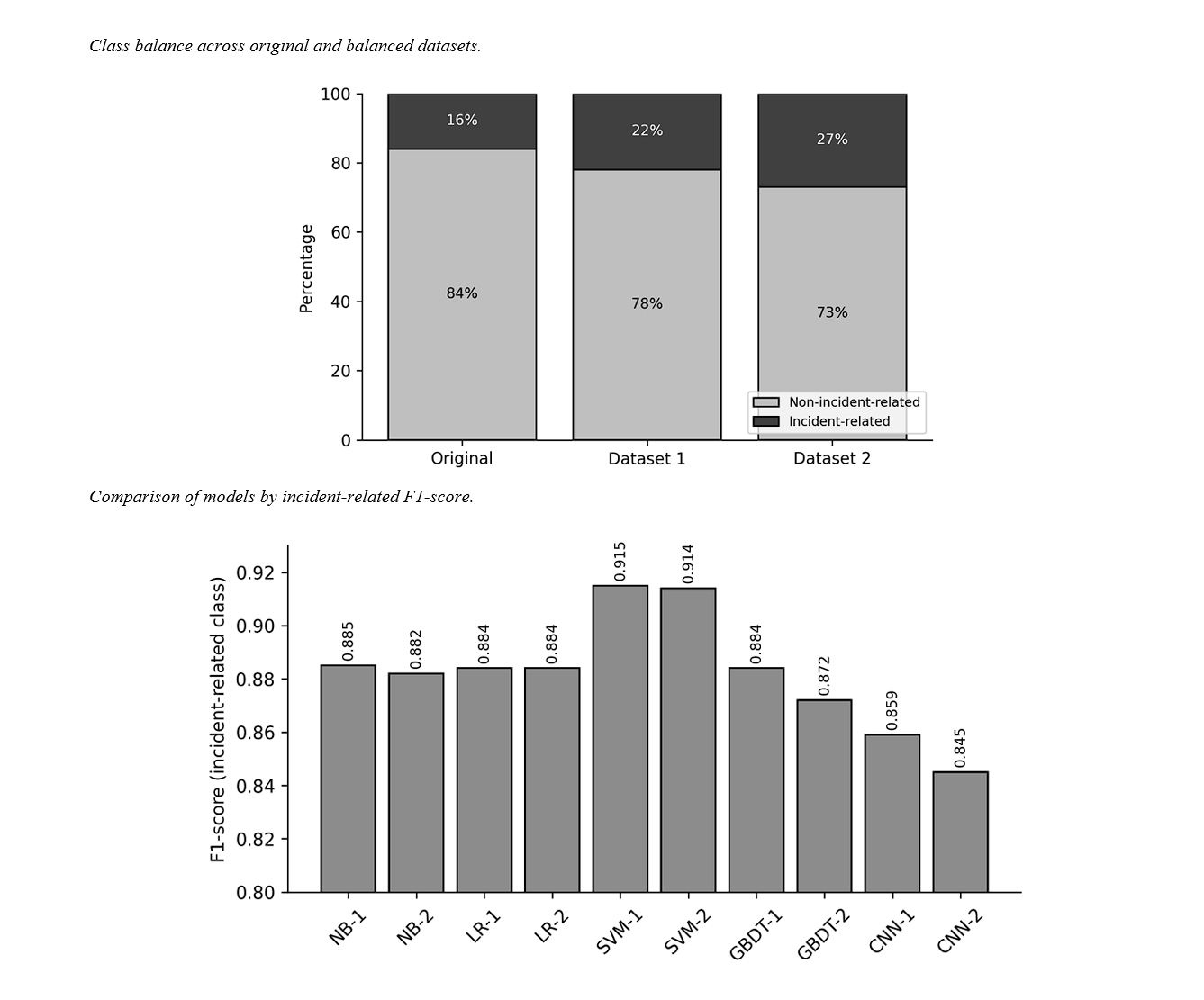
Social media platforms provide rapid public reports during demonstrations, crises, and civil unrest, but the volume and noise of user-generated content make manual monitoring impractical. This retrospective text-classification study evaluated supervised machine learning models for identifying incident-related civil unrest posts using the Civil Unrest on Twitter (CUT) dataset. The dataset consisted of 4,381 manually annotated English-language Twitter posts collected from 42 countries between 2014 and 2019. The analysis used keyword-based collection, language filtering, crowdsourced annotation, unigram bag-of-words representation, class-balancing procedures reported for the dataset, and supervised classification. Five algorithms were evaluated on the selected balanced dataset: Naive Bayes, Support Vector Machine, Logistic Regression, Gradient Boosted Decision Trees, and Convolutional Neural Network, each with and without hashtag features. In the original distribution, 690 posts were incident-related and 3,691 were non-incident-related. Dataset 2, containing 6,978 observations with 27% incident-related and 73% non-incident-related posts, was selected because it produced stronger minority-class performance. Incident-related F1-scores ranged from 0.845 to 0.915, and AUC values ranged from 0.958 to 0.977. SVM Model 1, trained with hashtag features, achieved the highest incident-related F1-score (0.915). The findings suggest that supervised classification may provide a useful filtering layer for analyst-supported civil unrest monitoring. However, the framework was evaluated on historical batch data rather than in a prospective streaming setting; therefore, real-time validation, transparent governance, multilingual testing, and stronger ethical safeguards are required before operational deployment.
Downloads
References
Atefeh, F., & Khreich, W. (2015). A survey of techniques for event detection in Twitter. Computational Intelligence, 31(1), 132-164. https://doi.org/10.1111/coin.12017
Boulianne, S. (2015). Social media use and participation: A meta-analysis of current research. Information, Communication & Society, 18(5), 524-538. https://doi.org/10.1080/1369118X.2015.1008542
Enikolopov, R., Makarin, A., & Petrova, M. (2020). Social media and protest participation: Evidence from Russia. Econometrica, 88(4), 1479-1514. https://doi.org/10.3982/ECTA14281
HaCohen-Kerner, Y., Miller, D., & Yigal, Y. (2020). The influence of preprocessing on text classification using a bag-of-words representation. PLOS ONE, 15(5), e0232525. https://doi.org/10.1371/journal.pone.0232525
Imran, M., Castillo, C., Diaz, F., & Vieweg, S. (2015). Processing social media messages in mass emergency: A survey. ACM Computing Surveys, 47(4), Article 67. https://doi.org/10.1145/2771588
Joachims, T. (1998). Text categorization with support vector machines: Learning with many relevant features. In C. Nedellec & C. Rouveirol (Eds.), Machine Learning: ECML-98 (pp. 137-142). Springer. https://doi.org/10.1007/BFb0026683
Kraft, A., & Usbeck, R. (2022). The ethical risks of analyzing crisis events on social media with machine learning. arXiv. https://arxiv.org/abs/2210.03352
Manning, C. D., Raghavan, P., & Schutze, H. (2008). Introduction to information retrieval. Cambridge University Press.
Marcus, A., Bernstein, M. S., Badar, O., Karger, D. R., Madden, S., & Miller, R. C. (2011). TwitInfo: Aggregating and visualizing microblogs for event exploration. Proceedings of the SIGCHI Conference on Human Factors in Computing Systems, 227-236. https://doi.org/10.1145/1978942.1978975
Shu, K., Sliva, A., Wang, S., Tang, J., & Liu, H. (2017). Fake news detection on social media: A data mining perspective. ACM SIGKDD Explorations Newsletter, 19(1), 22-36. https://doi.org/10.1145/3137597.3137600
Uysal, A. K., & Gunal, S. (2014). The impact of preprocessing on text classification. Information Processing & Management, 50(1), 104-112. https://doi.org/10.1016/j.ipm.2013.08.006
Van Laer, J., & Van Aelst, P. (2010). Internet and social movement action repertoires: Opportunities and limitations. Information, Communication & Society, 13(8), 1146-1171. https://doi.org/10.1080/13691181003628307
Downloads
Publication Timeline
- Submitted
- Revised
- Accepted