Job Insecurity and Turnover Intention: The Moderating Role of Psychological Capital among Nigerian Employees
DOI:
https://doi.org/10.61838/kman.jarac.5006Keywords:
Job insecurity, turnover intention, psychological capital, structural equation modeling, NigeriaAbstract
Objective: This study aimed to examine the relationship between job insecurity and turnover intention and to determine whether psychological capital moderates this relationship among employees in Nigeria.
Methods and Materials: A descriptive correlational design was employed with a sample of 410 full-time employees from diverse public and private organizations in Nigeria. The sample size was determined using Morgan and Krejcie’s table to ensure adequate statistical power. Data were collected via standardized instruments: the Job Insecurity Scale, the Psychological Capital Questionnaire (PCQ-24), and the Turnover Intention Scale (TIS-6). Statistical analyses were performed using SPSS-27 for descriptive and bivariate correlation analyses and AMOS-21 for Structural Equation Modeling (SEM). Model fit was evaluated using χ²/df, CFI, TLI, GFI, AGFI, and RMSEA indices.
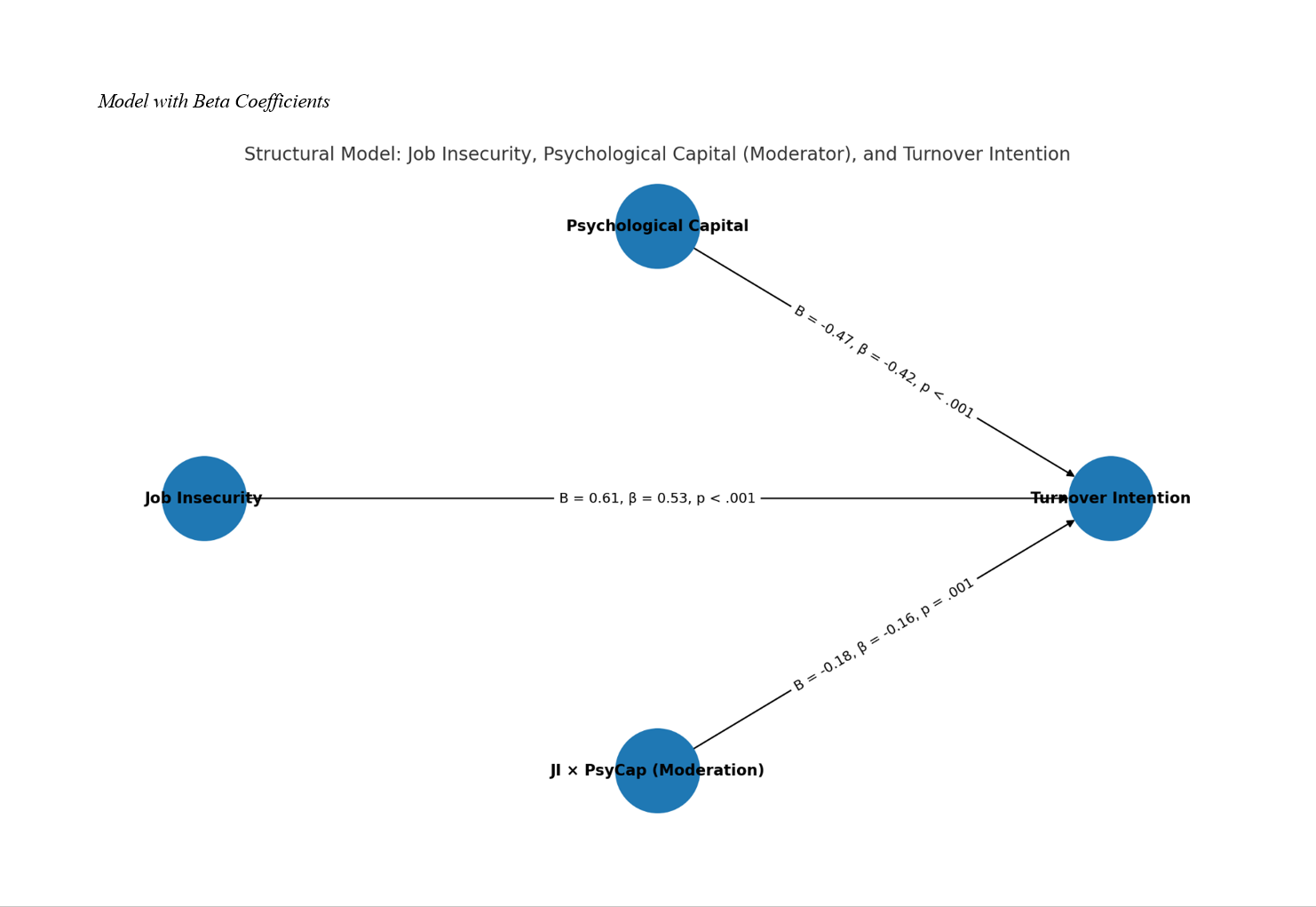
Findings: Job insecurity was positively and significantly associated with turnover intention (r = .56, p < .001), while psychological capital was negatively correlated with both job insecurity (r = –.41, p < .001) and turnover intention (r = –.48, p < .001). SEM indicated good model fit (χ² = 124.87, df = 61, χ²/df = 2.05, CFI = .96, TLI = .95, GFI = .94, AGFI = .91, RMSEA = .051). Job insecurity had a strong direct positive effect on turnover intention (β = .53, p < .001), while psychological capital showed a significant negative direct effect (β = –.42, p < .001). The interaction effect was significant (β = –.16, p = .001), confirming that higher psychological capital attenuates the impact of job insecurity on turnover intention.
Conclusion: These findings highlight the critical buffering role of psychological capital in reducing turnover intention under job insecurity. Developing employees’ hope, resilience, optimism, and self-efficacy can serve as an effective retention strategy, especially in economically volatile environments.
Downloads
References
Aditchere, J., & Angmortey, R. (2024). The Roles of Relational Leadership and Employee Satisfaction in the Linkage Between Social Capital and Employee Turnover: A Moderated-Mediation Analysis. https://doi.org/10.31124/advance.25002968.v1
Amjad, S., Basit, H. M., Khan, A. U., & Akram, H. (2024). The Influence of Psychological Empowerment &Amp; Turnover Intention Through Career Growth in Pharmaceutical Companies, Lahore, Pakistan. Jurnal Aplikasi Manajemen Ekonomi Dan Bisnis, 7(1), 53-81. https://doi.org/10.51263/jameb.v7i1.154
Ashraf, F., & Khan, M. A. (2022). A Study of Job Insecurity and Turnover Intentions Among Bullied Employees in Pakistan – Does Psychological Capital Ameliorate? Journal of Research in Social Sciences, 10(2), 1-17. https://doi.org/10.52015/jrss.10i2.187
Gom, D., Lew, T. Y., Jiony, M. M., Tanakinjal, G. H., & Sondoh, S. L. (2021). The Role of Transformational Leadership and Psychological Capital in the Hotel Industry: A Sustainable Approach to Reducing Turnover Intention. Sustainability, 13(19), 10799. https://doi.org/10.3390/su131910799
Harahap, M., & Salendu, A. (2021). Peran Perceived Organizational Support Dan Psychological Capital Sebagai Moderator Pada Hubungan Antara Job Insecurity Dan Turnover Intention. Syntax Literate Jurnal Ilmiah Indonesia, 6(1), 81. https://doi.org/10.36418/syntax-literate.v6i1.3775
Hermawan, A., Sartika, D., & Permana, R. H. (2024). Pengaruh Psychological Capital Terhadap Turnover Intention Pada Pegawai PT. X. Jurnal Riset Psikologi, 17-24. https://doi.org/10.29313/jrp.v4i1.3816
Lai, C.-H., & Chen, C. M. (2024). The Impact of Occupational Fatigue on the Turnover Intention of Workers in Shoe Manufacturing EnterprisesBased on the Mediating Role of Psychological Capital and the Moderating Role of Emotional Exhaustion. Advances in Social Behavior Research, 11(1), 76-83. https://doi.org/10.54254/2753-7102/11/2024113
Le, H., Lee, J., Nielsen, I., & Nguyen, T. L. A. (2022). Turnover Intentions: The Roles of Job Satisfaction and Family Support. Personnel Review, 52(9), 2209-2228. https://doi.org/10.1108/pr-08-2021-0582
Ma, Y., Sung, T. P., & Lü, X. (2023). The Impact of Psychological Capital and Employee Engagement on Turnover Intention: A Survey of Teachers in Guangxi Private Colleges and Universities. https://doi.org/10.4108/eai.9-12-2022.2327657
Obeng, A. F., Zhu, Y., Quansah, P. E., Ntarmah, A. H., & Cobbinah, E. (2021). High-Performance Work Practices and Turnover Intention: Investigating the Mediating Role of Employee Morale and the Moderating Role of Psychological Capital. Sage Open, 11(1). https://doi.org/10.1177/2158244020988557
Putri, A. A., & Rakhmawati, A. (2025). Pengaruh Stres Kerja Dan Psychological Capital Terhadap Kinerja Karyawan Dan Turnover Intention. Al-Kharaj Jurnal Ekonomi Keuangan & Bisnis Syariah, 7(7). https://doi.org/10.47467/alkharaj.v7i7.8925
Rahmawati, A., Havidz, I. L. H., & Cahyadi, I. M. S. (2023). Is Turnover Intention of Waste Industry Employees Determined by Career Growth, Affective, Normative and Continuance? Jurnal Logistik Indonesia, 7(2), 114-122. https://doi.org/10.31334/logistik.v7i2.3458
Sharma, I., & Tiwari, V. (2023). Modeling the Impact of Techno‐stress and Burnout on Employees’ Work‐life Balance and Turnover Intention: A Job Demands‐resources Theory Perspective. Global Business and Organizational Excellence, 43(1), 121-134. https://doi.org/10.1002/joe.22206
Sharma, I., Tiwari, V., Gupta, S., & Rana, N. P. (2024). Examining the Nexus Between Technostress and Turnover Intention: The Moderating Influence of PsyCap in Indian Information Management Contexts. Journal of Enterprise Information Management, 38(2), 450-473. https://doi.org/10.1108/jeim-08-2023-0434
Sharma, N., & Kaur, S. (2024). Effect of Psychological Contract on Employee Turnover Intention: Moderating Role of Select Demographic Variables. Environment and Social Psychology, 9(5). https://doi.org/10.54517/esp.v9i5.1793
Singh, R. (2023). “My Contract Is Breached, and I Want to Leave, but I Am Embedded!” How Do Reluctant Stayers Respond? Evidence-Based HRM a Global Forum for Empirical Scholarship, 11(4), 594-610. https://doi.org/10.1108/ebhrm-03-2022-0073
Suganda, U. K. (2022). Reducing Turnover Intention: The Mediating Role of Work-Life Balance and Organizational Commitment. International Journal of Business Ecosystem and Strategy (2687-2293), 4(3), 01-12. https://doi.org/10.36096/ijbes.v4i3.344
Syaharani, T. L. (2025). Pengaruh Psychological Capital Terhadap Turnover Intention Pada Karyawan Agensi Kreatif. Bandung Conference Series Psychology Science, 5(2). https://doi.org/10.29313/bcsps.v5i2.18968
Tetteh, S., Mensah, R. D., Opata, C. N., & Mensah, C. N. (2021). Service Employees’ Workplace Fun and Turnover Intention: The Influence of Psychological Capital and Work Engagement. Management Research Review, 45(3), 363-380. https://doi.org/10.1108/mrr-12-2020-0768
Wei, Y. C. (2022). Are Satisfied Employees Less Inclined to Quit? Moderating Effects of Human Capital and Abusive Supervision. Evidence-Based HRM a Global Forum for Empirical Scholarship, 10(4), 439-456. https://doi.org/10.1108/ebhrm-07-2021-0141
Xiao, S., Shi, L., Lin, H., Zhao, S., Ou, W., Zhang, J., Zhu, H., & Zhang, C. (2022). The Impact of Psychological Capital on Turnover Intention Among Chinese Nurses: A Moderated Mediation Model. Journal of nursing management, 30(7), 3031-3040. https://doi.org/10.1111/jonm.13702
Xue, J., Wang, H., Chen, M., Ding, X.-J., & Zhu, M.-T. (2022). Signifying the Relationship Between Psychological Factors and Turnover Intension: The Mediating Role of Work-Related Stress and Moderating Role of Job Satisfaction. Frontiers in psychology, 13. https://doi.org/10.3389/fpsyg.2022.847948
Yan, Z., Mansor, Z. D., Choo, W. C., & Abdullah, A. R. (2021). How to Reduce Employees’ Turnover Intention From the Psychological Perspective: A Mediated Moderation Model. Psychology research and behavior management, Volume 14, 185-197. https://doi.org/10.2147/prbm.s293839
Zhang, H., & Long, C. S. (2024). The Influence of Psychological Capital on Employees Turnover Intention: A Conceptual Model. Business Management and Strategy, 15(1), 109. https://doi.org/10.5296/bms.v15i1.21638
Downloads
Additional Files
Publication Timeline
- Submitted
- Revised
- Accepted