Factors Influencing Psychological Flexibility in Adults With Generalized Anxiety Disorder: A Qualitative Study
DOI:
https://doi.org/10.61838/kman.jarac.5091Keywords:
Psychological flexibility, Generalized Anxiety Disorder, Qualitative study, Semi-structured interviews, Mindfulness, Acceptance and Commitment Therapy, Coping strategiesAbstract
Objective: The aim of this study was to explore the factors influencing psychological flexibility in adults diagnosed with Generalized Anxiety Disorder (GAD).
Methods and Materials: This study employed a qualitative design using semi-structured interviews with 33 adults clinically diagnosed with GAD and residing in the United States. Participants were recruited through purposive sampling, and data collection continued until theoretical saturation was reached. Interviews lasted 45–70 minutes and were conducted either face-to-face or via secure online platforms. All interviews were audio-recorded, transcribed verbatim, and analyzed thematically using NVivo 14 software. To enhance rigor, multiple researchers coded the data, discrepancies were resolved through discussion, and reflexive memos were maintained throughout the process.
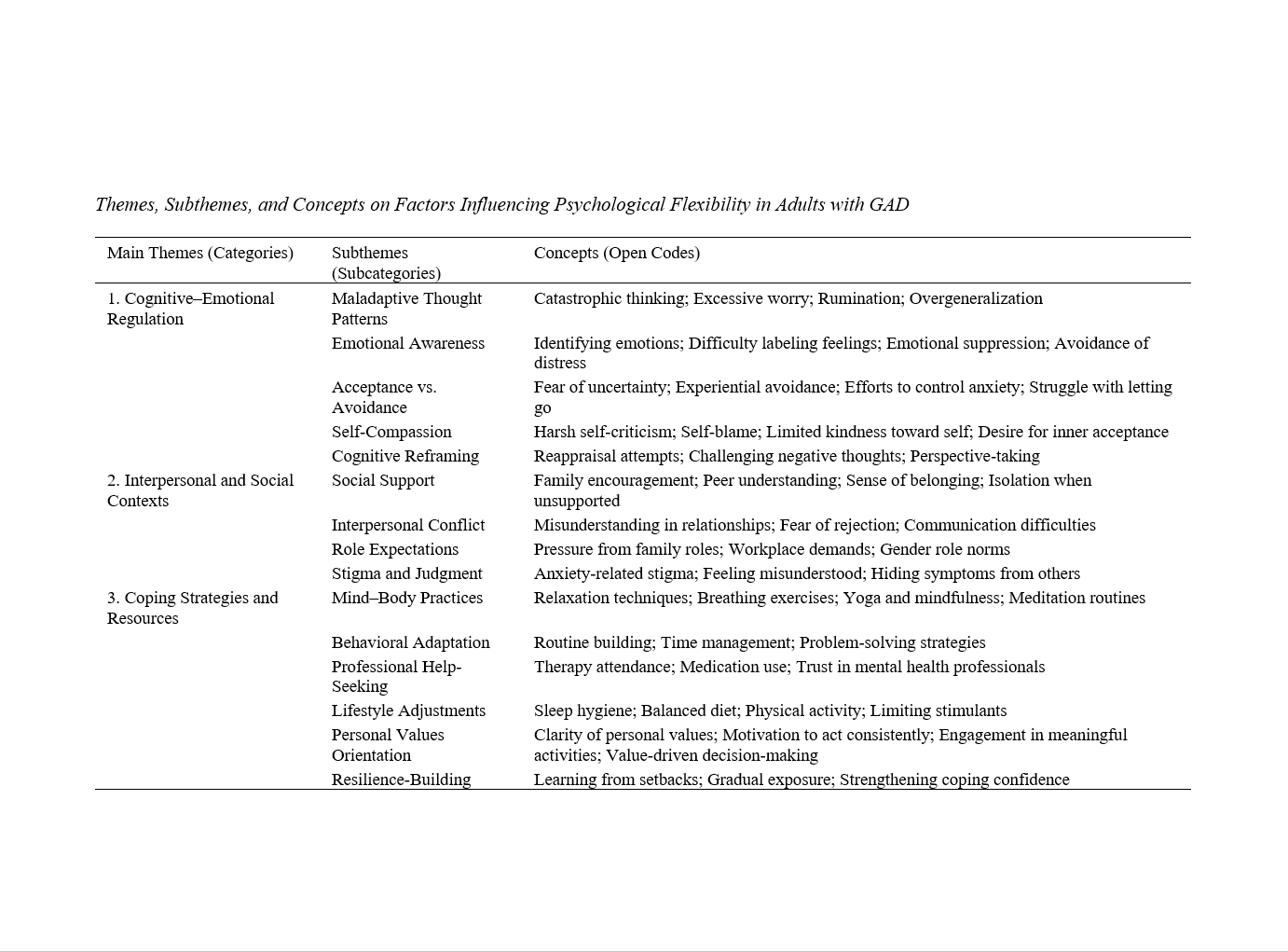
Findings: Analysis revealed three overarching themes with multiple subthemes. The first theme, cognitive–emotional regulation, included maladaptive thought patterns, emotional awareness deficits, avoidance versus acceptance struggles, lack of self-compassion, and attempts at cognitive reframing. The second theme, interpersonal and social contexts, encompassed the role of social support, interpersonal conflicts, role expectations, and experiences of stigma. The third theme, coping strategies and resources, highlighted the use of mind–body practices, behavioral adaptations, professional help-seeking, lifestyle adjustments, values orientation, and resilience-building. Participant quotations illustrated the tension between inflexibility (e.g., catastrophic thinking, self-criticism, concealment of symptoms) and adaptive coping strategies (e.g., mindfulness practices, values-driven actions).
Conclusion: This study provides an in-depth understanding of the multifaceted factors influencing psychological flexibility in adults with GAD. Findings underscore the interplay between cognitive-emotional processes, interpersonal dynamics, and coping resources, suggesting that interventions should not only target individual-level mechanisms such as acceptance and reappraisal but also address relational support and stigma reduction. Enhancing flexibility through mindfulness, self-compassion, and values-based strategies may improve resilience and functioning in this population.
Downloads
References
Aldiqs, M., Hamdan‐Mansour, A. M., Nowwara, A., Alhusamiah, B. K., Abuhashish, Y. H., & Amer, N. R. Y. (2025). Using Mindfulness-Based Cognitive Therapy to Reduce Anxiety Symptoms Among Individuals Diagnosed With Substance Use Disorder. Advances in Dual Diagnosis, 18(1), 14-25. https://doi.org/10.1108/add-09-2024-0028
Bijulakshmi, P., & Kumar, V. V. B. (2024). A Cross-Sectional Study on the Levels of Psychological Flexibility Among Individuals Diagnosed With Anxiety Disorders. Indian Journal of Psychiatric Nursing, 21(2), 97-101. https://doi.org/10.4103/iopn.iopn_86_23
Browning, M. E., Lloyd‐Richardson, E. E., Satterfield, S. L., & Trisal, A. V. (2023). A Pilot Study of Experiencing Racial Microaggressions, Obsessive-Compulsive Symptoms, and the Role of Psychological Flexibility. Behavioural and Cognitive Psychotherapy, 51(5), 396-413. https://doi.org/10.1017/s1352465823000188
Büyüköksüz, E., & Kayaalp-pehlivan, R. (2025). Psychological Inflexibility, Mindfulness, Emotion Regulation, Self-Compassion, and Anxiety in Adults: A Serial Mediation Model. Muğla Sıtkı Koçman Üniversitesi Eğitim Fakültesi Dergisi, 12(1), 107-134. https://doi.org/10.21666/muefd.1643883
Dörner, M., Känel, R. v., König, N., Pazhenkottil, A. P., Altwegg, R., Nager, L., Attanasio, V., Guth, L., Zirngast, S., Menzi, A., Zuccarella‐Hackl, C., & Princip, M. (2024). Mindfulness Is Associated With Lower Depression, Anxiety, and Post-Traumatic Stress Disorder Symptoms and Higher Quality of Life in Patients With an Implantable Cardioverter–Defibrillator—A Cross-Sectional Study. Healthcare, 12(11), 1118. https://doi.org/10.3390/healthcare12111118
Hammerstein, C. v., Khazaal, Y., Dupuis, M., Aubin, H. J., Benyamina, A., Luquiens, A., & Romo, L. (2019). Feasibility, Acceptability and Preliminary Outcomes of a Mindfulness-Based Relapse Prevention Program in a Naturalistic Setting Among Treatment-Seeking Patients With Alcohol Use Disorder: A Prospective Observational Study. BMJ open, 9(5), e026839. https://doi.org/10.1136/bmjopen-2018-026839
Hebert, K., & Best, L. A. (2021a). Factors Contributing to Well-Being: Comparing Functional Somatic Symptom Disorders and Well-Defined Autoimmune Disorders. 4, 128-132. https://doi.org/10.36315/2021inpact027
Hebert, K., & Best, L. A. (2021b). Living With a Chronic Disorder: The Benefits of Mindfulness and Psychological Flexibility. https://doi.org/10.36315/2021padvii23
Heredia, L., Ventura, D., Torrente, M., & Vicens, P. (2024). An 8‐week Secular Mindfulness‐based Training Program for Schoolteachers Increases Dispositional Mindfulness, Self‐reported Workplace Well‐being, Visuoconstructive Abilities, and Processing Speed. Mind Brain and Education, 18(3), 236-248. https://doi.org/10.1111/mbe.12419
Hoge, E. A., Reese, H. E., Oliva, I. A., Gabriel, C. D., Guidos, B. M., Bui, É., Simon, N. M., & Dutton, M. A. (2020). Investigating the Role of Interpretation Bias in Mindfulness-Based Treatment of Adults With Generalized Anxiety Disorder. Frontiers in psychology, 11. https://doi.org/10.3389/fpsyg.2020.00082
Huang, C., Xie, J., Owusua, T., Chen, Z., Wang, J., Qin, C., & He, Q. (2021). Is Psychological Flexibility a Mediator Between Perceived Stress and General Anxiety or Depression Among Suspected Patients of the 2019 Coronavirus Disease (COVID-19)? Personality and individual differences, 183, 111132. https://doi.org/10.1016/j.paid.2021.111132
Karbasdehi, Z. N., Fakhri, M., & Ghanadzadegan, H. (2024). Comparing the Effectiveness of Mindfulness and Positive Psychology Training on Reappraisal and Suppression in Students With Generalized Anxiety Disorder Symptoms. Jarac, 6(1), 195-203. https://doi.org/10.61838/kman.jarac.6.1.22
Kaynakçı, F. Z. Ü., Aydın, G., & Üçok, S. B. Ö. (2025). ACT‐Based Psychoeducation Program for Reducing Test Anxiety: A Mixed Method Case Study of Economically Disadvantaged Students. Psychology in the Schools. https://doi.org/10.1002/pits.23583
Masuda, A., Goodnight, B., Caporino, N. E., Rapadas, C. C., & Tully, E. C. (2025). The Roles of Psychological Inflexibility and Mindful Awareness on Distress in a Convenience Sample of Black American Adults in the United States. Behavioral Sciences, 15(2), 112. https://doi.org/10.3390/bs15020112
Nikzadi, H., Zakiei, A., & Ahmadi, V. (2023). The Role of Psychological Flexibility Components in Predicting Anxiety and Insomnia Severity. https://doi.org/10.21203/rs.3.rs-3279306/v1
Noruzi, M., Nazari, F., Karimi, J., Mohajerin, B., Ranjbari, T., & Lotfinia, S. (2024). Psychological Inflexibility: The Role of Trans Diagnostic Processes in Major Depressive Disorder, Generalized Anxiety Disorder and Obsessive-Compulsive Disorder. Appl Psychol Health Promot, 1(1). https://doi.org/10.5812/aphp-148467
Oliveira, S., Cunha, M., Rosado, A., Saraiva, M., & Ferreira, C. (2025). Mindfulness and Psychological Inflexibility in Portuguese Adolescent Athletes: A Novel Framework for Understanding the Link Between Shame and Sports Anxiety. Journal of Clinical Sport Psychology, 19(2), 215-232. https://doi.org/10.1123/jcsp.2023-0041
Özkan, E. (2025). Öz Duyarlılık Sosyal Kaygı Psikolojik Esneklik Üzerine Bir Derleme. International Journal of Social Sciences, 9(40), 43-64. https://doi.org/10.52096/usbd.9.40.04
Pang, N. T. P., Imon, G. N., Johoniki, E., Kassim, M. A. M., Omar, A., Syed Sharizman Syed Abdul, R., Hayati, F., Jeffree, M. S., & Ng, J. R. (2021). Fear of COVID-19 and COVID-19 Stress and Association With Sociodemographic and Psychological Process Factors in Cases Under Surveillance in a Frontline Worker Population in Borneo. International journal of environmental research and public health, 18(13), 7210. https://doi.org/10.3390/ijerph18137210
Piguet, C., Klauser, P., Celen, Z., Murray, R. J., Smith, M. M., & Merglen, A. (2021). Randomized Controlled Trial of a Mindfulness‐based Intervention in Adolescents From the General Population: The Mindfulteen Neuroimaging Study Protocol. Early Intervention in Psychiatry, 16(8), 891-901. https://doi.org/10.1111/eip.13235
Saraswati, P., Kanujia, S., & Kapri, B. C. (2024). The Impact of Yoga on Athletes' Mental Well-Being: An Experimental Study. Cureus. https://doi.org/10.7759/cureus.66044
Shabkolaei, M. E., Salehani, Z., & Lesani, S. (2024). Effectiveness of Acceptance and Commitment Therapy on Cognitive Fusion and Social Anxiety in Women With Generalized Anxiety Disorder. Aftj, 5(3). https://doi.org/10.61838/kman.aftj.5.3.3
Taha, S. M., & Elhay, E. A. (2022). Psychological Flexibility, Mindfulness and Perceived Social Support as Predictors of Psychological Symptoms Among Nursing Faculty Students at Mansoura University. Assiut Scientific Nursing Journal, 10(28), 10-20. https://doi.org/10.21608/asnj.2022.112602.1287
Tan, K. P., Ang, J. K., Koh, E. B. Y., Pang, N. T. P., & Saher, Z. M. (2023). Relationship of Psychological Flexibility and Mindfulness to Caregiver Burden, and Depressive and Anxiety Symptoms in Caregivers of People With Dementia. International journal of environmental research and public health, 20(5), 4232. https://doi.org/10.3390/ijerph20054232
Wielgus, B., Urban, W., Patriak, A., & Cichocki, Ł. (2020). Examining the Associations Between Psychological Flexibility, Mindfulness, Psychosomatic Functioning, and Anxiety During the COVID-19 Pandemic: A Path Analysis. International journal of environmental research and public health, 17(23), 8764. https://doi.org/10.3390/ijerph17238764
Головачева, В. А. (2023). Interdisciplinary Treatment Including Cognitive Behavioral Therapy and Mindfulness for Chronic Migraine and Drug-Induced Headache. Meditsinskiy Sovet = Medical Council(10), 80-88. https://doi.org/10.21518/ms2023-216
Downloads
Additional Files
Publication Timeline
- Submitted
- Revised
- Accepted