Machine‑Learning Prediction of Academic Stress from Working Memory Load and Neuroticism Facets
DOI:
https://doi.org/10.61838/kman.jarac.5166Keywords:
Academic Stress, Working Memory, Neuroticism, Machine Learning, StudentsAbstract
Objective: To employ advanced machine learning algorithms to predict the severity of academic stress among university students by synthesizing metrics of working memory load and specific facets of the neuroticism personality trait.
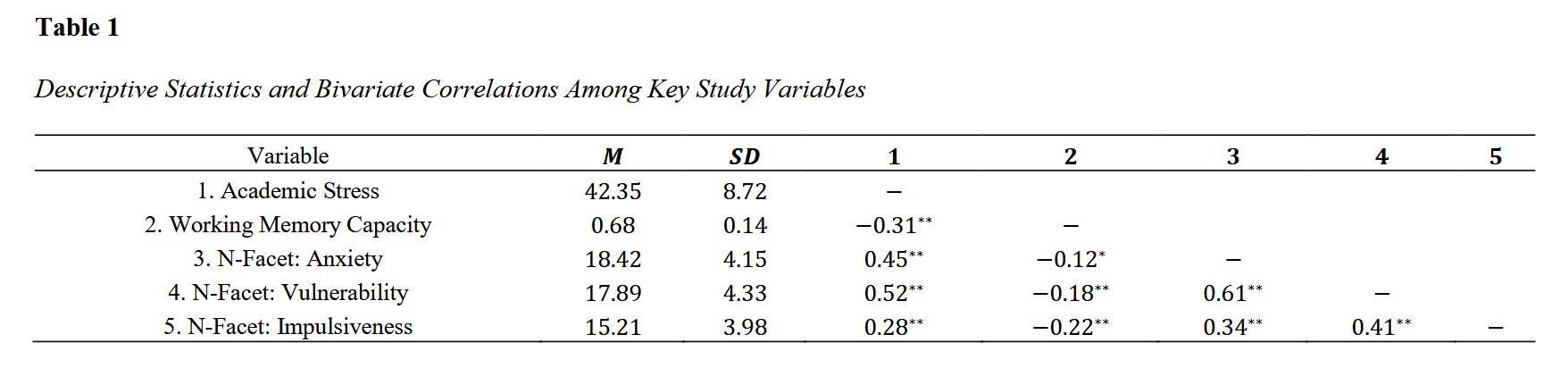
Methods and Materials: This predictive cross-sectional study evaluated a sample of N=452 Brazilian university students. Data were collected utilizing the Perception of Academic Stress Scale, a dual N-back task to measure working memory capacity, and the NEO Personality Inventory-Revised to assess neuroticism facets. The predictive modeling utilized several machine learning algorithms, with a primary focus on eXtreme Gradient Boosting (XGBoost). The dataset was split into an 80%training set with 10-fold cross-validation and a 20%hold-out test set, and feature importance was interpreted using SHapley Additive exPlanations (SHAP) values.
Findings: The XGBoost algorithm yielded the most robust predictive performance, explaining a significant portion of the variance in the test set (R^2=0.58, MAE=4.12, RMSE=5.36). SHAP analysis revealed that the Vulnerability to Stress facet was the strongest positive predictor of academic stress (mean absolute SHAP = 2.84), whereas Working Memory Capacity emerged as the strongest negative, protective predictor (mean absolute SHAP = 1.95), specifically when surpassing a standardized threshold of Z=0.50.
Conclusion: Machine learning architectures successfully demonstrate that academic stress is deeply driven by non-linear interactions between a student’s intrinsic emotional vulnerability and their momentary cognitive working memory capacity.
Downloads
References
Almurumudhe, L. K. A., Mahdad, A., Abdulkadhim Johni, A., & Yousefi, Z. (2024). The Mediating Role of Self-Esteem in the Relationship between Psychological Capital, Academic Engagement, and Academic Procrastination with Academic Performance among Students in Al-Diwaniyah, Iraq [Research Article]. Iranian Journal of Educational Sociology, 7(3), 1-9. https://doi.org/10.61838/kman.ijes.7.3.1
Aloufi, M. A., Jarden, R. J., Gerdtz, M. F., & Kapp, S. (2021). Reducing stress, anxiety and depression in undergraduate nursing students: Systematic review. Nurse Education Today, 102, 104877. https://doi.org/10.1016/j.nedt.2021.104877
Amalianita, B., Kusaini, U. N., Yulianti, Y., Zubaidah, Z., & Putri, Y. E. (2025). Analysis of Coping Mechanisms on Student Resilience in Managing Academic Stress. International. J. Of. Educ. Culture. Soc., 3(1), 155-165. https://doi.org/10.58578/ijecs.v3i1.4375
Antony, F. D., Maharani, F. T., Apriliani, E., & Lestari, I. A. (2025). The Relationship Between Academic Stress Levels and Insomnia Among University Students. Health and Technology Journal (Htechj), 3(1), 108-119. https://doi.org/10.53713/htechj.v3i1.300
Bai, Q., Bai, S., Dan, Q., Lei, L., & Wang, P. (2020). Mother phubbing and adolescent academic burnout: The mediating role of mental health and the moderating role of agreeableness and neuroticism. Personality and individual differences, 155, 109622. https://doi.org/10.1016/j.paid.2019.109622
Baniasadi, T. (2024). Comparison of Executive Function and Working Memory among Children with High and Low Levels of Physical Activity. International Journal of Education and Cognitive Sciences, 5(3), 9-15. https://doi.org/10.61838/kman.ijeas.5.3.2
Brambila‐Tapia, A. J. L., Velarde-Partida, E. U., Carrillo-Delgadillo, L. A., Macías-Espinoza, F., & Santos, S. R. l. (2025). Association Between Academic, Cognitive and Health-Related Variables With Academic Stress in Health Sciences University Students. Behavioral Sciences, 15(9), 1219. https://doi.org/10.3390/bs15091219
Buils, R. F., & Mateu-Pérez, R. (2025). The Reciprocal Relationship Between Vocational Indecision and Academic Stress, and How to Cope With It Through Resilience. Education Sciences, 15(2), 222. https://doi.org/10.3390/educsci15020222
Emami Khotbesara, Z., Mahdian, H., & Bakhshipour, A. (2024). Comparing the Effectiveness of Academic Buoyancy and Psychological Capital Training on Academic Procrastination in Female High School Students [Research Article]. Iranian Journal of Educational Sociology, 7(3), 149-160. https://doi.org/10.61838/kman.ijes.7.3.18
Fahim, A. U., Liza, S. J., Lina, S. J., & Salim, M. A. A. (2022). Study of Mental Stress Related with Lifestyle During COVID-19: A Case Study of Bangladesh. International Journal of Education and Cognitive Sciences, 3(2), 30-41. https://doi.org/10.22034/injoeas.2022.160611
García-Martínez, I., Augusto-Landa, J. M., León, S. P., & Quijano-López, R. (2023). Pathways between self-concept and academic stress: The role of emotional intelligence and personality among university students. Journal of Further and Higher Education, 47(2), 182-196. https://doi.org/10.1080/0309877X.2022.2102413
Haseli Songhori, M., & Salamti, K. (2024). The Linkage Between University Students’ Academic Engagement and Academic Support: The Mediating Role of Psychological Capital [Research Article]. Iranian Journal of Educational Sociology, 7(2), 72-84. https://doi.org/10.61838/kman.ijes.7.2.10
Hashemi, Z., Aini, S., & Taghavi, R. (2020). Examining the moderating role of spiritual intelligence in the relationship between HEXACO personality traits and academic stress among students. Psychological Sciences, 19(88), 451-461.
Igomigo, R., Obosi, A., & Oyelade, O. (2023). Influence of self-efficacy, academic motivation, academic stress and anxiety on memory recall among PG students. https://doi.org/10.21203/rs.3.rs-3715535/v1
Imran, M. (2025). The Impact of Academic Stress on the Mental Health and Well-Being of Higher Education’s Female Students. Res. J. Social Affairs, 3(1), 317-325. https://doi.org/10.71317/rjsa.003.01.0088
kang, m.-g., & Kim, S. (2025). Effects of Adolescent Grit, Parental Supervision, and Academic Stress on Self-Regulated Learning. K Assoc Edu Res, 10(2), 741-754. https://doi.org/10.48033/jss.10.2.36
Kashanian, A. A., & Sheikhpour, M. (2023). The Relationship between Personality and Psychological Well-Being with the Mediation of Positive Affectivity in High School Students. Journal of Assessment and Research in Applied Counseling (JARAC), 5(3), 87-93. https://doi.org/10.61838/kman.jarac.5.3.12
Kritikou, M., & Giovazolias, T. (2022). Emotion regulation, academic buoyancy, and academic adjustment of university students within a self-determination theory framework: A systematic review [Systematic Review]. Frontiers in psychology, 13. https://doi.org/10.3389/fpsyg.2022.1057697
Kuftyak, E. V. (2022). Procrastination, stress and academic performance in students. ARPHA Proceedings, 5, 965-974. https://doi.org/10.3897/ap.5.e0965
Liao, J. M. (2025). Attachment Styles and Coping Efficiency: Navigating Academic Stress. Lecture Notes in Education Psychology and Public Media, 92(1), 107-112. https://doi.org/10.54254/2753-7048/2025.22968
Mahmoudi, M., Saberi, H., & Bashardoust, S. (2022). Predicting psychological distress based on childhood trauma with the mediating role of alexithymia. icss, 24(3), 41-56. https://doi.org/10.30514/icss.24.3.41
Mashhadi, R., Ghaffari, M.-H., Jafar Tabatabaei, T. S., & Jafar Tabatabaei, S. S. (2023). The effectiveness of Self-regulation training on Distress Tolerance and Academic Engagement of Depressed students. IJNR, 18(5), 12-21. https://doi.org/10.22034/IJNR.18.5.12
Musso, P., Coppola, G., Pantaleo, E., Amoroso, N., Balenzano, C., Bellotti, R., Cassibba, R., Diacono, D., & Monaco, A. (2022). Psychological counseling in the Italian academic context: Expected needs, activities, and target population in a large sample of students. PLoS One, 17(4), e0266895. https://doi.org/10.1371/journal.pone.0266895
Pourjaberi, B., Shirkavand, N., & Ashoori, J. (2023). The Effectiveness of Cognitive Rehabilitation Training on Prospective Memory and Cognitive Flexibility in Individuals with Depression. International Journal of Education and Cognitive Sciences, 4(3), 45-53. https://doi.org/10.61838/kman.ijecs.4.3.5
Pourshalchi, H., Mahdavi, F., Radman, F., & Ostakhri, Z. (2025). The Effectiveness of Teaching Self-Regulation Strategies on Resilience and Academic Stress in Students with Low Academic Performance. Journal of Child Nursing, 11(3), 1-11. https://jpen.ir/browse.php?a_id=813&sid=1&slc_lang=fa
Rajbahak, A., Thapaliya, R., Bhattarai, P. C., & Devkota, A. (2025). Understanding the Academic Stress-Sleep Quality: Implications for Academic Performance. Int. J. Atharva, 3(1), 59-72. https://doi.org/10.3126/ija.v3i1.76715
Saleem, M. S., Isha, A. S. N., Awan, M. I., Yusop, Y. B., & Naji, G. M. A. (2022). Fostering Academic Engagement in Post-graduate Students: Assessing the Role of Positive Emotions, Positive Psychology, and Stress [Original Research]. Frontiers in psychology, 13. https://doi.org/10.3389/fpsyg.2022.920395
Samong, E. C. (2024). Academic Stress: Coping Strategies by Nursing Students. International Journal of Social Science and Human Research, 07(02). https://doi.org/10.47191/ijsshr/v7-i02-11
Sarfika, R., Saifudin, I. M. M. Y., Malini, H., Effendi, N., & Wenny, B. P. (2024). Peer Pressure and Academic Stress Among Junior High School Students: A Cross-Sectional Study†. Frontiers of Nursing, 11(2), 191-199. https://doi.org/10.2478/fon-2024-0020
Sedighi Arfaee, F., Rashidi, A., & Tabesh, R. (2021). The Distress Tolerance in the Elderly: The Role of Experiential Avoidance, Rumination and Mindfulness. Aging Psychology, 7(1), 12-11. https://doi.org/10.22126/jap.2021.6108.1498
Shalu, S. S., Mathew, E. M., Preethi, P., Reshma, R., Mallikarjun, M., Nitin, N., Jat, M. C., & Natekar, D. S. (2025). A Correlational Study to Assess the Academic Stress and Self Esteem Among School Going Adolescents in Bagalkot. Scholars Journal of Applied Medical Sciences, 13(02), 483-487. https://doi.org/10.36347/sjams.2025.v13i02.032
Singh, L. B., Kumar, A., & Srivastava, S. (2021). Academic burnout and student engagement: a moderated mediation model of internal locus of control and loneliness. Journal of International Education in Business, 14(2), 219-239. https://doi.org/10.1108/JIEB-03-2020-0020
Suwajo, T. (2024). Correlation of Learning Engagement and Social Support Affecting the Academic Stress of Thai High School Students. International Journal of Public Health Science (Ijphs), 13(3), 1095. https://doi.org/10.11591/ijphs.v13i3.23680
Van, T. (2024). The Relationship Between Academic Stress and Dropout Intention of University Students: The Mediating Role of Teacher and Family Support. Revista Romaneasca pentru Educatie Multidimensionala, 16(2), 642-665. https://doi.org/10.18662/rrem/16.2/877
Varo, C., Aires-González, M. d. M., Jiménez, M. G., Sánchez, M. E. T., & Cano‐García, F. J. (2023). Effective Coping With Academic Stress Is a Matter of Personality Types: Revisiting the Person-Centred Approach. Behavioral Sciences, 13(8), 687. https://doi.org/10.3390/bs13080687
Wang, Z., Li, C., Xie, Z., & Hong, O. T. (2024). Grit Difference in the Association Between Academic Stress and Adolescents' Meaning in Life: The Roles of School Burnout and Self‐Compassion. Child Care Health and Development, 50(6). https://doi.org/10.1111/cch.70005
Zuo, X., Zhao, L., Li, Y., He, W., Yu, C., & Wang, Z. (2024). Psychological mechanisms of English academic stress and academic burnout: the mediating role of rumination and moderating effect of neuroticism. Frontiers in psychology, 15, 1309210. https://doi.org/10.3389/fpsyg.2024.1309210
Downloads
Additional Files
Publication Timeline
- Submitted
- Revised
- Accepted