A Predictive ML Model of Self‑Compassion, Shame‑Proneness, and Emotion Regulation Strategies in Counseling Outcomes
DOI:
https://doi.org/10.61838/kman.jarac.5205Keywords:
Machine Learning, Self-Compassion, Shame-Proneness, Emotion RegulationAbstract
Objective: The primary objective of this study was to construct and validate a predictive machine learning model to determine the relative mathematical feature importance and prognostic capacity of baseline self-compassion, shame-proneness, and emotion regulation strategies on outpatient clinical counseling outcomes.
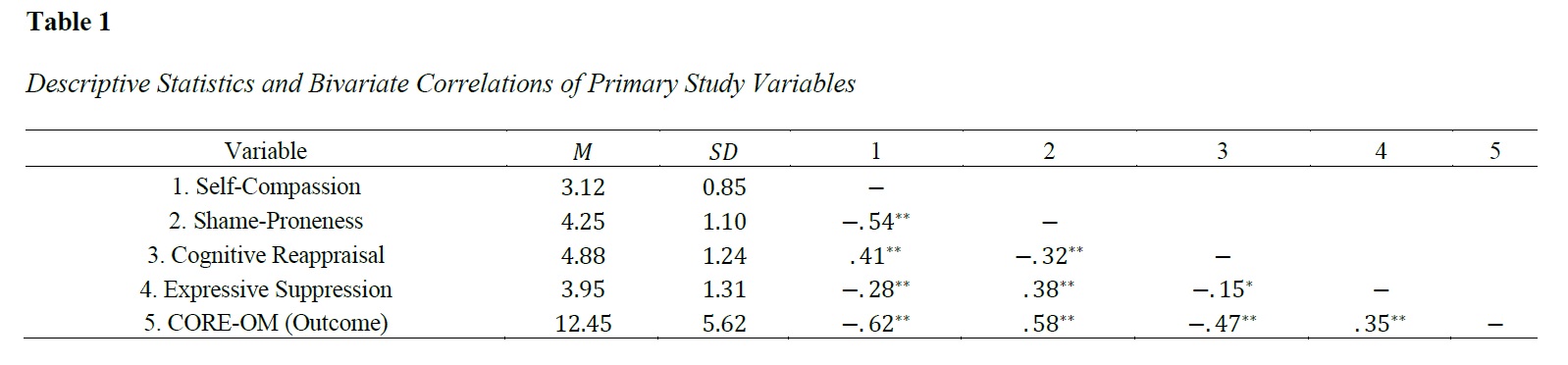
Methods and Materials: A prospective observational cohort design was utilized with n=452 Canadian adult outpatients attending a minimum of 6 psychotherapy sessions. Baseline psychological variables were assessed using the 26-item Self-Compassion Scale (SCS), the Test of Self-Conscious Affect (TOSCA) shame-proneness subscale, and the 10-item Emotion Regulation Questionnaire (ERQ). Ultimate treatment outcomes were quantified at termination using the 34-item Clinical Outcomes in Routine Evaluation-Outcome Measure (CORE-OM). Data preprocessing incorporated K-Nearest Neighbors imputation for missing values and Z-score normalization (z=(x-μ)/σ) for all psychometric features. Following dimensionality reduction, a Random Forest regressor was trained on an 80%training split (n=361) employing 10-fold cross-validation for hyperparameter tuning, and subsequently evaluated on a 20%testing split (n=91).
Findings: The optimized Random Forest model (n_estimators=200, max_depth=10) demonstrated robust predictive generalization on the independent testing set, accounting for 61%of the variance in counseling outcomes (R^2=.61) with a Root Mean Square Error (RMSE) of 3.45and a Mean Absolute Percentage Error (MAPE) of 16.5%. The algorithmic extraction of Gini importance scores revealed a definitive predictive hierarchy: baseline self-compassion emerged as the paramount prognostic indicator (score =.385), followed sequentially by shame-proneness (.312), cognitive reappraisal (.195), and expressive suppression (.108).
Conclusion: Baseline self-compassion and shame-proneness serve as the most critical transdiagnostic determinants of psychotherapeutic success, demonstrating that the application of machine learning algorithms to intake assessments can revolutionize personalized prognostic modeling and clinical treatment planning.
Downloads
References
Bhuptani, P. H., & Messman, T. L. (2021). Self-compassion and shame among rape survivors. Journal of interpersonal violence, 37(17-18), NP16575-NP16595. https://doi.org/10.1177/08862605211021994
Büyüköksüz, E., & Kayaalp-pehlivan, R. (2025). Psychological Inflexibility, Mindfulness, Emotion Regulation, Self-Compassion, and Anxiety in Adults: A Serial Mediation Model. Muğla Sıtkı Koçman Üniversitesi Eğitim Fakültesi Dergisi, 12(1), 107-134. https://doi.org/10.21666/muefd.1643883
Cutajar, K., & Bates, G. (2025). Australian Women in the Perinatal Period During COVID-19: The Influence of Self-Compassion and Emotional Regulation on Anxiety, Depression, and Social Anxiety. Healthcare, 13(2), 120. https://doi.org/10.3390/healthcare13020120
Jeon, S., & Park, K.-H. (2023). The Relationship Between Internalized Shame and Self-Concealment: The Mediating Effects of Fear of Negative/Positive Evaluation and Self-Compassion. Korean Association for Learner-Centered Curriculum and Instruction, 23(23), 507-520. https://doi.org/10.22251/jlcci.2023.23.23.507
Kang, M., & Jo, H. (2024). The Influence of Social Comparison Tendency on SNS Addiction Tendency: The Mediating Effect of Internalized Shame Moderated by Self-Compassion. Korean Association for Learner-Centered Curriculum and Instruction, 24(22), 1-16. https://doi.org/10.22251/jlcci.2024.24.22.1
Kotera, Y., Tsuda‐McCaie, F., Edwards, A. M., Bhandari, D., Williams, D., & Neary, S. (2022). Mental Health Shame, Caregiver Identity, and Self-Compassion in UK Education Students. Healthcare, 10(3), 584. https://doi.org/10.3390/healthcare10030584
Liu, C., Lin, P. T., & Xiong, Z. (2024). Self-Compassion and Psychological Flourishing Among College Students: The Mediating Role of Hope and the Moderating Role of Emotion Regulation. Behavioral Sciences, 14(12), 1149. https://doi.org/10.3390/bs14121149
Mills, J. S., Minister, C., & Samson, L. (2022). Enriching sociocultural perspectives on the effects of idealized body norms: Integrating shame, positive body image, and self-compassion. Frontiers in psychology, 13, 983534. https://doi.org/10.3389/fpsyg.2022.983534
Moradmand, M., Ashayeri, H., & Namvar, H. (2023). Prediction of Adolescent Shame Based on Self-Compassion and Emotional Regulation According to the Mediating Role of Problem Solving. Aftj, 4(5), 57-83. https://doi.org/10.61838/kman.aftj.4.5.4
Nguyen, A., Grummitt, L., Barrett, E. L., Bailey, S., Gardner, L. A., Champion, K. E., & Birrell, L. (2025). The relationship between emotion regulation and mental health in adolescents: Self-compassion as a moderator. Mental Health & Prevention, 38. https://doi.org/10.1016/j.mhp.2025.200430
Ohadi Haeri, H., Tavakoli Toroghi, E., & Ebrahimi, S. (2024). Predicting Loneliness Based on Attachment Style and Emotional Dysregulation with the Mediation of Self-Compassion. Psychological studies, 20(4), 105-120. https://doi.org/10.22051/psy.2025.48275.3023
Omidi, A., Ahmadi, V., & valizadeh, r. (2024). Comparison of the effectiveness of emotion regulation training with cognitive therapy based on mindfulness on perceived stress and self-compassion in patients with irritable bowel syndrome. medical journal of mashhad university of medical sciences, 66(6). https://mjms.mums.ac.ir/article_23901.html
Osareh, N., Pirani, Z., & ZanganehMolagh, F. (2024). Evaluating the effectiveness of cognitive self-compassion and emotion regulation training on motivational self-regulation and social and adaptive functioning of female students with anxiety. school psychology and institution, 13(1), 63-76. https://journal.uma.ac.ir/article_2907.html?lang=en
Park, S., & Lee, H.-K. (2024). The Relationship Between Internalized Shame and Relationship Addiction in University (Graduate) Students: Self-Compassion and Distress Tolerance as Sequential Mediators. Korean Assoc Learner-Centered Curric Instr, 24(24), 175-189. https://doi.org/10.22251/jlcci.2024.24.24.175
Rasouli, M., Khazaie, H., & Yarahmadi, Y. (2024). Predicting Sexual Distress Based on Self-Compassion in Women With a History of Mastectomy: Investigation of the Mediating Role of Body Image and Difficulties in Emotion Regulation. Middle East Journal of Rehabilitation and Health Studies, 11(4). https://doi.org/10.5812/mejrh-144890
Rehman, S., Addas, A., Rehman, E., & Khan, M. A. (2024). The Mediating Roles of Self-Compassion and Emotion Regulation in the Relationship Between Psychological Resilience and Mental Health Among College Teachers. Psychology research and behavior management, Volume 17, 4119-4133. https://doi.org/10.2147/prbm.s491822
Rezagholiyan, M., Nemati, F., & Hashemi, T. (2025). Development of a Model of Students' Subjective Well-Being Based on Attachment Styles, Self-Compassion, and Emotion Regulation Styles with the Mediating Role of Quality of Life. Journal of Adolescent and Youth Psychological Studies (JAYPS), 6(1), 21-33. https://doi.org/10.61838/
Sadeghi, A., Jahangiri, M., & Taghvaei, D. (2024). The effectiveness of self-compassion-focused therapy on depression, caregiver burden, and emotional dysregulation in caregivers of elderly patients with Alzheimer's disease. Journal of Research in Psychological Health, 18(2), 1-20. https://system.khu.ac.ir/rph/article-1-4524-fa.pdf
Seekis, V., & Kennedy, R. (2023). The impact of beauty and self-compassion TikTok videos on young women's appearance shame and anxiety, self-compassion, mood, and comparison processes. Body Image, 45, 117-125. https://doi.org/10.1016/j.bodyim.2023.02.006
Sim, H. R., & Choi, H. N. (2023). The Moderated Mediating Effect of Self-Compassion on the Relationship Between Internalized Shame, Rumination, and Interpersonal Satisfaction. Korean Association for Learner-Centered Curriculum and Instruction, 23(11), 479-495. https://doi.org/10.22251/jlcci.2023.23.11.479
Siwik, C. J., Phillips, K., Zimmaro, L., Salmon, P., & Sephton, S. E. (2022). Depressive symptoms among patients with lung cancer: elucidating the roles of shame, guilt, and self-compassion. J. Health Psychol., 27(5), 1039-1047. https://doi.org/10.1177/1359105320988331
Skelton, W. M., Cardaciotto, L., O'Hayer, C. V., & Goldbacher, E. (2021). The role of self-compassion and shame in persons living with HIV/AIDS. AIDS care, 33(6), 818-826. https://doi.org/10.1080/09540121.2020.1769836
Syafitri, N., Lubis, R., Indrawan, Y. F., & Choong, T. C. (2024). Self-Compassion: Unveiling Mental Health Through Emotion Regulation in High-School Students. Tazkiya Journal of Psychology, 12(1), 1-16. https://doi.org/10.15408/tazkiya.v12i1.37794
Vidal, J., Ciudad-Fernández, V., Navarrete, J., Soler, J., Schmidt, C., Molinari, G., & Cebolla, A. (2024). From Self-Criticism to Self-Compassion: Exploring the Mediating Role of Two Emotion Dysregulation Variables in Their Relationship to Depressive Symptoms. Current Psychology. https://doi.org/10.1007/s12144-024-06325-6
Wild, M. G., Coppin, J. D., Mendoza, C., Metts, A., Pearson, R., & Creech, S. K. (2025). Self-compassion, mindfulness, and emotion regulation predict multiple dimensions of quality of life in US post-9/11 veterans. Quality of Life Research, 1-10. https://doi.org/10.1007/s11136-025-03908-
Xu, X., Li, Y., Liu, S., & Wang, W. (2024). Longitudinal Relationships Between Bullying Victimization and Dual Social Behaviors: The Roles of Self-Compassion and Trauma-Related Shame. Psychology research and behavior management, Volume 17, 1463-1475. https://doi.org/10.2147/prbm.s450013
Yaghoubi, S., Birashk, B., Aghebati, A., & Ashouri, A. (2021). Mediating role of external shame and self-compassion in the relationship between peer victimization and depression in adolescents. Iranian Journal of Psychiatry and Clinical Psychology, 27(1), 16-31. https://doi.org/10.32598/ijpcp.27.1.3288.1
Downloads
Additional Files
Publication Timeline
- Submitted
- Revised
- Accepted