
Explainable Boosting Machine (EBM) for Decision-Making Competence: Cognitive Reflection, Risk Perception, Emotional Bias, and Uncertainty Tolerance
Keywords:
Decision-Making Competence, Explainable Boosting Machine, Cognitive Reflection, Risk Perception, Emotional Bias, Uncertainty ToleranceAbstract
Objective: The present study aimed to model and explain decision-making competence using an Explainable Boosting Machine (EBM) by examining the individual and interactive contributions of cognitive reflection, risk perception, emotional bias, and uncertainty tolerance.
Methods and Materials: This study employed a cross-sectional predictive design with a sample of 428 adults recruited from Canada through online research platforms. Participants completed a battery of validated instruments, including the Adult Decision-Making Competence scale (A-DMC), Cognitive Reflection Test (CRT), Domain-Specific Risk-Taking (DOSPERT) scale (risk perception subscale), Emotional Decision-Making Questionnaire (EDMQ), and the Intolerance of Uncertainty Scale (IUS-12). Data were collected via a secure online system and screened for missing values and outliers. The primary analytical approach involved the use of an Explainable Boosting Machine (EBM), implemented in Python, to model both linear and non-linear relationships among variables while preserving interpretability. Model performance was evaluated using R², RMSE, and MAE indices, and k-fold cross-validation (k = 10) was applied to ensure robustness. Feature importance metrics, interaction effects, and partial dependence functions were extracted to interpret the contribution of each predictor.
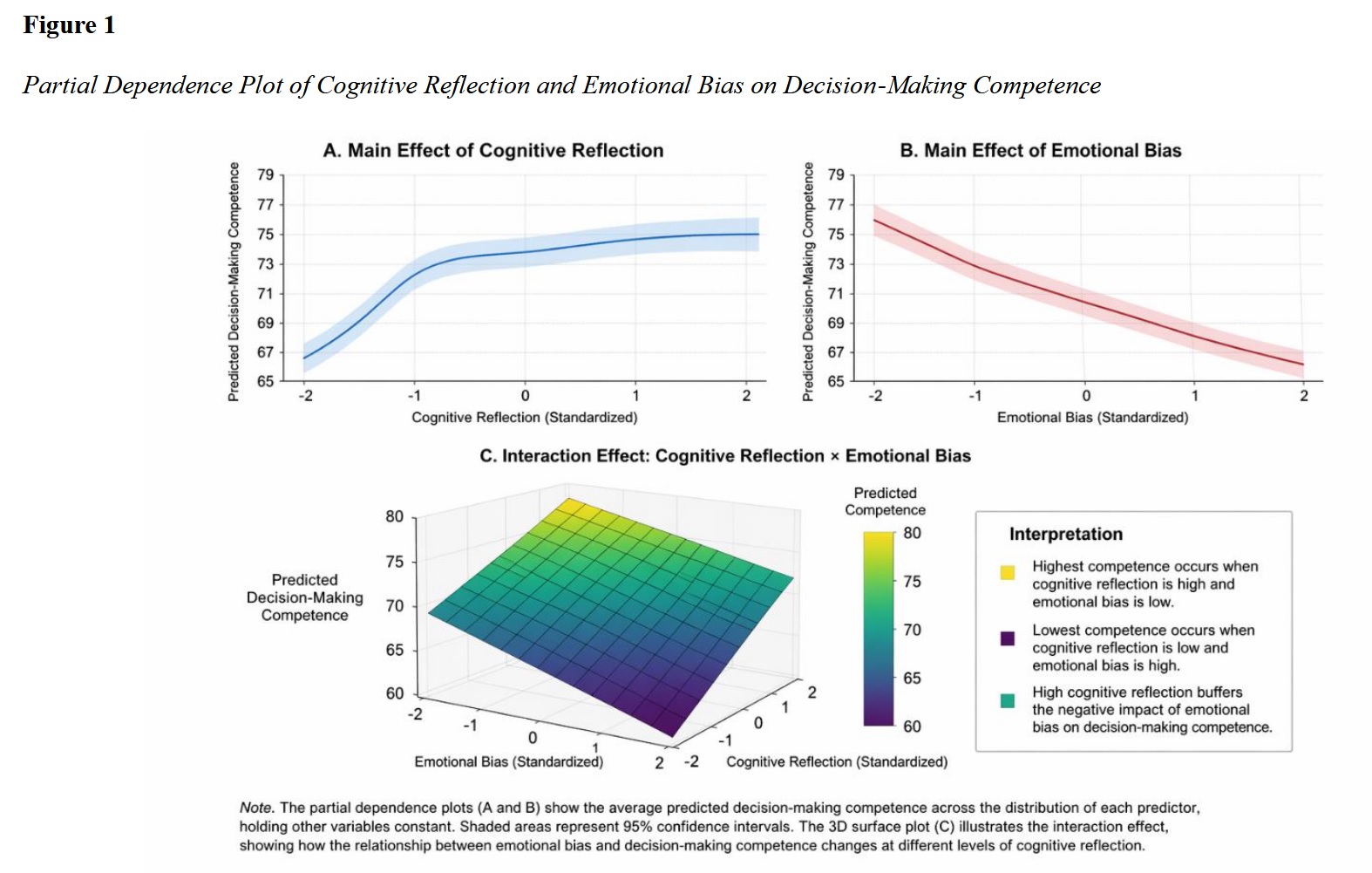
Findings: The EBM model demonstrated strong predictive performance, explaining 48% of the variance in decision-making competence (R² = 0.48). Cognitive reflection emerged as the strongest positive predictor, followed by uncertainty tolerance and risk perception, while emotional bias showed a significant negative effect. All predictors contributed significantly to the model, with non-linear patterns indicating diminishing returns at higher levels of cognitive reflection. Interaction analyses revealed that cognitive reflection significantly attenuated the negative impact of emotional bias, while uncertainty tolerance enhanced the positive effects of accurate risk perception. These results indicate that both cognitive and affective variables, as well as their interactions, play a critical role in shaping decision-making competence.
Conclusion: The findings highlight the multifactorial and interactive nature of decision-making competence, demonstrating that higher cognitive reflection and uncertainty tolerance enhance decision quality, whereas emotional bias impairs it, with explainable machine learning offering a powerful and interpretable framework for capturing these complex relationships.
Downloads
References
Anifa, A. S., & Soegiharto, S. (2023). Does the Psychology of Investment Decisions Depend on Risk Perception and Financial Literacy? Maksimum, 13(2), 152. https://doi.org/10.26714/mki.13.2.2023.152-163
Cao, T., & Scheibehenne, B. (2025). The Impact of Distribution Properties on Sampling Behavior. Frontiers in psychology, 16. https://doi.org/10.3389/fpsyg.2025.1597227
Chen, C., Ishfaq, M., Ashraf, F., Sarfaraz, A., & Wang, K. (2022). Mediating Role of Optimism Bias and Risk Perception Between Emotional Intelligence and Decision-Making: A Serial Mediation Model. Frontiers in psychology, 13. https://doi.org/10.3389/fpsyg.2022.914649
Davidson, M. D. (2024). Cultural Theory and Political Philosophy: Why Cognitive Biases Toward Ambiguous Risk Explain Both Beliefs About Nature's Resilience and Political Preferences Regarding the Organization of Society. Risk Analysis, 45(6), 1374-1385. https://doi.org/10.1111/risa.17668
Hartono, H., Halim, E., Aswieri, A., Suharli, D., & Aurella, M. (2023). The Influence of Financial Literacy and Heuristic Behavior on Generation Z’s Investing Decisions During a Global Pandemic. E3s Web of Conferences, 426, 02008. https://doi.org/10.1051/e3sconf/202342602008
Ivory, M., Sturdee, M., Towse, J. N., Levine, M. N., & Nuseibeh, B. (2023). Can You Hear the ROAR of Software Security? How Responsibility, Optimism and Risk Shape Developers’ Security Perceptions. https://doi.org/10.31234/osf.io/pexvz
Ivory, M., Towse, J. N., Sturdee, M., Levine, M., & Nuseibeh, B. (2023). Recognizing the Known Unknowns; The Interaction Between Reflective Thinking and Optimism for Uncertainty Among Software Developer’s Security Perceptions. Technology Mind and Behavior, 4(4), 319-334. https://doi.org/10.1037/tmb0000122
Ivory, M. R., Towse, J. N., Sturdee, M., Levine, M. N., & Nuseibeh, B. (2023a). Recognizing the Known Unknowns; The Interaction Between Reflective Thinking and Optimism for Uncertainty Among Software Developer’s Security Perceptions. https://doi.org/10.31234/osf.io/vrf97
Ivory, M. R., Towse, J. N., Sturdee, M., Levine, M. N., & Nuseibeh, B. (2023b). Supplemental Material for Recognizing the Known Unknowns; The Interaction Between Reflective Thinking and Optimism for Uncertainty Among Software Developer’s Security Perceptions. Technology Mind and Behavior. https://doi.org/10.1037/tmb0000122.supp
Kumar, P., Islam, M. A., Pillai, R., & Tabash, M. I. (2024). Risk Perception-Perceived Investor Performance Nexus: Evaluating the Mediating Effects of Heuristics and Prospects With Gender as a Moderator. Sage Open, 14(2). https://doi.org/10.1177/21582440241256444
Lee, N., & Kim, B.-S. (2022). Can International Students’ Risk Perception and Place Image Create an Advantage in Safeguarding Place Loyalty in Post-Covid-19 Tourism? Sustainability, 14(17), 10633. https://doi.org/10.3390/su141710633
Makwana, C. (2024). Understanding Behavioural Biases Driving Equity Investors in India: A Factor Analysis Approach. Metamorphosis, 23(2), 117-125. https://doi.org/10.1177/09726225241264607
McColl, K., Debin, M., Souty, C., Guerrisi, C., Turbelin, C., Falchi, A., Bonmarin, I., Paolotti, D., Obi, C., Duggan, J., Moreno, Y., Wisniak, A., Flahault, A., Blanchon, T., Colizza, V., & Raude, J. (2021). Are People Optimistically Biased About the Risk of COVID-19 Infection? Lessons From the First Wave of the Pandemic in Europe. International journal of environmental research and public health, 19(1), 436. https://doi.org/10.3390/ijerph19010436
Nam, Y.-Y., & Yang, Y. (2025). Cognitive Inconsistency in Travel Risk Perception: A Behavioral Economics Perspective. Journal of Hospitality & Tourism Research, 49(7), 1303-1316. https://doi.org/10.1177/10963480251318035
Overbye-Thompson, H., Hamilton, K. A., & Fisher, J. C. (2025). Understanding Human Detection of Algorithmic Bias Through Drift-Diffusion Modeling. https://doi.org/10.21203/rs.3.rs-7359286/v1
Qian, Y., Wang, X., Huang, X., Li, J., Jin, C., Chen, J., & Sha, M. (2024). Bounded Rationality in Healthcare: Unraveling the Psychological Factors Behind Patient Satisfaction in China. Frontiers in psychology, 15. https://doi.org/10.3389/fpsyg.2024.1296032
Qiu, Z., Liu, Q., Li, X., & Zhang, Y. (2024). Why Do Workers Generate Biased Risk Perceptions? An Analysis of Anchoring Effects and Influential Factors in Workers' Assessment of Unsafe Behavior. Safety and Health at Work, 15(3), 300-309. https://doi.org/10.1016/j.shaw.2024.05.004
Rawat, B. R. (2024). Influence of Overconfidence and Loss Aversion Biases on Investment Decision: The Mediating Effect of Risk Tolerance. Far Western Rev., 2(1), 57-73. https://doi.org/10.3126/fwr.v2i1.70499
Renkert, M. F. (2025). Acute Stress Reduces Risk-Aversion by Changing Magnitude Perception. https://doi.org/10.1101/2025.11.03.685504
Riasudeen, S., Ratnoo, H. S., Kannadhasan, M., & Singh, P. (2022). Risk Perception as a Mediator in Explaining the Relationship of Cognitive Biases and New Venture Creation. The Journal of Entrepreneurship, 31(2), 274-297. https://doi.org/10.1177/09713557221096874
Saivasan, R., & Lokhande, M. (2022). Influence of Risk Propensity, Behavioural Biases and Demographic Factors on Equity Investors' Risk Perception. Asian Journal of Economics and Banking, 6(3), 373-403. https://doi.org/10.1108/ajeb-06-2021-0074
Schippers, M. C., Kepp, K. P., & Ioannidis, J. P. A. (2025). Biases and Debiasing in Policy Decision‐making. European Journal of Clinical Investigation, 55(9). https://doi.org/10.1111/eci.70064
Singh, N. (2023). Aggressive Investment Choices – Do Cultural Values and Past Investing Experiences Play a Role? Journal of Advances in Management Research, 21(1), 125-152. https://doi.org/10.1108/jamr-06-2023-0170
Sudirman, W. F. R., Winario, M., Priyatno, A. M., & Assyifa, Z. (2023). Risk Tolerance: Heuristic Bias Towards Investment Decision Making. Jurnal Manajemen Teori Dan Terapan | Journal of Theory and Applied Management, 16(2), 266-279. https://doi.org/10.20473/jmtt.v16i2.47471
Trott, P., Ellwood, P., & Baxter, D. (2024). How Cognitive Bias Prevents Serendipity in New Product Development (And What to Do About It). Ieee Transactions on Engineering Management, 71, 11269-11281. https://doi.org/10.1109/tem.2024.3407515
Wan, A., Huang, Q., Elahi, E., & Peng, B. (2023). Evolution and Simulation of Drug Safety Regulations: Construction of a Game Model for Capture Event. Kybernetes, 53(5), 1763-1783. https://doi.org/10.1108/k-08-2022-1184
Wangzhou, K., Khan, M., Hussain, S., Ishfaq, M., & Farooqi, R. (2021). Effect of Regret Aversion and Information Cascade on Investment Decisions in the Real Estate Sector: The Mediating Role of Risk Perception and the Moderating Effect of Financial Literacy. Frontiers in psychology, 12. https://doi.org/10.3389/fpsyg.2021.736753
Waters, E. A., Kiviniemi, M. T., Hay, J. L., & Orom, H. (2021). Dismissing “Don’t Know” Responses to Perceived Risk Survey Items Threatens the Validity of Theoretical and Empirical Behavior-Change Research. Perspectives on Psychological Science, 17(3), 841-851. https://doi.org/10.1177/17456916211017860
Wibowo, M. A., Indrawati, N. K., & Aisjah, S. (2023). The Impact of Overconfidence and Herding Bias on Stock Investment Decisions Mediated by Risk Perception. International Journal of Research in Business and Social Science (2147-4478), 12(5), 174-184. https://doi.org/10.20525/ijrbs.v12i5.2663
Yi, C.-H., & Li, S. (2021). A Study on the Formation and Evolution Model of Social Psychology in Major Public Health Emergencies. E3s Web of Conferences, 290, 02027. https://doi.org/10.1051/e3sconf/202129002027
Zhang, M., Nazir, M. S., Farooqi, R., & Ishfaq, M. (2022). Moderating Role of Information Asymmetry Between Cognitive Biases and Investment Decisions: A Mediating Effect of Risk Perception. Frontiers in psychology, 13. https://doi.org/10.3389/fpsyg.2022.828956
Downloads
Additional Files
Publication Timeline
- Submitted
- Revised
- Accepted