A Cross-Cultural Structural Equation Model of Social Anxiety: The Roles of Intolerance of Uncertainty, Fear of Negative Evaluation, and Self-Compassion
Keywords:
Social Anxiety, Intolerance of Uncertainty, Fear of Negative Evaluation, Self-Compassion, Structural Equation Modeling, Cross-Cultural PsychologyAbstract
Objective: This study aimed to test a cross-cultural structural equation model of social anxiety by examining the direct and indirect roles of intolerance of uncertainty, fear of negative evaluation, and self-compassion among adults residing in Canada.
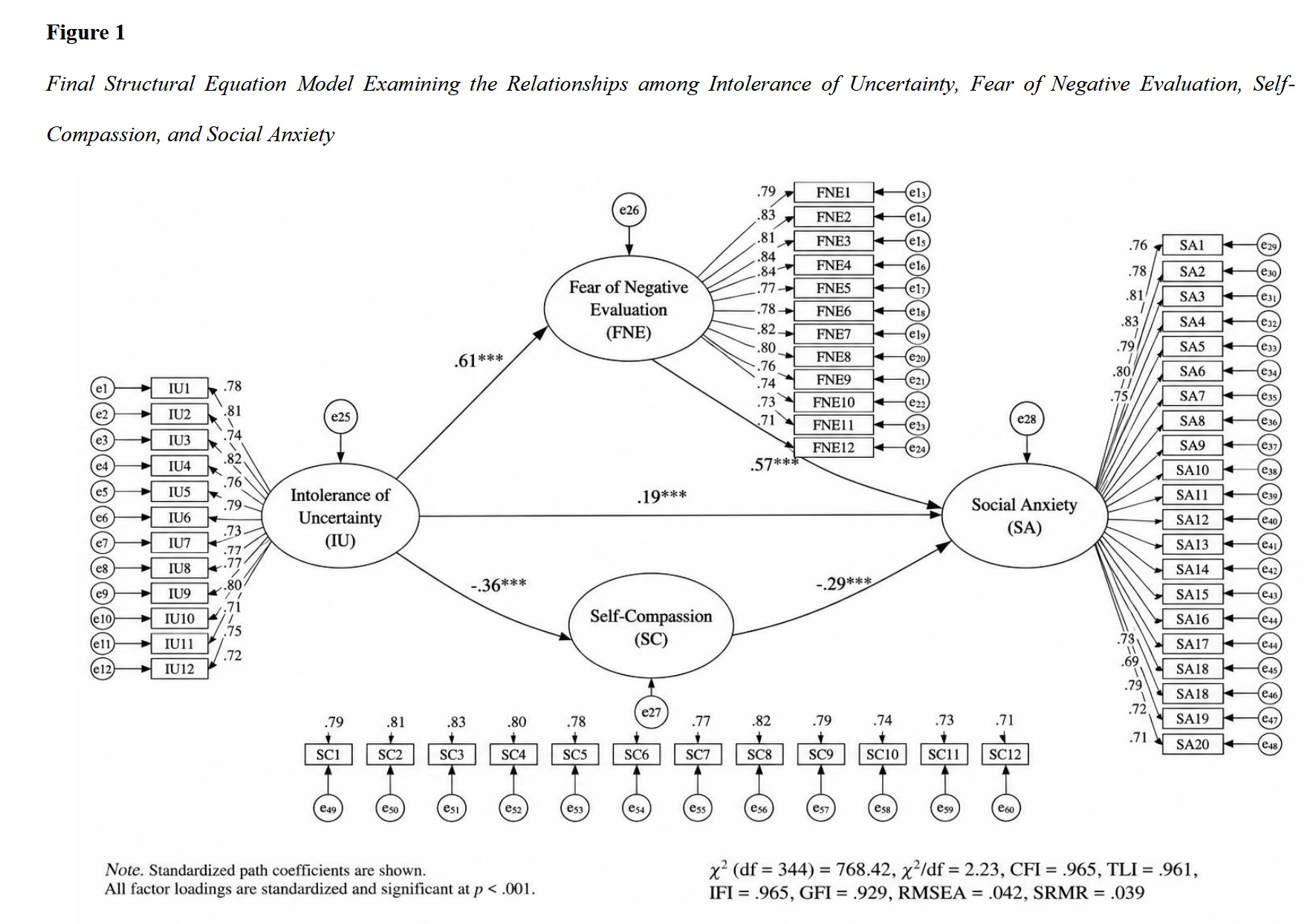
Methods and Materials: This cross-sectional correlational study was conducted among 701 adults from culturally diverse backgrounds in Canada. Participants completed standardized self-report measures assessing social anxiety, intolerance of uncertainty, fear of negative evaluation, and self-compassion. Data were analyzed using IBM SPSS Statistics and AMOS. Preliminary analyses examined reliability, normality, and correlations among the main variables. Confirmatory factor analysis was used to evaluate the measurement model, and structural equation modeling was applied to test the hypothesized direct and indirect pathways. Bootstrap analysis with 5,000 resamples was used to examine mediation effects.
Findings: The measurement model demonstrated excellent fit to the data, χ²/df = 2.23, CFI = .965, TLI = .961, IFI = .965, GFI = .929, RMSEA = .042, and SRMR = .039. In the structural model, intolerance of uncertainty significantly predicted fear of negative evaluation (β = .61, p < .001), self-compassion (β = −.36, p < .001), and social anxiety (β = .19, p < .001). Fear of negative evaluation significantly predicted social anxiety (β = .57, p < .001), while self-compassion negatively predicted social anxiety (β = −.29, p < .001). Bootstrap results confirmed significant indirect effects of intolerance of uncertainty on social anxiety through fear of negative evaluation (β = .35, p < .001) and self-compassion (β = .10, p < .001). The total indirect effect was significant (β = .45, p < .001), and the total effect reached β = .64 (p < .001).
Conclusion: The findings support an integrated cross-cultural model in which intolerance of uncertainty contributes to social anxiety both directly and indirectly through increased fear of negative evaluation and reduced self-compassion.
Downloads
References
Adamson, J., Brede, J., Babb, C., Serpell, L., Jones, C. R. G., Fox, J. R. E., & Mandy, W. (2022). Towards Identifying a Method of Screening for Autism Amongst Women With Restrictive Eating Disorders. European Eating Disorders Review, 30(5), 592-603. https://doi.org/10.1002/erv.2918
Albayrak, İ. (2023). Self-Compassion and School Burnout in Adolescents During the Lockdown Period: The Parallel Mediator Role of Intolerance of Uncertainty and Positivity. Kuramsal Eğitimbilim, 16(4), 789-807. https://doi.org/10.30831/akukeg.1270675
Antuña‐Camblor, C., Péris-Baquero, Ó., Juarros‐Basterretxea, J., Cano‐Vindel, A., & Rodríguez‐Díaz, F. J. (2024). Transdiagnostic Risk Factors of Emotional Disorders in Adults: A Systematic Review. Anales de Psicología, 40(2), 199-218. https://doi.org/10.6018/analesps.561051
Bates, G., Apputhurai, P., & Knowles, S. R. (2024). Bivalent Fears of Evaluation in Social Anxiety: Evaluation of an Extended Psychoevolutionary Model. European Journal of Investigation in Health Psychology and Education, 14(11), 2918-2931. https://doi.org/10.3390/ejihpe14110191
Bui, V., & Moscovitch, D. A. (2024). Predictors of Excessive Reassurance Seeking in Social Anxiety. Cognitive therapy and research, 48(2), 292-302. https://doi.org/10.1007/s10608-024-10473-1
Buljubašić, A., & Bulut, S. (2022). Self-Compassion and Its Relevance to the Academic Performance and Achievement. Journal of Anxiety & Depression, 5(1), 145-145. https://doi.org/10.46527/2582-3264.145
Bulut, M. B. (2022). Relationship Between COVID-19 Anxiety and Fear of Death: The Mediating Role of Intolerance of Uncertainty Among a Turkish Sample. Current Psychology, 42(10), 8441-8450. https://doi.org/10.1007/s12144-022-03281-x
Chasson, M., Ben‐Ari, O. T., & Abu‐Sharkia, S. (2022). Posttraumatic Growth in the Wake of COVID-19 Among Jewish and Arab Pregnant Women in Israel. Psychological Trauma Theory Research Practice and Policy, 14(8), 1324-1332. https://doi.org/10.1037/tra0001189
Counsell, A., Furtado, M., Iorio, C., Anand, L., Canzonieri, A., Fine, A., Fotinos, K., Epstein, I., & Katzman, M. A. (2024). Intolerance of Uncertainty, Social Anxiety, and Generalized Anxiety: Differences by Diagnosis and Symptoms. https://doi.org/10.32920/27637551.v1
Fu, J., Xu, C., Yan, W., & Li, L. (2023). The Effect of Intolerance of Uncertainty on State Anxiety in the Regular Epidemic Prevention and Control Phase in the Context of Informatization: A Moderated Chain Mediation Model. Applied Research in Quality of Life, 18(4), 1849-1873. https://doi.org/10.1007/s11482-023-10165-0
Ghosh, A., Cohen, K., Jans, L., Busch, C. A., McDanal, R., Yang, Y., Cooper, K. M., & Schleider, J. L. (2023a). A Digital Single-Session Intervention (Project Engage) to Address Fear of Negative Evaluation Among College Students: A Pilot Randomized Controlled Trial. https://doi.org/10.31234/osf.io/km7wt
Ghosh, A., Cohen, K., Jans, L., Busch, C. A., McDanal, R., Yang, Y., Cooper, K. M., & Schleider, J. L. (2023b). A Digital Single-Session Intervention (Project Engage) to Address Fear of Negative Evaluation Among College Students: Pilot Randomized Controlled Trial. Jmir Mental Health, 10, e48926. https://doi.org/10.2196/48926
Ghosh, A., Cohen, K., Jans, L., Busch, C. A., McDanal, R., Yang, Y., Cooper, K. M., & Schleider, J. L. (2023c). A Digital Single-Session Intervention (Project Engage) to Address Fear of Negative Evaluation Among College Students: Pilot Randomized Controlled Trial (Preprint). https://doi.org/10.2196/preprints.48926
Katzman, J., Weiss, E. A., Ojeda, C. J., Katzman, W. G., & Felsman, P. (2023). A Pilot Experience With Improvisational Theater to Reduce Burnout in Psychiatric Residency. Creative Education, 14(05), 1094-1110. https://doi.org/10.4236/ce.2023.145070
Kavradım, S. T., Almaz, G., & Özer, Z. (2022). Perception of Coronaphobia, Compassion and Associated Factors Among Nurses During the Outbreak of COVID-19: A Cross-Sectional Study. Turkiye Klinikleri Journal of Nursing Sciences, 14(2), 560-569. https://doi.org/10.5336/nurses.2021-85171
Keng, S. L., & Hwang, E. Z. N. (2022). Self-Compassion as a Moderator of the Association Between COVID-19 Stressors and Psychological Symptoms: A Longitudinal Study. Behaviour Change, 39(4), 263-274. https://doi.org/10.1017/bec.2022.2
Kiltz, L., Trippenzee, M., Fleer, J., Fokkens-Bruinsma, M., & Jansen, E. (2023). Predictors of University Student Well-Being and Post-Traumatic Growth in Times of COVID-19 in the Netherlands. https://doi.org/10.31234/osf.io/6sdq4
Lei, J., Mason, C., Russell, A., Hollocks, M. J., & Leigh, E. (2024). Understanding Mechanisms That Maintain Social Anxiety Disorder in Autistic Individuals Through the Clark and Wells (1995) Model and Beyond: A Systematic Review. Clinical Child and Family Psychology Review, 27(4), 966-1030. https://doi.org/10.1007/s10567-024-00509-z
Macovei, C. M., Bumbuc, Ș., & Martinescu-Bădălan, F. (2023). The Role of Personality Traits in Mediating the Relation Between Fear of Negative Evaluation and Social Interaction Anxiety. Frontiers in psychology, 14. https://doi.org/10.3389/fpsyg.2023.1268052
Maftei, A., & Lãzãrescu, G. (2022). Times Are Harsh, Be Kind to Yourself! Anxiety, Life Satisfaction, and the Mediating Role of Self-Compassion. Frontiers in psychology, 13. https://doi.org/10.3389/fpsyg.2022.915524
Mogeda El Sayed El, K., Samak, A. Y., & Khalil, N. Y. (2026). Psychological Adaptation to Chronic Immune-Mediated Disease: A Network Analysis of Fear of Progression, Psychopathology, and Positive Psychological Resources in a Saudi Multicenter Sample. https://doi.org/10.21203/rs.3.rs-9004507/v1
Ortiz, A. M. L., Peters, A. S., Webber, K. T., Butler, R. M., & Levinson, C. A. (2026). Eating Disorder Symptoms and Corresponding Evidence-Based Treatments: A Narrative Review. Journal of eating disorders, 14(1). https://doi.org/10.1186/s40337-025-01485-7
Palma, E. M. S., Sousa, A. R. d., Teixeira, J. R. B., Moreira, W. C., Ana Caroline Monteiro de, A., Souza, L. F. V., Júlio Cézar Ramos dos, A., Hannah Souza de Almeida, P., Hérica Emília Félix de, C., Muniz, V. d. O., Nilo Manoel Pereira Vieira, B., Almeida, É. S., Mota, T. N., Santos, S. D. d., Antônio Tiago da Silva, S., Silva, J. C. d., Camila Aparecida Pinheiro Landim, A., Lourenção, L. G., Queiroz, A. M. d., . . . Mendes, I. A. C. (2022). Influence of Sociodemographic and Emotional Factors on the Relationship Between Self-Compassion and Perceived Stress Among Men Residing in Brazil During the COVID-19 Pandemic. International journal of environmental research and public health, 19(13), 8159. https://doi.org/10.3390/ijerph19138159
Pickard, J. A., Deane, F. P., & Gonsalvez, C. J. (2024). Effects of a Brief Mindfulness Intervention Program: Changes in Mindfulness and Self-Compassion Predict Increased Tolerance of Uncertainty in Trainee Psychologists. Training and Education in Professional Psychology, 18(1), 69-77. https://doi.org/10.1037/tep0000466
Poluch, M., Feingold-Link, J., Papanagnou, D., Kilpatrick, J., Ziring, D., & Ankam, N. (2022). Intolerance of Uncertainty and Self-Compassion in Medical Students: Is There a Relationship and Why Should We Care? Journal of Medical Education and Curricular Development, 9. https://doi.org/10.1177/23821205221077063
Pretorius, T. B., & Padmanabhanunni, A. (2025). The Relationship Between Intolerance of Uncertainty and Alcohol Use in First Responders: A Cross-Sectional Study of the Direct, Mediating and Moderating Role of Generalized Resistance Resources. International journal of environmental research and public health, 22(3), 383. https://doi.org/10.3390/ijerph22030383
Qiang, J., He, X., Zheng, X., Huang, J., & Xu, C. (2024). The Association Between Intolerance of Uncertainty and Academic Burnout Among University Students: The Role of Self-Regulatory Fatigue and Self-Compassion. Frontiers in Public Health, 12. https://doi.org/10.3389/fpubh.2024.1441465
Schuette, S., Andrade, F. C., Woodward, J. T., & Smoski, M. J. (2023). Identifying Modifiable Factors Associated With Psychological Health in Women Experiencing Infertility. Journal of Health Psychology, 28(12), 1143-1156. https://doi.org/10.1177/13591053231185549
Spiroiu, F. I., & Maranzan, K. A. (2025). Cognitive‐Emotional Impact of Negative Interpretations of Ambiguous Social Information and Fear of Negative Evaluation on the Association Between Intolerance of Uncertainty and Social Anxiety Subtypes: A Cross‐Sectional Mediation Analysis. Scandinavian journal of psychology, 66(6), 882-896. https://doi.org/10.1111/sjop.13115
Therriault, D., Lane, J., Houle, A. A., Dupuis, A., Gosselin, P., Thibault, I., Dionne, P., Morin, P., & Dufour, M. (2022). Effects of the HORS‐PISTE Universal Anxiety Prevention Program Measured According to Initial Level of Student Problems. Psychology in the Schools, 60(4), 1299-1318. https://doi.org/10.1002/pits.22836
Thyagaraj, Y., Topel, S., & Charpentier, C. J. (2025). Biased Information-Seeking and Information-Integration in Social Anxiety. Current opinion in psychology, 62, 102002. https://doi.org/10.1016/j.copsyc.2025.102002
Wilson, G. A., Malivoire, B. L., Cassin, S. E., & Antony, M. M. (2022). A Mixed Methods Investigation of Reasons Underlying Fear of Positive Evaluation. Clinical Psychology & Psychotherapy, 30(2), 473-485. https://doi.org/10.1002/cpp.2818
Downloads
Additional Files
Publication Timeline
- Submitted
- Revised
- Accepted