Explainable XGBoost Models for Predicting Burnout among Mental Health Professionals Using Compassion Fatigue, Psychological Capital, Self-Care, and Occupational Stress
Keywords:
Burnout, Mental Health Professionals, XGBoost, Explainable Artificial Intelligence, Compassion Fatigue, Psychological Capital, Self-Care, Occupational StressAbstract
Objective: This study aimed to develop and interpret an explainable XGBoost model for predicting burnout among mental health professionals in Malaysia using compassion fatigue, psychological capital, self-care, and occupational stress as primary predictors.
Methods and Materials: This cross-sectional predictive study was conducted among 742 mental health professionals in Malaysia, including counselors, clinical psychologists, psychiatric nurses, psychiatrists, social workers, psychotherapists, and other mental health specialists. Burnout was assessed using the Maslach Burnout Inventory–Human Services Survey, compassion fatigue using the Professional Quality of Life Scale, psychological capital using the Psychological Capital Questionnaire, self-care using the Self-Care Assessment Worksheet, and occupational stress using the Health and Safety Executive Management Standards Indicator Tool. Data were analyzed using Python-based machine learning procedures. After preprocessing, the dataset was divided into training and testing sets using stratified sampling. An XGBoost classifier was trained and optimized through five-fold cross-validation and hyperparameter tuning. Model performance was evaluated using accuracy, precision, recall, specificity, F1-score, Matthews correlation coefficient, AUC-ROC, and Brier score. SHAP analysis was applied to interpret global and individual predictor contributions.
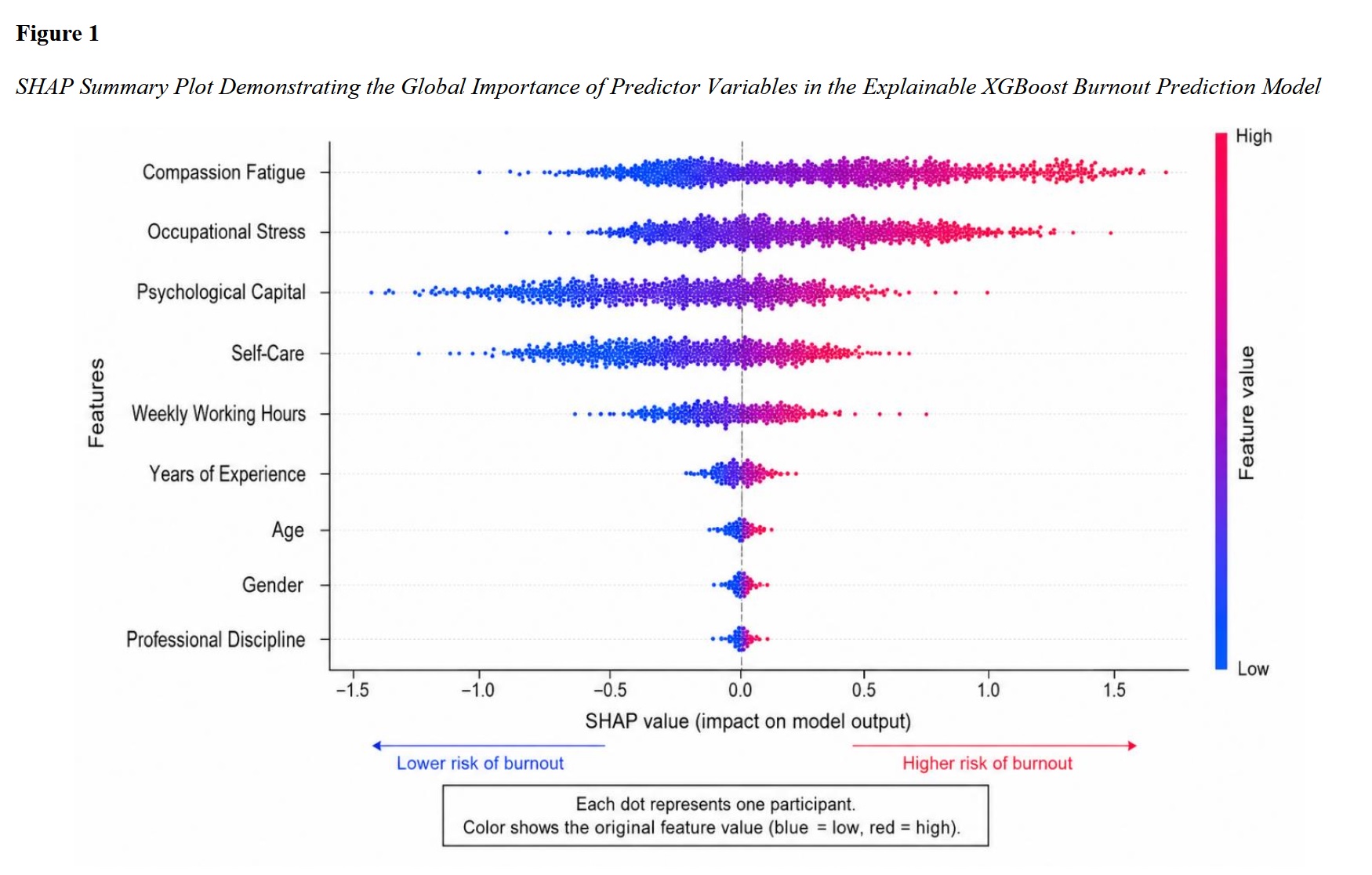
Findings: Compassion fatigue showed a strong positive association with burnout, while occupational stress also demonstrated a strong positive relationship with burnout. Psychological capital and self-care were negatively associated with burnout, indicating their protective role. The optimized XGBoost model demonstrated excellent predictive performance, with test accuracy of 91.9%, precision of 91.3%, recall of 90.7%, specificity of 92.6%, F1-score of 91.0%, Matthews correlation coefficient of 0.864, AUC-ROC of 0.962, and Brier score of 0.071. SHAP analysis identified compassion fatigue as the most influential predictor, followed by occupational stress, psychological capital, and self-care.
Conclusion: Explainable XGBoost modeling provided an accurate and interpretable approach for predicting burnout among Malaysian mental health professionals. The findings emphasize that burnout is primarily shaped by modifiable psychological and occupational factors, particularly compassion fatigue, occupational stress, psychological capital, and self-care.
Downloads
References
Almadani, A. H., Alenezi, S., Algazlan, M. S., & Alrabiah, E. S. (2022). Compassion Fatigue Among Practicing and Future Psychiatrists: A National Perspective. Cureus. https://doi.org/10.7759/cureus.25417
Almadani, A. H., Alenezi, S., Algazlan, M. S., Alrabiah, E. S., Alharbi, R. A., Alkhamis, A. S., & Temsah, M. H. (2023). Prevalence and Predictive Factors of Compassion Fatigue Among Healthcare Workers in Saudi Arabia: Implications for Well-Being and Support. Healthcare, 11(15), 2136. https://doi.org/10.3390/healthcare11152136
Aminihajibashi, S., Jensen, T. K., & Skar, A. M. S. (2024). Exploring Key Job Demands and Resources in Norwegian Child Mental Health Services: A Cross-Sectional Study of Associations With and Relationship Between Compassion Satisfaction, Burnout, Secondary Traumatic Stress and Turnover Intention. Frontiers in Public Health, 12. https://doi.org/10.3389/fpubh.2024.1304345
Araújo, D., Bártolo, A., Fernandes, C., Pereira, A., & Monteiro›, S. (2024). Intervention Programs Targeting Burnout in Health Professionals: A Systematic Review. Iranian Journal of Public Health. https://doi.org/10.18502/ijph.v53i5.15580
Bégin, C., Berthod, J., Martinez, L. Z., & Truchon, M. (2022). Use of Mobile Apps and Online Programs of Mindfulness and Self-Compassion Training in Workers: A Scoping Review. Journal of Technology in Behavioral Science, 7(4), 477-515. https://doi.org/10.1007/s41347-022-00267-1
Bouskill, K., Danz, M., Meredith, L. S., Chen, C., Chang, J., Baxi, S. M., Huynh, D. T., Motala, A., Larkin, J., & Hempel, S. (2022). Burnout: Definition, Prevalence, Risk Factors, Prevention, and Interventions Literature Reviews. https://doi.org/10.7249/rr-a428-1
Cruz, C. M., Alamag, K. N. A., Broncano, T. P., Nadua, I. G., & Sumang, E. M. (2024). Experiences and Challenges of Mental Health Professionals in the National Capital Region. https://doi.org/10.14293/pr2199.000711.v1
Dewidar, A. E., Gado, E., Gemeay, E. M., & Sabra, A. (2022). Effect of Training Program About Compassion on Professional Quality of Life of Mental Health Nurses. International Egyptian Journal of Nursing Sciences and Research, 2(2), 81-97. https://doi.org/10.21608/ejnsr.2022.212300
Dolley-Lesciks, O., Rose, J., Jones, C. I., & Long, C. G. (2024). Compassion Fatigue Among Staff in a Medium Secure Psychiatric Setting: Individual and Environmental Factors. https://doi.org/10.5772/intechopen.1003936
Garnett, A., Hui, L., Oleynikov, C., & Boamah, S. A. (2023). Compassion Fatigue in Healthcare Providers: A Scoping Review. BMC Health Services Research, 23(1). https://doi.org/10.1186/s12913-023-10356-3
Gelaw, A. Y., Parker, S. K., Johnson, A., Nguyen, H., Jolly, A., Forner, V. W., Deng, C., & Collie, A. (2024). Determinants of Psychological Injury Among Health and Social Care Workers in Community Settings: A Systematic Review. Work a Journal of Prevention Assessment & Rehabilitation, 78(1), 3-27. https://doi.org/10.3233/wor-230426
Graves, J., Joyce, C., & Hegazi, I. (2023). From Empathy to Compassion Fatigue: A Narrative Review of Implications in Healthcare. https://doi.org/10.5772/intechopen.107399
Hamzaa, H. G., Abdel-Aal, M. H., Atta, M. H. R., AbdElnaby, H. S. M., & Othman, A. A. (2025). Analysis of Compassion Fatigue Among Psychiatric Nurses and Its Effect on Spiritual and Competent Care. Journal of Psychiatric and Mental Health Nursing. https://doi.org/10.1111/jpm.13174
Henderson, A., Jewell, T., Huang, X., & Simpson, A. (2024). Personal Trauma History and Secondary Traumatic Stress in Mental Health Professionals: A Systematic Review. Journal of Psychiatric and Mental Health Nursing, 32(1), 13-30. https://doi.org/10.1111/jpm.13082
Kunst, H., Byington, E., Johnson, A., & Nguyen, H. (2025). Mapping Workplace Compassion Research Across the Social Sciences: A Bibliometric Review. Australian Journal of Management, 50(3), 665-705. https://doi.org/10.1177/03128962251358615
Mahmoud, A. S., Gabal, S. A., Sayed, S., & Wahba, N. M. I. (2023). Psychological Capital and Compassion Fatigue Among Nurses Working in Port Said Hospitals. Port Said Scientific Journal of Nursing, 10(2), 320-349. https://doi.org/10.21608/pssjn.2023.134173.1194
May, H., Millar, J. F. A., Griffith, E., Gillmore, C., Kristoffersen, M., Robinson, R., & West, M. (2024). Interventions to Address Empathy-Based Stress in Mental Health Workers: A Scoping Review and Research Agenda. PLoS One, 19(12), e0306757. https://doi.org/10.1371/journal.pone.0306757
McGrath, K., Matthews, L. R., & Heard, R. (2022). Predictors of Compassion Satisfaction and Compassion Fatigue in Health Care Workers Providing Health and Rehabilitation Services in Rural and Remote Locations: A scoping Review. Australian Journal of Rural Health, 30(2), 264-280. https://doi.org/10.1111/ajr.12857
Noor, A. M., Suryana, D., Kamarudin, E. M. E., Naidu, N. B. M., Kamsani, S. R., & Govindasamy, P. (2025). Compassion Fatigue in Helping Professions: A Scoping Literature Review. BMC psychology, 13(1). https://doi.org/10.1186/s40359-024-01869-5
Ottisova, L., Gillard, J., Wood, M., Langford, S., Bastien, R. J., Haris, A. M., Wild, J., Bloomfield, M., & Robertson, M. C. (2022). Effectiveness of Psychosocial Interventions in Mitigating Adverse Mental Health Outcomes Among Disaster‐exposed Health Care Workers: A Systematic Review. Journal of Traumatic Stress, 35(2), 746-758. https://doi.org/10.1002/jts.22780
Pagani, L. S., Kazandjian, N., Geoffrion, S., & Barnett, T. A. (2025). Early Adulthood and Care Giving Professions in the 21st Century: Mental Wellness as an Institutional Priority and Reward Strategy. Inquiry the Journal of Health Care Organization Provision and Financing, 62. https://doi.org/10.1177/00469580251399302
Rayani, A., Hannan, J., Alreshidi, S. M., Aboshaiqah, A. E., Alodhialah, A. M., & Hakamy, E. (2024). Compassion Satisfaction, Burnout, and Secondary Traumatic Stress Among Saudi Nurses at Medical City: A Cross-Sectional Study. Healthcare, 12(8), 847. https://doi.org/10.3390/healthcare12080847
Saxena, S., & Rathore, B. (2024). Adversity Quotient as Determining Factor of Mental Health and Professional Quality of Life Among Healthcare Professionals: A Systematic Review. Annals of Neurosciences, 32(1), 58-65. https://doi.org/10.1177/09727531241231055
Schaefer, M. R., Bemis, H., Lembeck, P., Fisher, R., Tager, J. B., & Hildenbrand, A. K. (2024). Our Well-Being Matters, Too: Cultivating Resilience and Self-Care in Pediatric Psychologists. Clinical Practice in Pediatric Psychology, 12(4), 403-416. https://doi.org/10.1037/cpp0000536
Unjai, S., Forster, E., Mitchell, A. E., & Creedy, D. (2024). Interventions to Promote Resilience and Passion for Work in Health Settings: A Mixed-Methods Systematic Review. International Journal of Nursing Studies Advances, 7, 100242. https://doi.org/10.1016/j.ijnsa.2024.100242
Vastani, N., & Malcom, A. (2022). Assessing the Impact of the COVID-19 Pandemic on Nurse Practitioners' Professional Quality of Life. Journal of the American Association of Nurse Practitioners, 34(12), 1300-1307. https://doi.org/10.1097/jxx.0000000000000796
Wahid, A.-S. A., Mohd, I. H., & Omar, M. K. (2023). Psychological Capital (PSYCAP), Emotional Labour, and Burnout in Malaysia: An Overview. International Journal of Academic Research in Business and Social Sciences, 13(5). https://doi.org/10.6007/ijarbss/v13-i5/16656
Μangoulia, P., Tsokas, N., Koukia, E., Malli, F., Missouridou, E., Dafogianni, C., Kyranou, M., & Fradelos, Ε. C. (2025). Cultivating Self-Compassion to Improve Social Workers’ Professional Quality of Life in Primary Healthcare. Healthcare, 13(11), 1313. https://doi.org/10.3390/healthcare13111313
Downloads
Additional Files
Publication Timeline
- Submitted
- Revised
- Accepted