Modeling the Psychological Determinants of Digital Addiction: The Mediating Roles of Loneliness, Self-Control, and Emotional Dysregulation
Keywords:
Digital addiction, loneliness, self-control, emotional dysregulation, structural equation modeling, CanadaAbstract
Objective: This study aimed to model the psychological determinants of digital addiction among Canadian adults by examining the direct and indirect effects of loneliness, self-control, and emotional dysregulation within an integrated structural equation model.
Methods and Materials: This quantitative cross-sectional correlational study was conducted among 642 adults residing in Canada who reported regular daily use of digital technologies. Participants completed standardized self-report measures assessing digital addiction, loneliness, self-control, and emotional dysregulation. Data were analyzed using IBM SPSS Statistics version 29 and AMOS version 29. Preliminary analyses included assessment of normality, reliability, convergent validity, and correlations among study variables. The hypothesized relationships among the constructs were tested using structural equation modeling with maximum likelihood estimation. Model fit was evaluated using χ²/df, CFI, TLI, GFI, AGFI, RMSEA, and SRMR. Indirect effects were examined through bootstrap resampling with 5,000 samples and bias-corrected 95% confidence intervals.
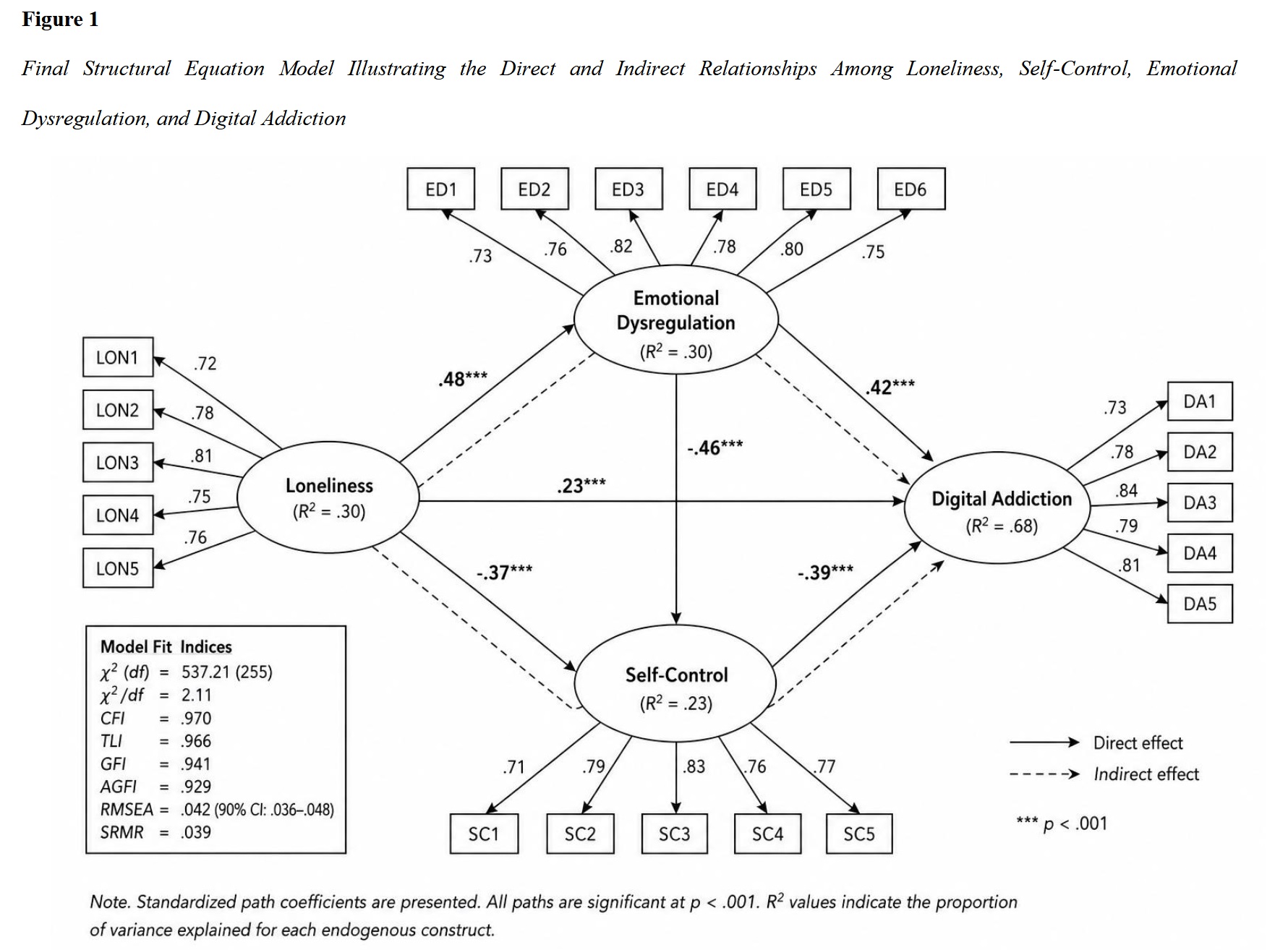
Findings: The measurement model demonstrated satisfactory fit to the data, χ²/df = 2.11, CFI = .970, TLI = .966, GFI = .941, AGFI = .929, RMSEA = .042, and SRMR = .039. Digital addiction was positively associated with loneliness and emotional dysregulation and negatively associated with self-control. In the structural model, emotional dysregulation significantly predicted digital addiction (β = .42, p < .001), self-control significantly and negatively predicted digital addiction (β = −.39, p < .001), and loneliness significantly predicted digital addiction (β = .23, p < .001). Loneliness significantly predicted emotional dysregulation (β = .48, p < .001) and negatively predicted self-control (β = −.37, p < .001), while emotional dysregulation negatively predicted self-control (β = −.46, p < .001). Bootstrap results confirmed significant indirect effects of loneliness on digital addiction through emotional dysregulation and self-control. The final model explained 68% of the variance in digital addiction.
Conclusion: The findings indicate that digital addiction is shaped by interconnected interpersonal, emotional, and self-regulatory mechanisms. Loneliness contributes to problematic digital use both directly and indirectly by increasing emotional dysregulation and weakening self-control. These results highlight the importance of addressing emotional regulation, self-control, and social connectedness in prevention and intervention programs for digital addiction.
Downloads
References
Alsawalqa, R. O., & Haroon Abdel Rahim, A. L. Z. (2025). The Mediating Role of Smartphone Addiction in the Relationship Between Emotion Regulation Difficulties and Juvenile Delinquency. Frontiers in Psychiatry, 16. https://doi.org/10.3389/fpsyt.2025.1695691
Chiappini, S., Sampogna, G., Ventriglio, A., Menculini, G., Ricci, V., Pettorruso, M., Volpe, U., & Martinotti, G. (2025). Exploring Emerging Psychopathological Characteristics and Challenges of Novel Depression Subtypes: Insights From the Literature. Frontiers in Psychiatry, 16. https://doi.org/10.3389/fpsyt.2025.1613251
Dong, R., Yuan, D., Xue, W., Cai, J., Ai, Z., & Zhou, S. (2025). Exploring the Relationship Between Social Media Dependence and Internet Addiction Among College Students From a Bibliometric Perspective. Frontiers in psychology, 16. https://doi.org/10.3389/fpsyg.2025.1463671
Fatima, A., Akhter, M. S., Kanekar, A., Roy, S., Imade, B., & Sharma, M. (2025). A Scoping Review of the Use and Determinants of Social Media Among College Students. Healthcare, 13(17), 2234. https://doi.org/10.3390/healthcare13172234
Feng, B. (2025). Social Anxiety and Smartphone Addiction Among College Students: The Mediating Role of Loneliness. Frontiers in Psychiatry, 16. https://doi.org/10.3389/fpsyt.2025.1621900
Fioravanti, G., Benucci, S. B., & Ghinassi, S. (2025). Psychological Risk Factors for Problematic Social Network Use: An Overview of Systematic Reviews and Meta-Analyses. Addictive Behaviors Reports, 21, 100600. https://doi.org/10.1016/j.abrep.2025.100600
G., M., & R., D. R. (2024). Exploring the Relationship Between Attachment Styles and Loneliness Levels in Young Adults. International Journal for Multidisciplinary Research, 6(3). https://doi.org/10.36948/ijfmr.2024.v06i03.19869
Heidari, Z., Kianimoghadam, A. S., Arani, A. M., & Bakhtiari, M. (2025). Investigating the Relationship Between Loneliness, Physical Activity, and Internet Addiction: The Mediating Role of Academic Burnout and Self-Control. Iranian Journal of Psychiatry. https://doi.org/10.18502/ijps.v20i3.19040
Hung, L. C., & Hung, M.-T. (2025). The Mediating Role of Rumination in the Relationship Between Loneliness and Smartphone Addiction Among College Students. https://doi.org/10.21203/rs.3.rs-6263058/v1
Jin, Y., Xiong, W., Liu, X., & An, J. (2023). Trait Mindfulness and Problematic Smartphone Use in Chinese Early Adolescent: The Multiple Mediating Roles of Negative Affectivity and Fear of Missing Out. Behavioral Sciences, 13(3), 222. https://doi.org/10.3390/bs13030222
Karaköse, T., Yıldırım, B., Tülübaş, T., & Kardas, A. (2023). A Comprehensive Review on Emerging Trends in the Dynamic Evolution of Digital Addiction and Depression. Frontiers in psychology, 14. https://doi.org/10.3389/fpsyg.2023.1126815
Kaye, A. D., Islam, R. K., Tong, V. T., Sorrel, M. L., Allen, K. E., Nguyen, I. D., Miller, B. C., Sharpe, M., Ahmadzadeh, S., Griffin, P., Shekoohi, S., & Varrassi, G. (2025). A Narrative Inquiry Into Problematic Internet Use Among Young Adults: A Narrative Review. Cureus. https://doi.org/10.7759/cureus.85705
Kumar, R., Anand, N., & Sharma, M. K. (2025). Coping With the Empty Nest: The Role of Loneliness, Distress, and Emotion Dysregulation in Problematic Series Watching Among Parents of Immigrant Offspring. https://doi.org/10.21203/rs.3.rs-6692946/v1
Lazo-Caparros, M. D., Gómez-Urquiza, J. L., González-Díaz, A., Pérez-Conde, I., Gómez-Torres, P., & Membrive‐Jiménez, M. J. (2025). Assessment Tools and Psychosocial Consequences of Smartphone Addiction in Nursing Students: A Systematic Review and Meta-Analysis. Healthcare, 13(20), 2639. https://doi.org/10.3390/healthcare13202639
Li, Y., Tian, E., Zhang, J., Bakar, Z. B. A., & Ashari, Z. B. M. (2026). Longitudinal Relationships Among Depression, Learning Burnout and Mobile Phone Addiction in Chinese Adolescents: A Cross-Lagged Analysis. https://doi.org/10.21203/rs.3.rs-9836628/v1
Liu, S., Wu, Y.-F., Sun, F., Zhou, Y., & Yin, A. (2025). The Moderating Role of Social Support in the Relationship Between Alexithymia and Problematic Smartphone Use Among Chinese Depressed Adolescents: A Cross-Sectional Study. Frontiers in Psychiatry, 16. https://doi.org/10.3389/fpsyt.2025.1650290
Magalhães, J., Figueiredo, M. M. C., Ana Beatriz Teófilo Macedo Dos, S., Cefalì, F., Solfa, D. d. O., Neto, R. B. M., Fontenelle, S. G. P., Girão, M. V. F., Barreiros, R. M., Stangherlin, L., & Júlio César Claudino dos, S. (2024). The Relationship Between Addictive Use of Social Media and Psychiatric Disorders: The Mediating Role of Emotion Dysregulation. Brazilian Journal of Clinical Medicine and Review, 2(4), 34-43. https://doi.org/10.52600/2965-0968.bjcmr.2024.2.4.34-43
Mestre‐Bach, G., Paiva, Ú., Iñiguez, L. S. M., Beranuy, M., Martín-Vivar, M., Mallorquí‐Bagué, N., Normand, E., Contreras, M. J., Potenza, M. N., & Arrondo, G. (2025). The Association Between Internet-Use-Disorder Symptoms and Loneliness: A Systematic Review and Meta-Analysis With a Categorical Approach. Psychological medicine, 55. https://doi.org/10.1017/s0033291725000376
Ntumi, S., Amos, P. M., Danquah, S. A., Amoako, B. M., & Amezugbe, C. (2025). From Likes to Lows: A Serial Mediation Analysis of How Social Media Addiction, Fear of Missing Out (FoMO), Emotional Regulation, Assessment Engagement, and Assessment Anxiety Influence Depression Among Adolescents in Ghana. https://doi.org/10.21203/rs.3.rs-6916786/v1
Park, H., & Jung, T.-W. (2024). The Effects of Equine-Assisted Learning on Adolescents With Internet Gaming Disorder. Healthcare, 12(3), 311. https://doi.org/10.3390/healthcare12030311
Patel, D. G., Kshatri, A. H. S., Kommuru, S., & Javvaji, C. K. (2025). A Narrative Review of Digital Addiction and Health: A New Challenge for Modern Medicine. Cureus. https://doi.org/10.7759/cureus.100491
Pecora, G., Laghi, F., Baiocco, R., Baumgartner, E., & Sette, S. (2025). A Latent Profile Analysis of Psychological Functioning During the COVID‐19 Pandemic: Adolescents' Perceived Social Support and Lifestyle Behaviours. International journal of psychology, 60(2). https://doi.org/10.1002/ijop.70025
Poulus, D., Nicholson, M., Obine, E. A. C., Drew, M., Fisher, K., Vella, S. A., Seidler, Z. E., & Sharpe, B. T. (2026). Mental Health and Well‐being in Esports: A Scoping Review. Applied Psychology, 75(1). https://doi.org/10.1111/apps.70055
Shah, H. A., & Househ, M. (2023). Mapping Loneliness Through Social Intelligence Analysis: A Step Towards Creating Global Loneliness Map. BMJ Health & Care Informatics, 30(1), e100728. https://doi.org/10.1136/bmjhci-2022-100728
Şimşek, Ö., & Başaran, B. (2025). A Manual Three-Step Latent Profile Analysis to Discover Phubbing Risk Profiles Among University Students. Frontiers in psychology, 16. https://doi.org/10.3389/fpsyg.2025.1510585
Śniadach, J., Orlof, W., Sołowiej-Chmiel, J., Kicman, A., Szymkowiak, S., & Waszkiewicz, N. (2025). Chemsex as a Diagnostic Challenge: Toward Recognition in ICD-12 and Integrated Treatment Approaches—A Narrative Review. Journal of clinical medicine, 14(17), 6275. https://doi.org/10.3390/jcm14176275
Tadpatrikar, A. (2025). Policies and Public Health Initiatives to Mitigate the Mental Health Impact of Internet Use Among Children and Adolescents. Indian Journal of Psychiatry, 67(12), 1180-1186. https://doi.org/10.4103/indianjpsychiatry_409_25
Tagliaferri, G., Vilar, M. M., Frisari, F. V., Quaglieri, A., Mari, E., Burrai, J., Giannini, A. M., & Cricenti, C. (2025). Connected by Boredom: A Systematic Review of the Role of Trait Boredom in Problematic Technology Use. Brain Sciences, 15(8), 794. https://doi.org/10.3390/brainsci15080794
Varchetta, M., Tagliaferri, G., Mari, E., Quaglieri, A., Cricenti, C., & Vilar, M. M. (2024). Cross-Cultural Examination of Problematic Internet Use and Associated Psychological Variables: A Comparative Study in Italy, Spain, Ecuador, and Peru. Journal of clinical medicine, 13(12), 3451. https://doi.org/10.3390/jcm13123451
Wang, J., & Shen, W. (2025). The Emotional Reinforcement Mechanism of and Phased Intervention Strategies for Social Media Addiction. Behavioral Sciences, 15(5), 665. https://doi.org/10.3390/bs15050665
Zhan, X., & Zhu, W. (2025). Influencing Factors of Short-Form Video Addiction Among Chinese University Students: A Systematic Review. Frontiers in psychology, 16. https://doi.org/10.3389/fpsyg.2025.1663670
Downloads
Additional Files
Publication Timeline
- Submitted
- Revised
- Accepted