The Relationship Between Cyberbullying and Suicidal Ideation in Adolescent Girls The Mediating Role of Perceived Maternal Acceptance and Perceived Burdensomeness
Keywords:
Cyberbullying, Suicidal Ideation, Perceived Maternal Acceptance, Perceived Burdensomeness, Adolescent Girls, Structural Equation Modeling.Abstract
Objective: The present study aimed to investigate the relationship between cyberbullying and suicidal ideation among adolescent girls and to examine the mediating roles of perceived maternal acceptance and perceived burdensomeness in this relationship.
Methods and Materials: This study employed a descriptive-correlational design using structural equation modeling (SEM). The statistical population consisted of female high school students in Qazvin, Iran, during the 2025–2026 academic year. Using a multistage cluster sampling method, 520 students were recruited, of whom 498 valid questionnaires were retained for analysis. Data were collected using the Cyberbullying Scale (CBS), the Beck Scale for Suicide Ideation (BSSI), the Perceived Burdensomeness subscale of the Interpersonal Needs Questionnaire (INQ), and the Perceived Maternal Acceptance Scale (PMAS). Descriptive statistics, Pearson correlation coefficients, and structural equation modeling were performed using SPSS version 28 and AMOS version 24. The significance of indirect effects was assessed through bootstrap analysis with 5,000 resamples and 95% confidence intervals.
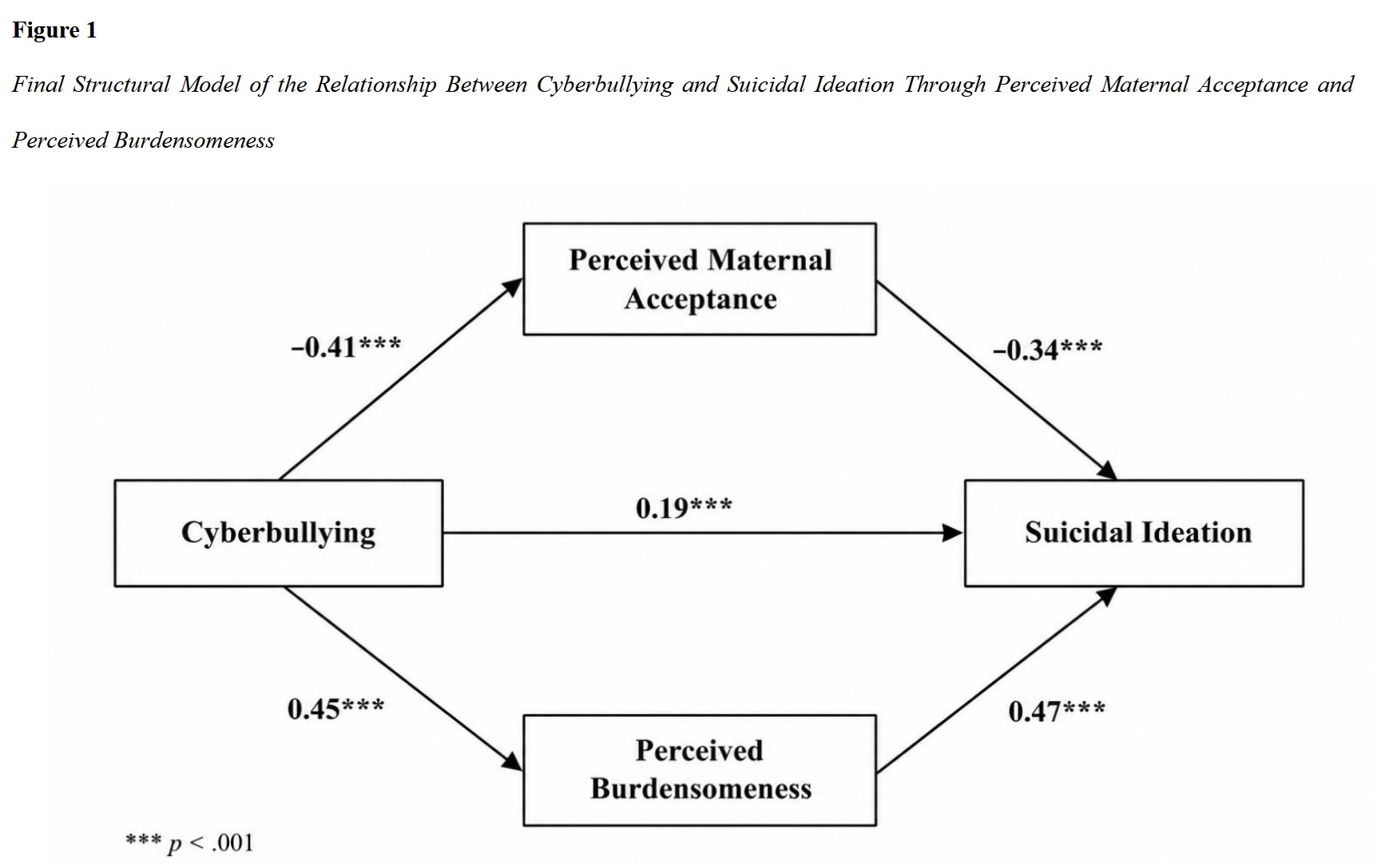
Findings: The results revealed significant positive correlations between cyberbullying and suicidal ideation (r = .48, p < .01) and between cyberbullying and perceived burdensomeness (r = .42, p < .01). Cyberbullying was negatively associated with perceived maternal acceptance (r = -.39, p < .01). Structural equation modeling demonstrated satisfactory model fit (χ²/df = 2.29, CFI = .95, TLI = .94, RMSEA = .051). Cyberbullying had significant direct effects on perceived burdensomeness (β = .45, p < .001), perceived maternal acceptance (β = -.41, p < .001), and suicidal ideation (β = .19, p < .001). Perceived burdensomeness positively predicted suicidal ideation (β = .47, p < .001), whereas perceived maternal acceptance negatively predicted suicidal ideation (β = -.34, p < .001). Bootstrap analyses confirmed significant indirect effects through perceived burdensomeness (Effect = .21, 95% CI [.14, .29]) and perceived maternal acceptance (Effect = .14, 95% CI [.08, .21]).
Conclusion: The findings indicate that cyberbullying is a significant predictor of suicidal ideation among adolescent girls. Perceived burdensomeness and perceived maternal acceptance partially mediate this relationship, suggesting that both interpersonal cognitive vulnerabilities and family-based protective factors play crucial roles in understanding adolescent suicide risk. Interventions aimed at reducing cyberbullying, strengthening maternal acceptance, and addressing maladaptive perceptions of burdensomeness may contribute to the prevention of suicidal ideation in adolescents.
Downloads
References
Agustiningsih, N., Yusuf, A., Ahsan, A., & Fanani, Q. (2024). The Impact of Bullying and Cyberbullying on Mental Health: A Systematic Review. International Journal of Public Health Science (Ijphs), 13(2), 513. https://doi.org/10.11591/ijphs.v13i2.23683
Aledeh, M., Sokan–Adeaga, A. A., Adam, H., Aledeh, S., & Kotera, Y. (2024). Suggesting Self-Compassion Training in Schools to Stop Cyberbullying: A Narrative Review. Discover Psychology, 4(1). https://doi.org/10.1007/s44202-023-00110-5
António, R., Guerra, R., & Moleiro, C. (2023). Cyberbullying During COVID-19 Lockdowns: Prevalence, Predictors, and Outcomes for Youth. Current Psychology, 43(2), 1067-1083. https://doi.org/10.1007/s12144-023-04394-7
Bansal, S., Garg, N., Singh, J., & Walt, F. v. d. (2024). Cyberbullying and Mental Health: Past, Present and Future. Frontiers in psychology, 14. https://doi.org/10.3389/fpsyg.2023.1279234
Chhabria, A., & Khar, P. (2023). Aggression, Suicide, and Self-Harm in Children and Adolescents. Journal of Indian Association for Child and Adolescent Mental Health, 19(1), 53-59. https://doi.org/10.1177/09731342231190715
Chu, X., Yang, S., Sun, Z., Jiang, M., & Xie, R. (2022). The Association Between Cyberbullying Victimization and Suicidal Ideation Among Chinese College Students: The Parallel Mediating Roles of Core Self-Evaluation and Depression. Frontiers in Psychiatry, 13. https://doi.org/10.3389/fpsyt.2022.929679
DeSmet, A., Rodelli, M., Walrave, M., Portzky, G., Dumon, E., & Soenens, B. (2021). The Moderating Role of Parenting Dimensions in the Association Between Traditional or Cyberbullying Victimization and Mental Health Among Adolescents of Different Sexual Orientation. International journal of environmental research and public health, 18(6), 2867. https://doi.org/10.3390/ijerph18062867
Doumas, D. M., & Midgett, A. (2022). Witnessing Cyberbullying and Suicidal Ideation Among Middle School Students. Psychology in the Schools, 60(4), 1149-1163. https://doi.org/10.1002/pits.22823
Dwangu, A. M. (2023). Causes and Effects of Suicides Committed by Pupils in South African Schools. International Journal of Research in Education Humanities and Commerce, 04(03), 257-273. https://doi.org/10.37602/ijrehc.2023.4321
Fadhli, S. A. M., Yan, J. L. S., Halim, A. S. A., Razak, A. A., & Rahman, A. A. (2022). Finding the Link Between Cyberbullying and Suicidal Behaviour Among Adolescents in Peninsular Malaysia. Healthcare, 10(5), 856. https://doi.org/10.3390/healthcare10050856
Farkas, B. F. (2025). The Association Between Cyberbullying and Nonsuicidal Self-Injury: The Mediating Role of Depression and Anxiety. Scandinavian journal of child and adolescent psychiatry and psychology, 13(1), 139-150. https://doi.org/10.2478/sjcapp-2025-0013
Fekih‐Romdhane, F., Malaeb, D., Farah, N., Stambouli, M., Cheour, M., Obeïd, S., & Hallit, S. (2024). The Relationship Between Cyberbullying Perpetration/Victimization and Suicidal Ideation in Healthy Young Adults: The Indirect Effects of Positive and Negative Psychotic Experiences. BMC psychiatry, 24(1). https://doi.org/10.1186/s12888-024-05552-2
Geng, J., Wang, Y., Wang, P., Zeng, P., & Lei, L. (2021). Gender Differences Between Cyberbullying Victimization and Meaning in Life: Roles of Fatalism and Self-Concept Clarity. Journal of interpersonal violence, 37(19-20), NP17157-NP17181. https://doi.org/10.1177/08862605211028285
Hilty, D. M., Stubbe, D., McKean, A. J., Hoffman, P., Zalpuri, I., Myint, M. T., Joshi, S. V., Pakyürek, M., & Li, S. T. T. (2023). A Scoping Review of Social Media in Child, Adolescents and Young Adults: Research Findings in Depression, Anxiety and Other Clinical Challenges. BJPsych Open, 9(5). https://doi.org/10.1192/bjo.2023.523
Jiménez, T., Estévez, J. F., Ochoa, G. M., & Estévez, E. (2025). Suicidal Ideation and Suicidal Attempt in Spanish Adolescents: Risk Profiles Identified Through Decision Tree Analysis. Psychosocial Intervention, 34(3), 161-173. https://doi.org/10.5093/pi2025a13
Jin, X., Zhang, K., Twayigira, M., Gao, X., Xu, H., Huang, C., Luo, X., & Shen, Y. (2023). Cyberbullying Among College Students in a Chinese Population: Prevalence and Associated Clinical Correlates. Frontiers in Public Health, 11. https://doi.org/10.3389/fpubh.2023.1100069
Kee, D. M. H., Anwar, A., & Vranješ, I. (2024). Cyberbullying Victimization and Suicide Ideation: The Mediating Role of Psychological Distress Among Malaysian Youth. Computers in human Behavior, 150, 108000. https://doi.org/10.1016/j.chb.2023.108000
Kingsbury, M., Hammond, N. G., Johnstone, F. C. W., & Colman, I. (2022). Suicidality Among Sexual Minority and Transgender Adolescents: A Nationally Representative Population-Based Study of Youth in Canada. Canadian Medical Association Journal, 194(22), E767-E774. https://doi.org/10.1503/cmaj.212054
Lee, J., Chun, J., Kim, J., & Lee, S. (2021). A Social-Ecological Approach to Understanding the Relationship Between Cyberbullying Victimization and Suicidal Ideation in South Korean Adolescents: The Moderating Effect of School Connectedness. International journal of environmental research and public health, 18(20), 10623. https://doi.org/10.3390/ijerph182010623
Meng, F., Zhu, X., Gao, Q., Li, X., Chen, J., & Sa, Q. (2022). Integrating the Interpersonal Theory of Suicide Into the Relations Between Cyber-Victimization and Suicidality Among Adolescents: A Short-Term Prospective Study. Journal of interpersonal violence, 38(1-2), 981-1006. https://doi.org/10.1177/08862605221086638
Mohamed, E., Hassan, E. E., Hassan, Z., Abouzeid, O. N., & Mohammed, M. (2023). Adolescents Cyberbullying and Its Consequences on Self-Esteem and Suicidal Thoughts at Minia Governorate, Egypt. Minia Scientific Nursing Journal, 013(3), 35-46. https://doi.org/10.21608/msnj.2023.233705.1077
Peprah, P., Oduro, M. S., Okwei, R., Adu, C., Asiamah-Asare, B. Y., & Agyemang‐Duah, W. (2023). Cyberbullying Victimization and Suicidal Ideation Among in-School Adolescents in Three Countries: Implications for Prevention and Intervention. BMC psychiatry, 23(1). https://doi.org/10.1186/s12888-023-05268-9
Perwitasari, D. R., & Wuryaningsih, E. W. (2022). Why Did You Do That to Me?: A Systematic Review of Cyberbullying Impact on Mental Health and Suicide Among Adolescents. NurseLine Journal, 7(1), 35. https://doi.org/10.19184/nlj.v7i1.27311
Planellas, I., & Calderón, C. (2024). Do Cybervictimizations Predict Suicide-Related Behaviors in Adolescents? Mediating Role of the “Escaping” Coping Strategy. Journal of interpersonal violence, 40(5-6), 1015-1036. https://doi.org/10.1177/08862605241256384
Rakoff, J., Chavarria, J., Hamilton, H. A., & Elton‐Marshall, T. (2022). Cross-Sectional Study of Factors Associated With Suicide Ideation in Ontario Adolescents. The Canadian Journal of Psychiatry, 68(5), 327-337. https://doi.org/10.1177/07067437221111364
Rivers, A. S., Russon, J., Winston‐Lindeboom, P., Ruan‐Iu, L., & Diamond, G. (2021). Family and Peer Relationships in a Residential Youth Sample: Exploring Unique, Non-Linear, and Interactive Associations With Depressive Symptoms and Suicide Risk. Journal of youth and adolescence, 51(6), 1062-1073. https://doi.org/10.1007/s10964-021-01524-x
Ruan Víctor dos Santos, S., Moura, H. S. D., Araujo, P. N. d., Santos, F. L. d., & Fortuna, C. M. (2025). Virtual Violence as a Contributing Factor to the Mental Health of Young People: A Scoping Review. Canadian Journal of Nursing Research. https://doi.org/10.1177/08445621251364528
Russon, J., Washington, R., Machado, A. M., Smithee, L., & Dellinger, J. (2022). Suicide Among LGBTQIA+ Youth: A Review of the Treatment Literature. Aggression and Violent Behavior, 64, 101578. https://doi.org/10.1016/j.avb.2021.101578
Sarhangi, N., Rostami, M., Abbasirad, R., Fasihi, M., & Ahmadboukani, S. (2023). Cyber Victimization and Suicidal Behavior in High School Students: The Mediating Role of Psychological Problems and Perceived Social Support. Psychology in the Schools, 60(7), 2395-2408. https://doi.org/10.1002/pits.22868
Tintori, A., Pompili, M., Ciancimino, G., Corsetti, G., & Cerbara, L. (2023). The Developmental Process of Suicidal Ideation Among Adolescents: Social and Psychological Impact From a Nation-Wide Survey. Scientific reports, 13(1). https://doi.org/10.1038/s41598-023-48201-6
Wiguna, T., Minayati, K., Kaligis, F., Ismail, R. I., Wijaya, E., Murtani, B. J., & Pradana, K. (2021). The Effect of Cyberbullying, Abuse, and Screen Time on Non-Suicidal Self-Injury Among Adolescents During the Pandemic: A Perspective From the Mediating Role of Stress. Frontiers in Psychiatry, 12. https://doi.org/10.3389/fpsyt.2021.743329
Wilson, E., Crudgington, H., Morgan, C., Hirsch, C. R., Prina, M., & Gayer‐Anderson, C. (2022). The Longitudinal Course of Childhood Bullying Victimization and Associations With self‐injurious Thoughts and Behaviors in Children and Young People: A Systematic Review of the Literature. Journal of adolescence, 95(1), 5-33. https://doi.org/10.1002/jad.12097
Wright, M. F., & Wachs, S. (2021). The Buffering Effect of Perceived Parental Social Support in the Longitudinal Relationship Between Homophobic Cyberbullying and LGBTQIA Adolescents’ Health Outcomes. The Journal of Early Adolescence, 42(9), 1152-1174. https://doi.org/10.1177/02724316211036759
Wright, M. F., & Wachs, S. (2023). Cyberbullying Involvement and Depression Among Elementary School, Middle School, High School, and University Students: The Role of Social Support and Gender. International journal of environmental research and public health, 20(4), 2835. https://doi.org/10.3390/ijerph20042835
Zhou, J., Zhao, H., & Zou, Y. (2023). Cyberbullying and Traditional Bullying Victimization, Depressive Symptoms, and Suicidal Ideation Among Chinese Early Adolescents: Cognitive Reappraisal and Emotion Invalidation as Moderators. Social Science Computer Review, 42(2), 512-534. https://doi.org/10.1177/08944393231192237
Downloads
Additional Files
Publication Timeline
- Submitted
- Revised
- Accepted