CatBoost Classification of Digital Burnout Based on Technostress, Online Boundary Control, and Sleep Procrastination
Keywords:
Digital burnout, CatBoost, technostress, online boundary control, sleep procrastination, machine learning, classificationAbstract
Objective: This study aimed to classify digital burnout severity among adult digital technology users in Canada using the CatBoost machine learning algorithm based on technostress, online boundary control, and sleep procrastination.
Methods and Materials: This applied, quantitative, cross-sectional, and predictive classification study was conducted among 486 adult digital technology users residing in Canada. Participants were selected through convenience sampling and completed standardized self-report measures assessing digital burnout, technostress, online boundary control, and sleep procrastination. Digital burnout was categorized into low, moderate, and high classes and used as the target outcome variable. Technostress, online boundary control, and sleep procrastination were entered as predictor variables. The dataset was divided into training and testing subsets, and the CatBoost classifier was developed using cross-validation and hyperparameter tuning. Model performance was evaluated using accuracy, precision, recall, F1-score, ROC-AUC, Cohen’s kappa, confusion matrix, and feature importance indices.
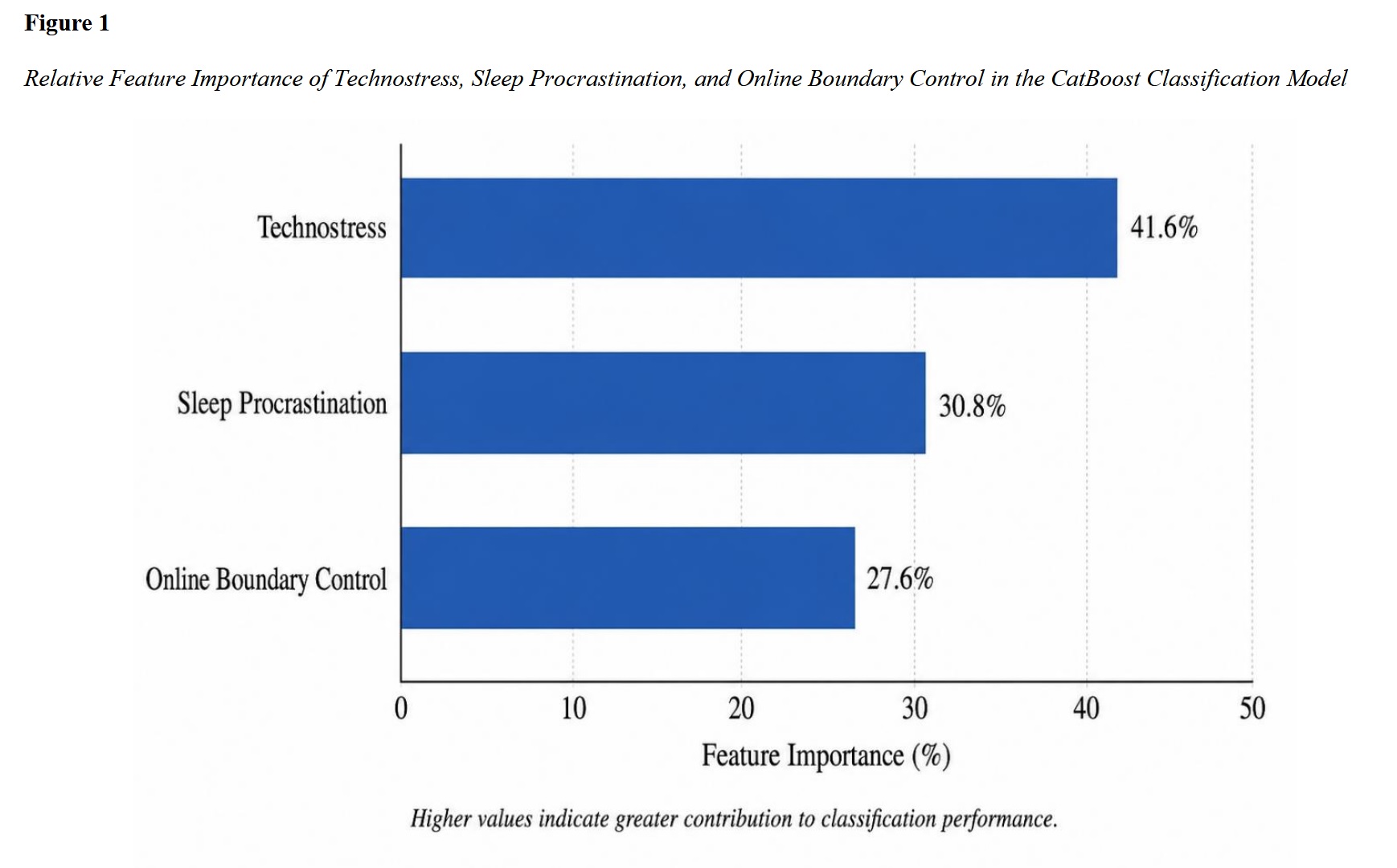
Findings: The CatBoost model demonstrated strong classification performance in predicting digital burnout severity. The overall accuracy of the model was 0.84, with a weighted F1-score of 0.84 and a macro-average ROC-AUC of 0.91. Cohen’s kappa coefficient was 0.75, indicating substantial agreement between observed and predicted burnout classes. Class-specific results showed that the model classified low digital burnout with precision = 0.88, recall = 0.91, and F1-score = 0.89; moderate digital burnout with precision = 0.79, recall = 0.79, and F1-score = 0.79; and high digital burnout with precision = 0.84, recall = 0.81, and F1-score = 0.82. Feature importance analysis showed that technostress was the strongest predictor, followed by sleep procrastination and online boundary control.
Conclusion: The findings indicate that CatBoost can accurately classify digital burnout severity based on psychological and behavioral predictors. Technostress, sleep procrastination, and online boundary control appear to be meaningful indicators for identifying individuals at risk of higher digital burnout.
Downloads
References
An, Y., & Zhang, M. X. (2024). Relationship Between Problematic Smartphone Use and Sleep Problems: The Roles of Sleep-Related Compensatory Health Beliefs and Bedtime Procrastination. Digital Health, 10. https://doi.org/10.1177/20552076241283338
Bahmani, D. S., Rigotti, V., Stanga, Z., Lang, U. E., Blais, R. K., Kelley, M. L., & Brand, S. (2024). Sleep Disturbances and Psychological Well-Being Among Military Medical Doctors of the Swiss Armed Forces: Study Protocol, Rationale and Development of a Cross-Sectional and Longitudinal Interventional Study. Frontiers in Public Health, 12. https://doi.org/10.3389/fpubh.2024.1390636
Bok, S., Shum, J., & Lee, M. (2024). Temporal Motivation Theory: Punctuality Is a Matter of Seconds. Journal of Marketing Education, 46(3), 225-239. https://doi.org/10.1177/02734753241232564
Bozkurt, A., Demirdöğen, E. Y., & Akıncı, M. A. (2024). The Association Between Bedtime Procrastination, Sleep Quality, and Problematic Smartphone Use in Adolescents: A Mediation Analysis. Eurasian Journal of Medicine, 56(1), 69-75. https://doi.org/10.5152/eurasianjmed.2024.23379
Caninsti, R., & Rahayu, S. A. T. (2024). The Role of Smartphone Addiction on Bed Procrastination and Mindful Eating Behavior in Adolescents. Indigenous Jurnal Ilmiah Psikologi, 9(1), 1-13. https://doi.org/10.23917/indigenous.v9i1.2804
Choi, S.-Y., & Kim, J.-H. (2024). Validity and Reliability of the Korean Version of the Digital Burnout Scale. Frontiers in Public Health, 12. https://doi.org/10.3389/fpubh.2024.1386394
Clark, T. A. (2025). Work–Life Balance in an Online World: Simple Strategies for Managing Technostress. Journal of Pediatric Surgical Nursing, 14(4), 132-138. https://doi.org/10.1177/23320249251367754
Correa-Iriarte, S., Hidalgo-Fuentes, S., & Vilar, M. M. (2023). Relationship Between Problematic Smartphone Use, Sleep Quality and Bedtime Procrastination: A Mediation Analysis. Behavioral Sciences, 13(10), 839. https://doi.org/10.3390/bs13100839
Deng, M., & Li, Z. (2025). The Relationship Between Mobile Phone Addiction, Bedtime Procrastination, and Campus-Based Physical Activity: A Longitudinal Follow-Up Study Based on a College Student Population. Frontiers in psychology, 16. https://doi.org/10.3389/fpsyg.2025.1690574
Fiore, M., Arena, D., Crisafi, V., Grieco, V., Palella, M., Timperanza, C., Conti, A., Cuffari, G., & Ferrante, M. (2025). Digital Devices Use and Sleep in Adolescents: An Umbrella Review. International journal of environmental research and public health, 22(10), 1517. https://doi.org/10.3390/ijerph22101517
Gao, T., Zhang, W., & Su, Y. (2026). Temporal Network Analysis of Bedtime Procrastination and Depression Among Adolescents: A Prospective Longitudinal Study. Medcomm, 7(2). https://doi.org/10.1002/mco2.70620
Grah, B., & Penger, S. (2022). Focus, Time Management and Personal Energy of Students During Online Education. ENTRENOVA - ENTerprise REsearch InNOVAtion, 8(1), 127-137. https://doi.org/10.54820/entrenova-2022-0012
He, Y., Wen, J., Liu, F., Zhou, C., Qian, P., & Miao, M. (2025). Mapping the Links Between Problematic Smartphone Use, Exercise Procrastination, and Self-Control: A Network Analysis. BMC psychology, 13(1). https://doi.org/10.1186/s40359-025-03051-x
Hu, W., Ye, Z., & Zhang, Z. (2022). Off-Time Work-Related Smartphone Use and Bedtime Procrastination of Public Employees: A Cross-Cultural Study. Frontiers in psychology, 13. https://doi.org/10.3389/fpsyg.2022.850802
Huang, T., Liu, Y., Tan, T. C., Wang, D., Zheng, K., & Liu, W. (2023). Mobile Phone Dependency and Sleep Quality in College Students During COVID-19 Outbreak: The Mediating Role of Bedtime Procrastination and Fear of Missing Out. https://doi.org/10.21203/rs.3.rs-2497672/v1
Jeon, H., Lee, W. E., & Suh, S. (2023). Emotion Regulation Strategies as a Moderator Between Insomnia Severity and Bedtime Procrastination. Sleep Medicine Research, 14(4), 220-226. https://doi.org/10.17241/smr.2023.02033
Jiang, X., Xie, L. Y., & Wang, S. (2024). Study on Sleep Procrastination Behavior and Psychological Prevention Strategies Among University Students During Vocational Awareness Internships. Pacific International Journal, 7(4), 129-134. https://doi.org/10.55014/pij.v7i4.662
Kamene, K. (2025). Insomnia Epidemic: How Poor Sleeping Habits Are Undermining Mental Wellness. Premier Journal of Social Science. https://doi.org/10.70389/pjss.100012
Klingelhoefer, J., & Meier, A. (2023). Social Media and Well-Being at Work, at Home, and in-Between: A Review. 398-418. https://doi.org/10.4337/9781789906769.00032
Mai, X., Zhang, J., & Zhu, M. (2025). Procrastination Within the Nursing Context: A Concept Analysis. Nursing Open, 12(10). https://doi.org/10.1002/nop2.70308
Marrinhas, D., Santos, V., Salvado, C., Pedrosa, D., & Pereira, A. (2023). Burnout and Technostress During the COVID-19 Pandemic: The Perception of Higher Education Teachers and Researchers. Frontiers in Education, 8. https://doi.org/10.3389/feduc.2023.1144220
Meng, F., & Xuan, B. (2023). Boredom Proneness on Chinese College Students’ Phubbing During the COVID‐19 Outbreak: The Mediating Effects of Self‐Control and Bedtime Procrastination. Journal of Healthcare Engineering, 2023(1). https://doi.org/10.1155/2023/4134283
Naga, J. F., & Ebardo, R. (2025). Social Network Sites (SNS) an Archetype of Techno-Social Stress: A Systematic Review. Heliyon, 11(1), e41119. https://doi.org/10.1016/j.heliyon.2024.e41119
Ojeda, L. (2024). Impostor Phenomenon and Burnout. 81-109. https://doi.org/10.1037/0000397-005
Oliveira, A., Pereira, B., Rosário, P., & Magalhães, P. (2022). Bedtime Procrastination During the Second COVID-19 Lockdown in Portugal. Sleep Science, 15(01), 105-111. https://doi.org/10.5935/1984-0063.20220031
Roy, R. S., John, S. M. T., & John, J. M. (2022). Bedtime Procrastination and Thought Control Among Hostellers And Day Scholars. International Journal of Engineering Technology and Management Sciences, 6(5), 498-504. https://doi.org/10.46647/ijetms.2022.v06i05.077
Sadjiarto, R. E. A. A. S. A., & Susilo, D. (2024). The Influence of Japanese City Pop Music on Emerging Adults’ Sleep Quality. Incoheliv, 1(1), 60-68. https://doi.org/10.24123/incoheliv.v1i1.6562
Sarfraz, M., Ivaşcu, L., Shah, S. G. M., & Farid, A. (2022). Editorial: Cross-Cultural Occupational Health Psychology Challenges for the 21st Century. Frontiers in psychology, 13. https://doi.org/10.3389/fpsyg.2022.970631
Schmidt, L. I., Baetzner, A. S., Dreisbusch, M. I., Mertens, A., & Sieverding, M. (2023). Postponing Sleep After a Stressful Day: Patterns of Stress, Bedtime Procrastination, and Sleep Outcomes in a Daily Diary Approach. Stress and Health, 40(3). https://doi.org/10.1002/smi.3330
Shi, X., Wu, Y., Cao, F., Wang, X., Du, K., & Zang, S. (2024). The Effect of Loneliness on Interpersonal Sensitivity Among Nursing Undergraduates: A Chain Mediation Role of Problematic Internet Use and Bedtime Procrastination. BMC Nursing, 23(1). https://doi.org/10.1186/s12912-024-02321-0
Wang, B., & Parker, S. K. (2023). Embracing the Digital Workplace: A SMART Work Design Approach to Supporting Virtual Work. 403-424. https://doi.org/10.4337/9781802200508.00032
Wang, Y. (2026). Socio-Ecological Correlates of Exercise Procrastination and Exercise Addiction: A Preliminary Exploratory Study Using a Single-University Sample. Frontiers in Psychiatry, 17. https://doi.org/10.3389/fpsyt.2026.1787438
Wang, Y. M., Wang, X., Wu, S., Zhang, W., Li, J., & Liu, B. (2025). Physical Exercise and Bedtime Procrastination Among College Students: Mediating Roles of Self-Control and Mobile Phone Addiction. Frontiers in psychology, 16. https://doi.org/10.3389/fpsyg.2025.1630326
Downloads
Additional Files
Publication Timeline
- Submitted
- Revised
- Accepted