Support Vector Machine Classification of Cyberchondria Severity Based on Health Anxiety, Intolerance of Uncertainty, and Online Reassurance Seeking
Keywords:
Cyberchondria, Support Vector Machine, Health Anxiety, Intolerance of Uncertainty, Online Reassurance Seeking, ClassificationAbstract
Objective: The present study aimed to classify cyberchondria severity based on health anxiety, intolerance of uncertainty, and online reassurance seeking using a Support Vector Machine model among adults living in Canada.
Methods and Materials: This applied, quantitative, cross-sectional study was conducted using a predictive machine-learning classification design. The statistical population included adults living in Canada who used the Internet to search for health-related information. A total of 426 participants were selected through online convenience sampling. Data were collected using the Cyberchondria Severity Scale-12, the Short Health Anxiety Inventory, the Intolerance of Uncertainty Scale-12, an online reassurance-seeking measure, and a demographic information form. Cyberchondria severity was classified into low, moderate, and high groups using percentile-based categorization. The dataset was divided into training and testing subsets using stratified sampling, with 70% of the data used for model training and 30% reserved for independent testing. Support Vector Machine models with different kernels were trained and compared through cross-validation, and the final model was evaluated using accuracy, precision, recall, F1-score, area under the curve, and confusion matrix analysis.
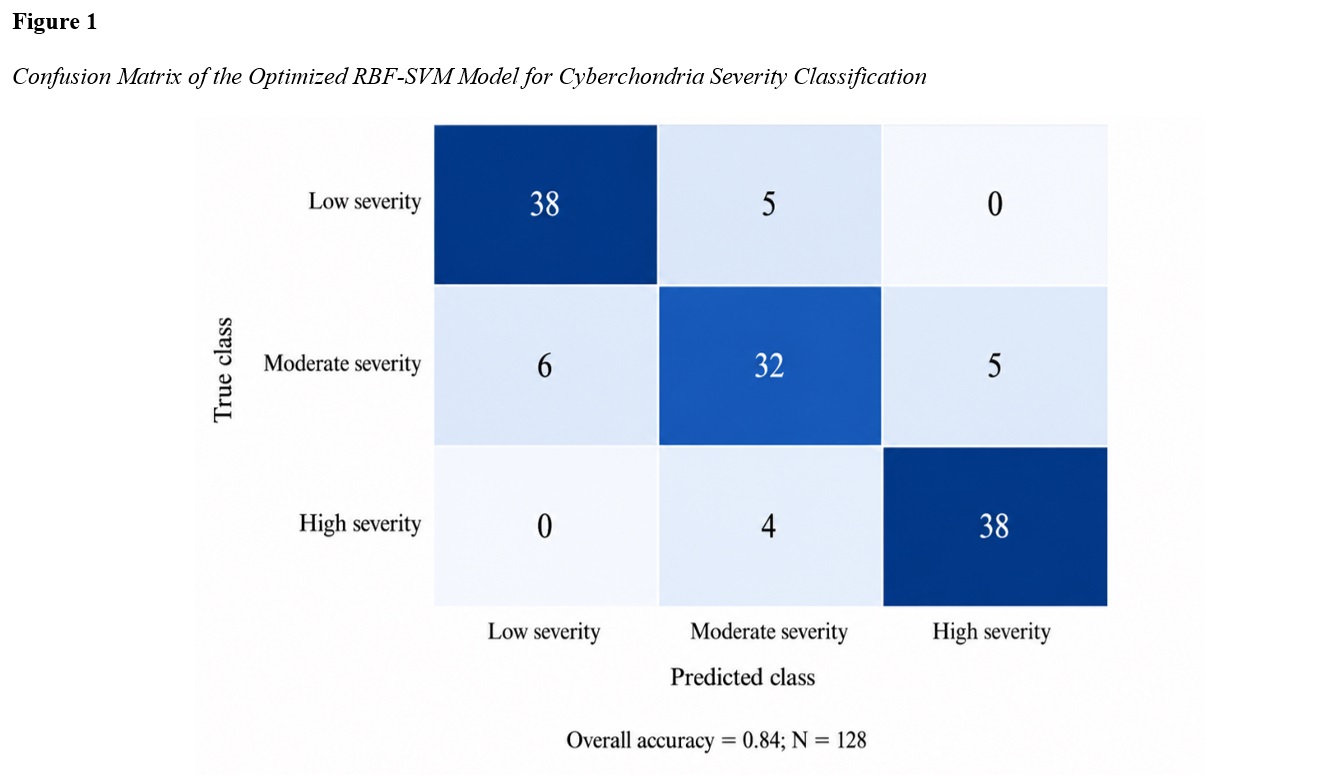
Findings: The radial basis function Support Vector Machine showed the best cross-validated performance and was selected as the final model. In the independent test set, the final model achieved an overall accuracy of 0.84, macro F1-score of 0.84, weighted F1-score of 0.84, and macro AUC of 0.92. Class-level results showed strong performance for low cyberchondria severity and high cyberchondria severity, with F1-scores of 0.87 and 0.89, respectively. The moderate severity group showed lower but acceptable classification performance, with an F1-score of 0.76. The confusion matrix indicated that classification errors occurred mainly between adjacent severity categories, with no direct confusion between low and high severity groups. Permutation-based importance analysis indicated that online reassurance seeking was the strongest predictor, followed by health anxiety and intolerance of uncertainty.
Conclusion: The findings showed that cyberchondria severity can be accurately classified using a Support Vector Machine model based on health anxiety, intolerance of uncertainty, and online reassurance seeking. The results highlight the importance of anxiety-related cognition, difficulty tolerating health uncertainty, and repeated digital reassurance seeking in identifying individuals at greater risk for severe cyberchondria.
Downloads
References
Abu Khait, A., Mrayyan, M. T., Al-Rjoub, S., Rababa, M., & Al-Rawashdeh, S. (2023). Cyberchondria, anxiety sensitivity, hypochondria, and internet addiction: Implications for mental health professionals. Current Psychology, 42(31), 27141-27152. https://doi.org/10.1007/s12144-022-03815-3
Bui, V., & Moscovitch, D. A. (2024). Predictors of Excessive Reassurance Seeking in Social Anxiety. Cognitive therapy and research, 48(2), 292-302. https://doi.org/10.1007/s10608-024-10473-1
Clark, G. I., Rock, A. J., Clark, L. H., & Murray‐lyon, K. (2020). Adult Attachment, Worry and Reassurance Seeking: Investigating the Role of Intolerance of Uncertainty. Clinical Psychologist, 24(3), 294-305. https://doi.org/10.1111/cp.12218
Dameery, K. A., Quteshat, M., Harthy, I. A., & Khalaf, A. (2020). Cyberchondria, Uncertainty, and Psychological Distress Among Omanis During COVID-19: An Online Cross-Sectional Survey. https://doi.org/10.21203/rs.3.rs-84556/v1
Evraire, L. E., Dozois, D. J. A., & Wilde, J. L. (2022). The Contribution of Attachment Styles and Reassurance Seeking to Trust in Romantic Couples. Europe’s Journal of Psychology, 18(1), 19-39. https://doi.org/10.5964/ejop.3059
Fathi Avali Gheshlaqi, A., & Najafi, M. (2023). A comparison of intolerance of uncertainty, cyberchondria, and health anxiety in individuals with obsessive-compulsive disorder, generalized anxiety disorder, depression, and normal individuals. Cultural Psychology Journal, 7(2), 46-64. https://jcp.samt.ac.ir/article_187000.html
Fowler, C., & Gasiorek, J. (2016). Depressive Symptoms, Excessive Reassurance Seeking, and Relationship Maintenance. Journal of Social and Personal Relationships, 34(1), 91-113. https://doi.org/10.1177/0265407515624265
Ivanova, E., & Karabeliova, S. (2014). Elaborating on internet addiction and cyberchondria relationships: direct and mediated effects. Journal of Education, Culture and Society, 5(1), 127-144. https://doi.org/10.15503/jecs20141.127.144
Khait, A. A., Mrayyan, M. T., Al‐Rjoub, S., Rababa, M., & Al‐Rawashdeh, S. (2022). Cyberchondria, Anxiety Sensitivity, Hypochondria, and Internet Addiction: Implications for Mental Health Professionals. Current Psychology, 42(31), 27141-27152. https://doi.org/10.1007/s12144-022-03815-3
Kobori, O., Salkovskis, P. M., Pagdin, R., Read, J., & Halldorsson, B. (2017). Carer's Perception of and Reaction to Reassurance Seeking in Obsessive Compulsive Disorder. The Cognitive Behaviour Therapist, 10. https://doi.org/10.1017/s1754470x17000095
Kobryn, M., & Duplaga, M. (2024). Does Health Literacy Protect Against Cyberchondria: A Cross-Sectional Study? Telemedicine and e-Health, 30(4), e1089-e1100. https://doi.org/10.1089/tmj.2023.0425
Mestre‐Bach, G., & Potenza, M. N. (2023). Cyberchondria: A Growing Concern During the COVID-19 Pandemic and a Possible Addictive Disorder? Current Addiction Reports, 10(1), 77-96. https://doi.org/10.1007/s40429-022-00462-3
Mrayyan, M. T., Abu Khait, A., Al-Mrayat, Y., Alkhawaldeh, J. F. M., Alfayoumi, I., Algunmeeyn, A., & Alhabashneh, H. (2024). Anxiety sensitivity moderates the relationship between internet addiction and cyberchondria among nurses. Journal of Health Psychology. https://doi.org/10.1177/13591053241249634
Najafi, K., Kachouei, M., & Bastami Katouli, M. (2024). A Structural Model of Self-Dichotomy and Reassurance Seeking with Obsessive Beliefs Mediated by Self-Doubt. Journal of Psychology Growth, 13(8), 171-180. https://frooyesh.ir/article-1-5275-fa.html
Noor, A. M., & Oglesby, M. E. (2015). Relationship between cyberchondria and OCD. Psychiatry research, 230, 441-446. https://doi.org/10.1016/j.psychres.2015.09.034
Oniszczenko, W. (2021). Anxious Temperament and Cyberchondria as Mediated by Fear of COVID-19 Infection: A Cross-Sectional Study. PLoS One, 16(8), e0255750. https://doi.org/10.1371/journal.pone.0255750
Parsons, C. A., & Alden, L. E. (2022). Online reassurance-seeking and relationships with obsessive-compulsive symptoms, shame, and fear of self. Journal of Obsessive-Compulsive and Related Disorders, 33, 100714. https://doi.org/10.1016/j.jocrd.2022.100714
Schenkel, S. K., Jungmann, S. M., Gropalis, M., & Witthöft, M. (2021). Conceptualizations of Cyberchondria and Relations to the Anxiety Spectrum: Systematic Review and Meta-Analysis. Journal of medical Internet research, 23(11), e27835. https://doi.org/10.2196/27835
Starcevic, V., & Berle, D. (2015). Cyberchondria: An old phenomenon in a new guise. https://doi.org/10.1093/med/9780199380183.003.0006
Starr, L. R., Santee, A. C., & Huang, M. (2023). Dependency and Excessive Reassurance Seeking. 133-155. https://doi.org/10.1037/0000332-007
Torabi, S., & Pourmohammad, P. (2025). The Relationship Between Neuroticism and Cyberchondria: The Mediating Role of Intolerance of Uncertainty and Metacognitive Beliefs About Health. https://doi.org/10.21203/rs.3.rs-6675727/v1
Varma, R., & Singh, T. (2023). Cyberchondria and Health: Exploring the Linkages. Mind and Society, 12(02), 29-34. https://doi.org/10.56011/mind-mri-122-20233
Wearden, A., Perryman, K., & Ward, V. A. (2006). Adult Attachment, Reassurance Seeking and Hypochondriacal Concerns in College Students. Journal of Health Psychology. https://doi.org/10.1177/1359105306069086
Zareii, A., & Zarnaghash, M. (2022). Prediction of cyberchondria and COVID-19 anxiety based on internet addiction. Dastavadhaye of Clinical Psychology, 7(51), 2-58. https://jacp.scu.ac.ir/article_18284_en.html?lang=fa
Zolotareva, A. (2022). Cyberchondria, but Not Preventive Behavior, Mediates the Relationship Between Fear of COVID-19 and Somatic Burden: Evidence From Russia. Frontiers in Psychiatry. https://doi.org/10.3389/fpsyt.2022.1018659
Downloads
Additional Files
Publication Timeline
- Submitted
- Revised
- Accepted