Development and Validation of the Responsibility for Negative Thoughts Questionnaire
Keywords:
responsibility, negative thoughts, rumination, factor analysis, validity and reliabilityAbstract
Objective: This study aimed to develop and psychometrically validate a questionnaire for assessing responsibility for negative thoughts.
Methods and Materials: This descriptive-correlational instrument-development study used a researcher-developed 35-item questionnaire. The initial items were evaluated by six psychology professors and two educational sciences professors to determine their content validity and conceptual relevance. Construct validity was examined using exploratory factor analysis based on principal component analysis with varimax rotation. First- and second-order confirmatory factor analyses were subsequently conducted to assess the relationships between the items and their corresponding factors and between the identified factors and the overarching construct. Convergent validity was evaluated by examining the correlations between the developed questionnaire and the Jerabek Social Anxiety Scale. Internal consistency reliability was assessed using Cronbach’s alpha coefficients for the subscales and total questionnaire.
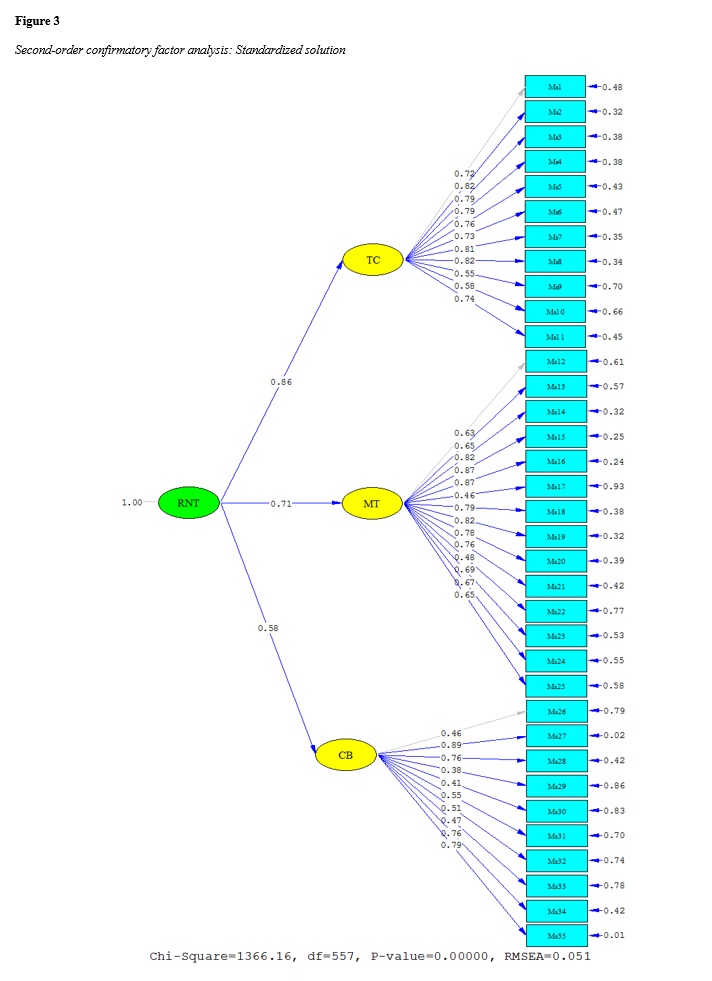
Findings: The content validity ratio of the questionnaire was 0.91. The Kaiser–Meyer–Olkin coefficient was 0.88, and Bartlett’s test of sphericity was statistically significant, χ²(596) = 7,786.54, p < .001, confirming the suitability of the data for factor analysis. Exploratory factor analysis identified three factors with eigenvalues greater than 1.00, which collectively explained 70.18% of the total variance. First-order confirmatory factor analysis demonstrated an acceptable model fit, χ²/df = 2.53, GFI = 0.92, CFI = 0.94, IFI = 0.93, and RMSEA = 0.053. The second-order model also showed satisfactory fit, χ²/df = 2.45, GFI = 0.93, CFI = 0.94, IFI = 0.95, and RMSEA = 0.051. Thought control, magical thinking, compensatory behavior, and the total questionnaire score were significantly correlated with social anxiety, with coefficients ranging from 0.52 to 0.68 (p < .01). Cronbach’s alpha coefficients ranged from 0.89 to 0.93 for the subscales and were 0.94 for the total scale.
Conclusion: The Responsibility for Negative Thoughts Questionnaire demonstrated a coherent three-factor structure, satisfactory convergent validity, appropriate model fit, and excellent internal consistency, supporting its use in psychological research and clinical assessment.
Downloads
References
Alipour, A., Rahimi, A., Shadnia, S., Rahimi, M., Erfan Talab Evini, P., Hosseini, S. M., & Mostafazadeh, B. (2025). Investigating the Relationship between Automatic Negative Thoughts and Experiential Avoidance with Psychological Distress and the Mediating Role of Cognitive Emotion Regulation in Patients with a History of Suicide Attempt. Iranian Journal of Psychiatry, 20(1), 12-21. https://doi.org/10.18502/ijps.v20i1.17397
Dalir, M. (2020). The Role of Obsessive Beliefs Including Responsibility, Perfectionism, and Importance of Thoughts in Sleep Quality. Rooyesh-e-Ravanshenasi Journal, 9(1), 1-8.
Harris, J. (2020). Violence and Responsibility. Routledge. https://doi.org/10.4324/9781003031864
He, J., Mao, Y., Morrison, A. M., & Coca-Stefaniak, J. A. (2021). On Being Warm and Friendly: The Effect of Socially Responsible Human Resource Management on Employee Fears of the Threats of COVID-19. International Journal of Contemporary Hospitality Management, 33(1), 346-366. https://doi.org/10.1108/IJCHM-04-2020-0300
Hickman, C., Marks, E., Pihkala, P., Clayton, S., Lewandowski, R. E., Mayall, E. E., & Van Susteren, L. (2021). Climate Anxiety in Children and Young People and Their Beliefs about Government Responses to Climate Change: A Global Survey. The Lancet Planetary Health, 5(12), e863-e873. https://doi.org/10.1016/S2542-5196(21)00278-3
Koenig, H. G., & Al Zaben, F. (2021). Moral Injury: An Increasingly Recognized and Widespread Syndrome. Journal of religion and health, 60(5), 2989-3011. https://doi.org/10.1007/s10943-021-01328-0
Mikalef, P., Conboy, K., Lundström, J. E., & Popovič, A. (2022). Thinking Responsibly about Responsible AI and 'the Dark Side' of AI. European Journal of Information Systems, 31(3), 257-268. https://doi.org/10.1080/0960085X.2022.2026621
Mousavi, S. Z., & Seyed, T. (2023). Predicting Obsessive-Compulsive Disorder Based on Rumination and Distress Tolerance during the COVID-19 Epidemic. Rooyesh-e-Ravanshenasi Journal, 12(4), 159-166.
Soheili, F., Abbasi, S., & Gholamali, L. (2021). The Effect of Concrete Processing Style versus Abstract Processing Style on Working Memory Capacity in Severe Rumination. Applied Psychological Research, 46(12), 271-292.
Sohrabi, E., Rasouli, M., & Eiri, V. (2025). Predicting Negative Automatic Thoughts Based on Emotional Self-Regulation in Adolescents from Divorced Families. Fourth International Scientific Congress of Students of Psychology, Educational Sciences, and Counseling, Tehran.
Stade, E. C., Stirman, S. W., Ungar, L. H., Boland, C. L., Schwartz, H. A., Yaden, D. B., & Eichstaedt, J. C. (2024). Large Language Models Could Change the Future of Behavioral Healthcare: A Proposal for Responsible Development and Evaluation. NPJ Mental Health Research, 3(1), 12. https://doi.org/10.1038/s44184-024-00056-z
Tanhaei Rashvanloo, F., Torkamani, M., Mirshahi, S., Haji Bekloo, N., & Karshki, H. (2021). Validation and Reliability Assessment of the Persian Version of the Co-Rumination Questionnaire.
Tanrıverdi, S., Şen, M. A., & Genç, H. (2024). Assessment of Preoperative Anxiety and Negative Automatic Thoughts in Patients Waiting for Corneal Transplantation. European Journal of Clinical and Experimental Medicine, 22(1), 30-35. https://doi.org/10.15584/ejcem.2024.1.3
Yeo, D., Lee, S., Choi, H., Park, M. H., & Park, B. (2024). Emotional abuse mediated by negative automatic thoughts impacts functional connectivity during adolescence. Neurobiology of Stress, 30, 100623. https://doi.org/10.1016/j.ynstr.2024.100623
Zou, Y., Wang, R., Xiong, X., Bian, C., Yan, S., & Zhang, Y. (2025). Effects of Acceptance and Commitment Therapy on Negative Emotions, Automatic Thoughts and Psychological Flexibility for Depression and Its Acceptability: A Meta-Analysis. BMC psychiatry, 25(1), 602. https://doi.org/10.1186/s12888-025-07067-w
Downloads
Additional Files
Publication Timeline
- Submitted
- Revised
- Accepted