Explainable Boosting Machine Prediction of Emotional Numbness from Trauma Exposure, Dissociation, and Alexithymia
Keywords:
Emotional numbness, trauma exposure, dissociation, alexithymia, Explainable Boosting Machine, interpretable machine learningAbstract
Objective: This study aimed to predict emotional numbness from trauma exposure, dissociation, and alexithymia among trauma-exposed adults in Canada using an interpretable Explainable Boosting Machine model.
Methods and Materials: This quantitative cross-sectional predictive study was conducted on 426 trauma-exposed adults residing in Canada. Participants completed standardized self-report measures assessing emotional numbness, lifetime trauma exposure, dissociative experiences, and alexithymia. Emotional numbness was considered the outcome variable, while trauma exposure, dissociation, and alexithymia were entered as predictor variables. Data were screened for missing values, response validity, outliers, and distributional properties. Descriptive statistics, reliability coefficients, and Pearson correlations were calculated before predictive modeling. The dataset was divided into training, validation, and test subsets. An Explainable Boosting Machine regression model was trained and evaluated against a conventional multiple linear regression model using root mean squared error, mean absolute error, and coefficient of determination. Global and local interpretability outputs were examined to determine predictor importance, non-linear effects, and interaction patterns.
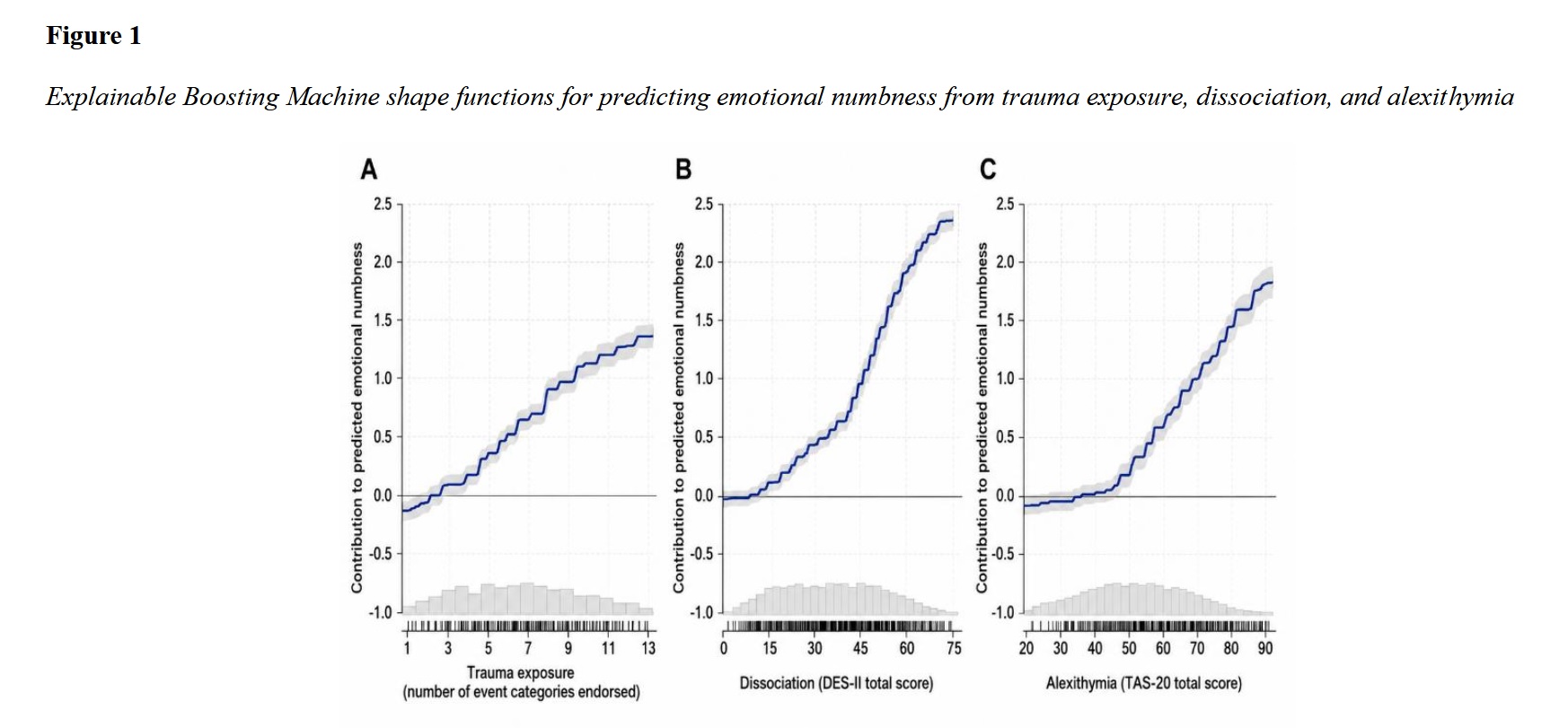
Findings: Inferential analyses showed that trauma exposure, dissociation, and alexithymia were all significantly and positively correlated with emotional numbness. Dissociation had the strongest correlation with emotional numbness, followed by alexithymia and trauma exposure. The Explainable Boosting Machine model outperformed multiple linear regression across predictive indices. In the independent test set, the linear regression model explained 44% of the variance in emotional numbness, whereas the Explainable Boosting Machine model explained 56% of the variance. The EBM model also showed lower prediction error, with RMSE = 7.67 and MAE = 5.94. Global importance analysis indicated that dissociation was the strongest predictor, followed by alexithymia and trauma exposure. Interaction analysis showed that the dissociation by alexithymia interaction was the most influential interaction effect.
Conclusion: The findings indicate that emotional numbness is best predicted by psychological processing variables, particularly dissociation and alexithymia, rather than trauma exposure alone. The Explainable Boosting Machine model provided both stronger predictive accuracy and clinically interpretable results, suggesting that emotional numbness may emerge through non-linear and interactive pathways involving trauma burden, dissociative detachment, and impaired emotional awareness.
Downloads
References
Andersson, H., Aspeqvist, E., Dahlström, Ö., Svedin, C. G., Jönsson, L., Landberg, Å., & Zetterqvist, M. (2022). Emotional Dysregulation and Trauma Symptoms Mediate the Relationship Between Childhood Abuse and Nonsuicidal Self-Injury in Adolescents. Frontiers in Psychiatry, 13. https://doi.org/10.3389/fpsyt.2022.897081
Aragona, M., Cavallo, M., Ferrari, F., Laurendi, G., & Nicolella, G. (2025). Mentalization in Asylum Seekers With Post-Traumatic Stress Disorder. International journal of environmental research and public health, 22(9), 1405. https://doi.org/10.3390/ijerph22091405
Bowen, M. E., McDevitt‐Murphy, M. E., Olin, C. C., & Buckley, B. E. (2022). The Utility of Assessing Alexithymia, in Addition to Coping, in the Context of Posttraumatic Stress. The Journal of Nervous and Mental Disease, 211(1), 17-22. https://doi.org/10.1097/nmd.0000000000001561
Caretti, V. (2025). The Assessment of the Dissociation of Intimacy: Development and Psychometric Properties of the Dissociation of Intimacy Questionnaire (DIQ). European Journal of Investigation in Health Psychology and Education, 15(12), 249. https://doi.org/10.3390/ejihpe15120249
Carpita, B., Bonelli, C., Pini, S., Cappiello, C., Nardi, B., Pustynnikova, M., Pioltino, M., Massimetti, G., Cremone, I. M., Mario, L., Fiorillo, A., & Dell’Osso, L. (2025). The Mediating Effect of Trauma and Loss Spectrum on the Relationship Between Autistic Traits and Eating Disorder Symptoms Among Patients With Borderline Personality Disorder. CNS Spectrums, 30(1). https://doi.org/10.1017/s1092852925100783
Cherechés, B. (2024). The Rhetoric of Dalit Psychological Suffering in Meena Kandasamy’s the Gypsy Goddess (2014). Caste / a Global Journal on Social Exclusion, 5(2), 143-159. https://doi.org/10.26812/caste.v5i2.1744
Chmiel, J., & Kurpas, D. (2025). Neural Correlates of Borderline Personality Disorder (BPD) Based on Electroencephalogram (EEG)—A Mechanistic Review. International Journal of Molecular Sciences, 26(17), 8230. https://doi.org/10.3390/ijms26178230
Cole, R., Smythe, L. D., Edwards, M. J., Happé, F., & Nicholson, T. R. (2025). Exploring the Autism and Functional Neurological Disorder Association: Considerations From Biopsychosocial, Neuropsychological and Computational Models. Autism, 30(2), 269-284. https://doi.org/10.1177/13623613251393504
Cusworth, K., Paulik, G., Thomas, N., Preece, D. A., Campitelli, G., & Mathersul, D. C. (2024). Emotion Processes in Voice‐hearers: Understanding Differences in Emotional Reactivity, Emotion Regulation and Alexithymia. Psychology and Psychotherapy Theory Research and Practice, 97(4), 706-721. https://doi.org/10.1111/papt.12554
Ditzer, J., Wong, E. Y., Modi, R. N., Behnke, M., Gross, J. J., & Talmon, A. (2023). Child Maltreatment and Alexithymia: A Meta-Analytic Review. Psychological bulletin, 149(5-6), 311-329. https://doi.org/10.1037/bul0000391
Edwards, E. (2022). Posttraumatic Stress and Alexithymia: A Meta-Analysis of Presentation and Severity. Psychological Trauma Theory Research Practice and Policy, 14(7), 1192-1200. https://doi.org/10.1037/tra0000539
Gibson, J. (2024). Trauma, Early Life Stress, and Mindfulness in Adulthood. BMC psychology, 12(1). https://doi.org/10.1186/s40359-024-01563-6
Glaus, J., Moser, D. A., Serpa, S. R., Jouabli, S., Turri, F., Plessen, K. J., & Schechter, D. S. (2022). Families With Violence Exposure and the Intergenerational Transmission of Somatization. Frontiers in Psychiatry, 13. https://doi.org/10.3389/fpsyt.2022.820652
Gori, A., Topino, E., Cacioppo, M., Craparo, G., Schimmenti, A., & Caretti, V. (2023). An Integrated Approach to Addictive Behaviors: A Study on Vulnerability and Maintenance Factors. European Journal of Investigation in Health Psychology and Education, 13(3), 512-524. https://doi.org/10.3390/ejihpe13030039
Grady, S., Crowley, N., Scott, S., Ndukwe, C. I., Donohoe, R. T., & Gaynor, K. (2025). The Role of Trauma, Attachment, Dissociation, and Alexithymia in Pathways to Negative Symptoms in Psychosis. British Journal of Clinical Psychology, 64(4), 1002-1019. https://doi.org/10.1111/bjc.12554
Joseph, A.-L., Jerram, M., & Valera, E. M. (2024). Emotional Clarity and Psychopathology in Women Who Have Experienced Physical Intimate Partner Violence. Violence Against Women, 31(10), 2603-2621. https://doi.org/10.1177/10778012241254852
Lynn, S. J., Polizzi, C. P., Merckelbach, H., Chiu, C. D., Maxwell, R., Heugten, D. v., & Lilienfeld, S. O. (2022). Dissociation and Dissociative Disorders Reconsidered: Beyond Sociocognitive and Trauma Models Toward a Transtheoretical Framework. Annual Review of Clinical Psychology, 18(1), 259-289. https://doi.org/10.1146/annurev-clinpsy-081219-102424
Mendez, M. F. (2021). Frontotemporal Dementia: A Window to Alexithymia. Journal of Neuropsychiatry, 33(2), 157-160. https://doi.org/10.1176/appi.neuropsych.20100252
Ogłodek, E. (2022). Alexithymia and Emotional Deficits Related to Posttraumatic Stress Disorder: An Investigation of Content and Process Disturbances. Case Reports in Psychiatry, 2022, 1-5. https://doi.org/10.1155/2022/7760988
Paivio, S. C., & Pascual‐Leone, A. (2023). Trauma and Its Effects. 15-32. https://doi.org/10.1037/0000336-002
Patel, H., O’Connor, C., Andrews, K., Amlung, M., Lanius, R. A., & McKinnon, M. C. (2022). Dissociative Symptomatology Mediates the Relation Between Posttraumatic Stress Disorder Severity and Alcohol‐related Problems. Alcoholism Clinical and Experimental Research, 46(2), 289-299. https://doi.org/10.1111/acer.14764
Phillips, M., Madubata, I. J., Vujanovic, A. A., & Walker, R. L. (2026). The Moderating Role of Alexithymia in the Relationship Between Racial Trauma and Negative Emotionality Among Black Adults. Psychological Trauma Theory Research Practice and Policy, 18(2), 261-268. https://doi.org/10.1037/tra0001912
Pugach, C. P., Starr, L., Silvia, P., & Wisco, B. E. (2023). Negative Emotion Differentiation in Trauma-Exposed Community Members: Associations With Posttraumatic Stress Disorder Symptoms in Daily Life. Journal of Psychopathology and Clinical Science, 132(8), 1007-1018. https://doi.org/10.1037/abn0000851
Putica, A., Dam, N. T. V., Felmingham, K. L., & O’Donnell, M. (2024). Alexithymia and Treatment Response for Prolonged Exposure Therapy: An Evaluation of Outcomes and Mechanisms. Psychotherapy, 61(1), 44-54. https://doi.org/10.1037/pst0000512
Saladino, V. (2025). The Mediating Role of Alexithymia and Loneliness in the Relationship Between Childhood Emotional Abuse and Nomophobia. Developmental Child Welfare. https://doi.org/10.1177/25161032251388301
Seidemann, R., Duek, O., Jia, R., Levy, I., & Harpaz‐Rotem, I. (2021). The Reward System and Post-Traumatic Stress Disorder: Does Trauma Affect the Way We Interact With Positive Stimuli? Chronic Stress, 5. https://doi.org/10.1177/2470547021996006
Stingl, M., Hanewald, B., Kruse, J., & Sack, M. (2021). Positive Side Effects in Trauma-Focusing PTSD Treatment: Reduction of Attendant Symptoms and Enhancement of Affective and Structural Regulation. Psychological Trauma Theory Research Practice and Policy, 13(6), 713-721. https://doi.org/10.1037/tra0000700
Sun, Y.-T. J., Takarangi, M. K. T., & Nixon, R. D. (2025). Do Alexithymia and Maladaptive Cognitive Processes Influence Meta-Awareness of Trauma-Related Memories? Psychology of Consciousness Theory Research and Practice. https://doi.org/10.1037/cns0000426
Topino, E., Fioravanti, G., Fabiani, D., Musetti, A., & Gori, A. (2025). Alexithymia and Problematic Sexual Behaviour: The Mediation of Dissociative Patterns. Health Psychology Report, 13(4), 317-326. https://doi.org/10.5114/hpr/209086
Vail, S. L., Sun, T., Anderson, J. R., & Spencer, C. M. (2025). Self‐Regulatory Profile Scale: Development and Initial Psychometric Validation Using Exploratory Structural Equation Modeling. Journal of marital and family therapy, 51(4). https://doi.org/10.1111/jmft.70059
Wang, Q. (2024). Childhood Trauma and Non-Suicidal Self-Injury Among Chinese Adolescents: The Chain-Mediated Role of Alexithymia and Rumination. Psychiatry Investigation, 21(7), 726-735. https://doi.org/10.30773/pi.2024.0041
Xu, L., Ya, M. A., & Yan, Y. (2025). Relationship Between Alexithymia and Post-Traumatic Stress Disorder (PTSD) in Patients With a History of Early Pregnancy Loss (EPL) After Frozen-Thawed Embryo Transfer (FET): Mediating Effects of Intolerance of Uncertainty (IU). BMC psychiatry, 25(1). https://doi.org/10.1186/s12888-025-07595-5
Downloads
Additional Files
Publication Timeline
- Submitted
- Revised
- Accepted