A Structural Model of Trust in Artificial Intelligence and Intention to Use Digital Psychotherapy with the Mediating Role of Perceived Usefulness
Keywords:
Artificial intelligence, trust, perceived usefulness, digital psychotherapy, behavioral intention, technology acceptance, structural equation modelingAbstract
Objective: This study aimed to examine the structural relationships between trust in artificial intelligence and intention to use digital psychotherapy with the mediating role of perceived usefulness among adult residents of Tehran.
Methods and Materials: This quantitative study employed a descriptive-correlational, cross-sectional design based on structural equation modeling. The study sample comprised 400 adult residents of Tehran, Iran, selected through convenience sampling. Data were collected using adapted versions of the Trust in Automated Systems Scale, the Perceived Usefulness Scale, and the Behavioral Intention Scale. The psychometric properties of the measurement instruments were evaluated through confirmatory factor analysis, internal consistency reliability, convergent validity, and discriminant validity. Data were analyzed using Pearson’s correlation analysis and structural equation modeling with maximum likelihood estimation in SPSS-29 and AMOS-29. The mediating effect was examined using bias-corrected bootstrapping with 5,000 resamples.
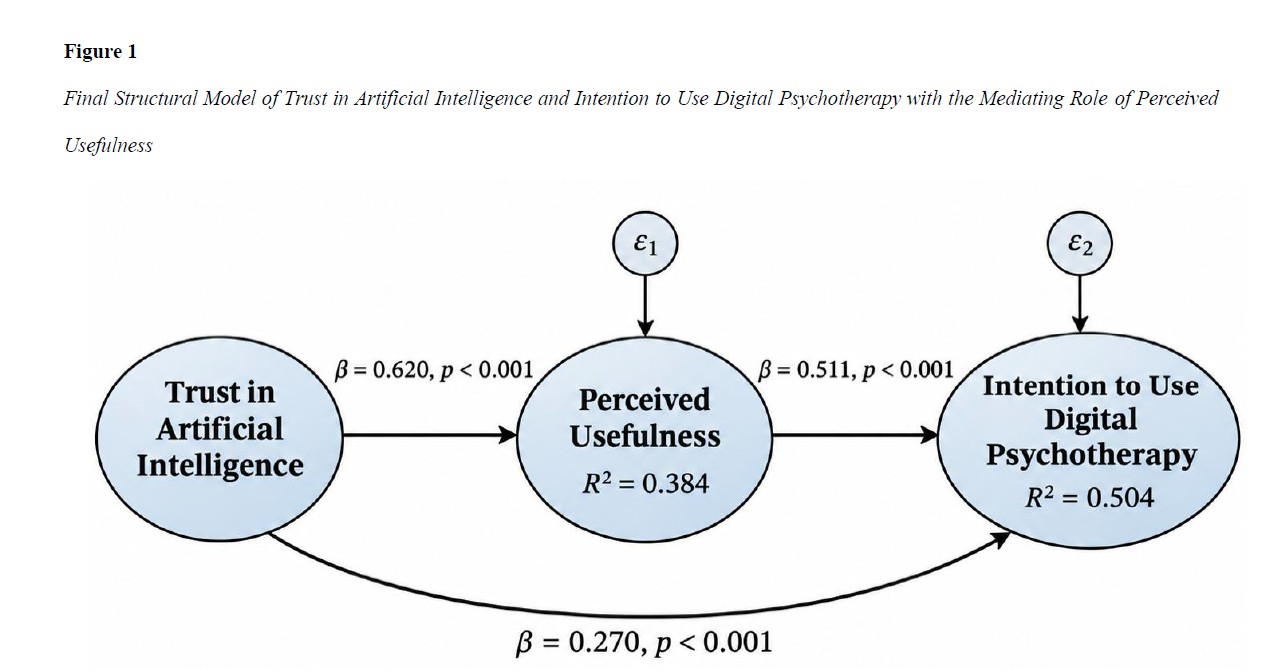
Findings: The structural model demonstrated satisfactory goodness-of-fit indices (χ²/df = 1.875, CFI = 0.963, TLI = 0.958, RMSEA = 0.047, SRMR = 0.043). Trust in artificial intelligence significantly predicted perceived usefulness (β = 0.620, p < 0.001) and intention to use digital psychotherapy (β = 0.270, p < 0.001). Perceived usefulness significantly predicted intention to use digital psychotherapy (β = 0.511, p < 0.001). The indirect effect of trust on behavioral intention through perceived usefulness was statistically significant (β = 0.317, p < 0.001), indicating complementary partial mediation. The structural model explained 38.4% and 50.4% of the variance in perceived usefulness and behavioral intention, respectively.
Conclusion: Trust in artificial intelligence and perceived usefulness constitute important psychological determinants of intention to use digital psychotherapy. Perceived usefulness partially accounts for the relationship between trust and behavioral intention.
Downloads
References
Alqurni, J. S. (2026). Exploring the Role of Agentic AI in Fostering Self-Efficacy, Autonomy Support, and Self-Learning Motivation in Higher Education. Frontiers in Artificial Intelligence, 9. https://doi.org/10.3389/frai.2026.1738774
Aourarh, Y., & Elkharraz, A. (2026). Artificial Intelligence Adoption in Recruitment and Selection: A Socio-Technical TAM–TOE Framework Explaining HR Professionals’ Behavioral Intention. Systems, 14(9), 1173. https://doi.org/10.3390/systems14091173
Arnout, B. A., & Alshehri, S. M. (2024). Causal Relationships Between the Use of AI, Therapeutic Alliance, and Job Engagement Among Psychological Service Practitioners. Behavioral Sciences, 15(1), 21. https://doi.org/10.3390/bs15010021
Balaskas, S., & Androulakis, G. (2025). Explainability, Safety Cues, and Trust in GenAI Advisors: A SEM–ANN Hybrid Study. Future Internet, 17(12), 566. https://doi.org/10.3390/fi17120566
Balaskas, S., Tsiantos, V. D., Chatzifotiou, S., & Rigou, M. (2025). Determinants of ChatGPT Adoption Intention in Higher Education: Expanding on TAM With the Mediating Roles of Trust and Risk. Information, 16(2), 82. https://doi.org/10.3390/info16020082
Bondac, G. T., Stănescu, S.-G., Ionescu, C. A., Duică, A., & Uzlău, M. C. (2026). Decision-Making in Complex Systems Using AI-Based Decision Support: The Role of Trust, Transparency, and Data Quality. Electronics, 15(2), 372. https://doi.org/10.3390/electronics15020372
Ciarmoli, D., Gennaro, A., Lecce, F., Reho, M., & Triberti, S. (2025). Avatars in Mental Health: Psychotherapists’ Attitudes Towards Avatar Technology and Factors Influencing Adoption. European Journal of Investigation in Health Psychology and Education, 15(12), 256. https://doi.org/10.3390/ejihpe15120256
Daruwala, N. A. (2025). Behavioural Intention and Smart Home Technology Adoption. International Journal of Technology and Human Interaction, 21(1), 1-24. https://doi.org/10.4018/ijthi.372059
Fan, M., He, X., Zhou, M., & Xia, T. (2026). A Study on the Factors Associated With College Students’ Intention to Use AI-Based Mental Health Services: The Roles of Trust, Empathy, and Privacy Concern. Behavioral Sciences, 16(10), 1874. https://doi.org/10.3390/bs16101874
Fan, M., Xie, X., & Xia, T. (2026). A Meta-Analysis of the Acceptance of Artificial Intelligence in Psychotherapy. Behavioral Sciences, 16(9), 1552. https://doi.org/10.3390/bs16091552
Gumusel, E. (2024). A Literature Review of User Privacy Concerns in Conversational Chatbots: A Social Informatics Approach: An Annual Review of Information Science and Technology (ARIST) Paper. Journal of the Association for Information Science and Technology, 76(1), 121-154. https://doi.org/10.1002/asi.24898
He, Q., Wang, J., & He, D. (2024). The Influence of Task and Group Disparities Over Users’ Attitudes Toward Using Large Language Models for Psychotherapy. Proceedings of the Human Factors and Ergonomics Society Annual Meeting, 68(1), 1147-1152. https://doi.org/10.1177/10711813241268507
Huțul, T. D., Popescu, A., Karner‐Huțuleac, A., Holman, A. C., & Huțul, A. (2024). Who's Willing to Lay on the Virtual Couch? Attitudes, Anthropomorphism and Need for Human Interaction as Factors of Intentions to Use Chatbots for Psychotherapy. Counselling and Psychotherapy Research, 24(4), 1479-1488. https://doi.org/10.1002/capr.12794
Lan, Y., Chen, H., & Xia, L. (2025). Mindfulness and AI Adoption: Extending the Technology Acceptance Model for Chinese Media Students. Frontiers in psychology, 16. https://doi.org/10.3389/fpsyg.2025.1637502
Luo, T., & Cao, S. (2026). An Empirical Study on College Students’ Behavioral Intention to Use Generative Artificial Intelligence: An Integrated Model Based on the Innovation Diffusion Theory and Trust Theory. Sage Open, 16(1). https://doi.org/10.1177/21582440251409860
Mohsin, A. M. A., Li, S., & Quah, K. W. J. (2026). The Influence of Artificial Intelligence, Social Media, and Personality Traits on Purchase Decision-Making Among Generation Z University Students. Administrative Sciences, 16(10), 461. https://doi.org/10.3390/admsci16100461
Naji, G. M. A., Alzoraiki, M., Rao, N. S., & Iskandar, Y. H. P. (2026). Factors Influencing Intention to Use AI in Business Decision Making Among Professional Employees in Malaysia’s Financial Industry. Frontiers in Artificial Intelligence, 9. https://doi.org/10.3389/frai.2026.1779573
Oberthaler, M., Röhrig, B., Petrak, F., & Goerigk, S. A. (2026). Perceived Usefulness of Digital Assistance Systems Among Psychology Students and Psychotherapists: Predictors, Barriers and the Impact of a Brief Video Demonstration. International journal of psychology, 61(6). https://doi.org/10.1002/ijop.70268
Papathomas, A., Konteos, G., & Avlogiaris, G. (2025). Behavioral Drivers of AI Adoption in Banking in a Semi-Mature Digital Economy: A TAM and UTAUT-2 Analysis of Stakeholder Perspectives. Information, 16(2), 137. https://doi.org/10.3390/info16020137
Qian, Y. H. (2025). Fostering Adolescent Engagement in Generative AI Art Therapy: A Dual SEM-ANN Analysis of Emotional. Frontiers in psychology, 16. https://doi.org/10.3389/fpsyg.2025.1628471
Rad, D., Maier, M. L., Triff, Z., & Marcu, R. (2025). Entangled Autopoiesis: Reframing Psychotherapy and Neuroscience Through Cognitive Science and Systems Engineering. Brain Sciences, 15(10), 1032. https://doi.org/10.3390/brainsci15101032
Rahman, M. S., Sabbir, M. M., Zhang, J., Moral, I. H., & Hossain, G. M. S. (2023). Examining Students’ Intention to Use ChatGPT: Does Trust Matter? Australasian Journal of Educational Technology, 51-71. https://doi.org/10.14742/ajet.8956
Ren, G., Wang, G., & Huang, T. (2025). What Influences Potential Users’ Intentions to Use Hotel Robots? Sustainability, 17(12), 5271. https://doi.org/10.3390/su17125271
Riches, S., Azevedo, L., Vora, A., Kaleva, I., Taylor, L., Guan, P., Jeyarajaguru, P., McIntosh, H., Petrou, C., Pisani, S., & Hammond, N. (2021). Therapeutic Engagement in Robot‐assisted Psychological Interventions: A Systematic Review. Clinical Psychology & Psychotherapy, 29(3), 857-873. https://doi.org/10.1002/cpp.2696
Seo, K. H., & Lee, J. H. (2021). The Emergence of Service Robots at Restaurants: Integrating Trust, Perceived Risk, and Satisfaction. Sustainability, 13(8), 4431. https://doi.org/10.3390/su13084431
Suhluli, S. A. (2026). Digital Adoption of Generative AI Tools: A Multi-Theory Model Linking Cognitive Load, User Perceptions, and System Attributes. Sustainability, 18(4), 2076. https://doi.org/10.3390/su18042076
Tabassum, A., Ghaznavi, I., Abd-Alrazaq, A. A., & Qadir, J. (2025). Exploring the Application of AI and Extended Reality Technologies in Metaverse-Driven Mental Health Solutions: Scoping Review. Journal of medical Internet research, 27, e72400. https://doi.org/10.2196/72400
Tam, D. H. (2026). The Ethical Dilemma of AI-Generated Videos: A Hybrid PLS-SEM, ANN, and fsQCA Study of Purchase Intention in E-Commerce. https://doi.org/10.21203/rs.3.rs-11651204/v1
Tian, Q. (2026). Educational Anxiety and Student Mental Health in the Era of Artificial Intelligence: A Multi-Source Data Fusion Analysis in Smart Education. Frontiers in Public Health, 14. https://doi.org/10.3389/fpubh.2026.1804527
Ţuclea, C.-E., & Holostencu, L.-F. (2026). Generation Z Employees’ Acceptance and AI Use Intensity: A Moderated Mediation Model of Psychological Safety, Technostress, and Trust. Merits, 6(1), 7. https://doi.org/10.3390/merits6010007
Uddin, M. N., Low, W. T., Rahman, M. A., & Mokhtar, S. (2024). An Exploration of Millennials' Attitudes Towards the Use of Artificial Intelligence Chatbots for Customer Service Within E-Commerce Platforms. Proceedings of the International Conference on Business Management and Leadership, 1(1), 1-19. https://doi.org/10.33422/icbml.v1i1.374
Yao, K. C., & Chiang, S. (2025). Mathematical Modeling and Structural Equation Analysis of Acceptance Behavior Intention to AI Medical Diagnosis Systems. Mathematics, 13(15), 2390. https://doi.org/10.3390/math13152390
Yirmiya, K., & Fonagy, P. (2025). Mentalizing Without a Mind: Psychotherapeutic Potential of Generative AI. Journal of medical Internet research, 27, e79156. https://doi.org/10.2196/79156
Zhang, Z., Lu, X., Zhang, Y., Zhang, H., & Zhang, M. (2026). Privacy Assurances and Professional-Boundary Warnings in Generative AI Mental Health Chatbots: A Randomized Vignette Experiment on Calibrated Trust, Overreliance Risk, and Professional Help-Seeking Intentions. Frontiers in psychology, 17. https://doi.org/10.3389/fpsyg.2026.1934264
Zhu, J., Chen, J., Covarrubias, M., Li, D., & Wei, W. (2026). Higher Education Students’ Trust Formation and Behavioral Intention Toward GenAI in Interdisciplinary Learning: A Behavioral Reasoning Theory Perspective. Sustainability, 18(15), 7986. https://doi.org/10.3390/su18157986
Zubala, A., Pease, A., Lyszkiewicz, K., & Hackett, S. (2025). Art Psychotherapy Meets Creative AI: An Integrative Review Positioning the Role of Creative AI in Art Therapy Process. Frontiers in psychology, 16. https://doi.org/10.3389/fpsyg.2025.1548396
Downloads
Additional Files
Publication Timeline
- Submitted
- Revised
- Accepted