Avoidance as a Mediating Mechanism Between Maladaptive Coping and PTSD Symptoms
DOI:
https://doi.org/10.61838/kman.jarac.1867Keywords:
Posttraumatic stress disorder, maladaptive coping, avoidance, mediation, structural equation modeling, CanadaAbstract
Objective: This study aimed to investigate whether avoidance mediates the relationship between maladaptive coping strategies and posttraumatic stress disorder (PTSD) symptoms among Canadian adults.
Methods and Materials: A descriptive correlational design was employed with a sample of 400 adults recruited from Canada, determined based on Morgan and Krejcie’s sample size table. Data were collected using the Posttraumatic Stress Disorder Checklist for DSM-5 (PCL-5), the Brief COPE maladaptive subscales, and the Impact of Event Scale–Avoidance subscale (IES-A). Statistical analyses were conducted using SPSS version 27 for descriptive and correlational analyses, and AMOS version 21 for structural equation modeling (SEM). Pearson correlation coefficients were computed to examine bivariate relationships, and SEM was applied to test the hypothesized mediation model. Model fit was assessed using multiple indices including χ²/df, GFI, AGFI, CFI, TLI, and RMSEA.
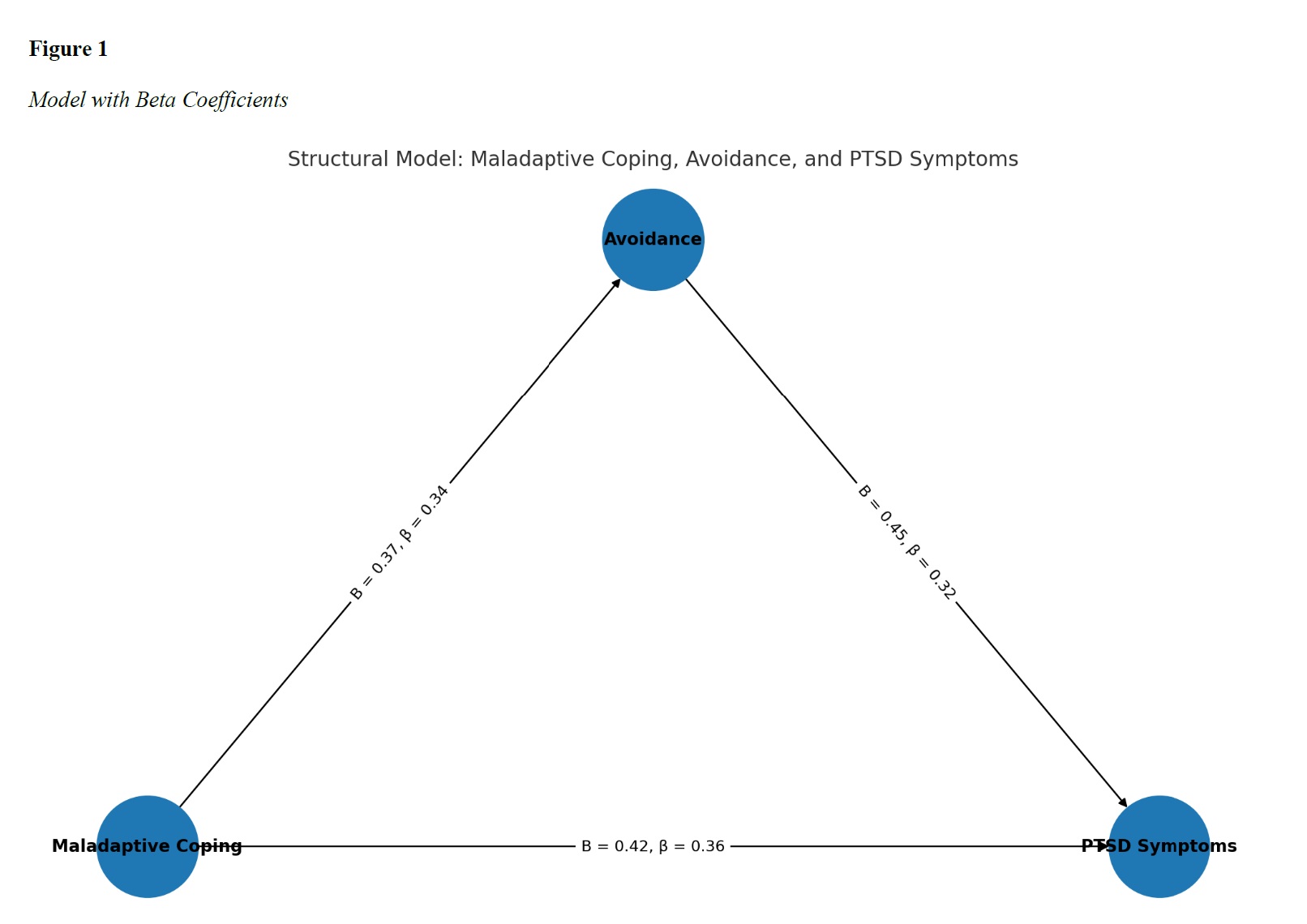
Findings: Pearson correlations revealed significant positive associations between maladaptive coping and PTSD symptoms (r = .52, p < .001), maladaptive coping and avoidance (r = .44, p < .001), and avoidance and PTSD symptoms (r = .47, p < .001). The structural model demonstrated good fit to the data (χ² = 124.86, df = 58, χ²/df = 2.15, GFI = .94, AGFI = .91, CFI = .96, TLI = .95, RMSEA = .053). Path analysis showed that maladaptive coping had a direct effect on PTSD symptoms (β = .36, p < .001), and an indirect effect via avoidance (β = .11, p < .001). The total effect of maladaptive coping on PTSD symptoms was β = .47 (p < .001), confirming the partial mediating role of avoidance.
Conclusion: The findings highlight avoidance as a significant mechanism through which maladaptive coping contributes to PTSD symptom severity. These results underscore the need for interventions that reduce avoidance behaviors and promote adaptive coping strategies to mitigate posttraumatic stress.
Downloads
Downloads
Additional Files
Publication Timeline
- Submitted
- Revised
- Accepted