Comparison of the Effectiveness of Acceptance and Commitment Therapy and Transdiagnostic Therapy on Interpersonal Guilt and Emotional Inhibition in Patients with Multiple Sclerosis
DOI:
https://doi.org/10.61838/kman.jarac.7.2.4Keywords:
Acceptance and Commitment Therapy, Transdiagnostic Therapy, Multiple Sclerosis, Interpersonal Guilt, Emotional InhibitionAbstract
Objective: The aim of the present study was to compare the effectiveness of Acceptance and Commitment Therapy (ACT) and Transdiagnostic Therapy on interpersonal guilt and emotional inhibition in patients with Multiple Sclerosis (MS).
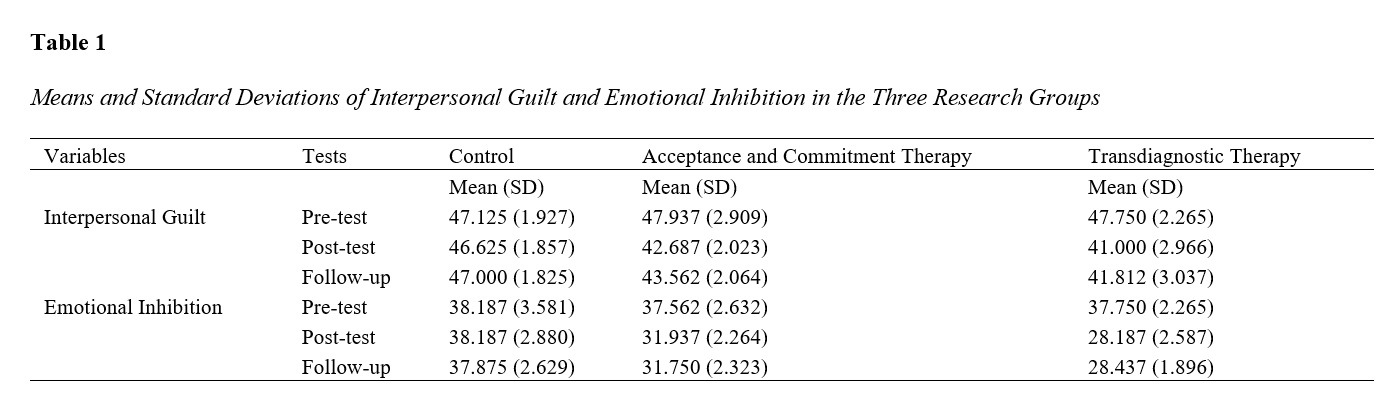
Methods and Materials: The study employed a quasi-experimental design with pre-test, post-test, and follow-up phases, including a control group. The research population consisted of all women aged 20 to 40 years with MS who were members of the MS Association of Amol in the first half of 2023. The research sample included 48 individuals with MS who were selected through simple random sampling and were randomly assigned to two experimental groups and one control group. The research instruments included the Interpersonal Guilt Scale by Gazzillo et al. (2018) and the Emotional Inhibition Scale by Kellner (1986). Data were analyzed using repeated measures analysis of covariance (ANCOVA) and Bonferroni post-hoc tests with SPSS version 24 software.
Findings: The results indicated significant differences between the effects of ACT, Transdiagnostic Therapy, and the control group on the variables of interpersonal guilt and emotional inhibition (P < 0.05). Furthermore, post-hoc test results revealed that Transdiagnostic Therapy had the most significant therapeutic effects on improving emotional inhibition in patients with MS compared to ACT. The two-month follow-up confirmed the stability of the study's results.
Conclusion: The effectiveness of both therapeutic approaches suggests that clinicians and treatment teams can utilize psychological treatment approaches alongside biological treatments to reduce the severity of psychological and emotional symptoms resulting from chronic illnesses, thereby facilitating the treatment process.
Downloads
References
Alizadeh, M., Alilou, M.-M., Bakhshipoor, A., & Birami, M. (2023). The effectiveness of Acceptance and Commitment Therapy (ACT) on emotional dysregulation in patients with multiple sclerosis: A single-case study. Psychiatric Nursing, 11(4), 83-94. https://ijpn.ir/browse.php?a_id=2228&sid=1&slc_lang=fa&ftxt=0
Amiri, M., Khosh-Akhlagh, H., Sajadian, P.-S., & Rezaei-Jamalui, H. (2023). Comparison of the effectiveness of Acceptance and Commitment Therapy (ACT) and Transdiagnostic Therapy on sexual performance and Type D personality components in individuals with cardiovascular disease. Knowledge and Research in Psychology, 93, 154-174. https://journals.iau.ir/article_704950.html
Asadollahi, F., Mohammadi, M., Naziri, G., & Fath, N. (2022). Validation and confirmatory factor analysis of the Persian version of the Kellner Emotional Inhibition Questionnaire in the clinical population of Lorestan Province. Applied Psychology Quarterly, 16(2), 37-57. https://doi.org/10.52547/apsy.2021.224133.1194
Azadmanesh, N., Shahabi-Zadeh, F., Shahraki, E., & Asadi-Younesi, M.-R. (2021). Comparison of the effectiveness of Acceptance and Commitment Therapy (ACT) and Unified Transdiagnostic Treatment on anxiety and somatic symptoms in patients with systemic lupus erythematosus. Journal of Mashhad University of Medical Sciences, 64(1), 2643-2657. https://doi.org/10.22038/mjms.2021.19623
Barlow, D. H., Farchione, T. J., Sauer-Zavala, S., Latin, H. M., Ellard, K. K., Bullis, J. R., & Cassiello-Robbins, C. (2017). Unified protocol for transdiagnostic treatment of emotional disorders: Therapist guide. Oxford University Press. https://doi.org/10.1093/med-psych/9780190685973.001.0001
Barlow, D. H., Harris, B. A., Eustis, E. H., & Farchione, T. J. (2020). The unified protocol for transdiagnostic treatment of emotional disorders. World Psychiatry, 19(2), 245. https://doi.org/10.1002/wps.20748
Blay, M., Duarte, M., Dessouli, M. A., Durpoix, A., Rufenacht, E., Weibel, S., & Perroud, N. (2024). Proposition of a transdiagnostic processual approach of emotion dysregulation based on core triggers and interpersonal style. Frontiers in Psychiatry, 15, 1260138. https://doi.org/10.3389/fpsyt.2024.1260138
Celleri, M., Cremades, C. F., Etchevers, M. J., & Garay, C. J. (2023). Effectiveness of the Unified Protocol for the transdiagnostic treatment of emotional disorders in online and group format in Argentina: study protocol for a randomized controlled trial. Trials, 24(1), 678. https://doi.org/10.1186/s13063-023-07428-4
Davis, C. H., Klimczak, K., Aller, T. B., Twohig, M. P., & Levin, M. E. (2024). Reach, adoption, and maintenance of online acceptance and commitment therapy at a university: An implementation case study. Psychological Services. https://doi.org/10.1037/ser0000834
Dehghan, M., Sharifi, P., Hasani, J., Young, C. A., & Langdon, D. (2023). Healthier living with MS: The key role of self-efficacy and emotion regulation. Multiple Sclerosis and Related Disorders, 73, 104608. https://doi.org/10.1016/j.msard.2023.104608
Dobson, R., & Giovannoni, G. (2019). Multiple sclerosis-a review. European Journal of Neurology, 26(1), 27-40. https://doi.org/10.1111/ene.13819
Fang, S., Ding, D., Zhang, R., & Huang, M. (2023). Psychological mechanism of acceptance and commitment therapy and rational emotive behavior therapy for treating hoarding: Evidence from randomized controlled trials. Frontiers in Public Health, 11, 1084467. https://doi.org/10.3389/fpubh.2023.1084467
Farchione, T. J., Spencer-Laitt, D. M., Sauer-Zavala, S., & Barlow, D. H. (2023). The Unified Protocol for Transdiagnostic Treatment of Emotional Disorders and physical health comorbidity: An introduction. Behavioral Therapy. https://doi.org/10.1016/j.beth.2024.04.007
Fattahi, A., Mazini, F., Jaberghaderi, N., Rajabi, F., Derakhshani, M., & Laki, M. (2023). Effectiveness of acceptance and commitment therapy upon distress, emotion regulation, and self-compassion in patients with cardiovascular disease: a randomized clinical trial. Trends in Psychiatry and Psychotherapy, AheadOfPrint, 0-0. https://doi.org/10.47626/2237-6089-2023-0685
Fragkiadaki, E., Cotterill, N., Rice, C., Smith, J. A., & Nizza, I. E. (2023). Evaluation of the feasibility and acceptability of an integrative group psychological intervention for people with Multiple Sclerosis: A study protocol. PLoS One, 18(7), e0288295. https://doi.org/10.1371/journal.pone.0288295
Gazzillo, F., Gorman, B., De Luca, E., Faccini, F., Bush, M., Silberschatz, G., & Dazzi, N. (2018). Preliminary data about the validation of a self-report for the assessment of interpersonal guilt: The Interpersonal Guilt Rating Scales-15s (IGRS-15s). Psychodynamic Psychiatry, 46(1), 23-48. https://doi.org/10.1521/pdps.2018.46.1.23
Hanna, M., & Strober, L. B. (2020). Anxiety and depression in Multiple Sclerosis (MS): Antecedents, consequences, and differential impact on well-being and quality of life. Multiple Sclerosis and Related Disorders, 44, 102261. https://doi.org/10.1016/j.msard.2020.102261
Hayes, S. C. (2016). Acceptance and commitment therapy, relational frame theory, and the third wave of behavioral and cognitive therapies-republished article. Behavior therapy, 47(6), 869-885. https://doi.org/10.1016/j.beth.2016.11.006
Hayes, S. C., Strosahl, K. D., & Wilson, K. G. (2009). Acceptance and commitment therapy. American Psychological Association. http://personal.kent.edu/~dfresco/CBT_Readings/ACT.pdf
Joaquim, S. B., Simões de Almeida, R., & Marques, A. J. (2023). Transdiagnostic Cognitive Behavioral Group Interventions: A Systematic Review. Cognitive therapy and research, 1-24. https://doi.org/10.1007/s10608-023-10372-x
Karimi, M., Thani, F. N., Naqhsh, Z., & Ghazaghi, T. (2022). The effectiveness of acceptance and commitment therapy and cognitive-behavioral therapy in enhancing resiliency and quality of life among Multiple sclerosis patients: A randomized clinical trial study. Iranian journal of psychiatry and behavioral sciences, 16(1). https://doi.org/10.5812/ijpbs.107467
Karimian, Z., Haghayegh, S.-A., Emami-Najafi-Dehkordi, S.-M.-H., & Raeisi, M. (2021). Comparison of the effectiveness of Transdiagnostic Therapy and Acceptance and Commitment Therapy (ACT) on emotion regulation and illness perception in patients with irritable bowel syndrome. Behavioral Sciences Research, 19(3), 477-488. https://doi.org/10.52547/rbs.19.3.477
Kellner, R. (1986). Abridged Manual of the Emotional Inhibition Scale. University of New Mexico. https://pubmed.ncbi.nlm.nih.gov/21829045/
Kouhneshin Taromi, F., Afshari Nia, K., & Kakaberaei, K. (2021). Comparison of the effectiveness of Acceptance and Commitment Therapy (ACT) and Transdiagnostic Therapy in increasing life satisfaction among nurses working in Social Security hospitals in Kermanshah. Journal of Psychological Methods and Models, 12(43), 55-69. https://civilica.com/doc/1909534/
Merwin, R. M., Nikolaou, P., Moskovich, A. A., Babyak, M., Smith, P. J., & Karekla, M. (2023). Change in body image flexibility and correspondence with outcomes in a digital early intervention for eating disorders based on acceptance and commitment therapy. Body Image, 44, 131-135. https://doi.org/10.1016/j.bodyim.2022.12.010
Nasbum, A. (2013). A Practical Guide to Diagnostic Interviews Using DSM-5 Criteria (F Rezaei, AA Forooghi, Persian trans ed.). Arjmand.
Pakenham, K. I., & Landi, G. (2023). A pilot randomized control trial of an online acceptance and commitment therapy (ACT) resilience training program for people with multiple sclerosis. Sclerosis, 1(1), 27-50. https://doi.org/10.3390/sclerosis1010005
Patel, A., Al-Bahou, R., Thakkar, R., Patel, D., Foster, D., Benjamin, J., & Lucke-Wold, B. (2024). The Role of Neuroglia in Administrating Nerve Blockers and Anesthesia to Patients. Neuroglia, 5(1), 13-26. https://doi.org/10.3390/neuroglia5010002
Peña-Sarrionandia, A., Mikolajczak, M., & Gross, J. J. (2015). Integrating emotion regulation and emotional intelligence traditions: a meta-analysis. Frontiers in psychology, 6, 160. https://doi.org/10.3389/fpsyg.2015.00160
Pourhaji, F., Peyman, N., Taraghdar, M. M., Jamali, J., & Tehrani, H. (2023). Explaining the burden of psychosocial factors on the worsening symptoms of MS: a qualitative study of patients' experiences. BMC Neurology, 23(1), 98. https://doi.org/10.1186/s12883-023-03148-z
Sadeghi, R., Rezaei-Sharif, A., Molaei-Nasab, S.-E., & Fatemi, F.-S. (2022). Psychometric properties of the short form of the Interpersonal Guilt Scale and its relationship with COVID-19 anxiety. Applied Psychology Quarterly, 16(2), 83-105. https://doi.org/10.52547/apsy.2021.224188.1186
Schaeuffele, C., Meine, L. E., Schulz, A., Weber, M. C., Moser, A., Paersch, C., & Kleim, B. (2024). A systematic review and meta-analysis of transdiagnostic cognitive behavioural therapies for emotional disorders. Nature Human Behaviour, 1-17. https://doi.org/10.1038/s41562-023-01787-3
Shahkaram, H., Yaztappeh, J. S., Sadeghi, A., Kianimoghadam, A. S., Soltanabadi, S., Bakhtiari, M., & Arani, A. M. (2024). Comparing the effectiveness of transdiagnostic treatment with acceptance and commitment therapy on emotional disorders, rumination, and life satisfaction in patients with irritable bowel syndrome: a randomized clinical trial. BMC Gastroenterology, 24(1), 1-12. https://doi.org/10.1186/s12876-024-03142-w
Silveira, C., Guedes, R., Maia, D., Curral, R., & Coelho, R. (2019). Neuropsychiatric symptoms of multiple sclerosis: state of the art. Psychiatry Investigation, 16(12), 877. https://doi.org/10.30773/pi.2019.0106
Downloads
Additional Files
Publication Timeline
- Submitted
- Revised
- Accepted
Issue
Section
License
Copyright (c) 2024 Mojgan Navaei (Author); Mohammad Kazem Fakhri (Corresponding Author); Bahram Mirzaian (Author)

This work is licensed under a Creative Commons Attribution-NonCommercial 4.0 International License.