Comparison of the Effectiveness of Problem-Solving Approach-Based Training and Critical Thinking Training on Reducing Academic Self-Handicapping Behaviors and Academic Procrastination in Nursing Students with Test Anxiety
DOI:
https://doi.org/10.61838/kman.jarac.7.3.8Keywords:
problem solving, critical thinking, academic self-disabling behaviors, academic procrastination, exam anxietyAbstract
Objective: The present study aimed to compare the effectiveness of problem-solving approach-based training and critical thinking training on reducing academic self-handicapping behaviors and academic procrastination in nursing students with test anxiety.
Methods and Materials: This research was a quasi-experimental study with a pretest-posttest design involving two intervention groups and one control group. The study population included nursing students with test anxiety in Birjand during the academic year 2022-2023. According to Cohen’s table, 36 students were selected through purposive sampling and randomly assigned to three groups. The measurement tools in this study included the Academic Procrastination Questionnaire (Savari, 2011) and the Academic Self-Handicapping Questionnaire (Schwinger & Stiensmeier-Pelster, 2011). The experimental groups underwent 8 sessions of 80-minute training based on problem-solving and critical thinking, while the control group received no such training. After the training period, a post-test was administered to all groups. The obtained data were analyzed using multivariate covariance analysis (MANCOVA) with SPSS statistical software.
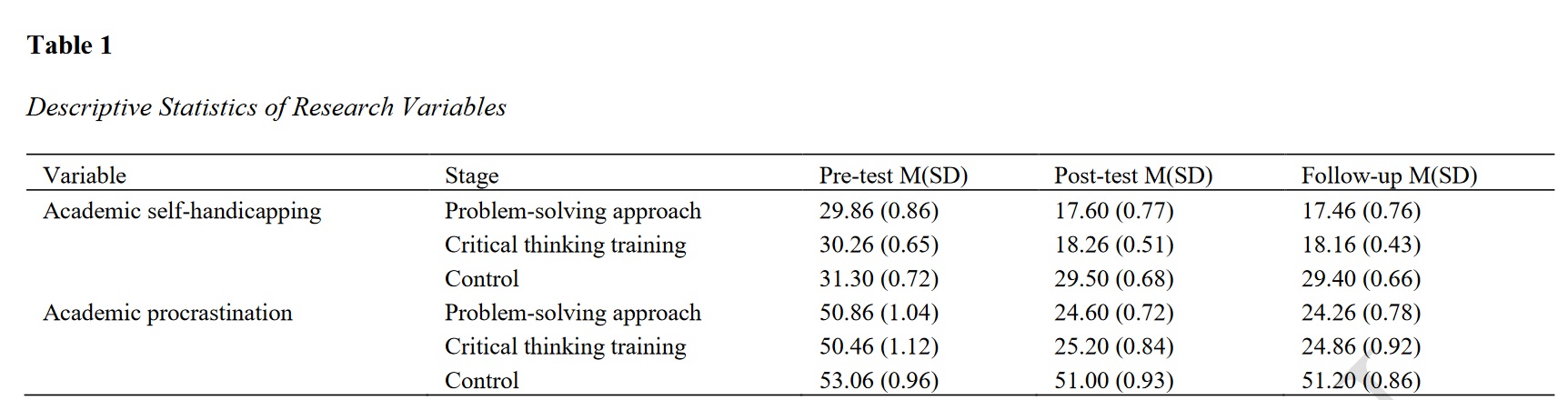
Findings: The study results showed that problem-solving and critical thinking training significantly reduced academic self-handicapping behaviors and academic procrastination in nursing students with test anxiety. However, no significant difference was found between the two training approaches regarding their effect on reducing academic self-handicapping behaviors and academic procrastination.
Conclusion: This study demonstrated that both problem-solving approach-based training and critical thinking training significantly reduced academic self-handicapping behaviors and academic procrastination in nursing students with test anxiety. The effects of the interventions were maintained during follow-up, highlighting the long-term benefits of these methods. Given the critical role these skills play in improving academic performance and reducing negative behaviors, integrating problem-solving and critical thinking training into educational and clinical programs is recommended to enhance student outcomes and well-being.
Downloads
References
Alipour, F., Farid, A., & Mosleh, S. Q. (2024). The model of academic procrastination based on academic self-handicapping and perfectionism with the mediating role of students' sense of competence. Research in cognitive and behavioral sciences, 13(2), 1-20. https://cbs.ui.ac.ir/article_27778_en.html?lang=fa
Almurumudhe, L. K. A., Mahdad, A., Abdulkadhim Johni, A., & Yousefi, Z. (2024). The Mediating Role of Self-Esteem in the Relationship between Psychological Capital, Academic Engagement, and Academic Procrastination with Academic Performance among Students in Al-Diwaniyah, Iraq [Research Article]. Iranian Journal of Educational Sociology, 7(3), 1-9. https://doi.org/10.61838/kman.ijes.7.3.1
Alt, D., Kapshuk, Y., & Dekel, H. (2023). Promoting perceived creativity and innovative behavior: Benefits of future problem-solving programs for higher education students. Thinking Skills and Creativity, 47. https://doi.org/10.1016/j.tsc.2022.101201
Babazadeh, Z., Mojaver, S., & Fathi, K. (2021). The impact of problem-solving training on self-concept, self-esteem, and self-regulation in students with learning disabilities. Learning Disabilities Scientific Journal, 11(1), 5-19. https://jld.uma.ac.ir/article_1391_e2e1018d6995913b08b6c3896f5ae765.pdf
Barutçu Yıldırım, F., & Demir, A. (2020). Self-handicapping among university students: The role of procrastination, test anxiety, self-esteem, and self-compassion. Psychological Reports, 123(3), 825-843. https://doi.org/10.1177/0033294118825099
Barzegar, Z., Kiani, Q., & Shahnawaz, A. (2022). Determining the relationships between critical thinking and deep learning with intrinsic interest in students. Journal of Disability Studies, 1(1), 1-10. https://jdisabilstud.org/browse.php?a_id=2308&slc_lang=en&sid=1&printcase=1&hbnr=1&hmb=1
Berglas, S., & Jones, E. E. (1978). Drug choice as a self-handicapping strategy in response to no-no-contingent success. Journal of personality and social psychology, 36(4), 405-417. https://psycnet.apa.org/record/1979-05889-001
Brando-Garrido, C., Montes-Hidalgo, J., Limonero, J. T., Gómez-Romero, M. J., & Tomás-Sábado, J. (2020). Relationship of academic procrastination with perceived competence, coping, self-esteem and self-efficacy in nursing students. Enfermería Clínica (English Edition), 30(6), 398-403. https://doi.org/10.1016/j.enfcli.2019.07.012
Dadzie, J., Annan-Brew, R., Akai-Tetteh, V. A., & Ahenkora, A. T. Psychometric Characteristics of Test Anxiety Analysis Tools. International Journal of Research and Innovation in Social Science, 5(1), 1-8. https://www.researchgate.net/publication/367254087_IJRISS_Volume_VI_Issue_XII
Elder, L., & Paul, R. (2010). The thinker's guide to analytic thinking. Foundation for Critical Thinking Press. https://www.amazon.com/Thinkers-Guide-Analytic-Thinking-Apart/dp/0944583199
Esmalian, S., Nouri Qasemabadi, R., & Hasani, J. (2021). The mediating role of maladaptive cognitive emotion regulation strategies in the relationship between metacognitive beliefs and test anxiety. Quarterly Journal of Applied Psychology, 16(4), 111-132. https://doi.org/10.52547/apsy.2022.225586.1251
Evriani, T. (2024). How Does the Effectiveness of Cognitive Behavior Therapy in Reducing Academic Anxiety Influence the Academic Procrastination of Undergraduate Students? Buana Pendidikan Jurnal Fakultas Keguruan Dan Ilmu Pendidikan, 20(1), 22-28. https://doi.org/10.36456/bp.vol20.no1.a8698
García, F. C., García, Á., Berbén, A. B. G., Pichardo, M. C., & Justicia, F. (2014). Revised Learning Process Questionnaire-Two Factor Version--Modified (R-LPQ-2F) [Database record]. APA PsycTests. https://doi.org/10.1037/t61646-000
Ghaffari, A., & Arfa Baluchi, F. (2011). The relationship of achievement motivation and academic self-concept with test anxiety in postgraduate students at Ferdowsi University of Mashhad. Journal of Clinical Psychology and Counseling Research, 1(2), 121-136. https://tpccp.um.ac.ir/article_29675.html?lang=en
Gharibnavaz, S., Nouri Qasemabadi, R., & Moqaddasin, M. (2017). The relationship between metacognitive beliefs and test anxiety: The mediating role of cognitive emotion regulation strategies. Cognitive Psychology Quarterly, 5(4), 1-15. https://jcp.khu.ac.ir/article-1-2843-en.html
Ghavipanah, S., Ebrahimi, H., Barzanji Atri, S., Pakpour, V., & Tarverdi Zadeh, P. (2014). The effectiveness of problem-solving skills training on depression in nursing and midwifery students. Hayat Scientific-Research Journal, 20(2), 38-46. https://hayat.tums.ac.ir/browse.php?a_id=799&slc_lang=en&sid=1&printcase=1&hbnr=1&hmb=1
Hoffmann, A. F., Merino-Soto, C., Huaire-Inacio, E. J., & Fernández-Liporace, M. (2021). The Revised Two Factor Study Process Questionnaire-Short Version: A Psychometric Analysis in College Students. European journal of education and psychology, 14(2), 1-22. https://psycnet.apa.org/record/2023-31461-001
Izadifard, R., & Sepasi Ashtiani, M. (2010). The effectiveness of cognitive-behavioral therapy with problem-solving training in reducing test anxiety symptoms. Behavioral Sciences Journal, 4(1), 23-27. https://www.behavsci.ir/article_67663.html
Jafari Panji, Z., Rahmanian, M., & Zare, H. (2018). The effectiveness of critical thinking training based on the Paul-Elder model on cognitive distortions and self-efficacy in adolescents. Cognitive Psychology Quarterly, 6(2), 61-70. https://jcp.khu.ac.ir/browse.php?a_id=2974&sid=1&slc_lang=en
Janiesch, C., Zschech, P., & Heinrich, K. (2021). Machine learning and deep learning. Electronic Markets, 31(3), 685-695. https://doi.org/10.1007/s12525-021-00475-2
Javadi, V., Khamsan, A., & Rastgoo Moghadam, M. (2016). The mediating role of self-regulation in the relationship between thinking styles and test anxiety in students of Birjand University. Cognitive Psychology Quarterly, 4(4), 11-22. https://jcp.khu.ac.ir/browse.php?a_id=2527&sid=1&slc_lang=en
Jia, J., Wang, L. L., Xu, J. B., Lin, X. H., Zhang, B., & Jiang, Q. (2021). Self-handicapping in chinese medical students during the covid-19 pandemic: the role of academic anxiety, procrastination and hardiness. Frontiers in psychology, 12, 741821. https://doi.org/10.3389/fpsyg.2021.741821
Jiménez-Gómez, M. A., Cárdenas-Becerril, L., Velásquez-Oyola, M. B., Carrillo-Pineda, M., & Barón-Díaz, L. Y. (2019). Reflective and critical thinking in nursing curriculum. Revista latino-americana de enfermagem, 1(2), 1-10. https://doi.org/10.1590/1518-8345.2861.3173
Khorami, F., & Zaboli, M. (2018). The relationship between problem-solving styles and academic procrastination in high school students: The mediating role of academic self-efficacy. Cognitive Strategies in Learning Journal, 6(10), 17-38. https://asj.basu.ac.ir/article_2350.html?lang=en
Khosravi, F., Zamani, B. B., & Zarei Zavarki, I. (2022). The relationship between mobile phone usage and dimensions of academic procrastination according to students' fields of study. Bimonthly Journal of Educational Strategies in Medical Sciences, 15(3), 242-251. https://edcbmj.ir/browse.php?a_code=A-10-2313-1&sid=1&slc_lang=en
Li, S., Ye, X., & Chen, W. (2019). Practice and effectiveness of "nursing case-based learning" course on nursing student's critical thinking ability: A comparative study. Nurse Education in Practice, 36, 91-96. https://doi.org/10.1016/j.nepr.2019.03.007
Madhan, B., Kumar, C. S., Naik, E. S., Panda, S., Gayathri, H., & Barik, A. K. (2012). Trait procrastination among dental students in India and its influence on academic performance. Journal of Dental Education, 76(10), 1393-1398. https://doi.org/10.1002/j.0022-0337.2012.76.10.tb05397.x
Martin, A. J. (2007). Examining a multidimensional model of student motivation and engagement using a construct validation approach. British Journal of Educational Psychology, 77(2), 413-440. https://doi.org/10.1348/000709906X118036
Martin, A. J., Marsh, H. W., Williamson, A., & Debus, R. L. (2003). Self-handicapping, defensive pessimism, and goal orientation: A qualitative study of university students. Journal of Educational Psychology, 95(3), 617. https://www.researchgate.net/publication/228611433_Self-Handicapping_Defensive_Pessimism_and_Goal_Orientation_A_Qualitative_Study_of_University_Students
Martinčeková, L., & Enright, R. D. (2020). The effects of self-forgiveness and shame-proneness on procrastination: exploring the mediating role of affect. Current Psychology, 39(2), 428-437. https://doi.org/10.1007/s12144-018-9926-3
Mirarab Razi, R., & Jafari, A. (2015). Predicting academic procrastination based on communication skills and identity styles in students. Cognitive Learning Strategies Biannual, 3(4), 55-69. https://asj.basu.ac.ir/article_1264.html?lang=en
Molaei Moghbeli, A., Kazemi, Y., & Davarpanah, A. (2022). The effectiveness of problem-solving skills training with a storytelling approach on academic self-handicapping in students. Journal of Educational Psychology Studies, 1(1), 1-10. https://jeps.usb.ac.ir/article_7311_d39bb57d622a7d56c1453b841c1af560.pdf
Moradizadeh, Y., Nouri Qasemabadi, R., & Hasani, J. (2016). The role of metacognitive beliefs and thought control strategies in symptoms of test anxiety in students. Cognitive Psychology Scientific-Research Quarterly, 4(4), 21-30. https://jcp.khu.ac.ir/article-1-2484-en.html
Mousavi, A., Dertaj, F., & Abolmaleki Hosseini, K. (2020). The causal model of the relationships between cognitive emotion regulation, socioeconomic status, and academic motivation: The mediating role of self-handicapping. Psychological Sciences Research Quarterly, 19(92), 999-1010. https://psychologicalscience.ir/browse.php?a_id=567&sid=1&slc_lang=en
Muliani, R., Imam, H., & Dendiawan, E. (2020). Relationship between stress level and academic procrastination among new nursing students. The Malaysian Journal of Nursing (MJN), 11(3), 63-67. https://doi.org/10.31674/mjn.2020.v11i03.010
Nikpey, I., Farahbakhsh, K., & Yusef Vand, L. (2017). The impact of self-regulated learning strategies training on students' critical thinking. School Psychology Scientific-Research Quarterly, 6(3), 116-135. https://jsp.uma.ac.ir/article_588.html?lang=en
Putwain, D. W. (2019). An examination of the self-referent executive processing model of test anxiety: control, emotional regulation, self-handicapping, and examination performance. European Journal of Psychology of Education, 34(2), 341-358. https://doi.org/10.1007/s10212-018-0383-z
Sabzi, N., Hosseinchari, M., Jokar, B., & Khorami, F. (2021). The relationship between core self-evaluation and academic self-handicapping with the mediation of academic emotions: Structural modeling. Journal of Modern Psychological Research, 16(62), 192-208. https://psychologyj.tabrizu.ac.ir/?_action=article&au=69654&_au=%D9%81%D8%B1%D9%87%D8%A7%D8%AF++%D8%AE%D8%B1%D9%85%D8%A7%D8%A6%DB%8C&lang=en
Savari, K. (2011). Development and validation of an academic procrastination test. Educational Measurement Quarterly, 5(2), 97-111. https://jem.atu.ac.ir/article_2660.html?lang=en
Schwinger, M., & Stiensmeier-Pelster, J. (2011). Prevention of self-handicapping - The protective function of mastery goals. Learning and Individual Differences, 21(6), 699-709. https://doi.org/10.1016/j.lindif.2011.09.004
Shaw, M., Burrus, S., & Ferguson, K. (2016). Factors that influence student attrition in online courses. Online Journal of Distance Learning Administration, 19(3), 211-231. https://ojdla.com/archive/fall193/shaw_burrus_ferguson193.pdf
Song, Y., Lee, Y., & Lee, J. (2022). Mediating effects of self-directed learning on the relationship between critical thinking and problem-solving in student nurses attending online classes: A cross-sectional descriptive study. Nurse Education Today, 109, 105227. https://doi.org/10.1016/j.nedt.2021.105227
Tannoubi, A., Guelmami, N., Bonsaksen, T., Chalghaf, N., Azaiez, F., & Bragazzi, N. L. (2022). Development and Preliminary Validation of the Physical Education-Study Process Questionnaire: Insights for Physical Education University Students. Frontiers in Public Health, 10(2), 1-10. https://doi.org/10.3389/fpubh.2022.856167
Wusik, M. F., & Axsom, D. (2016). Socially positive behaviors as self-handicapping. Journal of Social and Clinical Psychology, 35(6), 494-509. https://doi.org/10.1521/jscp.2016.35.6.494
Zacks, S., & Hen, M. (2018). Academic interventions for academic procrastination: A review of the literature. Journal of Prevention & Intervention in the Community, 46(2), 117-130. https://doi.org/10.1080/10852352.2016.1198154
Zamani, N., Barahmand, A., & Farhadi, M. (2017). The effectiveness of problem-solving training on reducing anxiety in nursing students. Nursing Education Journal, 6(3), 56-61. https://doi.org/10.21859/jne-06038
Zarei, L., & Khoshouei, M. S. (2016). The relationship between academic procrastination and metacognitive beliefs, emotion regulation, and tolerance of ambiguity in students. Research and Planning in Higher Education Quarterly, 22(3), 113-130. https://journal.irphe.ac.ir/article_702906.html?lang=en
Zhou, X. X., Wang, X. Y., Liu, E. H., Zhang, L., Zhang, H. X., Zhang, X. S., & Kuai, Z. X. (2022). An Unsupervised Deep Learning Approach for Dynamic-Exponential Intravoxel Incoherent Motion MRI Modeling and Parameter Estimation in the Liver. Journal of Magnetic Resonance Imaging, 1(2), 1-10. https://doi.org/10.1002/jmri.28074
Zyoud, A. H., Hamdan, K. M., Alkouri, O. A., Al-Sutari, M. M., Al-Tarifi, M., Albqoor, M. A., & Shaheen, A. (2022). Problem-Solving and Communication Skills of Undergraduate Nursing Students. The Open Nursing Journal, 16(1). https://opennursingjournal.com/VOLUME/16/ELOCATOR/e187443462208020/FULLTEXT/
Downloads
Additional Files
Publication Timeline
- Submitted
- Revised
- Accepted
Issue
Section
License
Copyright (c) 2024 Malihe Ganjifard (Author); Samaneh Sadat Jafar Tabatabaei (Corresponding Author); Toktam Sadat Jafar Tabatabaei, Fatemeh Shahabizadeh (Author)

This work is licensed under a Creative Commons Attribution-NonCommercial 4.0 International License.