Determining the Effectiveness of Zen Technique on Psychological Well-being and Pain in Elderly Residents of Kahrizak Nursing Home
DOI:
https://doi.org/10.61838/kman.jarac.3351Keywords:
Elderly, Zen Technique, Psychological Well-being, PainAbstract
Objective: This study aimed to examine the effectiveness of Zen meditation techniques on psychological well-being and pain in elderly residents.
Methods and Materials: The study employed a quasi-experimental design with pre-test, post-test, and follow-up assessments and included both experimental and control groups. A total of 42 elderly residents (20 men and 22 women, aged 65-85) from Kahrizak Nursing Home in Tehran, Iran, in 2023 were randomly assigned to the groups. The experimental group received Zen meditation training over 20 sessions (100 minutes per session, three times a week), while the control group received no intervention. Psychological well-being was assessed using the Ryff Psychological Well-being Questionnaire, and pain levels were measured with the McGill Pain Questionnaire. Data were analyzed using mixed two-factor ANOVA.
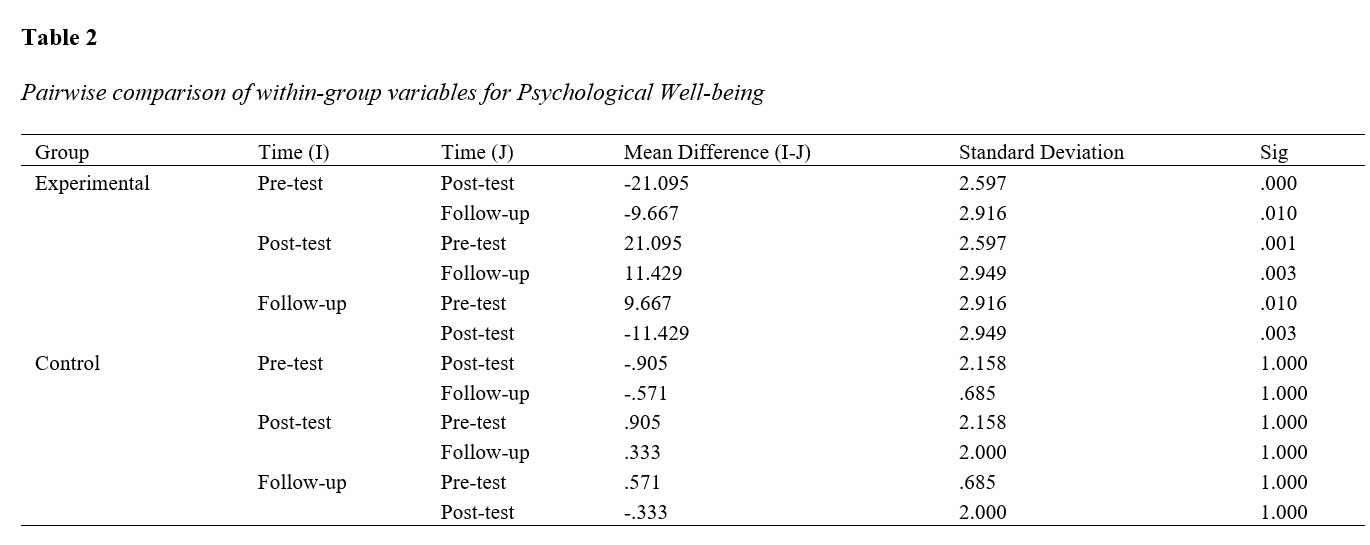
Findings: Results indicated that Zen meditation training significantly improved psychological well-being in the experimental group compared to the control group, with notable increases in self-acceptance, positive relations, autonomy, and personal growth. However, the effect on pain reduction was less pronounced and not significant compared to controls, although some pain reduction was observed in the post-test and follow-up assessments.
Conclusion: Zen meditation training effectively enhanced psychological well-being among elderly participants, suggesting it could be a beneficial intervention for improving mental health in this population. However, the limited effect on pain highlights the need for further investigation and potentially combining Zen meditation with other pain management strategies. The study recommends more extensive longitudinal research to establish the long-term impact of meditation on well-being and pain in diverse elderly populations.
Downloads
References
Aghaei, E., Roshan, R., Mohammadkhani, P., Shiri, M. R., & Gholami Fasharaki, M. (2017). Examining the changes in virtue-based (psychological) well-being during a Mindfulness-Based Cognitive Therapy (MBCT) intervention in a non-clinical sample: A process study Shahid Beheshti University]. https://jfmh.mums.ac.ir/article_19315.html
Ahn, H., Zhong, C., Miao, H., Chaoul, A., Park, L., Yen, I. H., & Abdi, S. (2019). Efficacy of combining home-based transcranial direct current stimulation with mindfulness-based meditation for pain in older adults with knee osteoarthritis: a randomized controlled pilot study. Journal of Clinical Neuroscience, 70, 140-145. https://doi.org/10.1016/j.jocn.2019.08.047
Asghari Moghadam, M. A. (2011). Pain and its measurement. Roshd Publications.
Bayani, A. A., Kochaki, A. M., & Bayani, A. (2008). Validity and reliability of the Ryff Psychological Well-Being Scale. Iranian Journal of Psychiatry and Clinical Psychology (Andisheh va Raftar), 14(2), 146-151. https://ijpcp.iums.ac.ir/article-1-464-en.html
Čakire, S., & Vanags, E. (2020). Meditation effect on brain function using EEG in randomized controlled studies: meta-analysis. Baltic Journal of Psychology, 21. https://openurl.ebsco.com/EPDB%3Agcd%3A16%3A7577280/detailv2?sid=ebsco%3Aplink%3Ascholar&id=ebsco%3Agcd%3A151224395&crl=f&link_origin=www.google.com
Chan, J. S., Deng, K., Wu, J., & Yan, J. H. (2019). Effects of meditation and mind-body exercises on older adults' cognitive performance: A meta-analysis. The Gerontologist, 59(6), e782-e790. https://doi.org/10.1093/geront/gnz022
Chaturvedi, V., Bansal, S., & Dhillon, L. K. (2021). Assessing the impact of kriya yoga path as a meditation technique taught at Yogoda Satsanga Society on psychological wellbeing of meditators and non-meditators. International Journal of Indian Culture and Business Management, 24(2), 141-166. https://doi.org/10.1504/IJICBM.2021.118882
Day, M. A., Ward, L. C., Ehde, D. M., Thorn, B. E., Burns, J., Barnier, A., & Jensen, M. P. (2019). A pilot randomized controlled trial comparing mindfulness meditation, cognitive therapy, and mindfulness-based cognitive therapy for chronic low back pain. Pain Medicine, 20(11), 2134-2148. https://doi.org/10.1093/pm/pny273
Deolindo, C. S., Ribeiro, M. W., Aratanha, M. A., Afonso, R. F., Irrmischer, M., & Kozasa, E. H. (2020). A critical analysis on characterizing the meditation experience through the electroencephalogram. Frontiers in Systems Neuroscience, 14, 53. https://doi.org/10.3389/fnsys.2020.00053
Etemadi Shams Abadi, A., Mohammadkhani, S., Moradi, A. R., & Akbari, M. (2019). The effect of loving-kindness meditation on executive functions and psychological well-being in the elderly. Journal of Public Health, 13(3), 52-63. https://chj.rums.ac.ir/article_101929.html?lang=en
Farias, M., Maraldi, E., Wallenkampf, K. C., & Lucchetti, G. (2020). Adverse events in meditation practices and meditation‐based therapies: a systematic review. Acta Psychiatrica Scandinavica, 142(5), 374-393. https://doi.org/10.1111/acps.13225
Fincham, G. W., Mavor, K., & Dritschel, B. (2023). Effects of mindfulness meditation duration and type on well-being: an online dose-ranging randomized controlled trial. Mindfulness, 14(5), 1171-1182. https://doi.org/10.1007/s12671-023-02119-2
Foulk, M., Montagnini, M., Fitzgerald, J., & Ingersoll-Dayton, B. (2023). Mindfulness-Based Group Therapy for Chronic Pain Management in Older Adults. Clinical Gerontologist, 1-10. https://doi.org/10.1080/07317115.2023.2229307
Ganesan, A., Gauthaman, J., & Kumar, G. (2022). The impact of mindfulness meditation on the psychosomatic spectrum of oral diseases: mapping the evidence. Journal of Lifestyle Medicine, 12(1), 1. https://doi.org/10.15280/jlm.2022.12.1.1
Goyal, M., Singh, S., Sibinga, E. M., Gould, N. F., Rowland-Seymour, A., Sharma, R., & Haythornthwaite, J. A. (2014). Meditation programs for psychological stress and well-being: a systematic review and meta-analysis. JAMA internal medicine, 174(3), 357-368. https://doi.org/10.1001/jamainternmed.2013.13018
Grant, J. A., Courtemanche, J., & Rainville, P. (2011). A non-elaborative mental stance and decoupling of executive and pain-related cortices predicts low pain sensitivity in Zen meditators. Pain, 152(1), 150-156. https://doi.org/10.1016/j.pain.2010.10.006
Haghghi, M., Fadai Vatan, R., Alizadeh Khoei, M., Forughan, M., & Kabodi, B. (2019). The effect of educational intervention using spaced retrieval on pain perception in elderly patients with Alzheimer's University of Social Welfare and Rehabilitation Sciences, Department of Gerontology].
Haji Zadeh, A. A. H., & Tajvar. (2024). The impact of population aging on health system functions: A systematic review. Journal of Elderly Studies, Iranian Journal of Gerontology. https://salmandj.uswr.ac.ir/article-1-2640-en.html
Honda, T. (2022). Case report: Zen meditation-integrated CBT normalized the impaired brain function of a chronic low back pain patient-From the findings of brain blood flow SPECT imaging. F1000research, 11, 1384. https://doi.org/10.12688/f1000research.126031.1
Hussain, N., & Said, A. S. (2019). Mindfulness-based meditation versus progressive relaxation meditation: Impact on chronic pain in older female patients with diabetic neuropathy. Journal of Evidence-Based Integrative Medicine, 24. https://doi.org/10.1177/2515690X19876599
Hwang, M. H., Bunt, L., & Warner, C. (2023). An eight-week zen meditation and music programme for mindfulness and happiness: Qualitative content analysis. International journal of environmental research and public health, 20(23), 7140. https://doi.org/10.3390/ijerph20237140
Jafari Roshan, M., & Riazi, S. R. (2022). Comparison of general health in the individuals committed to prayer/meditation with those who are not. Clinical Cancer Investigation Journal.
Jain, D., Verma, V., Parashar, N., Kumar, S., Kiran, U., Satija, A., & Tiwari, N. (2022). A Study on the Willingness to Use Meditation for Maintaining Psychological Well-Being During the COVID-19 Pandemic. Cureus, 14(6). https://doi.org/10.7759/cureus.25950
Jamshidian, N., Abbasi, H., Samadi, H., & Abedin Zadeh, S. (2019). The effect of a mindfulness training program on psychological well-being and static and dynamic balance in the elderly Yazd University, Faculty of Humanities and Social Sciences].
Jenabadi, H., Pilehchi, L., Salm Abadi, M., & Teyrani Rad, A. (2016). The effectiveness of mindfulness skills training on occupational stress and psychological well-being of female teachers. Iranian Journal of Occupational Health, 13(6), 58-69. https://www.researchgate.net/publication/318337453_Effectiveness_of_training_mindfulness_skills_in_professional_stress_and_psychological_well-being_of_female_teachers
Khosravi, M., Sadeghi, S., Moradi Alamdar, S., & Zanddel, K. McGill Pain Questionnaire in Persian: Translation, adaptation, and reliability in cancer patients: A brief report. https://bccr.tums.ac.ir/index.php/bccrj/article/view/129
Klimecki, O., Marchant, N. L., Lutz, A., Poisnel, G., Chetelat, G., & Collette, F. (2019). The impact of meditation on healthy ageing-the current state of knowledge and a roadmap to future directions. Current opinion in psychology, 28, 223-228. https://doi.org/10.1016/j.copsyc.2019.01.006
Kwon, C. Y., Chung, S. Y., & Kim, J. W. (2021). Mindfulness meditation program for the elderly in Korea: A preliminary review for planning the program. Integrative Medicine Research, 10(1), 100451. https://doi.org/10.1016/j.imr.2020.100451
la Cour, P., & Petersen, M. (2015). Effects of mindfulness meditation on chronic pain: a randomized controlled trial. Pain Medicine, 16(4), 641-652. https://doi.org/10.1111/pme.12605
Lidlau, K., Thompson, L. W., Sisken, L. D., Thompson, D. G., Zarani, F., Ferdousi, T., Bagherian Saravodi, R., Poor Sharifi, H., Shahr Babaki, H. I., & Goudarzi, N. (2008). Behavioral-Cognitive Therapy for the Elderly. Jihon Publications. https://www.amazon.com/Cognitive-Behaviour-Therapy-Older-People/dp/0471487112
Lindberg, D. A. (2005). Integrative review of research related to meditation, spirituality, and the elderly. Geriatric Nursing, 26(6), 372-377. https://doi.org/10.1016/j.gerinurse.2005.09.013
Lomas, T., Medina, J. C., Ivtzan, I., Rupprecht, S., & Eiroa-Orosa, F. J. (2019). Mindfulness-based interventions in the workplace: An inclusive systematic review and meta-analysis of their impact upon wellbeing. The Journal of Positive Psychology, 14(5), 625-640. https://doi.org/10.1080/17439760.2018.1519588
Mazaheri, M., & Manshaei, G. (2016). Comparing cognitive, behavioral aspects, and pain acceptance in patients with gastrointestinal disorders with different levels of mindfulness. Feiz Medical Journal, 20(1), 64-72. https://en.civilica.com/doc/947724/
Morone, N. E., Greco, C. M., & Weiner, D. K. (2008). Mindfulness meditation for the treatment of chronic low back pain in older adults: a randomized controlled pilot study. Pain, 134(3), 310-319. https://doi.org/10.1016/j.pain.2007.04.038
Mortezaei, L., & Sheikhi Nejad, F. (2014). Zen Management: Effective Management. Human Resource Studies Quarterly, 3(17), 147-163. https://elmnet.ir/doc/1453226-55194
Papalia, D. E., Olds, S., Feldman, R., Arab Qeistani, D., Yans, H. A., Sohrabi, H., Davarpanah, F., Hayat Roshanai, A., & Naghshbandi, S. (2018). Human Development and Growth Psychology. Roshd Publications. https://books.google.com/books/about/Human_Development.html?id=AlZpPwAACAAJ
Prashanth, S., Nalini, V., Priyanka, S., Thanalakshmi, J., Subbulakshmi, V., Amalraj, A., & Maheshkumar, K. (2024). Effect of mind sound resonance technique on physiological and psychological parameters among geriatric population: a structured study protocol for a randomized controlled trial. International Journal, 11(3), 224. https://doi.org/10.18203/2349-3259.ijct20242005
Ramírez-Barrantes, R., Arancibia, M., Stojanova, J., Aspé-Sánchez, M., Córdova, C., & Henríquez-Ch, R. A. (2019). Default Mode Network, Meditation, and Age‐Associated Brain Changes: What Can We Learn from the Impact of Mental Training on Well‐Being as a Psychotherapeutic Approach? Neural plasticity, 2019(1), 7067592. https://doi.org/10.1155/2019/7067592
Sadeghi, P., & Cheraghi, A. (2018). Examining the effectiveness of mindfulness training on psychological well-being and resilience in female-headed households. Family Research, 14(4), 549-562. https://jfr.sbu.ac.ir/article_97697.html?lang=en
Saidi, N., Lotfi, M., Akbarian, M., Saidi, A. R., & Salehi, A. (2021). Emotional regulation: A comparative study in elderly and adult populations. Elderly Journal: Iranian Gerontology Journal, 16(3), 412-425. https://salmandj.uswr.ac.ir/browse.php?a_id=2175&sid=1&slc_lang=en&html=1
Saidian Asl, M., & Goudarzi, M. A. (2011). Comparing the effectiveness of attention management therapy and relaxation training on pain perception in elderly patients with chronic pain Shiraz University, Faculty of Education and Psychology].
Samandari, S., Zamani, S., & Yazdani, M. (2020). Aging, the Unknown World. Konkash Publications.
Skwara, A. C., King, B. G., Zanesco, A. P., & Saron, C. D. (2022). Shifting baselines: longitudinal reductions in EEG beta band power characterize resting brain activity with intensive meditation. Mindfulness, 13(10), 2488-2506. https://doi.org/10.1007/s12671-022-01974-9
Sylapan, B. S., Nair, A. K., Jayanna, K., Mallipeddi, S., Sathyanarayana, S., & Kutty, B. M. (2020). Meditation, well-being and cognition in heartfulness meditators-A pilot study. Consciousness and Cognition, 86, 103032. https://doi.org/10.1016/j.concog.2020.103032
Tang, Y. Y., Hölzel, B. K., & Posner, M. I. (2015). The neuroscience of mindfulness meditation. Nature Reviews Neuroscience, 16(4), 213-225. https://doi.org/10.1038/nrn3916
Vijayaraghavan, N., & Chandran, M. (2019). Effect of meditation on psychological well-being. The International Journal of Indian Psychology, 7(2). https://www.researchgate.net/publication/334108825_Effect_of_Meditation_on_Psychological_Well-being
Wu, R., Liu, L. L., Zhu, H., Su, W. J., Cao, Z. Y., Zhong, S. Y., & Jiang, C. L. (2019). Brief mindfulness meditation improves emotion processing. Frontiers in Neuroscience, 13, 1074. https://doi.org/10.3389/fnins.2019.01074
Zanjari, N. (2018). Successful aging: A review of the concepts and dimensions of aging well. Tarh Naqd.
Zarshki, A., & Shayganmanesh, Z. (2021). The effectiveness of mindfulness training on positive and negative emotions, psychological well-being, and cognitive emotion regulation in the elderly Islamic Azad University, Faculty of Humanities].
Zeidan, F., Gordon, N. S., Merchant, J., & Goolkasian, P. (2010). The effects of brief mindfulness meditation training on experimentally induced pain. The Journal of Pain, 11(3), 199-209. https://doi.org/10.1016/j.jpain.2009.07.015
Downloads
Additional Files
Publication Timeline
- Submitted
- Revised
- Accepted
Issue
Section
License
Copyright (c) 2026 Seyedeh Robabeh Riazi (Author); Fatemeh Golshani (Corresponding Author); Anita Baghdasarians, Marjan Jafari Roshan (Author)

This work is licensed under a Creative Commons Attribution-NonCommercial 4.0 International License.