The Mediating Role of Cognitive Processes in the Relationship Between Peer Victimization and Dysregulated Behaviors in Individuals With Bipolar Disorder
DOI:
https://doi.org/10.61838/kman.jarac.3479Keywords:
Bipolar disorder, dysregulated behavior, cognitive processes, peer victimizationAbstract
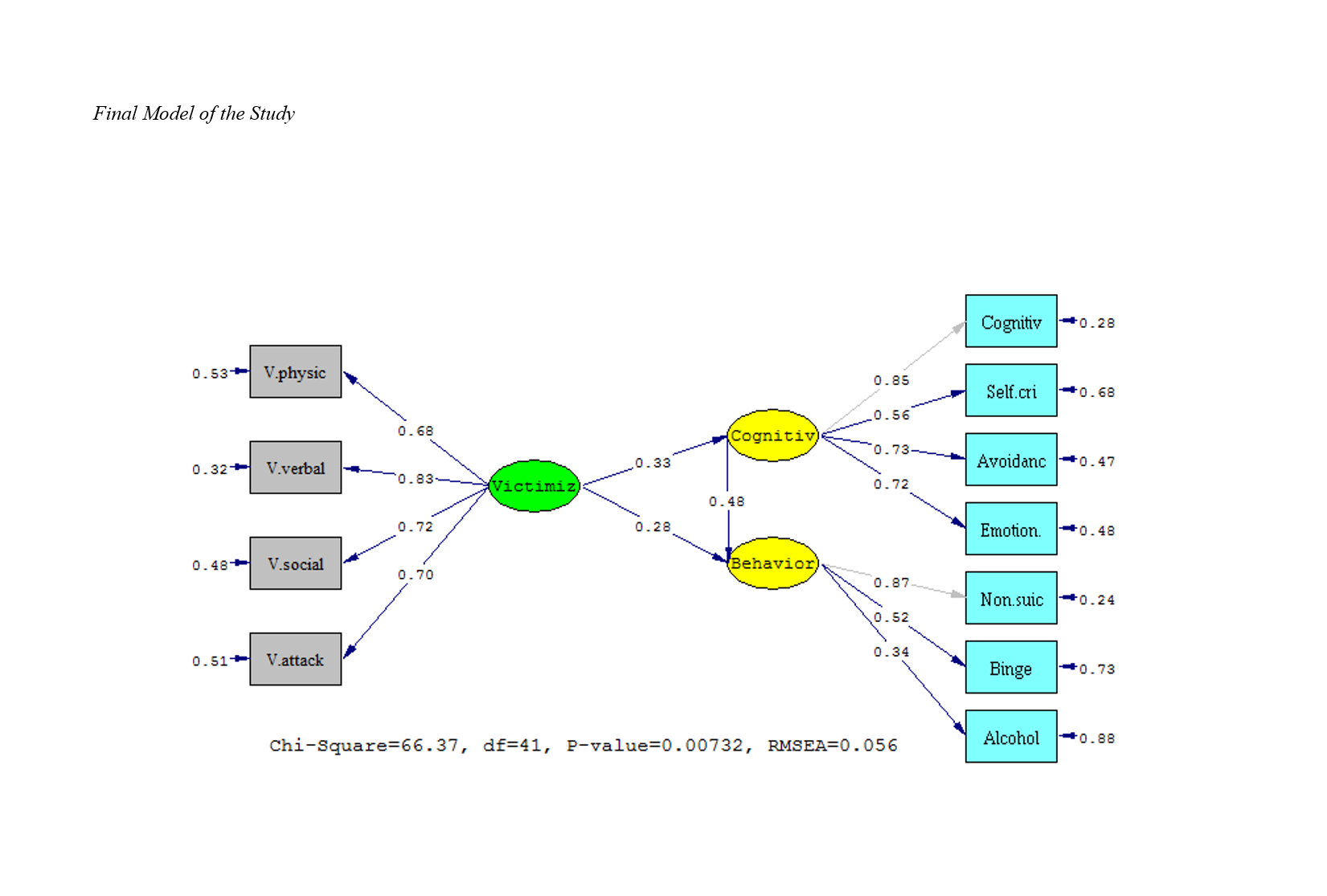
Objective: The primary objective of this study was to examine the mediating role of cognitive processes in the relationship between peer victimization and dysregulated behaviors in individuals with bipolar disorder.
Methods and Materials: This descriptive, correlational study included all individuals with bipolar disorder hospitalized at Razi Psychiatric Hospital in 2023-2024. From this population, 200 individuals were selected using convenience sampling. Data collection tools included the Binge Eating Severity Scale, the Deliberate and Conscious Self-Harm Inventory, the Alcohol Use Disorders Identification Test, the Multidimensional Peer Victimization Scale, the Cognitive Abilities Questionnaire, the Difficulties in Emotion Regulation Scale–Short Form, the Acceptance and Action Questionnaire, and the Levels of Self-Criticism Scale. Data analysis was conducted using SPSS and LISREL software, along with Pearson correlation methods and structural equation modeling (SEM).
Results: The study's findings indicated that cognitive processes (cognitive ability, self-criticism, experiential avoidance, and difficulties in emotion regulation) play a mediating role in the relationship between peer victimization and dysregulated behaviors (alcohol consumption, binge eating, and self-harm) in individuals with bipolar disorder (CFI = 0.97, NNFI = 0.97, IFI = 0.97, GFI = 0.94, RMSEA = 0.056).
Conclusion: Based on the results of this study, individuals with bipolar disorder who experience peer victimization engage in dysregulated behaviors mediated by cognitive processes. Therefore, clinical interventions targeting cognitive processes may play a significant role in preventing dysregulated behaviors in this group.
Downloads
References
Acosta, J. R., Librenza-Garcia, D., Watts, D., Francisco, A. P., Zortea, F., Raffa, B., & Passos, I. C. (2020). Bullying and psychotic symptoms in youth with bipolar disorder. Journal of affective disorders, 265, 603-610. https://doi.org/10.1016/j.jad.2019.11.101
Akbari Balootbangan, A., & Talepasand, S. (2015). The psychometric characteristics of the victimization questionnaire in primary schools in Semnan. Pajoohandeh Journal, 20(3), 163-170. http://pajoohande.sbmu.ac.ir/article-1-2024-fa.html
Anvari, S. M., & Mansouri, A. (2023). The Relationship between Cyberbullying Victimization and Non-Suicidal Self-Injury and Suicide Behaviors in Adolescents: The Mediating Role of Emotion Regulation. Clinical Psychology and Personality, 21(2), 129-138. https://doi.org/10.22070/cpap.2023.17691.1358
Bernstein, D. P., Stein, J. A., Newcomb, M. D., Walker, E., Pogge, D., Ahluvalia, T., & Zule, W. (2003). Development and validation of a brief screening version of the Childhood Trauma Questionnaire. Child abuse & neglect, 27(2), 169-190. https://doi.org/10.1016/S0145-2134(02)00541-0
Bond, F. W., Hayes, S. C., Baer, R. A., Carpenter, K. M., Guenole, N., Orcutt, H. K., & Zettle, R. D. (2011). Preliminary psychometric properties of the Acceptance and Action Questionnaire–II: A revised measure of psychological inflexibility and experiential avoidance. Behavior therapy, 42(4), 676-688. https://doi.org/10.1016/j.beth.2011.03.007
Brausch, A. M., & Woods, S. E. (2019). Emotion regulation deficits and nonsuicidal self‐injury prospectively predict suicide ideation in adolescents. Suicide and Life‐Threatening Behavior, 49(3), 868-880. https://doi.org/10.1111/sltb.12478
Cicchetti, D., & Rogosch, F. A. (1996). Equifinality and multifinality in developmental psychopathology. Development and Psychopathology, 8(4), 597-600. https://doi.org/10.1017/S0954579400007318
Corry, J., Green, M., Roberts, G., Fullerton, J. M., Schofield, P. R., & Mitchell, P. B. (2017). Does perfectionism in bipolar disorder pedigrees mediate associations between anxiety/stress and mood symptoms? International Journal of Bipolar Disorders, 5(1), 1-11. https://doi.org/10.1186/s40345-017-0102-8
Darabos, K., Mazza, M. C., Somers, J., Song, A. V., & Hoyt, M. A. (2023). Peer victimization and relationships to approach and avoidance coping to health and health behaviors. Behavioral Medicine, 49(1), 15-28. https://doi.org/10.1080/08964289.2021.1946468
de la Fuente, D., Könen, T., In-Albon, T., Schemer, L., & Karbach, J. (2024). The Interplay of Emotion Regulation, Depressive Symptoms, and Age Under a COVID-19 Lockdown: Capturing Emotion Regulation Variability, Effort, and Success. Journal of Affective Disorders Reports, 100812. https://doi.org/10.1016/j.jadr.2024.100812
Degerud, E., Ystrom, E., Tambs, K., Ariansen, I., Mørland, J., Magnus, P., & Næss, Ø. (2018). The interplay between cognitive ability, alcohol consumption, and health characteristics. Psychological medicine, 48(12), 2011-2022. https://doi.org/10.1017/S0033291717003543
Dodge, K. A., Bates, J. E., & Pettit, G. S. (1990). Mechanisms in the cycle of violence. Science, 250(4988), 1678-1683. https://doi.org/10.1126/science.2270481
Favieri, F., Marini, A., & Casagrande, M. (2021). Emotional regulation and overeating behaviors in children and adolescents: a systematic review. Behavioral Sciences, 11(1), 11. https://doi.org/10.3390/bs11010011
Fornaro, M., Carvalho, A. F., De Prisco, M., Mondin, A. M., Billeci, M., Selby, P., & de Bartolomeis, A. (2022). The prevalence, odds, predictors, and management of tobacco use disorder or nicotine dependence among people with severe mental illness: Systematic review and meta-analysis. Neuroscience & Biobehavioral Reviews, 132, 289-303. https://doi.org/10.1016/j.neubiorev.2021.11.039
Garke, M. Å., Isacsson, N. H., Sörman, K., Bjureberg, J., Hellner, C., Gratz, K. L., & Jayaram-Lindström, N. (2021). Emotion dysregulation across levels of substance use. Psychiatry research, 296, 113662. https://doi.org/10.1016/j.psychres.2020.113662
Garrusi, B., & Nakhaee, N. (2009). Validity and reliability of a Persian version of the Childhood Trauma Questionnaire. Psychological Reports, 104(2), 509-516. https://doi.org/10.2466/PR0.104.2.509-5
Gormally, J. I. M., Black, S., Daston, S., & Rardin, D. (1982). The assessment of binge eating severity among obese persons. Addictive behaviors, 7(1), 47-55. https://doi.org/10.1016/0306-4603(82)90024-7
Gross, J. J., & Jazaieri, H. (2014). Emotion, emotion regulation, and psychopathology: An affective science perspective. Clinical Psychological Science, 2(4), 387-401. https://doi.org/10.1177/2167702614536164
Gu, H., Fang, L., & Yang, C. (2023). Peer victimization and adolescent non-suicidal self-injury: The mediating role of alienation and moderating role of mindfulness. Journal of interpersonal violence, 38(3-4), 3864-3882. https://doi.org/10.1177/08862605221109903
Hayes-Skelton, S. A., & Eustis, E. H. (2020). Experiential avoidance. In S. M. Blakey (Ed.), Clinical Handbook of Fear and Anxiety: Maintenance Processes and Treatment Mechanisms. American Psychological Association. https://psycnet.apa.org/record/2019-52029-007
Howells, R. L., Dunn, L. C., & Carter, J. C. (2024). The relationship between difficulties in the regulation of positive and negative emotions and binge-eating symptoms in young adults. Eating behaviors, 52, 101839. https://doi.org/10.1016/j.eatbeh.2023.101839
Iceta, S., Rodrigue, C., Legendre, M., Daoust, J., Flaudias, V., Michaud, A., & Bégin, C. (2021). Cognitive function in binge eating disorder and food addiction: A systematic review and three-level meta-analysis. Progress in Neuro-Psychopharmacology and Biological Psychiatry, 111, 110400. https://doi.org/10.1016/j.pnpbp.2021.110400
Iveson, M. H., Ball, E. L., Whalley, H. C., Deary, I. J., Cox, S. R., Batty, G. D., & McIntosh, A. M. (2024). Childhood cognitive ability and self-harm and suicide in later life. SSM-Population Health, 25, 101592. https://doi.org/10.1159/000524947
Kapczinski, N. S., Mwangi, B., Cassidy, R. M., Librenza-Garcia, D., Bermudez, M. B., Kauer-Sant’anna, M., & Passos, I. C. (2017). Neuroprogression and illness trajectories in bipolar disorder. Expert Review of Neurotherapeutics, 17(3), 277-285. https://doi.org/10.1080/14737175.2017.1240615
Kaufman, E. A., Xia, M., Fosco, G., Yaptangco, M., Skidmore, C. R., & Crowell, S. E. (2016). The Difficulties in Emotion Regulation Scale Short Form (DERS-SF): Validation and replication in adolescent and adult samples. Journal of psychopathology and behavioral assessment, 38, 443-455. https://doi.org/10.1007/s10862-015-9529-3
Labella, M. H., Klein, N. D., Yeboah, G., Bailey, C., Doane, A. N., Kaminer, D., & Cross‐Cultural Addictions Study, T. (2024). Childhood bullying victimization, emotion regulation, rumination, distress tolerance, and depressive symptoms: A cross‐national examination among young adults in seven countries. Aggressive Behavior, 50(1), e22111. https://doi.org/10.1002/ab.22111
Loew, C. A., Schauenburg, H., & Dinger, U. (2020). Self-criticism and psychotherapy outcome: A systematic review and meta-analysis. Clinical psychology review, 75, 101808. https://doi.org/10.1016/j.cpr.2019.101808
Manoli, A., Wright, L. C., Shakoor, S., Fisher, H. L., & Hosang, G. M. (2023). The association between childhood bullying victimisation and childhood maltreatment with the clinical expression of bipolar disorder. Journal of psychiatric research, 158, 226-230. https://doi.org/10.1016/j.jpsychires.2022.12.039
Mansouri, A., Khodayari Fard, M., Besharat, M., & Gholamali Lavasani, M. (2018). Moderating and mediating role of spiritual coping and cognitive emotion regulation strategies in the relationship between transdiagnostic factors and symptoms of generalized anxiety disorder: Developing a conceptual model. Journal of Research in Behavioural Sciences, 16(2), 130-142. https://doi.org/10.52547/rbs.16.2.130
Menesini, E., & Salmivalli, C. (2017). Bullying in schools: the state of knowledge and effective interventions. Psychology, Health & Medicine, 22(sup1), 240-253. https://doi.org/10.1080/13548506.2017.1279740
Mootabi, F., Moloodi, R., Dezhkam, M., & Omidvar, N. (2009). Standardization of the binge eating scale among Iranian obese population. Iranian Journal of Psychiatry, 4(4), 143-146. https://doi.org/https://ijps.tums.ac.ir/index.php/ijps/article/view/517
Mousavi, A. S., & Ghorbani, N. (2007). Self-knowledge, self-criticism, and psychological health. Journal of Psychological Studies, 2(3), 75-91. https://doi.org/10.22051/psy.2006.1688
Mynard, H., & Joseph, S. (2000). Development of the multidimensional peer‐victimization scale. Aggressive Behavior, 26(2), 169-178. https://doi.org/10.1002/(SICI)1098-2337(2000)26:2<169::AID-AB3>3.0.CO;2-A
Nagy, L. M., Shanahan, M. L., & Baer, R. A. (2021). An experimental investigation of the effects of self-criticism and self-compassion on implicit associations with non-suicidal self-injury. Behaviour Research and Therapy, 139, 103819. https://doi.org/10.1016/j.brat.2021.103819
Nariswari, A. A., & Muttaqin, D. (2023). Relational Aggression Victimization and Depression: Testing Self-Compassion and Self-Criticism as Moderator and Mediator. Humaniora, 14(1), 59-68. https://doi.org/10.21512/humaniora.v14i1.8318
Nejati, V. (2013). Cognitive abilities questionnaire: Development and evaluation of psychometric properties. Advances in Cognitive Science, 15(2), 11-19. http://icssjournal.ir/article-1-289-fa.html
Nierenberg, A. A., Agustini, B., Köhler-Forsberg, O., Cusin, C., Katz, D., Sylvia, L. G., & Berk, M. (2023). Diagnosis and treatment of bipolar disorder: a review. JAMA, 330(14), 1370-1380. https://doi.org/10.1001/jama.2023.18588
Noorbakhsh, S., Shams, J., Faghihimohamadi, M., Zahiroddin, H., Hallgren, M., & Kallmen, H. (2018). Psychometric properties of the Alcohol Use Disorders Identification Test (AUDIT) and prevalence of alcohol use among Iranian psychiatric outpatients. Substance Abuse Treatment, Prevention, and Policy, 13, 1-8. https://doi.org/10.1186/s13011-018-0141-x
Palmeira, L., Pinto-Gouveia, J., Cunha, M., & Carvalho, S. (2017). Finding the link between internalized weight-stigma and binge eating behaviors in Portuguese adult women with overweight and obesity: The mediator role of self-criticism and self-reassurance. Eating behaviors, 26, 50-54. https://doi.org/10.1016/j.eatbeh.2017.01.006
Peschel, S. K., Fürtjes, S., Voss, C., Sigrist, C., Berwanger, J., Ollmann, T. M., & Beesdo-Baum, K. (2023). Temporal associations between experiential avoidance and disordered eating behaviors in adolescents and young adults: findings from an epidemiological cohort study with ecological momentary assessment. Eating and Weight Disorders-Studies on Anorexia, Bulimia and Obesity, 28(1), 58. https://doi.org/10.1007/s40519-023-01584-x
Richardson, C. M., Hoene, T. H., & Rigatti, H. L. (2020). Self-critical perfectionism and daily drinking to cope with negative emotional experiences among college students. Personality and individual differences, 156, 109773. https://doi.org/10.1016/j.paid.2019.109773
Rosen, L. H., Scott, S., & Paulman, B. E. (2023). Peer victimization and eating behaviors in college students: the mediating role of perceived stress. Journal of Aggression, Conflict and Peace Research, 15(4), 260-273. https://doi.org/10.1108/JACPR-05-2022-0719
Rosen, P. J., Milich, R., & Harris, M. J. (2007). Victims of their own cognitions: Implicit social cognitions, emotional distress, and peer victimization. Journal of Applied Developmental Psychology, 28(3), 211-226. https://doi.org/10.1016/j.appdev.2007.02.001
Saunders, J. B., Aasland, O. G., Babor, T. F., De la Fuente, J. R., & Grant, M. (1993). Development of the alcohol use disorders identification test (AUDIT): WHO collaborative project on early detection of persons with harmful alcohol consumption‐II. Addiction, 88(6), 791-804. https://doi.org/10.1111/j.1360-0443.1993.tb02093.x
Shahani, S., & Mansouri, A. (2023). The mediating role of cognitive emotion regulation in the relationship between borderline personality traits and non-suicidal self-injury in students. Clinical Psychology and Personality, 21(1), 33-42. https://doi.org/10.22070/cpap.2023.17094.1302
Shamsabadi, A., Ahi, Q., Bahreinian, S. A., Mansouri, A., & Shahabizadeh, F. (2023). The Mediating Role of Difficulties in Emotion Regulation and Personality Organization in the Relationship between Object Relations and Non-suicidal Self-injury. Rooyesh-e-Ravanshenasi Journal (RRJ), 12(6), 151-162. http://frooyesh.ir/article-1-4498-fa.html
Sharma, A., & McClellan, J. (2021). Emotional and behavioral dysregulation in severe mental illness. Child and Adolescent Psychiatric Clinics, 30(2), 415-429. https://doi.org/10.1016/j.chc.2020.10.010
Simonič, B., Poljak Lukek, S., Valenta, T., Jerebic, D., Jerebic, S., Rijavec Klobučar, N., & Pate, T. (2024). The Role of Emotion Dysregulation in Problematic Alcohol Use and Coping with Problems. European Journal of Mental Health, 19, 1-15. https://doi.org/10.5708/EJMH.19.2024.0018
Svirko, E., & Hawton, K. (2007). Self-injurious behavior and eating disorders: The extent and nature of the association. Suicide and Life-Threatening Behavior, 37(4), 409-421. https://doi.org/10.1521/suli.2007.37.4.409
Thompson, R., & Zuroff, D. C. (2004). The Levels of Self-Criticism Scale: Comparative self-criticism and internalized self-criticism. Personality and individual differences, 36(2), 419-430. https://doi.org/10.1016/S0191-8869(03)00106-5
Tretyak, V., Huffman, A., & Lippard, E. T. (2022). Peer victimization and associated alcohol and substance use: prospective pathways for negative outcomes. Pharmacology Biochemistry and Behavior, 218, 173409. https://doi.org/10.1016/j.pbb.2022.173409
Vaillancourt, T., & Palamarchuk, I. S. (2021). Neurobiological factors of bullying victimization. In P. K. Smith & J. O. Norman (Eds.), The Wiley Blackwell handbook of bullying: A comprehensive and international review of research and intervention (pp. 399-414). Wiley Blackwell. https://doi.org/10.1002/9781118482650.ch22
Walker, K. A. (2023). Examining Adolescent Peer Victimization, Emotion Regulation, and Mental Health Using Path Analysis The University of Memphis]. https://digitalcommons.memphis.edu/etd/3069
Wolke, D., & Lereya, S. T. (2015). Long-term effects of bullying. Archives of Disease in Childhood, 100(9), 879-885. https://doi.org/10.1136/archdischild-2014-306667
Wupperman, P., Cohen, M. G., Haller, D. L., Flom, P., Litt, L. C., & Rounsaville, B. J. (2015). Mindfulness and modification therapy for behavioral dysregulation: A comparison trial focused on substance use and aggression. Journal of Clinical Psychology, 71(10), 964-978. https://doi.org/10.1002/jclp.22213
Yang, J. Y., McDonald, K. L., & Seo, S. (2024). Coping strategies in response to peer victimization: Comparing adolescents in the United States and Korea. Journal of Research on Adolescence, 34(1), 159-172. https://doi.org/10.1111/jora.12906
Downloads
Additional Files
Publication Timeline
- Submitted
- Revised
- Accepted
Issue
Section
License
Copyright (c) 2026 Akram Zarei Goonyani (Author); Ahmad Mansouri (Corresponding Author); Qasem Ahi, Seyed Abdolmajid Bahreinian, Fahime Saied (Author)

This work is licensed under a Creative Commons Attribution-NonCommercial 4.0 International License.