Smartphone Overuse and Relationship Dissatisfaction: The Mediating Role of Fear of Missing Out (FoMO)
DOI:
https://doi.org/10.61838/kman.jarac.7.3.28Keywords:
Smartphone overuse, Fear of Missing Out (FoMO), Relationship dissatisfactionAbstract
Objective: The objective of this study was to investigate the relationship between smartphone overuse and relationship dissatisfaction among young adults, with a specific focus on examining the mediating role of fear of missing out (FoMO).
Methods and Materials: A descriptive correlational design was employed, involving a sample of 400 young adults recruited from Manchester, United Kingdom. The sample size was determined based on the Morgan and Krejcie table to ensure adequate statistical power. Participants completed three validated instruments: the Smartphone Addiction Scale–Short Version (SAS-SV) for smartphone overuse, the Fear of Missing Out Scale (FoMOS) for FoMO, and the Couples Satisfaction Index (CSI-16) for relationship dissatisfaction. Data analysis was conducted using SPSS-27 for descriptive statistics and Pearson correlation analyses, while Structural Equation Modeling (SEM) was performed with AMOS-21 to test the hypothesized mediational model.
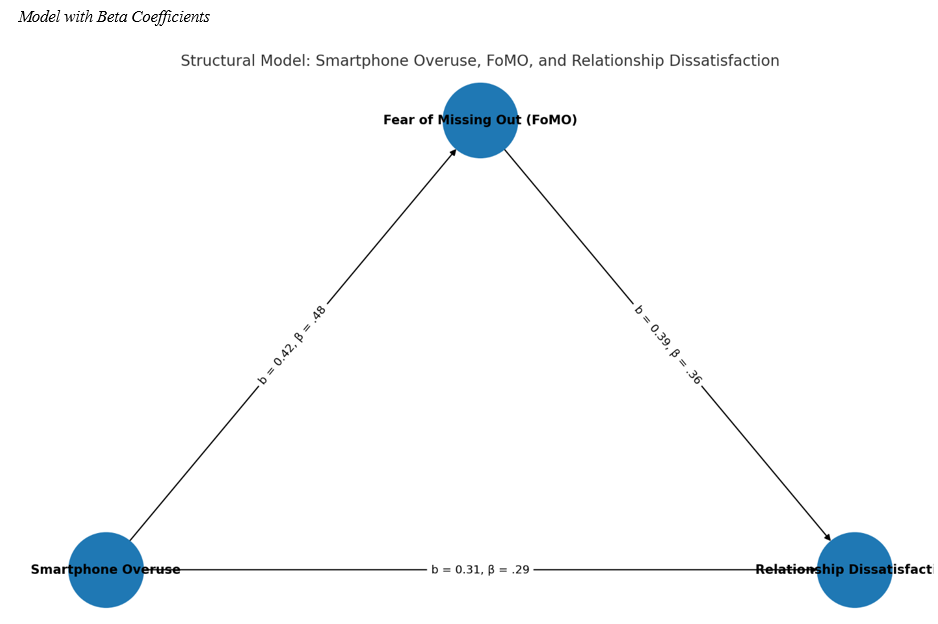
Findings: Pearson correlations revealed significant positive associations between smartphone overuse, FoMO, and relationship dissatisfaction (all p < .001). Model fit indices indicated acceptable fit (χ²/df = 2.01, CFI = .96, TLI = .95, RMSEA = .051), supporting the robustness of the mediational model. Smartphone overuse significantly predicted FoMO (β = .48, p < .001) and relationship dissatisfaction both directly (β = .29, p < .001) and indirectly through FoMO (β = .17, p = .002). The total effect of smartphone overuse on relationship dissatisfaction was β = .46 (p < .001), confirming the mediating role of FoMO in this relationship.
Conclusion: The findings underscore the need for interventions that address not only digital dependency but also the psychological mechanisms, such as FoMO, that intensify relational strain in the digital age.
Downloads
References
Alinejad, V., Parizad, N., Yarmohammadi, M., & Radfar, M. (2022). Loneliness and Academic Performance Mediates the Relationship Between Fear of Missing Out and Smartphone Addiction Among Iranian University Students. BMC psychiatry, 22(1). https://doi.org/10.1186/s12888-022-04186-6
Asuro, D. P. A., & Saloom, G. (2024). Pengaruh Fear of Missing Out, Adiksi Smartphone, Dan Loneliness Terhadap Perilaku Phubbing Pada Generasi Z Kota Tangerang Banten. Jurnal Psikologi, 17(1), 155-173. https://doi.org/10.35760/psi.2024.v17i1.9464
Bakioğlu, F., Deniz, M., Griffiths, M. D., & Pakpour, A. H. (2022). Adaptation and Validation of the Online-Fear of Missing Out Inventory Into Turkish and the Association With Social Media Addiction, Smartphone Addiction, and Life Satisfaction. BMC psychology, 10(1). https://doi.org/10.1186/s40359-022-00856-y
Casale, S., Fioravanti, G., Gioia, F., Redditi, E., & Spada, M. M. (2022). Fear of Missing Out and Fear of Not Being Up to Date: Investigating Different Pathways Towards Social and Process Problematic Smartphone Use. Current Psychology, 42(26), 22847-22856. https://doi.org/10.1007/s12144-022-03368-5
Dam, V. A. T., Dao, N. G., Nguyen, D. C., Vu, T. M. T., Boyer, L., Auquier, P., Fond, G., Ho, R., Ho, C. S. H., & Zhang, M. (2023). Quality of Life and Mental Health of Adolescents: Relationships With Social Media Addiction, Fear of Missing Out, and Stress Associated With Neglect and Negative Reactions by Online Peers. PLoS One, 18(6), e0286766. https://doi.org/10.1371/journal.pone.0286766
Gao, B., Liu, Y., Shen, Q., Fu, C., Li, W., & Xu, L. (2023). Why Cannot I Stop Phubbing? Boredom Proneness and Phubbing: A Multiple Mediation Model. Psychology research and behavior management, Volume 16, 3727-3738. https://doi.org/10.2147/prbm.s423371
Gökçearslan, Ş., Eşiyok, E., Griffiths, M. D., Doğan, M., & Turancı, E. (2023). Smartphone Addiction Among Adults: The Role of Smartphone Use, Fear of Missing Out (FoMO), and Self-Efficacy Among Turkish Adults. Addicta: The Turkish Journal On Addictions. https://doi.org/10.5152/addicta.2023.23001
Guan, J., Ma, W., & Liu, C. (2023). Fear of Missing Out and Problematic Smartphone Use Among Chinese College Students: The Roles of Positive and Negative Metacognitions About Smartphone Use and Optimism. PLoS One, 18(11), e0294505. https://doi.org/10.1371/journal.pone.0294505
GÜRbÜZ, F., Bayrakli, M., & Gezgin, D. M. (2023). The Effect of Cyberloafing Behaviors on Smartphone Addiction in University Students: The Mediating Role of Fear of Missing Out. Journal of Educational Technology and Online Learning, 6(1), 234-248. https://doi.org/10.31681/jetol.1089882
Ha, J.-P., & Yang, N. (2024). The Effect of Fear of Missing Out and SNS Addiction Proneness on Bedtime Procrastination: The Moderated Mediating Effect of Negative Affect. Journal of Sleep Medicine, 21(1), 36-43. https://doi.org/10.13078/jsm.240004
Jullyane Laysa de Carvalho, O., Otília Jurema de Carvalho, N., & Rodolfo Augusto Bacelar de, A. (2024). Fear of Missing Out Syndrome and Its Impact on Sleep Quality in Medical Students: A Cross-Sectional Study. Sleep Science, 17(03), e227-e234. https://doi.org/10.1055/s-0044-1780499
Kaviya, G., & Likitha, S. (2025). The Influence of Personality Traits on Smartphone Addiction, Phubbing, and Mental Well-Being. 237-264. https://doi.org/10.4018/979-8-3693-8804-4.ch009
Kim, Y. E., & Park, K.-H. (2023). The Relationship Between Smartphone Addiction Tendencies and Academic Burnout in (Under)Graduate Student: The Mediating Effects of Sleep Quality and Academic Procrastination. Korean Association for Learner-Centered Curriculum and Instruction, 23(1), 705-718. https://doi.org/10.22251/jlcci.2023.23.1.705
Koç, H., Gökalp, Z. Ş., & Seki, T. (2023). The Relationships Between Self-Control and Distress Among Emerging Adults: A Serial Mediating Roles of Fear of Missing Out and Social Media Addiction. Emerging Adulthood, 11(3), 626-638. https://doi.org/10.1177/21676968231151776
Lai, H., Mei, X., Huang, S., Wu, X., Liang, J. Q., Zhou, L., & Ye, Z. J. (2025). The Relationship Between Smartphone Addiction and Sleep Quality in Older Adults: The Mediating Role of Loneliness and Depression. BMC Nursing, 24(1). https://doi.org/10.1186/s12912-025-02883-7
Parizad, N., Radfar, M., Yarmohammadi, M., & Alinejad, V. (2022). Smartphone Addiction and Its Relationship With Loneliness, Fear of Missing Out, and Academic Performance Among Students of Urmia University of Medical Sciences. Nursing and Midwifery Journal, 20(1), 43-54. https://doi.org/10.52547/unmf.20.1.43
Paul, J., Manchanda, P., Arora, N., & Aggarwal, A. (2023). “I Can't Look at You While Talking!” – Fear of Missing Out and Smartphone Addiction as Predictors of Consumer's Phubbing Behavior. Journal of Research in Interactive Marketing, 18(4), 666-687. https://doi.org/10.1108/jrim-06-2023-0177
Pospíšilová, H., & Macháčková, P. (2024). Smartphone Addiction and Its Consequence on the Perceived Threat in Health, Family Social and Economic Areas. Social Pathology and Prevention, 9(2), 61-75. https://doi.org/10.25142/spp.2023.016
Putri, C. A., & Sa’id, M. (2024). The Effect of FoMO and Social Media Addiction on Phubbing Behavior in Adolescent K-Pop Fans. Nusantara. J. Behav. And. Soc. Sci, 3(4), 169-178. https://doi.org/10.47679/njbss.202464
Soraci, P., Demetrovics, Z., Bevan, N., Pisanti, R., Servidio, R., Bernardo, C. D., Chini, E., & Griffiths, M. D. (2025). FoMO and Psychological Distress Mediate the Relationship Between Life Satisfaction, Problematic Smartphone Use, and Problematic Social Media Use. International journal of mental health and addiction. https://doi.org/10.1007/s11469-024-01432-8
Stirnberg, J., Margraf, J., Precht, L.-M., & Brailovskaia, J. (2024). Problematic Smartphone Use, Depression Symptoms, and Fear of Missing Out: Can Reasons for Smartphone Use Mediate the Relationship? A Longitudinal Approach. J. Soc. Media Res., 1(1), 3-13. https://doi.org/10.29329/jsomer.3
Sun, Y. (2025). The Effect of Self-Concept on Idol Worship: A Chain Mediation Model. Academic Journal of Management and Social Sciences, 10(2), 120-126. https://doi.org/10.54097/nqp9ye13
Suprapto, M. H., Setiasih, S., & Siaputra, I. B. (2024). Parent-Child Relationship and Smartphone Addiction: The Role of Self-Control and Fear of Missing Out as Mediators. Journal of Educational Health and Community Psychology, 13(1), 170. https://doi.org/10.12928/jehcp.v13i1.28244
Yang, H., Liu, B., & Fang, J. (2021). Stress and Problematic Smartphone Use Severity: Smartphone Use Frequency and Fear of Missing Out as Mediators. Frontiers in Psychiatry, 12. https://doi.org/10.3389/fpsyt.2021.659288
Downloads
Additional Files
Publication Timeline
- Submitted
- Revised
- Accepted
Issue
Section
License
Copyright (c) 2025 Parichehr Mehdiabadi, Roodi Hooshmandi (Author); Jiantang Yang (Corresponding Author)

This work is licensed under a Creative Commons Attribution-NonCommercial 4.0 International License.