Parental Criticism and Emerging Adult Identity Confusion: The Moderating Role of Self-Compassion
DOI:
https://doi.org/10.61838/kman.jarac.7.3.26Keywords:
Parental criticism, identity confusion, self-compassion, emerging adulthood, structural equation modelingAbstract
Objective: This study aimed to examine the relationship between parental criticism and identity confusion in emerging adults and to determine whether self-compassion moderates this relationship.
Methods and Materials: A descriptive correlational design was employed with a sample of 422 emerging adults (aged 18–29) residing in Germany. Participants were recruited online and completed validated self-report questionnaires assessing parental criticism, self-compassion, and identity confusion. The sample size was determined according to the Morgan and Krejcie table to ensure adequate statistical power. Data analysis was conducted using SPSS-27 and AMOS-21. Descriptive statistics and Pearson’s correlation coefficients were computed to explore bivariate relationships among variables. Structural equation modeling (SEM) was performed to test the hypothesized model and to examine direct, indirect, and total effects, as well as the moderating role of self-compassion. Model fit was evaluated using multiple indices, including χ²/df, GFI, AGFI, CFI, TLI, and RMSEA.
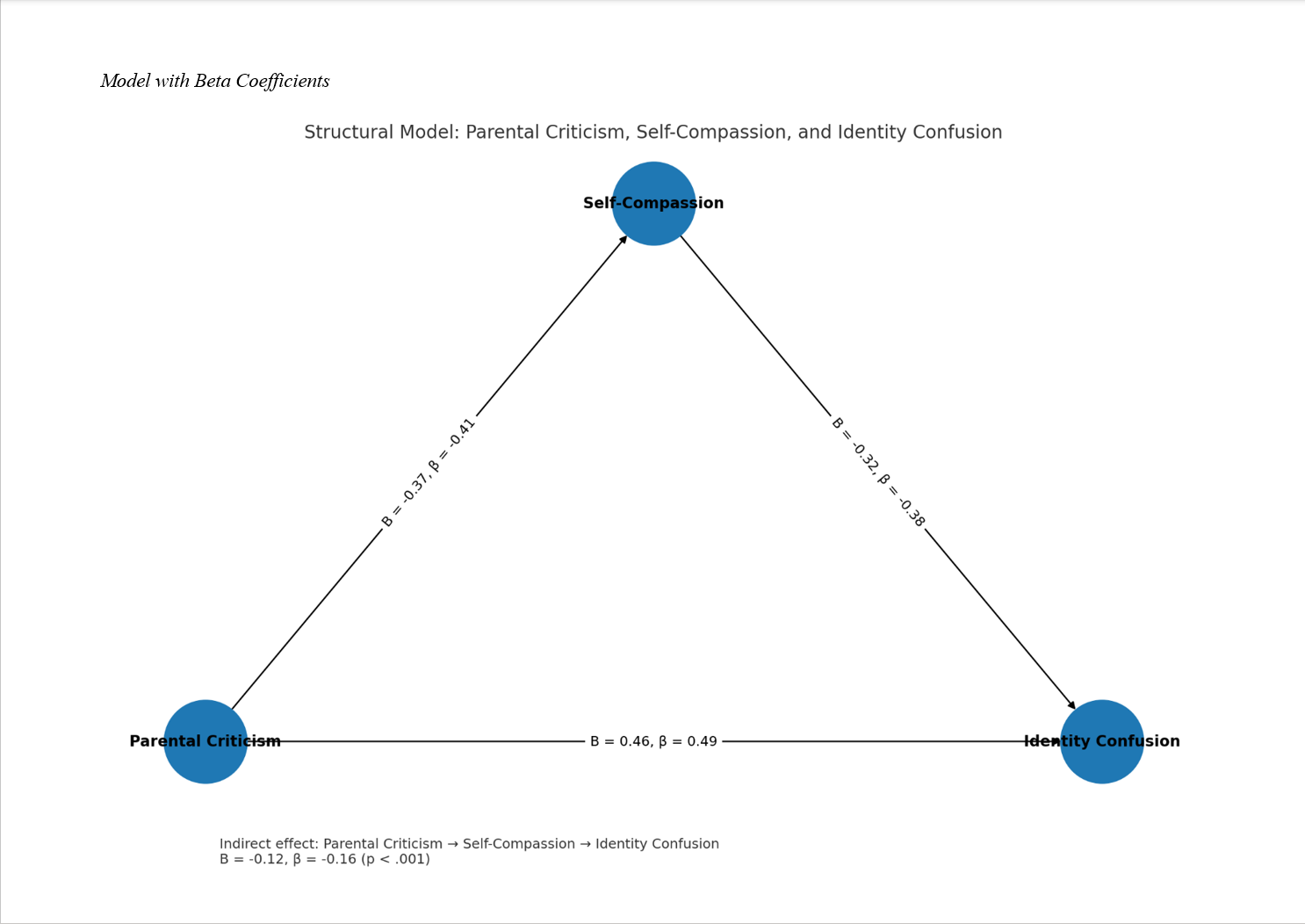
Findings: Results indicated a significant positive correlation between parental criticism and identity confusion (r = .52, p < .001) and a significant negative correlation between self-compassion and identity confusion (r = –.47, p < .001). SEM revealed that parental criticism directly predicted higher identity confusion (β = .49, p < .001), while self-compassion directly predicted lower identity confusion (β = –.38, p < .001). Parental criticism negatively predicted self-compassion (β = –.41, p < .001), and an indirect effect of parental criticism on identity confusion through reduced self-compassion was also significant (β = –.16, p < .001). The structural model demonstrated excellent fit (χ²/df = 2.01, CFI = .97, TLI = .96, RMSEA = .049).
Conclusion: Parental criticism significantly contributes to identity confusion in emerging adults; however, self-compassion acts as a protective factor by buffering this adverse effect. Enhancing self-compassion may be an effective strategy to support identity development among individuals with critical parental backgrounds.
Downloads
References
Aarthy, G. (2023). The Effects of Single Parenting on the Mental Health and Well-Being of Young Adults: A Comparative Analysis With Two Parent Households. 01-16. https://doi.org/10.55662/book.2023mdis.001
Bankier-Karp, A. (2022). Catalysts of Connectedness: A Case for Greater Complexity in Religious Identity Formation Research. Review of Religious Research, 64(2), 343-373. https://doi.org/10.1007/s13644-022-00486-1
Black, A. L., Hanson, C. L., & Crandall, A. (2025). Intergenerational Transmission of Family Healthy Lifestyle on Young Adult Well-Being. Translational Issues in Psychological Science. https://doi.org/10.1037/tps0000466
Camia, C., Sengsavang, S., Rohrmann, S., & Pratt, M. W. (2021). The Longitudinal Influence of Parenting and Parents’ Traces on Narrative Identity in Young Adulthood. Developmental Psychology, 57(11), 1991-2005. https://doi.org/10.1037/dev0001242
Cao, S. (2025). The Impact of Parental Interactions on Young People's Perspectives of Romantic Relationship. Lecture Notes in Education Psychology and Public Media, 105(1), 15-31. https://doi.org/10.54254/2753-7048/2024.24805
Chowdhury, S. R., Bhattacharya, S., Bhattacharya, S., & Bhattacharya, A. (2023). Role of Parents in the Gender Role Identity Formation of Offspring- An Exploratory Study. https://doi.org/10.21203/rs.3.rs-2694469/v1
Coleman, J., Thompson, T., Riley, K., Allen, K., Michalak, C., Shields, R. H., Berry‐Kravis, E., & Hessl, D. (2023). The Comparison of Expressed Emotion of Parents of Individuals With Fragile X Syndrome to Other Intellectual Disabilities. Journal of Applied Research in Intellectual Disabilities, 36(2), 394-404. https://doi.org/10.1111/jar.13069
Cruciani, G., Fontana, A., Benzi, I. M. A., Sideli, L., Parolin, L. A. L., Muzi, L., & Carone, N. (2024). Mentalized Affectivity, Helicopter Parenting, and Psychopathological Risk in Emerging Adults: A Network Analysis. European Journal of Investigation in Health Psychology and Education, 14(9), 2523-2541. https://doi.org/10.3390/ejihpe14090167
Diamond, G. M., & Boruchovitz‐Zamir, R. (2023). The Attachment Task. 113-144. https://doi.org/10.1037/0000352-006
Jain, P., G., T., & Joshi, D. C. (2025). Examining the Relationship Between Parental Bond and Emotional Intelligence in Shaping Adults' Perception in Romantic Relationship. Ijsat, 16(2). https://doi.org/10.71097/ijsat.v16.i2.6113
Jang, S., Ryu, J., Yon, K. J., Kim, P. Y., & Kim, M. S. (2023). Perceived Marginalization and Mental Health of Young Adults With Migration Backgrounds in South Korea: Exploring Moderating and Mediating Mechanisms. Frontiers in psychology, 14. https://doi.org/10.3389/fpsyg.2023.1239337
Jones, C. M., & Rogers, L. O. (2023). Family Racial/Ethnic Socialization Through the Lens of Multiracial Black Identity: A M(ai)cro Analysis of Meaning-Making. Race and Social Problems, 15(1), 59-78. https://doi.org/10.1007/s12552-023-09387-6
Kim, D.-h., & Kim, M.-S. (2021). The Effects of Perceived Parental Psychological Control on Social Anxiety of Young Adults in Twenties: Internalized Shame and Ambivalence Over Emotional Expressiveness as Mediators. The Korean Journal of Culture and Social Issues, 27(1), 51-71. https://doi.org/10.20406/kjcs.2021.2.27.1.51
Konishi, C., & Tesolin, J. (2024). Fostering Healthy Growth of Sexual and Gender Diverse Young People: The Role of Parents/Caregivers and Social-Emotional Learning. https://doi.org/10.5772/intechopen.1006943
Lee, H., & Lee, H.-J. (2022). The Effects of Parental Emotional Invalidation and Expressed Emotion on Internalizing and Externalizing Problems. The Korean Journal of Developmental Psychology, 35(2), 157-179. https://doi.org/10.35574/kjdp.2022.6.35.2.157
Neoh, M. J. Y., Carollo, A., Bonassi, A., Mulatti, C., Lee, A., & Esposito, G. (2021). A Cross-Cultural Study of the Effect of Parental Bonding on the Perception and Response to Criticism in Singapore, Italy and USA. https://doi.org/10.31234/osf.io/rscxv
Nikolajeva, M. (2019). Memory of the Present: Empathy and Identity in Young Adult Fiction. Narrative Works, 4(2). https://doi.org/10.7202/1062101ar
Pandey, N., Law, M., Gautam, R., Coordinator, A., Avinash, K., Goswami, S., Mishra, S., Das, M., Fowmina, M., Varghese, M. S., Avinash, D., Goswami, K., Sharma, P. K., Thakur, P., & Sharma, K. (2023). Marriages and Divorces in Indian Society. https://doi.org/10.55662/book.2023
Panhwar, M., & Tariq, Q. (2024). The Impact of Perceived Dysfunctional Parenting Styles on Level of Emotional Intelligence of Young Adults. J. Asian Dev. Studies, 13(1), 844-852. https://doi.org/10.62345/jads.2024.13.1.70
Rosina, R., McMaster, R., Lovecchio, V., & Wu, C. J. (2024). Young People Transitioning From Child and Adolescent to Adult Mental Health Services: A Qualitative Systematic Review. International journal of mental health nursing, 34(1). https://doi.org/10.1111/inm.13439
Shah, I. (2025). Parenting Styles and Their Effects on Emotional Intelligence and Identity Development in Emerging Adulthood. RJSP, 3(2), 1196-1205. https://doi.org/10.71145/rjsp.v3i2.271
Sugimura, K., Hihara, S., Hatano, K., Nakama, R., Saiga, S., & Tsuzuki, M. (2022). Profiles of Emotional Separation and Parental Trust From Adolescence to Emerging Adulthood: Age Differences and Associations With Identity and Life Satisfaction. Journal of youth and adolescence, 52(3), 475-489. https://doi.org/10.1007/s10964-022-01716-z
Tahir, Z., & Qurat-ul-ain, A. (2024). Perceived Parenting Styles, Emotional Intelligence and Conflict Resolution Styles Among Young Adults. International journal of psychology, 9(5), 60-76. https://doi.org/10.47604/ijp.2976
Viršilaitė, R., & Bukšnytė-Marmienė, L. (2021). The Relationship Between Experienced Parents’ Divorce and Their Circumstancs With Young Adults’ Behavioral and Emotional Difficulties. Pedagogika, 141(1), 230-251. https://doi.org/10.15823/p.2021.141.13
Wu, C. W., Chen, W., & Jen, C.-H. (2020). Emotional Intelligence and Cognitive Flexibility in the Relationship Between Parenting and Subjective Well-Being. Journal of Adult Development, 28(2), 106-115. https://doi.org/10.1007/s10804-020-09357-x
Yoo, H.-y., & Kwack, K.-h. (2023). The Effect of Mother's Parenting Efficacy and Emotional Expression on Emotional Intelligence and Peer Competence of Young Children. Korean Association for Learner-Centered Curriculum and Instruction, 23(22), 973-989. https://doi.org/10.22251/jlcci.2023.23.22.973
Downloads
Additional Files
Publication Timeline
- Submitted
- Revised
- Accepted