Identifying Core Indicators of Relapse in Clients Undergoing Cognitive Behavioral Therapy for Depression: A Qualitative Study
DOI:
https://doi.org/10.61838/kman.jarac.5158Keywords:
Depression, Cognitive Behavioral Therapy, Relapse, Qualitative Study, Thematic Analysis, Indicators, TurkeyAbstract
Objective: The objective of this study was to explore and identify the core indicators of relapse in clients who have completed cognitive behavioral therapy (CBT) for depression.
Methods and Materials: This qualitative study employed a thematic analysis approach based on semi-structured interviews. Twenty-one participants (12 female, 9 male) aged between 23 and 54 years, all of whom had previously undergone a full course of CBT for depression, were recruited from mental health centers in Turkey. Participants were selected through purposive sampling and interviews were continued until theoretical saturation was reached. Data collection involved individual interviews lasting 45–75 minutes, which were audio-recorded, transcribed verbatim, and supplemented with field notes. NVivo 14 software was used to assist with systematic coding, organization, and analysis of the data.
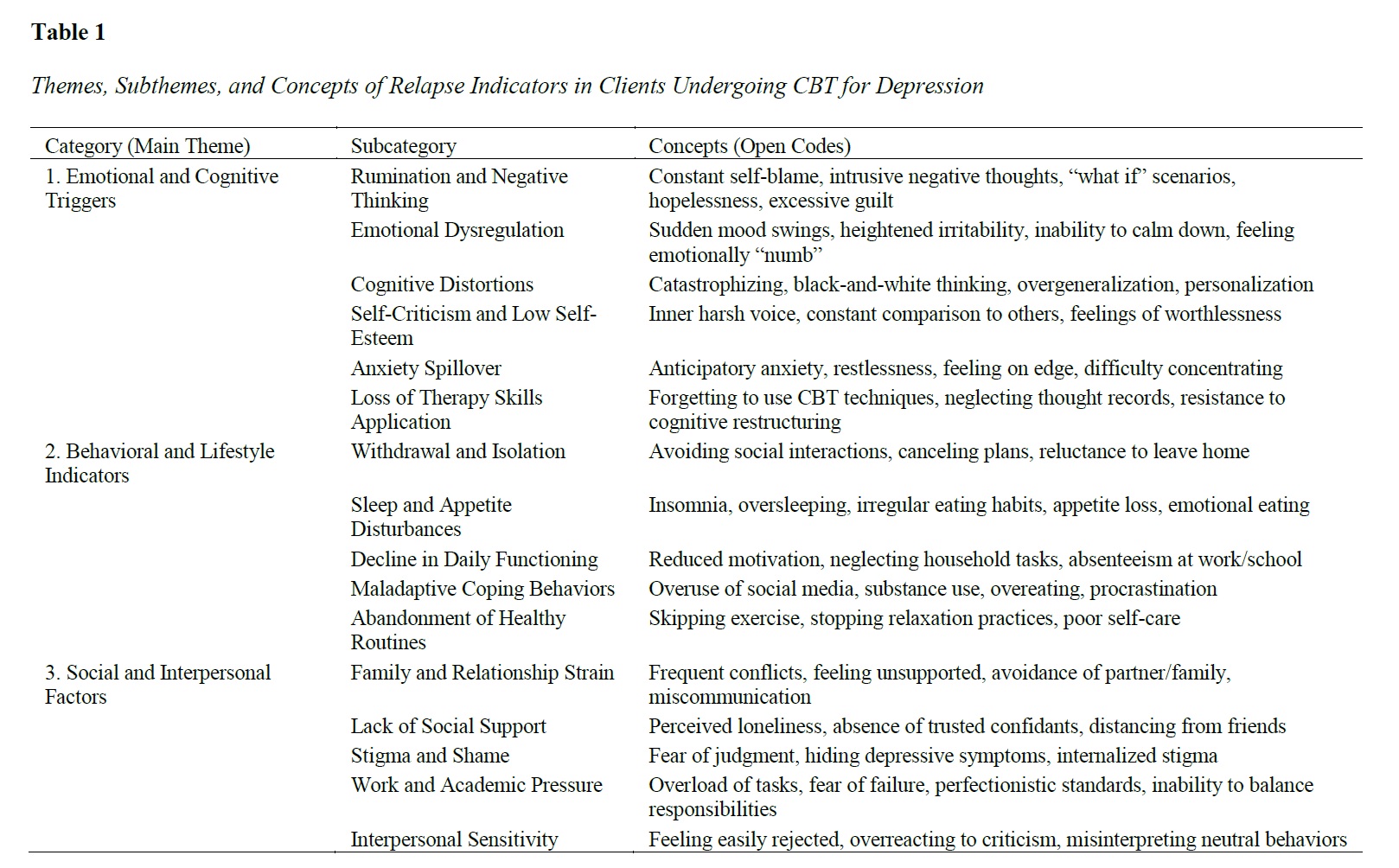
Findings: Thematic analysis revealed three overarching categories of relapse indicators. The first, emotional and cognitive triggers, included rumination, negative thinking, cognitive distortions, emotional dysregulation, and loss of therapy skills application. The second, behavioral and lifestyle indicators, encompassed withdrawal, disturbances in sleep and appetite, decline in daily functioning, maladaptive coping strategies, and abandonment of healthy routines. The third, social and interpersonal factors, involved family and relationship strain, lack of social support, stigma and shame, work and academic pressures, and interpersonal sensitivity.
Conclusion: Relapse in depression following CBT is a multifaceted process involving the interplay of cognitive-emotional vulnerabilities, behavioral patterns, and social stressors. Early identification of these indicators, combined with booster interventions, aftercare programs, and personalized relapse-prevention planning, may enhance the sustainability of treatment gains.
Downloads
References
Bernhardt, M., Schwert, C., Aschenbrenner, S., Weisbrod, M., & Schröder, A. (2021). Longitudinal Changes of Cognitive Deficits and Treatment Outcome of Cognitive Behavioral Therapy for Major Depression. The Journal of Nervous and Mental Disease, 209(5), 336-342. https://doi.org/10.1097/nmd.0000000000001301
Brenes, G. A., Danhauer, S. C., Lyles, M. F., Anderson, A., & Miller, M. E. (2017). Long-Term Effects of Telephone-Delivered Psychotherapy for Late-Life GAD. American Journal of Geriatric Psychiatry, 25(3), S130-S131. https://doi.org/10.1016/j.jagp.2017.01.149
Carstens, L., Hartling, C., Aust, S., Domke, A. K., Stippl, A., Spies, J., Brakemeier, E. L., Bajbouj, M., & Grimm, S. (2021). EffECTively Treating Depression: A Pilot Study Examining Manualized Group CBT as Follow-Up Treatment After ECT. Frontiers in psychology, 12. https://doi.org/10.3389/fpsyg.2021.723977
Chiang, K.-J., Tsai, J. C., Liu, D., Lin, C. H., Chiu, H. L., & Chou, K. R. (2017). Efficacy of Cognitive-Behavioral Therapy in Patients With Bipolar Disorder: A Meta-Analysis of Randomized Controlled Trials. PLoS One, 12(5), e0176849. https://doi.org/10.1371/journal.pone.0176849
Ezawa, I. D., Forand, N. R., & Strunk, D. R. (2020). An Examination of Dysfunctional Attitudes and Extreme Response Styles as Predictors of Relapse in Guided Internet‐based Cognitive Behavioral Therapy for Depression. Journal of Clinical Psychology, 76(6), 1047-1059. https://doi.org/10.1002/jclp.22955
Fuhr, K., Meisner, C., & Batra, A. (2023). Long-Term Outcomes of Depression Treatment With Hypnotherapy or Cognitive Behavioral Therapy. The Journal of Nervous and Mental Disease, 211(7), 519-524. https://doi.org/10.1097/nmd.0000000000001647
Hvenegaard, M., Watkins, E., Poulsen, S., Rosenberg, N., Gondan, M., Grafton, B., Austin, S. F., Howard, H., & Møeller, S. B. (2015). Rumination-Focused Cognitive Behaviour Therapy vs. Cognitive Behaviour Therapy for Depression: Study Protocol for a Randomised Controlled Superiority Trial. Trials, 16(1). https://doi.org/10.1186/s13063-015-0875-y
Johnco, C., Chen, J. T., Muir, C., Strutt, P., Dawes, P., Siette, J., Dias, C. B., Hillebrandt, H., Maurice, O., & Wuthrich, V. M. (2021). Long‐term Relapse Rates After Cognitive Behaviour Therapy for Anxiety and Depressive Disorders Among Older Adults: A Follow‐up Study During COVID‐19. Australasian Journal on Ageing, 40(2), 208-212. https://doi.org/10.1111/ajag.12928
Jonge, M. d., Bockting, C., Kikkert, M., Dijk, M. K. v., Schaik, A. v., Peen, J., Hollon, S. D., & Dekker, J. (2019). Preventive Cognitive Therapy Versus Care as Usual in Cognitive Behavioral Therapy Responders: A Randomized Controlled Trial. Journal of consulting and clinical psychology, 87(6), 521-529. https://doi.org/10.1037/ccp0000395
McCartney, M., Nevitt, S. J., Lloyd, A., Hill, R., White, R. G., & Duarte, R. (2020). Mindfulness‐based Cognitive Therapy for Prevention and Time to Depressive Relapse: Systematic Review and Network Meta‐analysis. Acta Psychiatrica Scandinavica, 143(1), 6-21. https://doi.org/10.1111/acps.13242
Muralidharan, A., Miklowitz, D. J., & Craighead, W. E. (2015). Psychosocial Treatments for Bipolar Disorder. https://doi.org/10.1093/med:psych/9780199342211.003.0010
Ngan, S. T. J., Chan, L. K., Chan, S. K. W., Lam, L., Li, W. K., Lim, K. O., Or, E., Pang, P. F., Poon, T. K., Wong, M. M., Wu, A. Y. T., & Wing, C. P. (2022). High-Definition Transcranial Direct Current Stimulation (HD-tDCS) as Augmentation Therapy in Late-Life Depression (LLD) With Suboptimal Response to Treatment – A Study Protocol for a Double-Blinded Randomized Sham-Controlled Trial. https://doi.org/10.21203/rs.3.rs-1448814/v1
Penedo, J. M. G., Coyne, A. E., Constantino, M. J., Krieger, T., Hayes, A. M., & Holtforth, M. G. (2020). Theory-Specific Patient Change Processes and Mechanisms in Different Cognitive Therapies for Depression. Journal of consulting and clinical psychology, 88(8), 774-785. https://doi.org/10.1037/ccp0000502
Pentaraki, A. (2018). Treatment Outcomes in Depression: Reducing Drop-Out Rates in Cognitive Therapy. Bjpsych Advances, 24(2), 101-109. https://doi.org/10.1192/bja.2017.8
Petre, L. M., Piepiora, P., Gemescu, M., & Gheorghe, D. A. (2024). Internet- And Mobile-Based Aftercare and Relapse Prevention Interventions for Anxiety and Depressive Disorders: A Systematic Review. Frontiers in psychology, 15. https://doi.org/10.3389/fpsyg.2024.1474016
Renani, H. Y., & Zare, T. Y. (2025). Advancing Depression Treatment: A Randomized Controlled Trial of Dynamic Interpersonal Therapy Versus CBT and Pharmacotherapy on Symptoms, Sleep, and Cognition. https://doi.org/10.31219/osf.io/hg8tc_v1
Roberts, H., Jacobs, R. H., Bessette, K. L., Crowell, S. E., Westlund-Schreiner, M., Thomas, L., Easter, R., Pocius, S., Dillahunt, A., Frandsen, S., Schubert, B., Farstead, B., Kerig, P. K., Welsh, R. C., Jago, D., Langenecker, S. A., & Watkins, E. (2021). Mechanisms of Rumination Change in Adolescent Depression (RuMeChange): Study Protocol for A randomised Controlled Trial of Rumination-Focused Cognitive Behavioural Therapy to Reduce Ruminative Habit and Risk of Depressive Relapse in High-Ruminating Adolescents. BMC psychiatry, 21(1). https://doi.org/10.1186/s12888-021-03193-3
Ruark, J., Mullane, E., Cleary, N., Cordeiro, A., Bezerra, E. D., Wu, V., Voutsinas, J., Shaw, B. E., Flynn, K. E., Lee, S. J., Turtle, C. J., Maloney, D. G., Fann, J. R., & Bar, M. (2020). Patient-Reported Neuropsychiatric Outcomes of Long-Term Survivors After Chimeric Antigen Receptor T Cell Therapy. Biology of Blood and Marrow Transplantation, 26(1), 34-43. https://doi.org/10.1016/j.bbmt.2019.09.037
Shunchao, L., & Chunqiu, P. (2024). Unveiling the Interplay of Depression, Antidepressants, and Cognitive Patterns: A Review of Silent Schemas in Mental Health Struggles. International Journal of Emerging Issues in Social Science Arts and Humanities, 02(02), 58-68. https://doi.org/10.60072/ijeissah.2024.v2i02.006
Vittengl, J. R., Clark, L. A., Thase, M. E., & Jarrett, R. B. (2015). Predictors of Longitudinal Outcomes After Unstable Response to Acute-Phase Cognitive Therapy for Major Depressive Disorder. Psychotherapy, 52(2), 268-277. https://doi.org/10.1037/pst0000021
Zhou, Y., Zhao, D., Zhu, X., Liu, L., Meng, M., Shao, X., Zhu, X., Xiang, J., He, J., Zhao, Y., Yuan, Y., Gao, R., Jiang, L., & Zhu, G. (2023). Psychological Interventions for the Prevention of Depression Relapse: Systematic Review and Network Meta-Analysis. Translational psychiatry, 13(1). https://doi.org/10.1038/s41398-023-02604-1
Downloads
Additional Files
Publication Timeline
- Submitted
- Revised
- Accepted