Identifying Indicators of Treatment Satisfaction in Online Therapy Platforms: A Qualitative Study in Taiwan
DOI:
https://doi.org/10.61838/kman.jarac.5160Keywords:
Online therapy, patient satisfaction, telehealth, qualitative research, therapeutic alliance, TaiwanAbstract
Objective: This study aimed to identify the core indicators of treatment satisfaction in online therapy platforms from the perspectives of clients in Taiwan.
Methods and Materials: A qualitative research design was employed using semi-structured, in-depth interviews. Twenty-two participants (12 women, 10 men), all of whom had engaged in online therapy within the previous year, were purposively recruited. Data collection continued until theoretical saturation was achieved. Interviews were conducted via video call or telephone, lasting between 45 and 70 minutes, and were transcribed verbatim. Thematic analysis was performed using NVivo 14 software, with iterative coding and regular team discussions to ensure reliability and conceptual clarity.
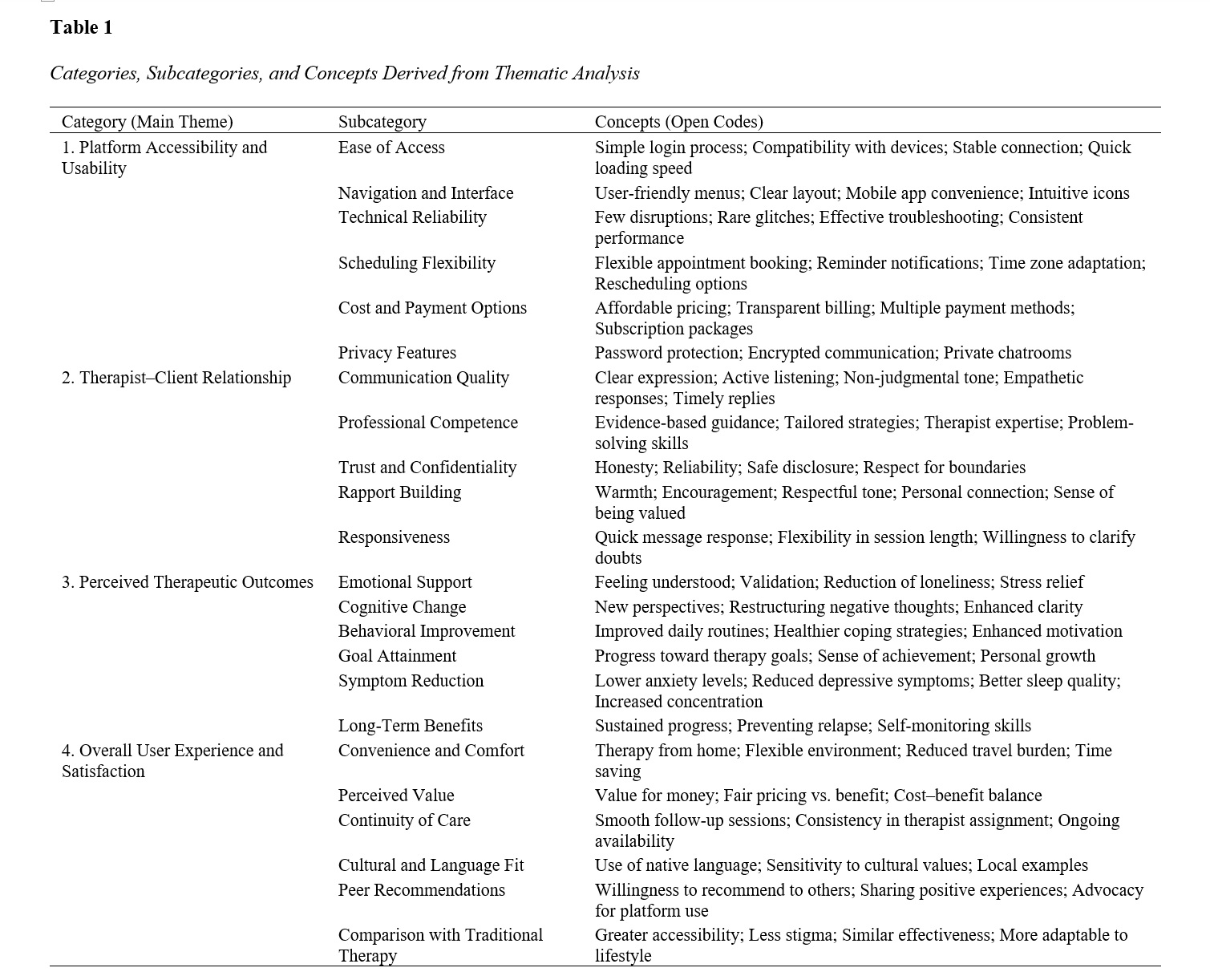
Findings: Analysis yielded four major categories of satisfaction indicators. The first, Platform Accessibility and Usability, included ease of access, intuitive navigation, reliability, flexible scheduling, transparent cost structures, and privacy protections. The second, Therapist–Client Relationship, encompassed communication quality, professional competence, trust, rapport building, and responsiveness. The third, Perceived Therapeutic Outcomes, reflected emotional support, cognitive reframing, behavioral improvements, goal attainment, symptom reduction, and long-term benefits. The fourth, Overall User Experience and Satisfaction, involved convenience, perceived value, continuity of care, cultural and language fit, peer recommendation, and comparisons with traditional therapy.
Conclusion: The study highlights that treatment satisfaction in online therapy platforms is a multidimensional construct shaped by both digital infrastructure and therapeutic relationships. By integrating technological reliability, therapist empathy, outcome visibility, and cultural resonance, platforms can foster higher satisfaction and sustained engagement.
Downloads
References
Basilisco, G. (2020). Patient Dissatisfaction With Medical Therapy for Chronic Constipation or Irritable Bowel Syndrome With Constipation: Analysis of N‐of‐1 Prospective Trials in 81 Patients. Alimentary Pharmacology & Therapeutics, 51(6), 629-636. https://doi.org/10.1111/apt.15657
Chhin, V., Roussos, J., Michaelson, T., Bana, M., Bezjak, A., Foxcroft, S., Hamilton, J. L., & Liu, F. F. (2017). Leveraging Mobile Technology to Improve Efficiency of the Consent-to-Treatment Process. Jco Clinical Cancer Informatics(1), 1-8. https://doi.org/10.1200/cci.17.00041
Chittle, M. D., Rao, S. K., Jaff, M. R., Patel, V. I., Gallen, K. M., Avadhani, R., Ferris, T. G., & Wasfy, J. H. (2015). Asynchronous Vascular Consultation via Electronic Methods: A Feasibility Pilot. Vascular Medicine, 20(6), 551-556. https://doi.org/10.1177/1358863x15601734
Daniela Annanias Gimenes de, P., Piatti, N. C. T. P., Lucíola da Cunha Menezes, C., & Chiavegato, L. D. (2020). Satisfaction Levels With Physical Therapy in Hospitalized Patients. Brazilian Journal of Physical Therapy, 24(2), 118-123. https://doi.org/10.1016/j.bjpt.2019.02.012
Duffin, K. C., Yeung, H., Takeshita, J., Krueger, G. G., Robertson, A. D., Troxel, A. B., Shin, D. B., Voorhees, A. S. V., & Gelfand, J. M. (2014). Patient Satisfaction With Treatments for Moderate-to-Severe Plaque Psoriasis in Clinical Practice. British Journal of Dermatology, 170(3), 672-680. https://doi.org/10.1111/bjd.12745
Elrifaey, S. M., Shall, S. I. E., & Emara, M. H. (2024). Does Growth Hormone Improve Growth Patterns and Patient Satisfaction in Short Children? Alexandria Journal of Pediatrics, 37(3), 219-223. https://doi.org/10.4103/ajop.ajop_35_24
Faizan, S. M., Afzal, S., Muneeb, H. N., Sarfraz, K., Ali, H., Haq, K., Hamid, M. F., & Arslan, H. R. M. (2022). Patient Satisfaction With Manual Physical Therapy Care. Pakistan Biomedical Journal, 85-88. https://doi.org/10.54393/pbmj.v5i7.630
Little, C. C., Russell, S. J., Hwang, C., Goldberg, L., Brown, S. K., Kirke, D. N., & Courey, M. S. (2022). Applications of Telemedicine in Speech‐Language Pathology: Evaluation of Patient Satisfaction. The Laryngoscope, 133(4), 895-900. https://doi.org/10.1002/lary.30303
Mahanggoro, T. P., Akrom, A., & Wahyuni, T. I. (2021). Satisfaction Level of Anti-Dm Medicine in DM Patients in Primary Health Service in Yogyakarta. Bali Medical Journal, 10(3), 1379-1384. https://doi.org/10.15562/bmj.v10i3.2978
Maier, A., Kettemann, D., Weyen, U., Grehl, T., Schulte, P. C., Steinbach, R., Rödiger, A., Weydt, P., Petri, S., Wolf, J., Großkreutz, J., Koch, J. C., Weishaupt, J. H., Rosseau, S., Nordén, J., Körtvélyessy, P., Koch, B. C. P., Holm, T. M., Hildebrandt, B., . . . Spittel, S. (2024). Mechanical Insufflation-Exsufflation in a Large Multicenter Cohort of People With Amyotrophic Lateral Sclerosis (ALS) - Provision, Perceived Cough Deficiency and Treatment Satisfaction. https://doi.org/10.21203/rs.3.rs-4509203/v1
Maier, A., Kettemann, D., Weyen, U., Grehl, T., Schulte, P. C., Steinbach, R., Rödiger, A., Weydt, P., Petri, S., Wolf, J., Großkreutz, J., Koch, J. C., Weishaupt, J. H., Rosseau, S., Nordén, J., Körtvélyessy, P., Koch, B. C. P., Holm, T. M., Hildebrandt, B., . . . Spittel, S. (2025). Provision, Cough Efficacy and Treatment Satisfaction of Mechanical Insufflation-Exsufflation in a Large Multicenter Cohort of Patients With Amyotrophic Lateral Sclerosis. Scientific reports, 15(1). https://doi.org/10.1038/s41598-025-91692-8
Mazumder, P., Banik, C. K., Basak, A. K., Saifuddin, A. Z. M., Habibullah, A. K. M., & Ghosh, G. (2023). Role of Oxygenation in Moderate COVID-19 Pneumonia With High Flow Nasal Cannula and Standard Non-Rebreathing Mask: A Comparative Study. Sir Salimullah Medical College Journal, 31(2), 79-85. https://doi.org/10.3329/ssmcj.v31i2.69447
Ponsignon, F., Mathieu, L., & Durrieu, F. (2023). Understanding the Drivers of Patient Satisfaction With Home Health Care Services: An Empirical Study of Two Care Pathways. The International Journal of Health Planning and Management, 38(6), 1644-1656. https://doi.org/10.1002/hpm.3687
Radenković, S., Velojić-Golubović, M., Radojković, D., Ćirić, V., & Kocić, R. (2021). Treatment Satisfaction in Patients With Diabetes Mellitus Type 1 Treated With Intensified Insulin Therapy With Insulin Analogues. Acta Facultatis Medicae Naissensis, 38(3), 240-246. https://doi.org/10.5937/afmnai38-32875
Shoghli, A., Ansari, N., Motamed, N., & Sabet, S. A. (2020). Perceived Social Support and Its Social Determinants in Gastrointestinal Cancer Patients in Zanjan, Iran, in 2018. Journal of Advances in Medical and Biomedical Research, 28(128), 132-137. https://doi.org/10.30699/jambs.28.128.132
Telles, S., Katare, N., Sharma, S. K., & Gupta, A. (2024). Perception of Illness and Life Satisfaction Following a Week of Yoga Therapy in Patients With Chronic Diseases. Indian Journal of Ancient Medicine and Yoga, 17(1), 9-12. https://doi.org/10.21088/ijamy.0974.6986.17124.2
Xu, R., Zhang, T., & Zhang, Q. (2020). What Motivates Chinese Physicians to Provide Online Counseling Services in Internet Hospitals: Online Reputation or Offline Reputation? (Preprint). https://doi.org/10.2196/preprints.24498
Yeşilyaprak, S. S., Özyürek, S., Tomruk, M., İlçin, N., Karadibak, D., Keskinoğlu, P., & Savcı, S. (2018). The Turkish Version of the MedRisk Instrument for Measuring Patient Satisfaction: Measurement Properties in Physical Therapy Care Among Inpatients. Disability and Rehabilitation, 42(2), 247-254. https://doi.org/10.1080/09638288.2018.1494216
Downloads
Additional Files
Publication Timeline
- Submitted
- Revised
- Accepted