Cognitive Reappraisal as a Mediating Mechanism Between Mindfulness and Stress Reduction
DOI:
https://doi.org/10.61838/kman.jarac.5161Keywords:
Mindfulness, Cognitive Reappraisal, Stress Reduction, Emotion Regulation, Structural Equation ModelingAbstract
Objective: The objective of this study was to examine whether cognitive reappraisal mediates the relationship between mindfulness and stress reduction among Canadian adults.
Methods and Materials: A descriptive correlational design was applied with a sample of 399 participants selected according to the Morgan and Krejcie table. Standardized instruments were used to measure mindfulness (Five Facet Mindfulness Questionnaire), cognitive reappraisal (Cognitive Emotion Regulation Questionnaire – Reappraisal subscale), and stress (Perceived Stress Scale). Data were analyzed using SPSS version 27 for descriptive statistics and Pearson correlations, followed by Structural Equation Modeling (SEM) in AMOS version 21 to test the hypothesized mediating model. Model fit was evaluated using χ², GFI, AGFI, CFI, TLI, and RMSEA indices.
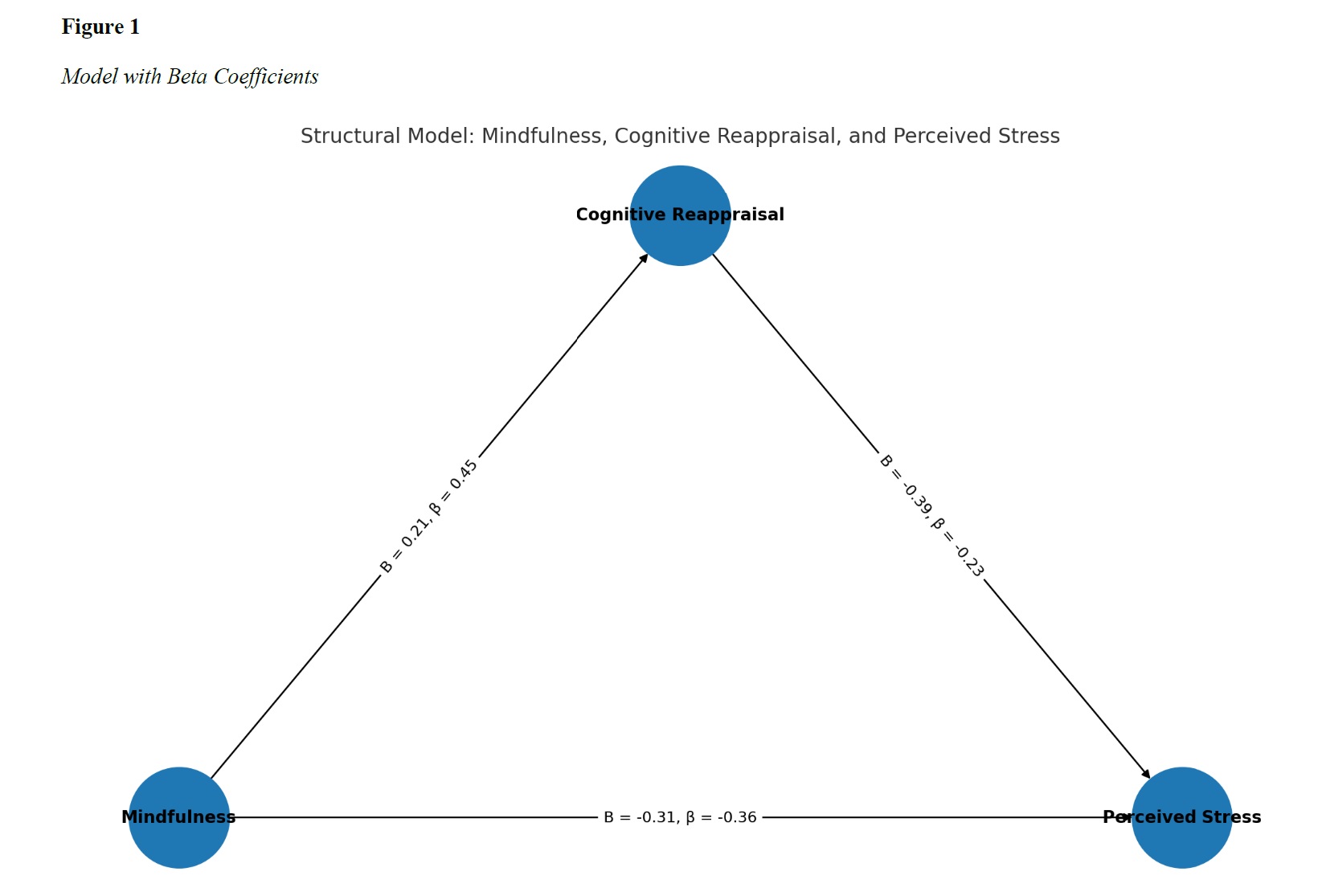
Findings: Pearson correlation results indicated that mindfulness was significantly and positively associated with cognitive reappraisal (r = .47, p < .001) and negatively related to perceived stress (r = –.54, p < .001). Cognitive reappraisal was also significantly and negatively associated with stress (r = –.39, p < .001). The structural model demonstrated excellent fit (χ²/df = 1.92, GFI = .94, AGFI = .91, CFI = .97, TLI = .96, RMSEA = .048). SEM results confirmed significant direct paths from mindfulness to reappraisal (β = .45, p < .001), reappraisal to stress (β = –.23, p = .002), and mindfulness to stress (β = –.36, p < .001). The indirect effect of mindfulness on stress through reappraisal was also significant (β = –.10, p = .004). Overall, the total effect of mindfulness on stress reduction was strong (β = –.46, p < .001).
Conclusion: The findings demonstrate that cognitive reappraisal partially mediates the effect of mindfulness on stress reduction, confirming that mindfulness not only directly lowers stress but also exerts indirect effects by enhancing adaptive emotion regulation strategies.
Downloads
References
An, L., Xiao, P., & Zhao, S. (2023). The Influence of Mindfulness on Posttraumatic Growth of Chinese People With Cancer. Social Behavior and Personality an International Journal, 51(11), 1-12. https://doi.org/10.2224/sbp.12761
Bossi, F., Zaninotto, F., D’Arcangelo, S., Lattanzi, N., Malizia, A. P., & Ricciardi, E. (2022). Mindfulness-Based Online Intervention Increases Well-Being and Decreases Stress After Covid-19 Lockdown. Scientific reports, 12(1). https://doi.org/10.1038/s41598-022-10361-2
Brown, M. M., Arigo, D., Wolever, R. Q., Smoski, M. J., Hall, M. H., Brantley, J. G., & Greeson, J. M. (2020). Do Gender, Anxiety, or Sleep Quality Predict Mindfulness-Based Stress Reduction Outcomes? Journal of Health Psychology, 26(13), 2656-2662. https://doi.org/10.1177/1359105320931186
Cavanagh, S. R., Lang, J. M., Birk, J. L., Fulwiler, C., & Urry, H. L. (2021). A Multicourse, Multisemester Investigation of the Impact of Cognitive Reappraisal and Mindfulness Instruction on Short- And Long-Term Learning in the College Classroom. Scholarship of Teaching and Learning in Psychology, 7(1), 14-38. https://doi.org/10.1037/stl0000174
Chen, M., & Cheung, R. Y. M. (2021). Testing Interdependent Self-Construal as a Moderator Between Mindfulness, Emotion Regulation, and Psychological Health Among Emerging Adults. International journal of environmental research and public health, 18(2), 444. https://doi.org/10.3390/ijerph18020444
Datu, J. A. D., Yang, W., & Lau, W. K. (2022). Does Mindfulness Matter for Cognitive Reappraisal and Academic Engagement? A Cross-Lagged Panel Model Study in Filipino High School Students. The Journal of Early Adolescence, 43(8), 993-1015. https://doi.org/10.1177/02724316221137951
Hanley, A. W., Vibe, M. d., Solhaug, I., Farb, N. A. S., Goldin, P. R., Gross, J. J., & Garland, E. L. (2021). Modeling the Mindfulness‐to‐meaning Theory's Mindful Reappraisal Hypothesis: Replication With Longitudinal Data From a Randomized Controlled Study. Stress and Health, 37(4), 778-789. https://doi.org/10.1002/smi.3035
Kam, J. W. Y., Wan-Sai-Cheong, L., Zuk, A. A. O., Mehta, A., Dixon, M. L., & Gross, J. J. (2024). A Brief Reappraisal Intervention Leads to Durable Affective Benefits. Emotion, 24(7), 1676-1688. https://doi.org/10.1037/emo0001391
Kaunhoven, R. J., & Dorjee, D. (2021). Mindfulness Versus Cognitive Reappraisal: The Impact of Mindfulness-Based Stress Reduction (MBSR) on the Early and Late Brain Potential Markers of Emotion Regulation. Mindfulness, 12(9), 2266-2280. https://doi.org/10.1007/s12671-021-01692-8
Lee, M., & Jang, K.-S. (2021). Mediating Effects of Emotion Regulation Between Socio-Cognitive Mindfulness and Achievement Emotions in Nursing Students. Healthcare, 9(9), 1238. https://doi.org/10.3390/healthcare9091238
Lee, M., & Park, H. (2022). Mediating Effects of Emotion Regulation Between Socio-Cognitive Mindfulness and Empathy in Nurses: A Cross-Sectional Study. BMC Nursing, 21(1). https://doi.org/10.1186/s12912-022-01081-z
Lee, Z. T., & Ling, K. K. (2023). Relationship Between Dispositional Mindfulness and Life Satisfaction Among Undergraduate Students in Malaysia: Cognitive Reappraisal as the Mediator. Jur. Kemanusiaan, 33-72. https://doi.org/10.11113/jur.kemanusiaan.v21n1.441
Martins-Klein, B., Chen, Z., Shanahan, M., Theos, G., Heideman, K., Orlovsky, I., DeFontes, C., & Alwan, E. (2023). Mindfulness Enhances Proactive Benefits of Reappraisal Use for Younger but Not Older Adults. Innovation in Aging, 7(Supplement_1), 1080-1081. https://doi.org/10.1093/geroni/igad104.3472
Schulte-Frankenfeld, P. M., & Trautwein, F. M. (2021). App‐based Mindfulness Meditation Reduces Perceived Stress and Improves Self‐regulation in Working University Students: A Randomised Controlled Trial. Applied Psychology Health and Well-Being, 14(4), 1151-1171. https://doi.org/10.1111/aphw.12328
Verdú, M. L., & Marcos, Y. Q. (2022). Application of the Mindfulness-Based Stress Reduction Program to Patients With Borderline Personality Disorder and Chronic Pain: A Pilot Study. Behavioral Psychology/Psicología Conductual, 30(2), 373-390. https://doi.org/10.51668/bp.8322203n
Wenzel, M., Blanke, E. S., Rowland, Z., & Brose, A. (2021). The Costs and Benefits of Mindfulness and Reappraisal in Daily Life. https://doi.org/10.31234/osf.io/ca7hg
Yang, W., Hu, D., & Guo, Y. (2024). The Relationship Between School Bullying Victimization and Social Mindfulness in Middle School Students: A Chain Mediating Model of Self-Concept Clarity and Cognition Reappraisal. Frontiers in psychology, 15. https://doi.org/10.3389/fpsyg.2024.1388301
Yu, J., Song, Y., Dan, H., Shi, Y., & Zhao, J. (2022). Factors Influencing Mindfulness Among Clinical Nurses in China: An Observational Cross‐sectional Study. Journal of nursing management, 30(3), 758-766. https://doi.org/10.1111/jonm.13560
Zheng, G. (2025). Mindfulness and Work Addiction Among Young Employees: The Mediating Roles of Cognitive Reappraisal and Perfectionism. Frontiers in Psychiatry, 16. https://doi.org/10.3389/fpsyt.2025.1631792
Zhong, Z. M., Jiang, H., Wang, H., & Liu, Y. (2025). The Association Between Mindfulness and Athletes’ Distress Tolerance: The Mediating Roles of Cognitive Reappraisal and Mental Toughness. Behavioral Sciences, 15(3), 298. https://doi.org/10.3390/bs15030298
Zhou, S., Wu, Y., & Xu, X. (2023). Linking Cognitive Reappraisal and Expressive Suppression to Mindfulness: A Three-Level Meta-Analysis. International journal of environmental research and public health, 20(2), 1241. https://doi.org/10.3390/ijerph20021241
Downloads
Additional Files
Publication Timeline
- Submitted
- Revised
- Accepted