Machine-Learning Prediction of Therapeutic Alliance Quality from Client Readiness to Change and Affective Dysregulation
DOI:
https://doi.org/10.61838/kman.jarac.5183Keywords:
Therapeutic Alliance, Affective Dysregulation, Readiness to Change, Machine LearningAbstract
Objective: The aim of this study is to utilize and compare advanced machine-learning algorithms to predict the early quality of the therapeutic alliance based on a multidimensional assessment of client readiness to change and specific facets of affective dysregulation.
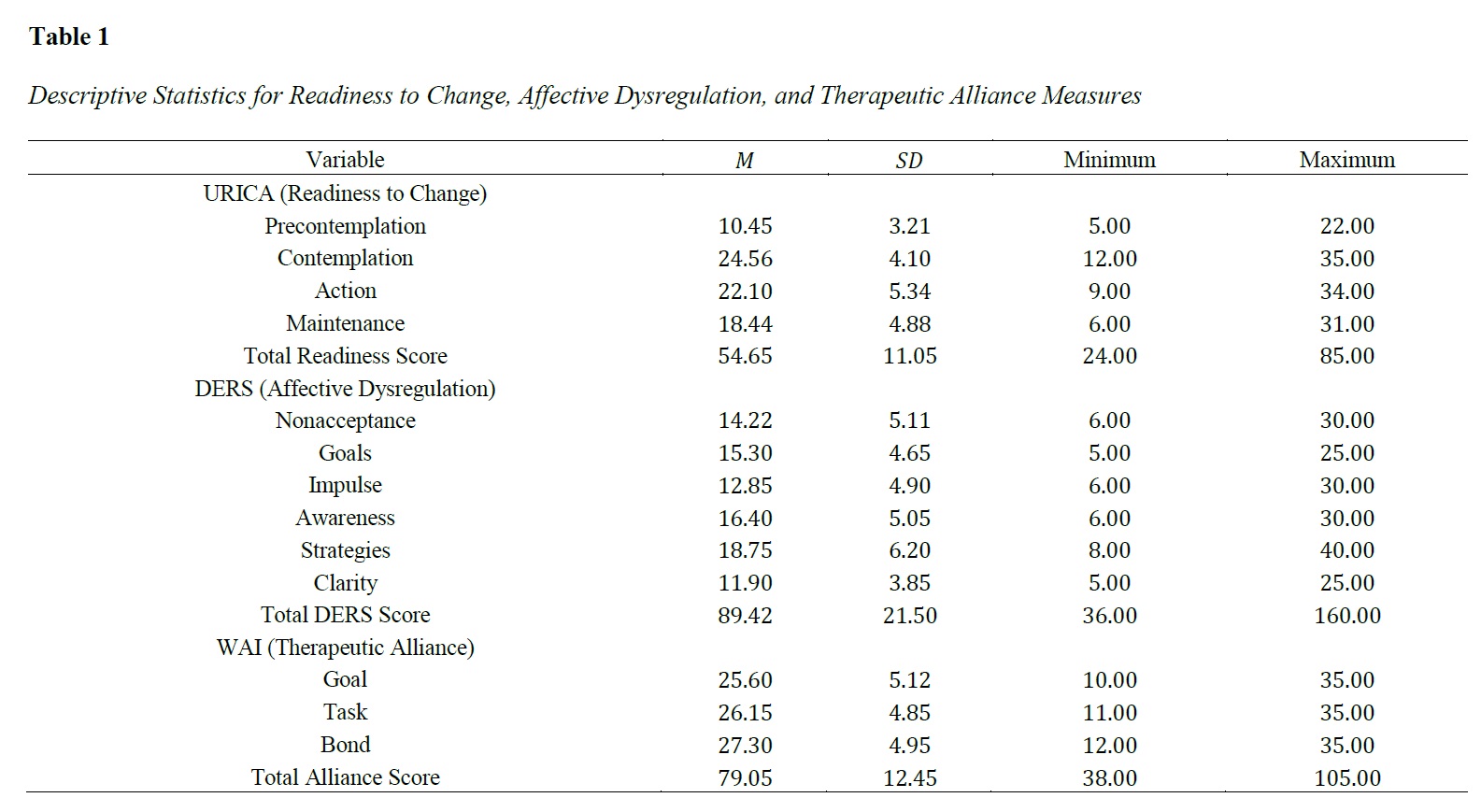
Methods and Materials: A prospective observational design was utilized, involving n=452treatment-seeking adults initiating outpatient psychotherapy in Canada. Baseline predictor variables were collected prior to the first therapy session using the University of Rhode Island Change Assessment (URICA) and the Difficulties in Emotion Regulation Scale (DERS). The criterion variable, therapeutic alliance quality, was measured after the fourth session using the Working Alliance Inventory (WAI). Missing data (<2.5%┤) were handled via multiple imputation. The dataset was standardized and split into an 80%training set (n=361) and a 20%testing set (n=91). Support Vector Regression (SVR), Multilayer Perceptron (MLP), and Random Forest (RF) models were trained and compared using randomized grid search with 10-fold cross-validation.
Findings: The sample had a mean age of M=34.6(SD=11.2) years. Preliminary analyses indicated that the WAI Total Score correlated positively with URICA (r=.46,p<.01) and negatively with DERS (r=-.52,p<.01). On the testing set, the Random Forest model demonstrated the highest predictive accuracy (R^2=.67, RMSE =7.15), outperforming the MLP (R^2=.56, RMSE =8.22) and SVR (R^2=.48, RMSE =8.95) algorithms. SHAP feature importance analysis of the RF model revealed that the strongest negative predictors of the alliance were the DERS Strategies (M.Abs.SHAP=2.84) and Goals (M.Abs.SHAP=2.45) subscales. The URICA Action stage (M.Abs.SHAP=2.10) and Precontemplation stage (M.Abs.SHAP=1.95) emerged as the most significant positive and negative motivational predictors, respectively.
Conclusion: Advanced machine-learning models can accurately forecast the early quality of the therapeutic alliance, computationally demonstrating that specific baseline deficits in emotion regulation and distinct motivational stages are fundamental determinants of the therapeutic bond.
Downloads
References
Alvarez, I., Herrero, M., & Martínez-Pampliega, A. (2024). The impact of emotion regulation on the establishment of the therapeutic alliance in post-divorce group intervention: A multilevel approach. PLoS One, 19(10), e0312293. https://doi.org/10.1371/journal.pone.0312293
Bar‐Kalifa, E., Prinz, J., Atzil‐Slonim, D., Rubel, J., Lutz, W., & Rafaeli, E. (2019). Physiological Synchrony and Therapeutic Alliance in an Imagery-Based Treatment. Journal of counseling psychology, 66(4), 508-517. https://doi.org/10.1037/cou0000358
Bartle-Haring, S., Shannon, S., Bowers, D., & Holowacz, E. (2016). Therapist Differentiation and Couple Clients' Perceptions of Therapeutic Alliance. Journal of marital and family therapy, 42(4), 716-730. https://doi.org/10.1111/jmft.12157
Crom, A., Paap, D., Wijma, A., Dijkstra, P. U., & Pool, G. (2020). Between the Lines: A Qualitative Phenomenological Analysis of the Therapeutic Alliance in Pediatric Physical Therapy. Physical & Occupational Therapy in Pediatrics, 40(1), 1-14. https://doi.org/10.1080/01942638.2019.1610138
Fang, M., Morgan, P., Yzaguirre, M. M., & Tseng, C. F. (2023). The Therapeutic Alliance in Couple Therapy: Patterns by Treatment and Sex in a Randomized Controlled Trial of Emotionally Focused Therapy and Treatment as Usual. Family Process, 62(4), 1423-1438. https://doi.org/10.1111/famp.12892
Fripp, J. A., & Adams, J. J. (2022). Enhancing the therapeutic alliance with African American clients: Using a critical race theoretical approach to navigate conversations about racism. Journal of Multicultural Counseling and Development, 50(3), 108-117. https://doi.org/10.1002/jmcd.12251
Glebova, T., Bartle-Haring, S., Gangamma, R., Knerr, M., Delaney, R. O., Meyer, K., McDowell, T., Adkins, K., & Grafsky, E. (2011). Therapeutic alliance and progress in couple therapy: multiple perspectives. Journal of Family Therapy, 33(1), 42-65. https://doi.org/10.1111/j.1467-6427.2010.00503.x
Harrington, S., Pascual‐Leone, A., Paivio, S., Edmondstone, C., & Baher, T. (2021). Depth of experiencing and therapeutic alliance: What predicts outcome for whom in emotion‐focused therapy for trauma? Psychology and Psychotherapy: Theory, Research and Practice, 94(4), 895-914. https://doi.org/10.1111/papt.12342
Janiri, D., Petracca, M., Moccia, L., Solito, M., Monaco, M. R. L., Cerbarano, M. L., Piano, C., Imbimbo, I., Nicola, M. D., Simonetti, A., Sani, G., & Bentivoglio, A. R. (2023). Functional Movement Disorders During COVID-19: Psychological Distress, Affective Temperament and Emotional Dysregulation. Journal of Personalized Medicine, 13(2), 175. https://doi.org/10.3390/jpm13020175
Kabrel, J. (2025). Human versus AI in psychotherapy: The role of expectancy and therapeutic alliance. Frontiers in psychology.
Katznelson, H., Falkenström, F., Daniel, S. I. F., Lunn, S., Folke, S., Pedersen, S. H., & Poulsen, S. (2020). Reflective Functioning, Psychotherapeutic Alliance, and Outcome in Two Psychotherapies for Bulimia Nervosa. Psychotherapy, 57(2), 129-140. https://doi.org/10.1037/pst0000245
Levin, A. W. (2024). The Therapeutic Alliance Between Study Participants and Intervention Facilitators Is Associated With Acute Effects and Clinical Outcomes in a Psilocybin-Assisted Therapy Trial for Major Depressive Disorder. PLoS One, 19(3), e0300501. https://doi.org/10.1371/journal.pone.0300501
Naim, R., German, R. E., White, J., Pandya, U., Dombek, K., Clayton, M., & Brotman, M. A. (2025). Treatment adherence, therapeutic alliance, and clinical outcomes during an exposure-based cognitive-behavioral therapy for pediatric irritability. BMC psychiatry, 25(1), 181. https://doi.org/10.1186/s12888-025-06601-0
Peters, E. M., Baetz, M., Marwaha, S., Balbuena, L., & Bowen, R. (2016). Affective Instability and Impulsivity Predict Nonsuicidal Self-Injury in the General Population: A Longitudinal Analysis. Borderline personality disorder and emotion dysregulation, 3(1). https://doi.org/10.1186/s40479-016-0051-3
Prakash, R. S. (2021). Mindfulness Meditation: Impact on Attentional Control and Emotion Dysregulation. Archives of Clinical Neuropsychology, 36(7), 1283-1290. https://doi.org/10.1093/arclin/acab053
Quiñones, M. M., Gallegos, A. M., Lin, F., & Heffner, K. L. (2020). Dysregulation of Inflammation, Neurobiology, and Cognitive Function in PTSD: An Integrative Review. Cognitive Affective & Behavioral Neuroscience, 20(3), 455-480. https://doi.org/10.3758/s13415-020-00782-9
Savage, J. A. (2011). Increasing adolescents' subjective well-being: effects of a Positive Psychology Intervention in comparison to the effects of therapeutic alliance, youth factors, and expectancy for change https://core.ac.uk/download/pdf/154468898.pdf
Tissue, A., Specker, P., Hoffman, J., Uppal, S., Cloitre, M., Neuner, F., O’Donnell, M., & Nickerson, A. (2022). Skills Training in Affective and Interpersonal Regulation for Refugees Integrated With Narrative Exposure Therapy: A Case Study on the Treatment of PTSD and Emotion Dysregulation for Refugees and Asylum-Seekers. Clinical Case Studies, 22(3), 285-306. https://doi.org/10.1177/15346501221133315
Tremain, H., McEnery, C., Fletcher, K., & Murray, G. (2019). The Therapeutic Alliance in Digital Mental Health Interventions for Serious Mental Illnesses: Narrative Review (Preprint). https://doi.org/10.2196/preprints.17204
Wong, N. R., Carta, K. E., Weintraub, M. J., & Miklowitz, D. J. (2022). Therapeutic alliance in family therapy and clinical outcomes among adolescents at risk for mood disorders. Journal of affective disorders, 300, 66-70. https://doi.org/10.1016/j.jad.2021.12.088
Downloads
Additional Files
Publication Timeline
- Submitted
- Revised
- Accepted