Predicting Obsessive–Compulsive Symptom Severity Using Models of Cognitive Inhibition and Perfectionism Dimensions
DOI:
https://doi.org/10.61838/kman.jarac.5198Keywords:
Obsessive-Compulsive Disorder, Cognitive Inhibition, Perfectionism, Thought Suppression, Response InhibitionAbstract
Objective: The objective of the present study was to determine the unique and incremental value of cognitive inhibition models and perfectionism dimensions in predicting obsessive-compulsive symptom severity.
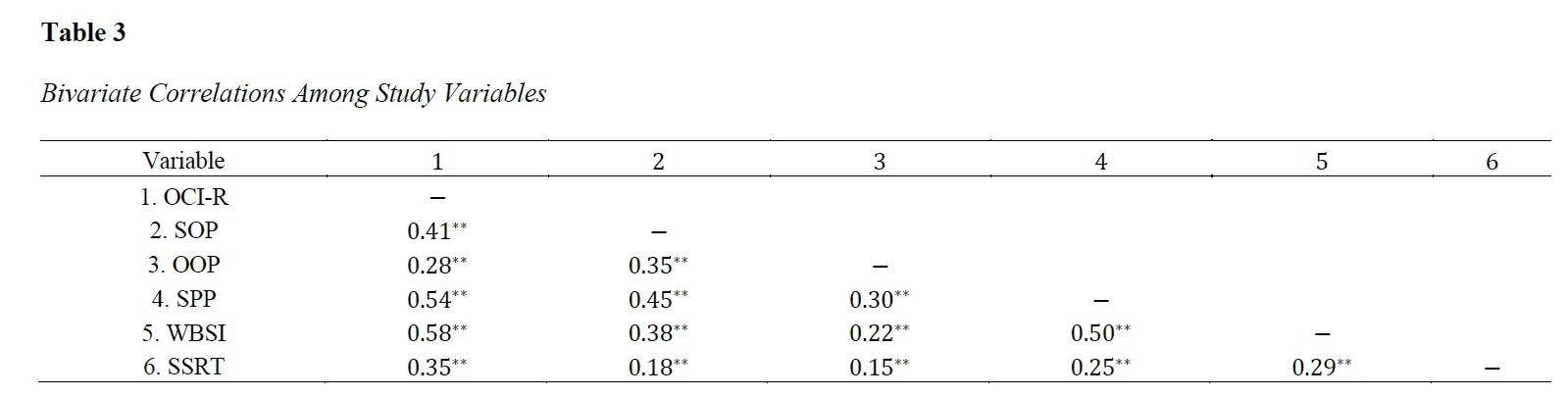
Methods and Materials: This study utilized a cross-sectional, correlational design with a community sample of 435 adults from Canada (mean age = 28.4years; 64%female). Participants completed a battery of measures including the Obsessive-Compulsive Inventory-Revised (OCI-R) to assess symptom severity, and the Hewitt and Flett Multidimensional Perfectionism Scale to evaluate self-oriented, other-oriented, and socially prescribed perfectionism. Cognitive inhibition was assessed using both subjective and objective measures: the White Bear Suppression Inventory (WBSI) for thought suppression, and a computerized Stop-Signal Task (SST) yielding a Stop-Signal Reaction Time (SSRT) for behavioral response inhibition. Data were analyzed using a three-step hierarchical multiple regression.
Findings: The final hierarchical regression model accounted for 48.5%of the total variance in obsessive-compulsive symptom severity. Demographic variables (Step 1) explained 4.2%of the variance. The addition of cognitive inhibition measures (Step 2) significantly explained an additional 35.8%of the variance (ΔR^2=0.358). Finally, perfectionism dimensions (Step 3) contributed an incremental 8.5%(ΔR^2=0.085). In the final comprehensive model, significant positive predictors of obsessive-compulsive severity included subjective thought suppression (β=0.32, p<0.001), socially prescribed perfectionism (β=0.24, p<0.001), objective SSRT (β=0.15, p<0.01), and self-oriented perfectionism (β=0.14, p<0.01). Age was a significant negative predictor (β=-0.09, p<0.05), while gender and other-oriented perfectionism were not significant in the final model.
Conclusion: Obsessive-compulsive symptom severity is robustly predicted by a pathological synergy between extreme perfectionistic standards and fundamental neurocognitive deficits in behavioral and cognitive inhibitory control.
Downloads
References
Ahmadi Golsfidi, E., Asadi, J., Khajvand Khooshli, A., & Abdollahzadeh, H. (2021). Modeling body image concern based on obsessive-compulsive disorder, perfectionism, and eating attitudes with the mediation of basic psychological needs in girls. Rooyesh-e Ravanshenasi Journal, 10(8). https://frooyesh.ir/browse.php?a_id=2889&slc_lang=en&sid=1&printcase=1&hbnr=1&hmb=1
Alilou, M. M., Hashemi, T., & Sadr, F. E. (2022). Structural Relationships Between Levels of Perfectionism and Obsessive-Compulsive Disorder Symptoms: The Mediating Role of Cognitive Styles. International journal of health sciences, 48597-48612. https://doi.org/10.53730/ijhs.v6ns7.13644
Besharat, M. A., Hosseini, S. A., & Jahed, H. (2019). Obsessive-compulsive personality disorder and perfectionism: A brief review. Thoughts and Behavior in Clinical Psychology, 14(51), 77-88. https://jtbcp.roudehen.iau.ir/m/article_1486.html?lang=en
Callaghan, T., Greene, D., Shafran, R., Lunn, J., & Egan, S. J. (2024). The relationships between perfectionism and symptoms of depression, anxiety and obsessive-compulsive disorder in adults: a systematic review and meta-analysis. Cognitive behaviour therapy, 53(2), 121-132. https://doi.org/10.1080/16506073.2023.2277121
Chen, I. J., Hu, M., Zhang, H., & Guo, Z. (2018). The Effect of Parenting Behavior on the Obsessive-Compulsive Symptom of College Students: The Mediating Role of Perfectionism. Creative Education, 09(05), 758-778. https://doi.org/10.4236/ce.2018.95057
Fekih-Romdhane, F., Pardini, S., Hallit, S., Novara, C., & Brytek-Matera, A. (2024). A multi-country examination of the relationship between perfectionism and disordered eating: the indirect effect of obsessive beliefs and obsessive-compulsive symptoms. Journal of eating disorders, 12(1), 69. https://doi.org/10.1186/s40337-024-01030-y
Fineberg, N. A., Day, G. A., de Koenigswarter, N., Reghunandanan, S., Kolli, S., Jefferies-Sewell, K., Hranov, G., & Laws, K. R. (2015). The neuropsychology of obsessive-compulsive personality disorder: a new analysis. CNS Spectrums, 20(5), 490-499. https://doi.org/10.1017/S1092852914000662
Golshani, F. (2020). Comparison of Perfectionism, Parenting styles and Quality of Life in Women with Obsessive-Compulsive Disorder and Healthy Women. Contemporary Psychology, Biannual Journal of the Iranian Psychological Association, 15(1), 29-39. https://bjcp.ir/browse.php?a_id=1493&sid=1&slc_lang=en&ftxt=0
Greville-Harris, M., Vuillier, L., Goodall, S., Talbot, C. V., Walker, C., & Appleton, K. M. (2024). Striving for the perfect diet? The mediating role of perfectionism in the relationship between obsessive compulsive symptoms and traits of Orthorexia Nervosa. Journal of eating disorders, 12(1), 91. https://doi.org/10.1186/s40337-024-01032-w
Hallit, S., Obeid, S., & Hallit, R. (2024). A multi-country examination of the relationship between perfectionism and disordered eating: The indirect effect of obsessive beliefs and obsessive-compulsive symptoms. Journal of eating disorders, 12(1), 69. https://doi.org/10.1186/s40337-024-01030-y
Hu, P., Liang, P., Liu, X., Ouyang, Y., & Wang, J. (2023). Parenting styles and obsessive-compulsive symptoms in college students: the mediating role of perfectionism. Frontiers in Psychiatry, 14, 1126689. https://doi.org/10.3389/fpsyt.2023.1126689
Kim, H., Seo, J., Namkoong, K., Hwang, E. H., Sohn, S. Y., Kim, S. J., & Kang, J. I. (2016). Alexithymia and perfectionism traits are associated with suicidal risk in patients with obsessive-compulsive disorder. Journal of affective disorders, 192, 50-55. https://doi.org/10.1016/j.jad.2015.12.018
Liang, Y., Xu, L., Huang, Y., Zhu, W., Yu, J., Ma, L., & Jiang, X. (2025). The relationship between obsessive-compulsive symptoms and parenting styles: The mediating effect of perfectionism. https://doi.org/10.22541/au.173935763.37800795/v1
Lunn, J., Greene, D., Callaghan, T., & Egan, S. J. (2023). Associations between perfectionism and symptoms of anxiety, obsessive-compulsive disorder and depression in young people: a meta-analysis. Cognitive behaviour therapy, 52(5), 460-487. https://doi.org/10.1080/16506073.2023.2211736
Malcolm, A., Labuschagne, I., Castle, D., Terrett, G., Rendell, P. G., & Rossell, S. L. (2018). The relationship between body dysmorphic disorder and obsessive-compulsive disorder: A systematic review of direct comparative studies. Australian & New Zealand Journal of Psychiatry, 52(11), 1030-1049. https://doi.org/10.1177/0004867418799925
Moien, M., & Farahani Far, M. (2024). The effectiveness of schema therapy with an emphasis on schema mindsets on rumination and perfectionism in individuals with treatment-resistant obsessive-compulsive disorder. Psychology Growth, 13(4), 144-135. https://frooyesh.ir
Rahimi, M., & Zamaniha, S. (2019). Student Obsessive-Compulsive Exercise Based on Parental Perfectionism and Impulsiveness. Social Science Quarterly, 12(43), 295-308. https://sanad.iau.ir/en/Article/1035185?FullText=FullText
Rajabi, S. (2018). Anxiety Sensitivity, Perfectionism, Loneliness and Self-esteem of elderly with Obsessive-Compulsive Disorder and Major Depression. Aging Psychology, 4(2), 119-129. https://jap.razi.ac.ir/article_959.html
Redden, S. A., Mueller, N. E., & Cougle, J. R. (2023). The impact of obsessive-compulsive personality disorder in perfectionism. International Journal of Psychiatry in Clinical Practice, 27(1), 18-24. https://doi.org/https://doi.org/10.1080/13651501.2022.2069581
Reuther, E. T., Davis Iii, T. E., Rudy, B. M., Jenkins, W. S., Whiting, S. E., & May, A. C. (2013). Intolerance of uncertainty as a mediator of the relationship between perfectionism and obsessive‐compulsive symptom severity. Depression and Anxiety, 30(8), 773-777. https://doi.org/10.1002/da.22100
Sher, A., Wootton, B. M., & Paparo, J. (2024). A preliminary investigation of the mediating roles of self‐compassion and emotion dysregulation in the relationship between maladaptive perfectionism and obsessive‐compulsive behaviors. Journal of Clinical Psychology, 80(3), 591-609. https://doi.org/10.1002/jclp.23640
Vakili Heris, S., Livarjani, S., & Moheb, N. (2020). Presenting a Pathological Model of Obsessive-Compulsive Disorder Based on Maladaptive Perfectionism and Sensitivity to Threat in Nonclinical Population: Mediating Role of Intolerance of Uncertainty. Journal of Applied Psychological Research, 10(4), 161-182. https://japr.ut.ac.ir/article_74272_en.html?lang=fa
Wake, S., Verde, A. D., Biagi, N., van Reekum, C. M., & Morriss, J. (2022). Just let me check: The role of individual differences in self-reported anxiety and obsessive-compulsive features on subjective, behavioural, and physiological indices during a checking task. International Journal of Psychophysiology, 179, 43-55. https://www.sciencedirect.com/science/article/pii/S0167876022001568
Wong, F. S., Lim, V., Black, M. I., & Grisham, J. R. (2021). The impact of modifying obsessive-compulsive beliefs about perfectionism. Journal of Behavior Therapy and Experimental Psychiatry, 73, 101675. https://doi.org/10.1016/j.jbtep.2021.101675
Downloads
Additional Files
Publication Timeline
- Submitted
- Revised
- Accepted