Modeling Generalized Anxiety Disorder from Intolerance of Uncertainty and Attentional Control Using AI‑Driven Feature Selection
DOI:
https://doi.org/10.61838/kman.jarac.5210Keywords:
Generalized Anxiety Disorder, Intolerance of Uncertainty, Attentional Control, Machine LearningAbstract
Objective: The primary objective of this study was to identify the most robust, item-level cognitive predictors of generalized anxiety disorder severity utilizing an artificial intelligence-driven hybrid feature selection pipeline applied to the constructs of intolerance of uncertainty and attentional control.
Methods and Materials: A cross-sectional predictive study design was utilized with a sample of 486 Canadian adults. Participants completed standardized self-report measures, including the 7-item Generalized Anxiety Disorder Assessment (GAD-7), the 12-item Intolerance of Uncertainty Scale (IUS-12), and the 20-item Attentional Control Scale (ACS). Data preprocessing involved k-nearest neighbors imputation for missing values and standardization of continuous variables (z=(x-μ)/σ). A hybrid machine learning approach combining Least Absolute Shrinkage and Selection Operator (LASSO) regression and Extreme Gradient Boosting Recursive Feature Elimination (XGBoost-RFE) was employed to extract key item-level predictors. The dataset was split into an 80%training set and a 20%testing set, with model hyperparameter tuning validated via 10-fold cross-validation.
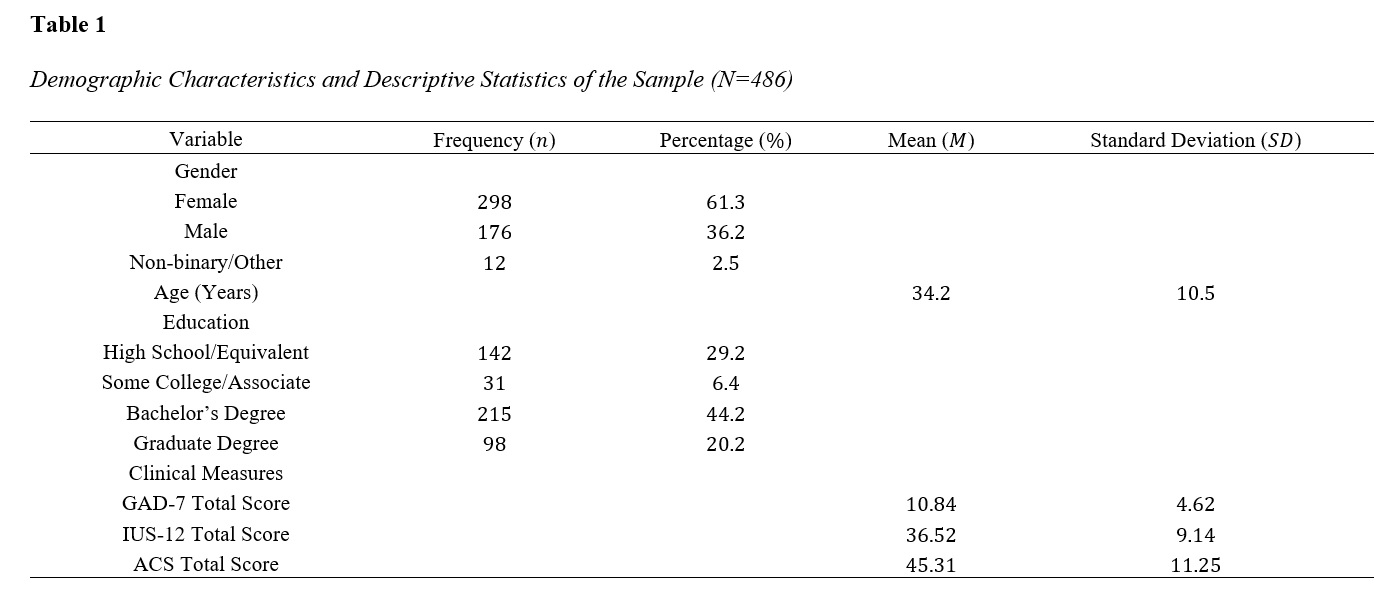
Findings: The sample (N=486; 61.3%female; age M=34.2, SD=10.5) exhibited significant baseline correlations between GAD-7 and both IUS-12 (r=.64,p<.001) and ACS (r=-.52,p<.001). From an initial pool of 32cognitive items, the hybrid AI pipeline (using an optimal LASSO penalty of α=0.034) identified a critical subset of just 7key features (4 capturing distress/paralysis from uncertainty and 3capturing difficulties in attentional shifting/focusing). The optimized XGBoost model utilizing these 7selected features achieved superior predictive performance on the test set (R^2=0.73, RMSE=2.40) compared to the baseline model utilizing all 32features (R^2=0.61, RMSE=2.88).
Conclusion: Granular, item-level cognitive vulnerabilities—specifically uncertainty-induced paralysis and severe deficits in attentional shifting—are the primary drivers of anxiety severity, demonstrating the transformative potential of AI in precise psychiatric modeling.
Downloads
References
Bhuptani, P. H., & Messman, T. L. (2021). Self-compassion and shame among rape survivors. Journal of interpersonal violence, 37(17-18), NP16575-NP16595. https://doi.org/10.1177/08862605211021994
Büyüköksüz, E., & Kayaalp-pehlivan, R. (2025). Psychological Inflexibility, Mindfulness, Emotion Regulation, Self-Compassion, and Anxiety in Adults: A Serial Mediation Model. Muğla Sıtkı Koçman Üniversitesi Eğitim Fakültesi Dergisi, 12(1), 107-134. https://doi.org/10.21666/muefd.1643883
Cutajar, K., & Bates, G. (2025). Australian Women in the Perinatal Period During COVID-19: The Influence of Self-Compassion and Emotional Regulation on Anxiety, Depression, and Social Anxiety. Healthcare, 13(2), 120. https://doi.org/10.3390/healthcare13020120
Jeon, S., & Park, K.-H. (2023). The Relationship Between Internalized Shame and Self-Concealment: The Mediating Effects of Fear of Negative/Positive Evaluation and Self-Compassion. Korean Association for Learner-Centered Curriculum and Instruction, 23(23), 507-520. https://doi.org/10.22251/jlcci.2023.23.23.507
Kang, M., & Jo, H. (2024). The Influence of Social Comparison Tendency on SNS Addiction Tendency: The Mediating Effect of Internalized Shame Moderated by Self-Compassion. Korean Association for Learner-Centered Curriculum and Instruction, 24(22), 1-16. https://doi.org/10.22251/jlcci.2024.24.22.1
Kotera, Y., Tsuda‐McCaie, F., Edwards, A. M., Bhandari, D., Williams, D., & Neary, S. (2022). Mental Health Shame, Caregiver Identity, and Self-Compassion in UK Education Students. Healthcare, 10(3), 584. https://doi.org/10.3390/healthcare10030584
Liu, C., Lin, P. T., & Xiong, Z. (2024). Self-Compassion and Psychological Flourishing Among College Students: The Mediating Role of Hope and the Moderating Role of Emotion Regulation. Behavioral Sciences, 14(12), 1149. https://doi.org/10.3390/bs14121149
Mills, J. S., Minister, C., & Samson, L. (2022). Enriching sociocultural perspectives on the effects of idealized body norms: Integrating shame, positive body image, and self-compassion. Frontiers in psychology, 13, 983534. https://doi.org/10.3389/fpsyg.2022.983534
Moradmand, M., Ashayeri, H., & Namvar, H. (2023). Prediction of Adolescent Shame Based on Self-Compassion and Emotional Regulation According to the Mediating Role of Problem Solving. Aftj, 4(5), 57-83. https://doi.org/10.61838/kman.aftj.4.5.4
Nguyen, A., Grummitt, L., Barrett, E. L., Bailey, S., Gardner, L. A., Champion, K. E., & Birrell, L. (2025). The relationship between emotion regulation and mental health in adolescents: Self-compassion as a moderator. Mental Health & Prevention, 38. https://doi.org/10.1016/j.mhp.2025.200430
Ohadi Haeri, H., Tavakoli Toroghi, E., & Ebrahimi, S. (2024). Predicting Loneliness Based on Attachment Style and Emotional Dysregulation with the Mediation of Self-Compassion. Psychological studies, 20(4), 105-120. https://doi.org/10.22051/psy.2025.48275.3023
Omidi, A., Ahmadi, V., & valizadeh, r. (2024). Comparison of the effectiveness of emotion regulation training with cognitive therapy based on mindfulness on perceived stress and self-compassion in patients with irritable bowel syndrome. medical journal of mashhad university of medical sciences, 66(6). https://mjms.mums.ac.ir/article_23901.html
Osareh, N., Pirani, Z., & ZanganehMolagh, F. (2024). Evaluating the effectiveness of cognitive self-compassion and emotion regulation training on motivational self-regulation and social and adaptive functioning of female students with anxiety. school psychology and institution, 13(1), 63-76. https://journal.uma.ac.ir/article_2907.html?lang=en
Park, S., & Lee, H.-K. (2024). The Relationship Between Internalized Shame and Relationship Addiction in University (Graduate) Students: Self-Compassion and Distress Tolerance as Sequential Mediators. Korean Assoc Learner-Centered Curric Instr, 24(24), 175-189. https://doi.org/10.22251/jlcci.2024.24.24.175
Rasouli, M., Khazaie, H., & Yarahmadi, Y. (2024). Predicting Sexual Distress Based on Self-Compassion in Women With a History of Mastectomy: Investigation of the Mediating Role of Body Image and Difficulties in Emotion Regulation. Middle East Journal of Rehabilitation and Health Studies, 11(4). https://doi.org/10.5812/mejrh-144890
Rehman, S., Addas, A., Rehman, E., & Khan, M. A. (2024). The Mediating Roles of Self-Compassion and Emotion Regulation in the Relationship Between Psychological Resilience and Mental Health Among College Teachers. Psychology research and behavior management, Volume 17, 4119-4133. https://doi.org/10.2147/prbm.s491822
Rezagholiyan, M., Nemati, F., & Hashemi, T. (2025). Development of a Model of Students' Subjective Well-Being Based on Attachment Styles, Self-Compassion, and Emotion Regulation Styles with the Mediating Role of Quality of Life. Journal of Adolescent and Youth Psychological Studies (JAYPS), 6(1), 21-33. https://doi.org/10.61838/
Sadeghi, A., Jahangiri, M., & Taghvaei, D. (2024). The effectiveness of self-compassion-focused therapy on depression, caregiver burden, and emotional dysregulation in caregivers of elderly patients with Alzheimer's disease. Journal of Research in Psychological Health, 18(2), 1-20. https://system.khu.ac.ir/rph/article-1-4524-fa.pdf
Seekis, V., & Kennedy, R. (2023). The impact of beauty and self-compassion TikTok videos on young women's appearance shame and anxiety, self-compassion, mood, and comparison processes. Body Image, 45, 117-125. https://doi.org/10.1016/j.bodyim.2023.02.006
Sim, H. R., & Choi, H. N. (2023). The Moderated Mediating Effect of Self-Compassion on the Relationship Between Internalized Shame, Rumination, and Interpersonal Satisfaction. Korean Association for Learner-Centered Curriculum and Instruction, 23(11), 479-495. https://doi.org/10.22251/jlcci.2023.23.11.479
Siwik, C. J., Phillips, K., Zimmaro, L., Salmon, P., & Sephton, S. E. (2022). Depressive symptoms among patients with lung cancer: elucidating the roles of shame, guilt, and self-compassion. J. Health Psychol., 27(5), 1039-1047. https://doi.org/10.1177/1359105320988331
Skelton, W. M., Cardaciotto, L., O'Hayer, C. V., & Goldbacher, E. (2021). The role of self-compassion and shame in persons living with HIV/AIDS. AIDS care, 33(6), 818-826. https://doi.org/10.1080/09540121.2020.1769836
Syafitri, N., Lubis, R., Indrawan, Y. F., & Choong, T. C. (2024). Self-Compassion: Unveiling Mental Health Through Emotion Regulation in High-School Students. Tazkiya Journal of Psychology, 12(1), 1-16. https://doi.org/10.15408/tazkiya.v12i1.37794
Vidal, J., Ciudad-Fernández, V., Navarrete, J., Soler, J., Schmidt, C., Molinari, G., & Cebolla, A. (2024). From Self-Criticism to Self-Compassion: Exploring the Mediating Role of Two Emotion Dysregulation Variables in Their Relationship to Depressive Symptoms. Current Psychology. https://doi.org/10.1007/s12144-024-06325-6
Wild, M. G., Coppin, J. D., Mendoza, C., Metts, A., Pearson, R., & Creech, S. K. (2025). Self-compassion, mindfulness, and emotion regulation predict multiple dimensions of quality of life in US post-9/11 veterans. Quality of Life Research, 1-10. https://doi.org/10.1007/s11136-025-03908-
Xu, X., Li, Y., Liu, S., & Wang, W. (2024). Longitudinal Relationships Between Bullying Victimization and Dual Social Behaviors: The Roles of Self-Compassion and Trauma-Related Shame. Psychology research and behavior management, Volume 17, 1463-1475. https://doi.org/10.2147/prbm.s450013
Yaghoubi, S., Birashk, B., Aghebati, A., & Ashouri, A. (2021). Mediating role of external shame and self-compassion in the relationship between peer victimization and depression in adolescents. Iranian Journal of Psychiatry and Clinical Psychology, 27(1), 16-31. https://doi.org/10.32598/ijpcp.27.1.3288.1
Downloads
Additional Files
Publication Timeline
- Submitted
- Revised
- Accepted