Predicting Digital Burnout Using Machine Learning: The Role of Cognitive Flexibility, Emotional Regulation, Social Comparison, and Online Disinhibition
DOI:
https://doi.org/10.61838/kman.jarac.5243Keywords:
digital burnout, machine learning, cognitive flexibility, emotional regulation, social comparison, online disinhibitionAbstract
Objective: The present study aimed to predict digital burnout using machine learning techniques by examining the roles of cognitive flexibility, emotional regulation, social comparison, and online disinhibition.
Methods and Materials: This study employed a cross-sectional predictive design with a sample of 512 adult participants from the United States who were active daily users of digital technologies. Data were collected through standardized self-report instruments measuring digital burnout, cognitive flexibility, emotional regulation (reappraisal and suppression), social comparison, and online disinhibition. Data preprocessing included normalization, multiple imputation for missing values, and encoding of variables. Machine learning models, including Random Forest, Gradient Boosting, and Support Vector Machine, were implemented to predict digital burnout. Model performance was evaluated using 10-fold cross-validation with metrics such as root mean square error (RMSE), mean absolute error (MAE), and coefficient of determination (R²). Feature importance was assessed using SHAP (Shapley Additive Explanations) values to determine the relative contribution of predictors.
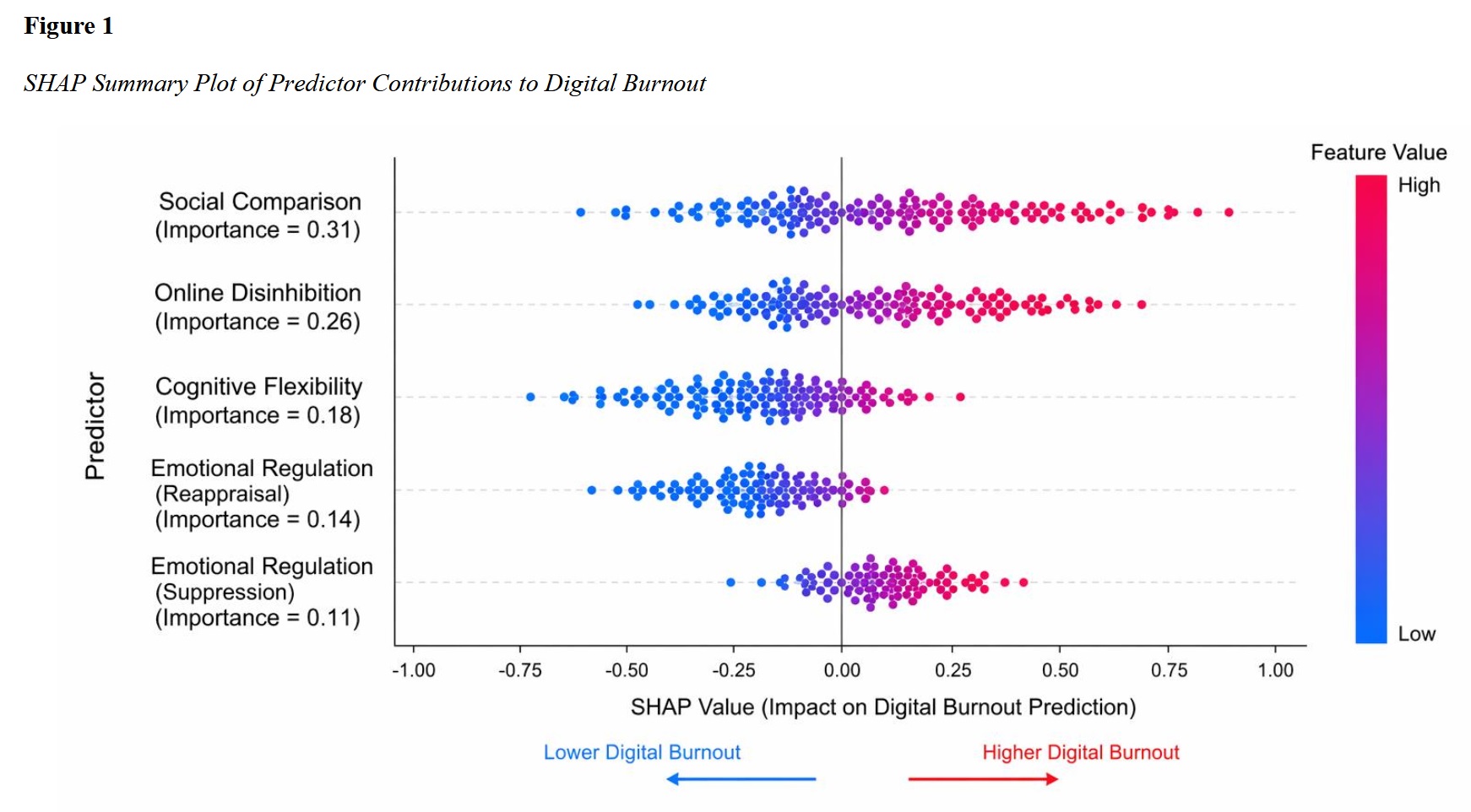
Findings (inferentials only): The Gradient Boosting model demonstrated the highest predictive performance (R² = 0.68, RMSE = 0.38), outperforming Random Forest (R² = 0.62) and Support Vector Machine (R² = 0.55). Social comparison emerged as the strongest positive predictor of digital burnout (importance = 0.31), followed by online disinhibition (0.26). Cognitive flexibility (β = negative contribution; importance = 0.18) and emotional regulation via reappraisal (importance = 0.14) were significant protective factors, whereas emotional suppression showed a smaller positive effect (0.11). All predictors were statistically significant (p < .01), and the model demonstrated high stability across cross-validation folds (R² range = 0.66–0.71).
Conclusion: Digital burnout is a multifactorial phenomenon best predicted through integrative machine learning models, with social comparison and online disinhibition as primary risk factors and cognitive flexibility and adaptive emotional regulation as key protective mechanisms.
Downloads
References
Al-Jarf, R. (2024). A Model for Alleviating Work Pressures and Enhancing Teachers’ Resilience. Journal of Psychology and Behavior Studies, 4(1), 94-103. https://doi.org/10.32996/jpbs.2024.1.11
Cebollero-Salinas, A., Escoriaza, J. C. d., & Hernández, S. O. (2022). Social Networks, Emotions, and Education: Design and Validation of E-Com, a Scale of Socio-Emotional Interaction Competencies Among Adolescents. Sustainability, 14(5), 2566. https://doi.org/10.3390/su14052566
Chen, Y. W., Pan, L., Lu, F., Sun, D., Liao, C., & Na, M. (2025). Psychological Detachment in Chinese Higher Education: A Multitheoretical Model of Academic Stress, Cultural Pressure, and Coping Resources. Frontiers in psychology, 16. https://doi.org/10.3389/fpsyg.2025.1647184
Connell, J. B. (2025). Unethical and Harmful Effects of Artificial Intelligence on Human Interactions and Well-Being: What Organizational Consultants Can Do. Consulting Psychology Journal Practice and Research, 77(2), 118-130. https://doi.org/10.1037/cpb0000284
Feher, A., Fejes, É., Fehér, G., Horváth, L., & Tibold, A. (2025). Association of Problematic Usage of the Internet With Burnout, Depression, Insomnia and Quality of Life Among Hungarian Recreational Esports Players: A Cross Sectional Study. Frontiers in Public Health, 13. https://doi.org/10.3389/fpubh.2025.1619810
Goldin, D., Alvarez, L., & Harscher, H. v. (2025). Cognitive Flexibility: What Mental Health Professionals Need to Know. Journal of Psychosocial Nursing and Mental Health Services, 63(4), 20-27. https://doi.org/10.3928/02793695-20241205-03
Heidari, Z., Kianimoghadam, A. S., Arani, A. M., & Bakhtiari, M. (2025). Investigating the Relationship Between Loneliness, Physical Activity, and Internet Addiction: The Mediating Role of Academic Burnout and Self-Control. Iranian Journal of Psychiatry. https://doi.org/10.18502/ijps.v20i3.19040
Lee, M. (2024). Introjected Regulation and Academic Burnout: A Moderated Mediation Model of Social Comparison and Distress Overtolerance. Stress and Health, 40(4). https://doi.org/10.1002/smi.3381
Long, R., Kennedy, M., Spink, K. M., & Lengua, L. J. (2023). Promoting College Student and Staff Well-Being Through a Mindfulness-Based Coping Program. Obm Integrative and Complementary Medicine, 08(03), 1-41. https://doi.org/10.21926/obm.icm.2303034
Lu, J. L., Zhu, S., Wang, R., & Liu, T. (2025). Exploring the Influencing Factors of Learning Burnout: A Network Comparison in Online and Offline Environments. Behavioral Sciences, 15(7), 903. https://doi.org/10.3390/bs15070903
Ma, X., Liu, Q., & Zhang, W. (2025). The Impact of Multidimensional Excessive Social Media Use on Academic Performance: The Moderating Role of Mindfulness. Frontiers in psychology, 16. https://doi.org/10.3389/fpsyg.2025.1579509
Nguyễn, H. M. T., Ɖỗ, T. H. T., & Nguyễn, N. Q. (2022). Professional Sports Trainers' Burnout in Fully Online and Blended Classes: Innovative Approaches in Physical Education and Sports Training. Frontiers in Education, 7. https://doi.org/10.3389/feduc.2022.918599
Reeves, A., Pattinson, M., & Butavicius, M. (2024). The Sleepless Sentinel: Factors That Predict Burnout and Sleep Quality in Cybersecurity Professionals. Information and Computer Security, 32(4), 477-491. https://doi.org/10.1108/ics-11-2023-0222
Rehman, T. U. (2024). Workplace Cyberbullying: Nature, Characteristics, and Implications. Evaluation Review, 49(4), 625-654. https://doi.org/10.1177/0193841x241304293
Salazar, L. R., García, N., Huntington, H., & Brooks, M. E. (2022). The Mediating Effects of Social Comparison on Faculty Burnout, Teaching Anxiety, and Satisfaction Among Faculty Who Taught During the COVID-19 Pandemic. Trends in Psychology. https://doi.org/10.1007/s43076-022-00246-8
Shoker, D., Desmet, L., Ledoux, N., & Héron, A. (2024). Effects of Standardized Mindfulness Programs on Burnout: A Systematic Review and Original Analysis From Randomized Controlled Trials. Frontiers in Public Health, 12. https://doi.org/10.3389/fpubh.2024.1381373
Song, W., Wang, Z., & Zhang, R. (2022). Classroom Digital Teaching and College Students’ Academic Burnout in the Post COVID-19 Era: A Cross-Sectional Study. International journal of environmental research and public health, 19(20), 13403. https://doi.org/10.3390/ijerph192013403
Tan, C. S. (2023). All by Myself: Examining Social Media’s Effect on Social Withdrawal and the Mediating Roles of Moral Disengagement and Cyberaggression. European Journal of Marketing, 58(2), 659-684. https://doi.org/10.1108/ejm-12-2022-0932
Ünlü, S., Uzun, K., & Arslan, G. (2025). Mindfulness-Based Intervention in Schools: Addressing Social Media Burnout and Enhancing Well-Being in Adolescents. Children, 12(7), 826. https://doi.org/10.3390/children12070826
Wang, K., Li, Y., Yang, Y., Zhang, T., & Luo, J. (2023). The Role of Loneliness and Learning Burnout in the Regulation of Physical Exercise on Internet Addiction in Chinese College Students. BMC public health, 23(1). https://doi.org/10.1186/s12889-023-16783-5
Wędzińska, M. (2024). Shaping Resilience Against Cyberbullying Through Social Skills Training. Studia Paedagogica Ignatiana, 27(1), 19-42. https://doi.org/10.12775/spi.2024.1.001
Wu, C. (2025). Beyond Laziness: A Motivation-Behavior-Emotion Typology of Cyberslacking in Contemporary Chinese Workplaces. Sage Open, 15(4). https://doi.org/10.1177/21582440251390679
Zarowsky, Z., & Rashid, T. (2022). Resilience and Wellbeing Strategies for Pandemic Fatigue in Times of Covid-19. International Journal of Applied Positive Psychology. https://doi.org/10.1007/s41042-022-00078-y
Downloads
Additional Files
Publication Timeline
- Submitted
- Revised
- Accepted