Designing a Mathematics Concepts Educational Package for Students with Mathematics Learning Disability in Sari City
DOI:
https://doi.org/10.61838/kman.jarac.5249Keywords:
Mathematics Learning Disability, Educational Package, Thematic AnalysisAbstract
Objective: The primary objective of this study was to design, develop, and validate an evidence-based educational package for teaching foundational mathematics concepts to elementary students with mathematics learning disabilities in Sari city.
Methods and Materials: This study employed a qualitative research design utilizing thematic analysis. The participant pool consisted of mathematics and special education specialists, selected through purposive sampling. Interviews continued until theoretical saturation was achieved after 12 participants, though 15 experts were ultimately interviewed to ensure absolute confidence. Data were collected using pre-designed, semi-structured audio-recorded interviews. The transcribed texts were analyzed utilizing MAXQDA software through a multi-stage coding process to identify overarching, organizing, and basic themes. To assess the validity and credibility of the designed package, quantitative metrics including the Content Validity Ratio (CVR) and the Content Validity Index (CVI) were calculated based on the expert panel’s ratings.
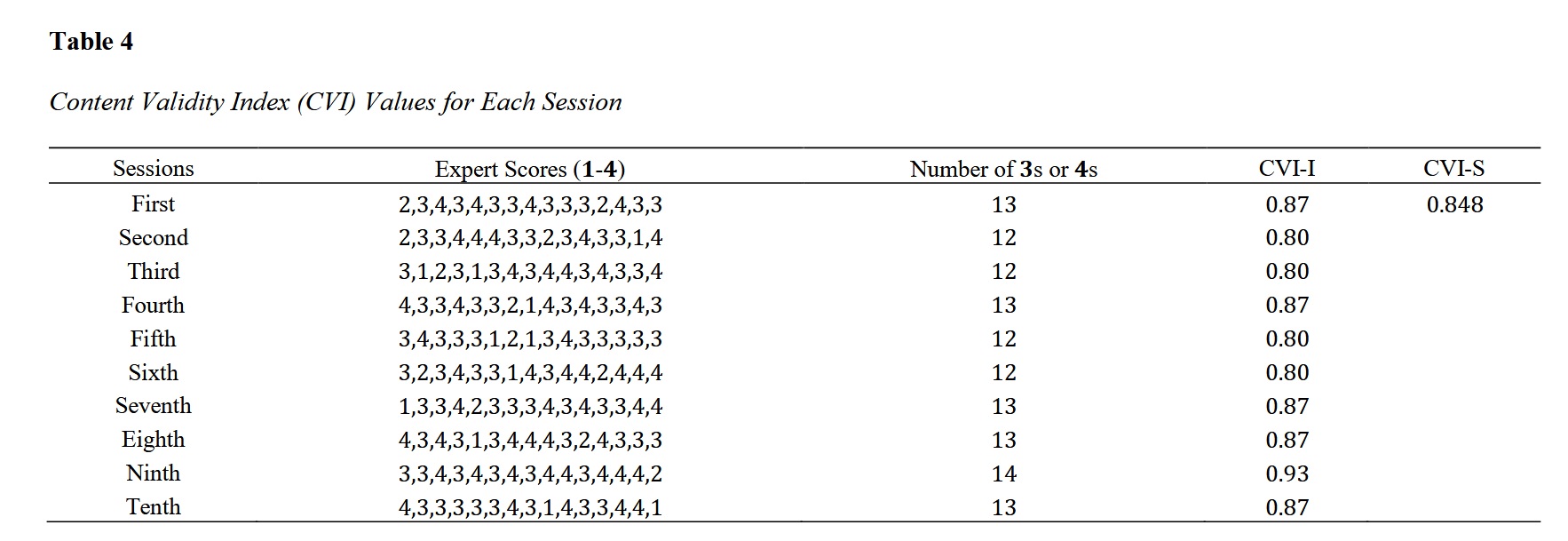
Findings: The thematic analysis yielded a structured, 10-session educational package emphasizing concrete-to-abstract number teaching, practical multisensory activities, and the reduction of math-related anxiety. Key overarching themes extracted included number conceptual understanding, counting skills, comparative numerical relationships, four operations, and motivation/self-efficacy. The quantitative validation confirmed the package’s high content validity. Depending on the session, CVR values were calculated at 0.60 (12 experts), 0.73 (13 experts), and 0.87 (14 experts). Furthermore, the item-level CVI (CVI-I) scores across the 10 sessions ranged from 0.80 to a peak of 0.93 (in the ninth session), with the scale-level CVI (CVI-S) for the first session established at 0.848.
Conclusion: The meticulously designed 10-session educational package is a highly valid, systematic framework. By combining concrete multisensory activities with targeted strategies to reduce emotional pressure, it provides educators with an effective, evidence-based tool to improve the mathematical self-efficacy and conceptual foundations of students with learning disabilities.
Downloads
References
Asad, Z., & Javed, F. (2023). EXPLORING THE EFFECTIVENESS OF IN-SERVICE TRAINING PROGRAMS FOR ENHANCING TEACHING SKILLS OF ESL TEACHERS AT HIGHER EDUCATION LEVEL: TEACHERS' PERCEPTIONS AND EXPERIENCES. Journal of Arts & Social Sciences, 10(1), 198-207.
Bernstein, Z. (2023). Assessment, Outcomes, and Innovation in Higher Education. In The Impacts of Innovative Institutions in Higher Education (pp. 263-276). Springer Nature Switzerland.
Coburn, J., & Borg, S. (2024). The impact of an in-service course on primary school English teachers: Case studies of change. European Journal of Teacher Education, 47(3), 615-631.
Espinas, D. R., & Fuchs, L. S. (2025). Interventions for comorbid learning disabilities. Child Development Perspectives, 19(3), 156-164.
Etela, P., Saadabadi Motlagh, H., & Yazdani, S. (2023). Investigating modifications in teachers' educational beliefs: A comparison of pre-service and novice teachers. Applied Linguistics and Applied Literature: Dynamics and Advances, 11(1), 55-75.
Far, F. T., Ghanadzadegan, H., & Heydari, S. (2024). Comparison of the Effectiveness of Training in Cognitive Emotion Regulation Strategies and Self-Regulated Learning Strategies on the Social Adaptation of Elementary Students with Specific Learning Disorder in Reading. Iranian Journal of Neurodevelopmental Disorders, 3(2), 66-74.
Folad, A., & Aladsosi, J. (2023). Pre-service teachers' self-efficacy in using open-source software for learning in Lagos State. Iranian Journal of Distance Education, 5(1), 108-155.
Ghanbarian Ghalandar, P., Salehi, M., & Aminifar, Z. (2024). Analyzing teachers' lived experiences of the one-year Article 28 skill training courses: Challenges of linking theory and practice. Theory and Practice in Teacher Education, 10(17), 17-34.
Hornby, G. (2024). Provost, Kent State University, USA Useful for teachers, parents, educators, and psychologists who want to achieve an effective answer to the special needs of children.—Santo F. Di Nuovo, Professor of Psychology, University of Catania, Italy, and President of the Italian Association of Psychology.
Hryhorash, O., Bocharov, D., Korneyev, M., Rudyanova, T., & Hryhorash, T. (2023). The quality of higher education and its funding in countries with different levels of socio-economic development.
Irmayanti, M., Chou, L. F., & Anuar, N. N. b. Z. (2025). Storytelling and math anxiety: a review of storytelling methods in mathematics learning in Asian countries. European Journal of Psychology of Education, 40(1), 24. https://doi.org/10.1007/s10212-024-00927-1
Junger, A. P. (2025). Digital Technologies in Mathematics Education: Discussions and Challenges in Light of New Educational Trends. Revista De Gestão Social E Ambiental, 19(3), e011553. https://doi.org/10.24857/rgsa.v19n3-019
Khasawneh, Y. J. A. (2023). An investigation of pre-service teacher preparation programs in teacher education and Co-teaching models. Information Sciences Letters, 12(7), 2849-2857.
Kuhn, C., Hagenauer, G., Gröschner, A., & Bach, A. (2024). Mentor teachers’ motivations and implications for mentoring style and enthusiasm. Teaching and Teacher Education, 139, 104441.
Liu, T., & Wang, Q. (2024). Are Teachers’ Time Resources Scarce? The Association between Teachers’ Time Poverty and Job Burnout: The Mediating Effect of Mental Health Factors.
Marange, I. Y., & Tatira, B. (2025). In-Service Mathematics Teachers’ Perceptions of GeoGebra Integrative Training Materials: The Case of Geometry Teaching. Eurasia Journal of Mathematics Science and Technology Education, 21(2), em2588. https://doi.org/10.29333/ejmste/15958
Maroufi, Y., Mohammadpour, E., & Heydari, S. (2023). Comparison of professional competencies of continuous bachelor's degree graduates and Article 28 skill learners of Farhangian University: A study based on TPACK model. Educational Measurement and Evaluation Studies, 13(44), 7-26.
Msamba, E. M., Msuya, E. A., & Anangisye, W. A. (2023). The Impact of In‐Service Education and Training on Teachers’ Learning: Perspectives from English Foreign Language Teachers in Tanzania. Education Research International, 2023(1), 6135444.
Munaji, M., Rohaeti, T., Mutadi, M., Sumliyah, S., & Kodirun, K. (2025). A literature review of flexibility in interactive mathematics classrooms: The role of teachers and students. Journal of Education and Learning (Edulearn), 19(2), 597-605. https://doi.org/10.11591/edulearn.v19i2.21501
Ng, C. T., Chen, Y. H., Wu, C. J., & Chang, T. T. (2022). Evaluation of math anxiety and its remediation through a digital training program in mathematics for first and second graders. Brain and Behavior, 12(5), e2557.
Nhlumayo, B. S. (2025). The Integration of ICT Pedagogy: A Panacea to Mathematics Teacher Training in South African Universities. Obp. https://doi.org/10.38140/obp3-2025-07
Nissim, Y., & Naifeld, E. (2024). Home and away ‘hybrid practicum’. Pre-service teachers experiencing the ‘class-academy’programme during the ‘COVID-19 year’in Israel. Israel Affairs, 30(3), 482-499.
Phan, H. T. T., Phan, D. D., & Nguyen, T. T. T. (2022). Is Flipped Learning more Effective than Traditional Classrooms in Developing Prospective Elementary Teachers’ Competence of Designing Integrated Natural Science Topics? International Journal of STEM Education for Sustainability, 2(1), 13-31.
Polydoros, G., & Antoniou, A. S. (2025). Empowering students with learning disabilities: Examining serious digital games’ potential for performance and motivation in math education. Behavioral Sciences, 15(3), 282.
Qaisra, R., & Haider, S. Z. (2023). The Influence of In-Service Teachers Training Programs on the Professional Development of School Teachers. Pakistan Journal of Humanities and Social Sciences, 11(1), 507-516.
Raeisi Chamazketi, S. (2023). Identifying and analyzing the problems faced by teachers to participate in virtual in-service training Payame Noor University].
Rafiei Afousi, H., Navid Adham, M., & Saki, R. (2024). Comparison of competencies of newly hired teachers admitted through 4-year courses and Article 28 of the Farhangian University Statute from the perspective of school principals in Isfahan Province. Educational and Scholastic studies, 4(3), 52-66.
Saadatmand Manshadi, D. (2023). Pathology of in-service training of sixth-grade primary school teachers in Savojbolagh city Shahid Beheshti University].
Schelling, N., & Rubenstein, L. D. (2023). Pre-service and in-service assessment training: Impacts on elementary teachers’ self-efficacy, attitudes, and data-driven decision making practice. Assessment in Education: Principles, Policy & Practice, 30(2), 177-202.
Smiling, J., & Hollebrands, K. (2025). Examining the effect of active participation on the TPACK knowledge of mathematics educators in a teaching mathematics with technology MOOC. International Journal of Educational Research Open, 9, 100469. https://doi.org/10.1016/j.ijedro.2025.100469
Sunandar, D. (2023). Enhancing Mathematics Education Through Collaborative Learning: A Study of Two Stay Two Stray (Ts-Ts) and Think-Pair-Share (TPS) Models within Realistic Mathematics Education. International Journal of Enterprise Modelling, 17(3), 130-138.
Tan, H. (2022). Influence of Teachers' Effective Teaching Behavior on Knowledge Transfer of Students in Online Teaching. International Journal of Emerging Technologies in Learning (Ijet), 17(9), 228-240.
Tom, A., & Singh, A. R. (2023). Effectiveness of Yoga Training as an Adjunct Intervention Alongside Multisensory Teaching in Enhancing Self-esteem and Behavioural Parameters of Children with Learning Disorders. Indian Journal of Health and Well-being, 14(3).
Torres-Peña, R. C., Peña-González, D., & Ariza-Echeverri, E. A. (2025). Mathematical thinking in preschool: Strengthening seriation and counting through problem solving. International Journal of Early Childhood. https://doi.org/10.1007/s13158-024-00402-4
Vaziri, H., Karimi, A., Sarkhani, Z., & Samiei, N. (2024). The effect of teachers' in-service training workshops on improving teaching skills in classrooms. Quarterly Journal of Strategic Research in Education, 1(8), 12-26.
Wang, X., Fang, F., & Elyas, T. (2023). ‘I have survived and become more confident’: effects of in-service TKT-based training on primary school English teachers’ professional beliefs and self-efficacy. Cambridge Journal of Education, 53(4), 511-532.
Woolcott, G., Whannell, R., Marshman, M., Galligan, L., Yeigh, T., & Axelsen, T. (2024). Exploring pre-service teachers’ affective-reflective skills: the effect of variations of a novel self-evaluation protocol. Asia-Pacific Journal of Teacher Education, 52(2), 126-154.
Downloads
Additional Files
Publication Timeline
- Submitted
- Revised
- Accepted