Examining the Effectiveness of Infra-Low Frequency Neurofeedback on Cognitive and Clinical Components and Brain Signals in Patients with Parkinson’s Disease
DOI:
https://doi.org/10.61838/kman.jarac.5279Keywords:
Parkinson’s disease, infra-low frequency, neurofeedback, cognitive profileAbstract
Objective: The aim of the present study was to examine the effectiveness of infra-low frequency neurofeedback on cognitive and clinical components and brain signals in patients with Parkinson’s disease.
Methods and Materials: The study population consisted of patients with Parkinson’s disease aged 50 to 95 years, with disease severity at stages 2 or 3 according to the Hoehn and Yahr criteria, who were referred to the neurology clinic of Ayatollah Rouhani Hospital in Babol. The final sample included 5 participants. During four phases of the study, participants completed computerized tests from the RehaCom software, the Unified Parkinson’s Disease Rating Scale, and the Montreal Cognitive Assessment. After the second pretest phase, each patient received 20 sessions of 30-minute infra-low frequency neurofeedback intervention based on the Othmer protocol (2017). Brainwave activity was recorded at each phase of the study. Behavioral data were analyzed using the paired-samples t-test, while brain signal data were analyzed using analysis of variance (ANOVA) and post hoc tests.
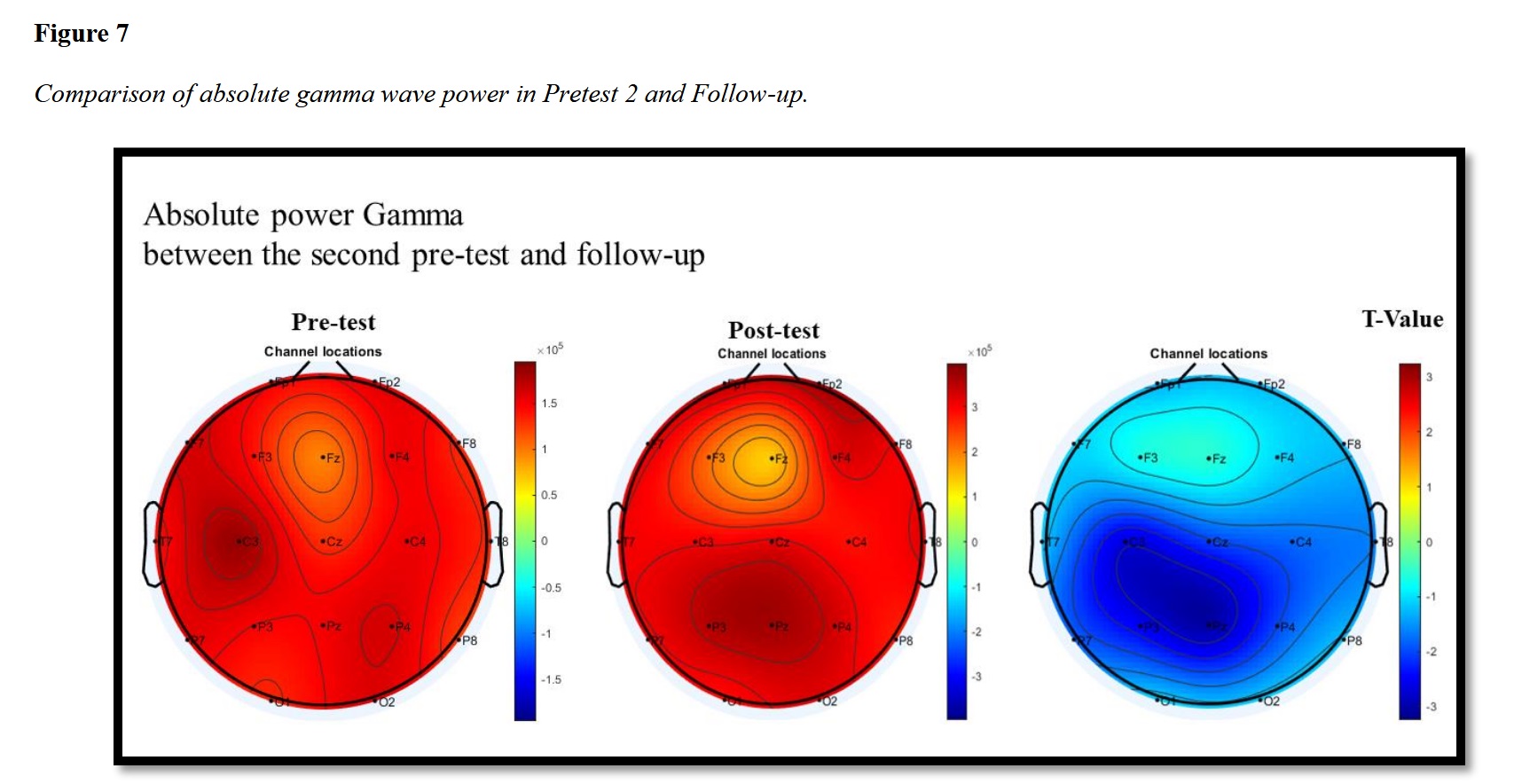
Findings: The findings indicated improvements in motor and cognitive performance of participants at the follow-up stage compared to the pretest. Results from the RehaCom computerized tests demonstrated improvements in selective attention, working memory capacity, and logical reasoning. Additionally, the absolute power of gamma and beta brainwaves decreased, suggesting enhanced cognitive and emotional regulation in participants.
Conclusion: The findings of this study indicate that infra-low frequency neurofeedback is effective in improving motor and cognitive functioning in individuals with Parkinson’s disease. Considering the results of the present study and the importance of non-invasive treatments in age-related disorders—particularly Alzheimer’s and Parkinson’s diseases—in enhancing cognitive and motor performance and slowing the progressive course of these disorders, greater attention to novel therapeutic approaches and further research is essential to address existing limitations and gaps in this field.
Downloads
References
Alegre, M., Lopez-Azcarate, J., Obeso, I., Wilkinson, L., Rodriguez-Oroz, M. C., Valencia, M., Garcia-Garcia, D., Guridi, J., Artieda, J., & Jahanshahi, M. (2013). The Subthalamic Nucleus Is Involved in Successful Inhibition in the Stop-Signal Task: A Local Field Potential Study in Parkinson's Disease. Experimental Neurology, 239, 1-12. https://doi.org/10.1016/j.expneurol.2012.08.027
Alonso-Frech, F., Zamarbide, I., Alegre, M., Rodriguez-Oroz, M. C., Guridi, J., Manrique, M., Valencia, M., Artieda, J., & Obeso, J. A. (2006). Slow Oscillatory Activity and Levodopa-Induced Dyskinesias in Parkinson's Disease. Brain, 129(7), 1748-1757. https://doi.org/10.1093/brain/awl103
Azarpaikan, A., Torbati, H. T., & Sohrabi, M. (2014). Neurofeedback and Physical Balance in Parkinson's Patients. Gait and Posture, 40(1), 177-181. https://doi.org/10.1016/j.gaitpost.2014.03.179
Badicu, G., Silva, R. M., Brini, S., Gonzalez-Fernandes, F. T., & Ardigò, L. P. (2025). The Role of Neurofeedback and Non-Invasive Brain Stimulation (tDCS/rTMS) in Enhancing Athletic Performance and Psychological Resilience in Elite Athletes. Functional Research in Sport Psychology, 2(3), 93-105. https://doi.org/10.22091/frs.2025.13496.1092
Buckner, R. L., Andrews-Hanna, J. R., & Schacter, D. L. (2008). The Brain's Default Network: Anatomy, Function, and Relevance to Disease. Annals of the New York Academy of Sciences, 1124(1), 1-38. https://doi.org/10.1196/annals.1440.011
Carmichael, D. W., Vulliemoz, S., Murta, T., Chaudhary, U., Perani, S., Rodionov, R., Rosa, M. J., Friston, K. J., & Lemieux, L. (2024). Measurement of the Mapping between Intracranial EEG and fMRI Recordings in the Human Brain. Bioengineering, 11(3), 224. https://doi.org/10.3390/bioengineering11030224
Cook, A. J., Pfeifer, K. J., & Tass, P. A. (2021). A Single Case Feasibility Study of Sensorimotor Rhythm Neurofeedback in Parkinson's Disease. Frontiers in Neuroscience, 15, 65. https://doi.org/10.3389/fnins.2021.623317
De Lau, L. M., & Breteler, M. M. (2006). Epidemiology of Parkinson's Disease. The Lancet Neurology, 5(6), 525-535. https://doi.org/10.1016/S1474-4422(06)70471-9
De Luca, M., Beckmann, C. F., De Stefano, N., Matthews, P. M., & Smith, S. M. (2006). fMRI Resting State Networks Define Distinct Modes of Long-Distance Interactions in the Human Brain. NeuroImage, 29(4), 1359-1367. https://doi.org/10.1016/j.neuroimage.2005.08.035
deCharms, R. C. (2007). Reading and Controlling Human Brain Activation Using Real-Time Functional Magnetic Resonance Imaging. Trends in Cognitive Sciences, 11(11), 473-481. https://doi.org/10.1016/j.tics.2007.08.014
Engel, A. K., & Fries, P. (2010). Beta-Band Oscillations: Signalling the Status Quo? Current opinion in neurobiology, 20(2), 156-165. https://doi.org/10.1016/j.conb.2010.02.015
Esmail, S., & Linden, D. E. (2014). Neural Networks and Neurofeedback in Parkinson's Disease. NeuroRegulation, 1(3-4), 240-240. https://doi.org/10.15540/nr.1.3-4.240
Fries, P. (2009). Neuronal Gamma-Band Synchronization as a Fundamental Process in Cortical Computation. Annual Review of Neuroscience, 32, 209-224. https://doi.org/10.1146/annurev.neuro.051508.135603
Grin-Yatsenko, V. A., Ponomarev, V. A., Kara, O., Wandernoth, B., Gregory, M., Ilyukhina, V. A., Kropotov, J. D., & Schneider, H. (2021). Effect of Infra-Low Frequency Neurofeedback on Infra-Slow EEG Fluctuations. Clinical Neurophysiology, 132(8), e27-e27. https://doi.org/10.1016/j.clinph.2021.02.373
Halje, P., Tamte, M., Richter, U., Mohammed, M., Cenci, M. A., & Petersson, P. (2012). Levodopa-Induced Dyskinesia Is Strongly Associated with Resonant Cortical Oscillations. Journal of Neuroscience, 32(47), 16541-16551. https://doi.org/10.1523/JNEUROSCI.3047-12.2012
Hammond, C., Bergman, H., & Brown, P. (2007). Pathological Synchronization in Parkinson's Disease: Networks, Models and Treatments. Trends in Neurosciences, 30(7), 357-364. https://doi.org/10.1016/j.tins.2007.05.004
Hiltunen, T., Kantola, J., Abou Elseoud, A., Lepola, P., Suominen, K., Starck, T., Nikkinen, J., Remes, J., Tervonen, O., & Palva, S. (2014). Infra-Slow EEG Fluctuations Are Correlated with Resting-State Network Dynamics in fMRI. Journal of Neuroscience, 34(2), 356-362. https://doi.org/10.1523/JNEUROSCI.0276-13.2014
Jahedi Delivand, S., Tarkhan, M., Ahadhi, M., & Qodsi, P. (2024). The effectiveness of transcranial direct current stimulation (tDCS) treatment on the quality of life and anxiety of children with attention-deficit/hyperactivity disorder (ADHD). Scientific Research Journal of School and Virtual Learning, 12(3), 29-38. https://etl.journals.pnu.ac.ir/article_11639.html?lang=en
Jenkinson, N., Kuhn, A. A., & Brown, P. (2013). Gamma Oscillations in the Human Basal Ganglia. Experimental Neurology, 245, 72-76. https://doi.org/10.1016/j.expneurol.2012.07.005
Kim, J., Kim, S., Lee, J., & Park, S. (2024). Real-time fMRI neurofeedback targeting the insula reduces trait anxiety: A randomized controlled trial. NeuroImage: Clinical, 41, 103158. https://doi.org/10.1016/j.nicl.2024.103158
Legarda, S. B., Michas-Martin, P. A., & McDermott, D. (2022). Managing Intractable Symptoms of Parkinson's Disease: A Nonsurgical Approach Employing Infralow Frequency Neuromodulation. Frontiers in human neuroscience, 16. https://doi.org/10.3389/fnhum.2022.894781
Mitra, A., Kraft, A., Wright, P., Acland, B., Snyder, A. Z., Rosenthal, Z., & Raichle, M. E. (2018). Spontaneous Infra-Slow Brain Activity Has Unique Spatiotemporal Dynamics and Laminar Structure. Neuron, 98(2), 297-305. https://doi.org/10.1016/j.neuron.2018.03.015
Nicholson, A. A., Ros, T., Densmore, M., Frewen, P. A., Théberge, J., Jetly, R., & Lanius, R. A. (2023). Real-time fMRI amygdala neurofeedback in generalized anxiety disorder: A randomized controlled trial. American Journal of Psychiatry, 180(5), 365-374. https://doi.org/10.1176/appi.ajp.2022.22040478
Raza, C., & Anjum, R. (2019). Parkinson's Disease: Mechanisms, Translational Models and Management Strategies. Life Sciences, 226, 77-90. https://doi.org/10.1016/j.lfs.2019.03.057
Richter, U., Halje, P., & Petersson, P. (2013). Mechanisms Underlying Cortical Resonant States: Implications for Levodopa-Induced Dyskinesia. Reviews in the Neurosciences, 24(4), 415-429. https://doi.org/10.1515/revneuro-2013-0018
Riedel, O., Klotsche, J., Spottke, A., Deuschl, G., Forstl, H., Henn, F., & Wittchen, H. U. (2010). Frequency of Dementia, Depression, and Other Neuropsychiatric Symptoms in 1,449 Outpatients with Parkinson's Disease. Journal of Neurology, 257, 1073-1082. https://doi.org/10.1007/s00415-010-5465-z
Ruiz, S., Buyukturkoglu, K., Rana, M., Birbaumer, N., & Sitaram, R. (2014). Real-Time fMRI Brain Computer Interfaces: Self-Regulation of Single Brain Regions to Networks. Biological Psychology, 95, 4-20. https://doi.org/10.1016/j.biopsycho.2013.04.010
Schneider, H., Riederle, J., & Seuss, S. (2021). Therapeutic Effect of Infra-Low-Frequency Neurofeedback Training on Children and Adolescents with ADHD. In. https://doi.org/10.5772/intechopen.97938
Schoffelen, J. M., Oostenveld, R., & Fries, P. (2005). Neuronal Coherence as a Mechanism of Effective Corticospinal Interaction. Science, 308(5718), 111-113. https://doi.org/10.1126/science.1107027
Shamsi Halasu, M., Tabatabaei, S. M., & Azmodeh, M. (2023). Comparing the Effectiveness of Transcranial Direct Current Stimulation (tDCS) and Cognitive Rehabilitation on Executive Functions in Children with Autism Spectrum Disorders. Scientific Journal of Pajouhan, 21(2), 113-121. https://doi.org/10.61186/psj.21.2.113
Smith, M. L., Collura, T. F., Ferrera, J., & de Vries, J. (2014). Infra-Slow Fluctuation Training in Clinical Practice: A Technical History. NeuroRegulation, 1(2), 187-187. https://doi.org/10.15540/nr.1.2.187
Sveinbjornsdottir, S. (2016). The Clinical Symptoms of Parkinson's Disease. Journal of Neurochemistry, 139(S1), 318-324. https://doi.org/10.1111/jnc.13691
Taheri, B., Fallahmohammadi, Z., Irandoust, K., & Tajari, S. N. (2025). The effect of low-intensity resistance training with practical blood flow restriction (pBFR) and transcranial direct current stimulation (tDCS) on thickness, strength and electrical activity of biceps brachii muscle in healthy men. Sport Sciences for Health, 21(2), 585-593. https://doi.org/10.1007/s11332-024-01290-w
Talebi, S., & Hashemi Mad, R. (2025). The Effectiveness of Meditation Exercises, Transcranial Direct Current Stimulation (tDCS), and Brain Exercise on Cognitive Abilities and Psychological Well-Being in Inactive Elderly Individuals. Journal of North Khorasan University of Medical Sciences, 17(2), 44-37. https://www.sid.ir/paper/1664152/fa
Zaidel, A., Spivak, A., Grieb, B., Bergman, H., & Israel, Z. (2010). Subthalamic Span of Beta Oscillations Predicts Deep Brain Stimulation Efficacy for Patients with Parkinson's Disease. Brain, 133(7), 2007-2021. https://doi.org/10.1093/brain/awq144
Zugman, A., Jett, L., Antonacci, C., Winkler, A. M., & Pine, D. S. (2023). A systematic review and meta-analysis of resting-state fMRI in anxiety disorders: Need for data sharing to move the field forward. Journal of anxiety disorders, 102773. https://doi.org/10.1016/j.janxdis.2023.102773
Downloads
Additional Files
Publication Timeline
- Submitted
- Revised
- Accepted