Predicting Therapist Effectiveness by Empathy Accuracy, Session Synchrony, Linguistic Alignment, and Reflective Depth: A Machine Learning Analysis
DOI:
https://doi.org/10.61838/kman.jarac.5303Keywords:
Therapist effectiveness, machine learning, empathy accuracy, session synchrony, linguistic alignment, reflective depth, psychotherapy processAbstract
Objective: The present study aimed to develop and validate a machine learning–based predictive model of therapist effectiveness by integrating empathy accuracy, session synchrony, linguistic alignment, and reflective depth within a multimodal analytical framework.
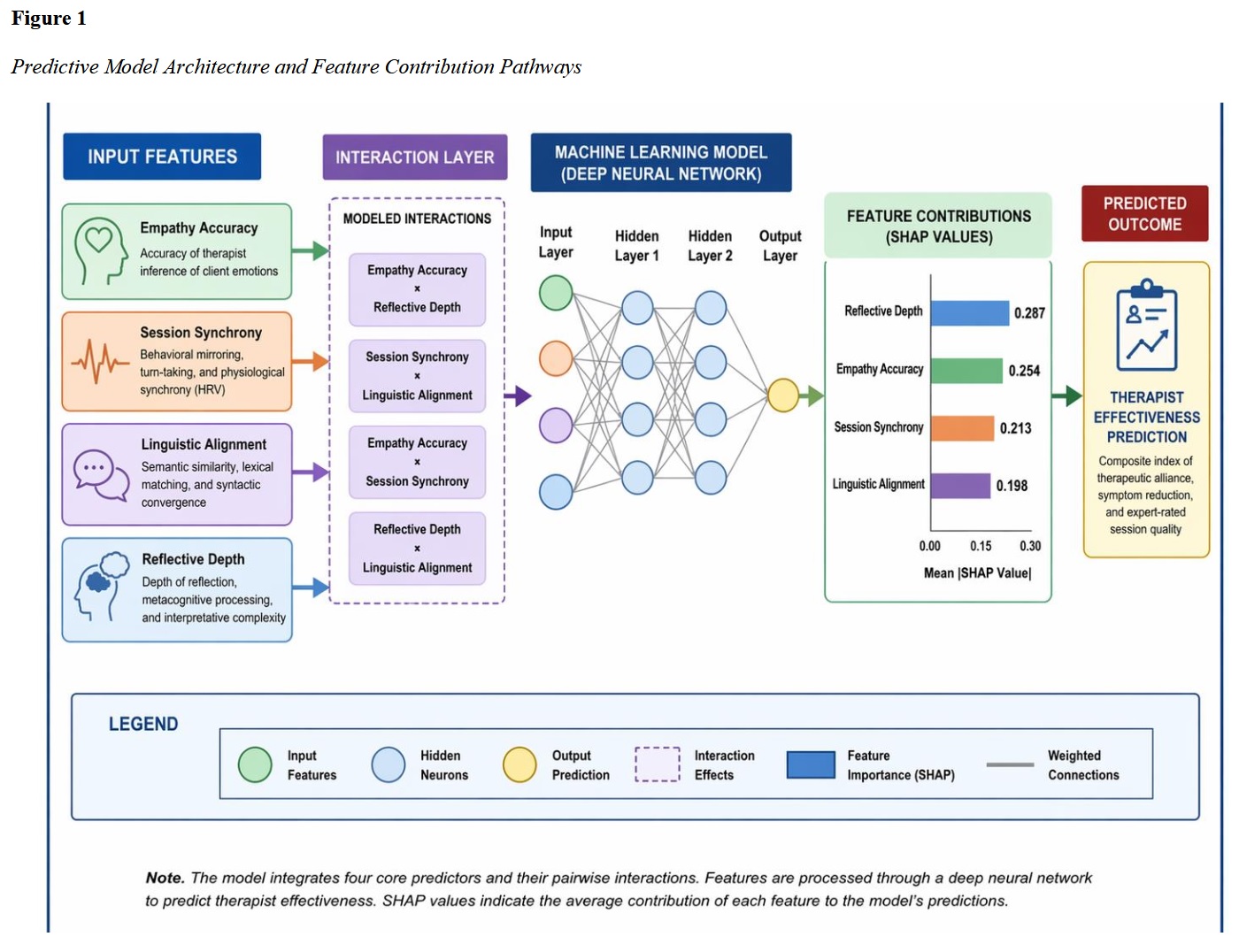
Methods and Materials: This quantitative predictive study was conducted with 214 licensed psychotherapists and 642 clients in Canada, forming 642 therapist–client dyads. Data were collected using a multimethod approach, including behavioral observation, physiological synchrony measurement, computational linguistic analysis, and standardized assessments of therapist effectiveness derived from client-reported outcomes, alliance measures, and expert ratings. Empathy accuracy was assessed through moment-to-moment emotional inference tasks, session synchrony was measured via behavioral and physiological coordination indicators, linguistic alignment was quantified using natural language processing techniques applied to session transcripts, and reflective depth was coded based on therapist verbal interventions. Data were preprocessed and analyzed using multiple supervised machine learning models, including random forest, gradient boosting, support vector machines, and deep neural networks, with model performance evaluated using cross-validation and predictive accuracy indices.
Findings: The deep neural network model demonstrated the highest predictive performance, explaining a substantial proportion of variance in therapist effectiveness. Reflective depth and empathy accuracy emerged as the strongest predictors, with significant positive contributions, while session synchrony and linguistic alignment also showed meaningful predictive effects. Interaction analyses revealed significant nonlinear relationships, particularly between empathy accuracy and reflective depth, as well as between synchrony and linguistic alignment, indicating synergistic effects among predictors in enhancing model performance.
Conclusion: The findings indicate that therapist effectiveness can be accurately predicted using machine learning models that integrate cognitive, emotional, and interactional dimensions of therapeutic processes, highlighting the importance of reflective depth and empathy accuracy as core mechanisms while underscoring the complementary roles of synchrony and linguistic alignment in shaping effective psychotherapy outcomes.
Downloads
References
Adel, L., Moses, L. E., Irvine, E., Greenway, K. T., Dumas, G., & Lifshitz, M. (2024). Interpersonal Neural Synchrony as a Mechanism of Therapeutic Alliance? A Systematic Review of Hyperscanning in Clinical Encounters. https://doi.org/10.31234/osf.io/g2yb7
Ameli, F., Minucci, F. A., Zanini, L., Calmi, G., & Spitoni, G. F. (2025). A Systematic Review of Patient-Therapist Synchrony as an Indicator of Emotion Regulation in Psychotherapy: An Integrated Approach. Research in Psychotherapy Psychopathology Process and Outcome, 28(2). https://doi.org/10.4081/ripppo.2025.866
Angeletti, L. L., Ventura, B., Galassi, F., Castellini, G., Ricca, V., Scalabrini, A., & Northoff, G. (2025). The Self and Its Intersubjective Synchrony in Psychotherapy: A Systematic Review. Clinical Psychology & Psychotherapy, 32(4). https://doi.org/10.1002/cpp.70110
Chui, H., Luk, S., Liu, F., Fung, K. K., & Loung, R. P. Y. (2023). Presession Mood Induction in Therapists: Effects on Therapist Empathy. Journal of counseling psychology, 70(6), 701-710. https://doi.org/10.1037/cou0000706
Felice, S. D., Chand, T., Croy, I., Engert, V., Schurz, M., Goldstein, P., Kirsch, P., Krach, S., Ma, Y., Scheele, D., Holroyd, C. B., Schweinberger, S. R., Hoehl, S., & Vrtička, P. (2024). Relational Neuroscience: Insights From Hyperscanning Research. https://doi.org/10.31234/osf.io/7vzp8
Frawley, C., & Taylor, D. D. (2024). The Relational Change Mechanisms of Child‐centered Play Therapy With Children Exposed to Adverse Childhood Experiences. Journal of Counseling & Development, 102(2), 153-162. https://doi.org/10.1002/jcad.12500
Gregorini, C., Carli, P. D., Parolin, L. A. L., Tschacher, W., & Preti, E. (2025). Potential Role of Nonverbal Synchrony in Psychotherapy: A Meta‐Analysis. Counselling and Psychotherapy Research, 25(1). https://doi.org/10.1002/capr.12885
Guastello, S. J., & Peressini, A. F. (2023). Quantifying Synchronization in Groups With Three or More Members Using SyncCalc: The Driver-Empath Model of Group Dynamics. Group Dynamics Theory Research and Practice, 27(3), 171-187. https://doi.org/10.1037/gdn0000199
Hill, C. E., & Norcross, J. C. (2023). Skills and Methods That Work in Psychotherapy: Observations and Conclusions From the Special Issue. Psychotherapy, 60(3), 407-416. https://doi.org/10.1037/pst0000487
Høgenhaug, S. S., Kongerslev, M., & Telléus, G. K. (2024). The Role of Interpersonal Coordination Dynamics in Alliance Rupture and Repair Processes in Psychotherapy—A Systematic Review. Frontiers in psychology, 14. https://doi.org/10.3389/fpsyg.2023.1291155
Klapprott, F., Kästner, D., Strauß, B., & Gumz, A. (2024). The Role of Prosody in Therapists’ Speech: A Scoping Review. Clinical Psychology Science and Practice, 31(4), 508-523. https://doi.org/10.1037/cps0000239
Lee, J. H. N., Chong, E. S. K., Chui, H., Lee, T., Luk, S., Tao, D., & Lee, N. W. T. (2023). A Curvilinear Association Between Therapists’ Use of Discourse Particles and Therapist Empathy in Psychotherapy. Journal of counseling psychology, 70(5), 562-570. https://doi.org/10.1037/cou0000696
Lee, J. H. N., Chui, H., Lee, T., Luk, S., Tao, D., & Lee, N. W. T. (2022). Formality in Psychotherapy: How Are Therapists’ and Clients’ Use of Discourse Particles Related to Therapist Empathy? Frontiers in Psychiatry, 13. https://doi.org/10.3389/fpsyt.2022.1018170
Li, X., Wu, M., Carney, J., & Li, F. (2025). Are We on the Same Page? An Examination of Therapist and Client Estimation of Each Other’s Session Quality Rating Using Truth and Bias Model. Journal of counseling psychology, 72(5), 475-486. https://doi.org/10.1037/cou0000818
Lim, M., Carollo, A., Bizzego, A., Chen, A. S. H., & Esposito, G. (2024). Synchrony Within, Synchrony Without: Establishing the Link Between Interpersonal Behavioural and Brain-to-Brain Synchrony During Role-Play. Royal Society Open Science, 11(9). https://doi.org/10.1098/rsos.240331
Morrissey, G., Tsuchiyagaito, A., Takahashi, T., McMillin, J., Aupperle, R. L., Misaki, M., & Khalsa, S. S. (2024). Could Neurofeedback Improve Therapist-Patient Communication? Considering the Potential for Neuroscience Informed Examinations of the Psychotherapeutic Relationship. Neuroscience & Biobehavioral Reviews, 161, 105680. https://doi.org/10.1016/j.neubiorev.2024.105680
Mosavi, N. S., Ribeiro, E., Sampaio, A., & Santos, M. F. (2023). Data Mining Techniques in Psychotherapy: Applications for Studying Therapeutic Alliance. Scientific reports, 13(1). https://doi.org/10.1038/s41598-023-43366-6
Muntigl, P., & Scarvaglieri, C. (2023). Discursive Angles on the Relationship in Psychotherapy. Frontiers in psychology, 14. https://doi.org/10.3389/fpsyg.2023.1198039
Ni, C. F., Jacques, J. G., Silber, C., & Dykeman, C. (2022). Language Style Matching as a Counseling Skill Evaluation Tool. https://doi.org/10.31234/osf.io/m4ztk
Rubin, M., Hickson, R., Suen, C. Y., & Vaishnav, S. (2025). Multimodal Assessment of Therapeutic Alliance: A Study Using Wearable Technology. Journal of Eye Movement Research, 18(4), 36. https://doi.org/10.3390/jemr18040036
Schaper, R., Nowotny, C., Michalek, S., Schmidt, U., & Brockmeyer, T. (2022). Language Style Matching and Treatment Outcome in Anorexia Nervosa. European Eating Disorders Review, 31(1), 110-120. https://doi.org/10.1002/erv.2943
Schore, A. N. (2022). Right Brain-to-Right Brain Psychotherapy: Recent Scientific and Clinical Advances. Annals of General Psychiatry, 21(1). https://doi.org/10.1186/s12991-022-00420-3
Shriberg, E., Zirikly, A., Atzil‐Slonim, D., Liakata, M., Bedrick, S., Desmet, B., Ireland, M. E., Lee, A., MacAvaney, S., Purver, M., Resnik, R., Yates, A., Tasnim, M., Ehghaghi, M., Diep, B., Novikova, J., Goodglass, H., Kaplan, E., Weıntraub, S., . . . Garg, R. (2022). Proceedings of the Eighth Workshop on Computational Linguistics and Clinical Psychology. https://doi.org/10.18653/v1/2022.clpsych-1
Tay, D., & Qiu, H. (2022). Modeling Linguistic (A)Synchrony: A Case Study of Therapist–Client Interaction. Frontiers in psychology, 13. https://doi.org/10.3389/fpsyg.2022.903227
Yirmiya, K., & Fonagy, P. (2025). Mentalizing Without a Mind: Psychotherapeutic Potential of Generative AI. Journal of medical Internet research, 27, e79156. https://doi.org/10.2196/79156
Downloads
Additional Files
Publication Timeline
- Submitted
- Revised
- Accepted